Yuzhen Wang, Ruifeng Yu (2024). Exploring the Willingness of Knowledge Workers to Use the Metaverse Office: A Qualitative Study. In: Accessibility, Assistive Technology and Digital Environments. AHFE Open Access, vol. 121, pp. 120–129. https://doi.org/10.54941/ahfe1004620
The metaverse, with its potential to provide immersive work environments, may emerge as an effective solution for telecommuting. However, the adoption and promotion of the metaverse office are slowed down due to the public's limited acceptance of this new technology. This study employed interviews (N = 8) and questionnaires (N = 12) to explore the willingness of knowledge workers to use the metaverse office and identify the main reasons influencing this decision. The findings indicate that while most participants hold a favourable view of the metaverse office concept, they concurrently acknowledge a significant disparity between its envisioned blueprint and its practical implementation. The reasons affecting the willingness to utilize the metaverse office primarily fall into three categories: the current development level of metaverse technology, the completeness of functions in the metaverse office platform, and the characteristics of the users. These insights provide guidance for the future advancement direction of the metaverse office.
Telecommuting (also known as working from home) is becoming more and more common. On the one hand, it offers unique advantages like flexibility (Gajendran & Harrison, 2007). For employees, they can avoid early morning commutes, saving time and money, and earn higher salaries in areas with lower living costs, thus improving their quality of life (Wang et al., 2021). For companies, it allows the hiring of outstanding talents from all over the world and save on rental expenses. On the other hand, the developments of information and communication technology have eased the barriers to telecommuting (Hoque & Bacon, 2022).
However, telecommuting based on chat software and online meeting plat- forms greatly differs from face-to-face work. Some studies indicate a decrease in work efficiency and sense of responsibility for employees with poor self- discipline due to a lack of supervision and management in telecommuting (Wolf et al., 2009). In the long term, the reduced social interaction caused by telecommuting (Golden & Eddleston, 2020) may lead to negative outcomes,
Exploring the Willingness of Knowledge Workers to Use the Metaverse Office 121
such as weakened interpersonal relationships, a lack of trust, and ineffective communication (Chen, 2021).
The metaverse office could become an effective solution for telecommuting by providing immersive office environments. Virtual reality (VR) and aug- mented reality (AR) technology allow employees to enter the metaverse space as holograms anytime and anywhere, building a “real” connection with the workplace through interactions in virtual spaces, and conducting daily check- ins, meetings, and communications. In short, the metaverse overcomes the barriers of physical distance, blending the flexibility of telecommuting with the immediacy of face-to-face communication. However, the metaverse office is not yet widely adopted.
This study aims to explore the willingness of knowledge workers to use the metaverse office and the key influencing factors, thereby providing a theoreti- cal basis for the advancement of metaverse. Knowledge workers are generally defined as employees who are highly educated, master professional skills in a certain field, and use more brain power than physical power to create value for their companies (Wang & Yu, 2023). This concept was first proposed by management expert Peter Drucker in 1959. Drucker also discovered the key role of knowledge work in societal transformation and emphasized the importance of knowledge workers (Janis et al., 2021). Furthermore, knowl- edge work, being more conducive to perform remotely compared to manual labour, may better promote the adoption of the metaverse office.
LITERATURE REVIEW
The metaverse, a term coined from the fusion of ‘meta’ and ‘universe’, is a human-constructed digital realm, either mirroring or transcending reality, and capable of interacting with the real world. The concept was first intro- duced in 1992, in Neal Stephenson’s Snow Crash, where the metaverse is depicted as a virtual space mirroring the real world and in which people act as avatars (Stephenson, 1992).
In the 1970s, with the popularization of the Internet, numerous massive multi-player online games emerged, such as Second Life, Minecraft, Roblox, and Sandbox. These platforms facilitated player interactions within game- created virtual worlds, gradually fostering norms and systems similar to those in the real world (Gent, 2022). This laid the early groundwork for the metaverse.
In recent years, the rapid development of 3D modelling, VR, and AR has enabled users to indulge in highly immersive interactions (Xi et al., 2022), further propelling the creation of metaverse spaces. Moreover, the COVID- 19 pandemic’s necessitation of remote engagement in political, economic, and cultural activities has normalized the online life (Dwivedi et al., 2022).
Hailed as the inaugural year of the metaverse, 2021 marked the resurgence and rapid development of it. Since then, leading corporations have substan- tially invested in the metaverse. For instance, Roblox was among the first to reference ‘metaverse’ in its IPO documents, and social media titan Face- book rebranded to ‘Meta’ to champion the metaverse. The global market’s potential for the metaverse is highly regarded, with PricewaterhouseCoopers
122 Wang and Yu
projecting its market size to hit US$1.5 trillion by 2030, and Morgan Stanley forecasting its market potential to surpass US$8 trillion in the future.
Academic research on the metaverse has also been expanded. Firstly, some new terms are used to describe the metaverse, such as: mirror world, embodied Internet, and post-reality universe (Lee et al., 2021). Secondly, the technologies that support the metaverse are discussed. Thirdly, it is foreseen that the metaverse will serve various industries, including retail, medical, edu- cation, and tourism (Gursoy et al., 2022). Finally, risks and challenges in the metaverse construction are considered (Di Pietro & Cresci, 2021). All in all, previous research has shown the huge capabilities and potential risks of the metaverse. However, there has been no user research on the metaverse office. This study aims to fill this gap.
METHODS
This study consisted of three sessions: focus group interview, individual interviews, and questionnaires.
Research Participants Participants were recruited from WeChat, all meeting the following criteria: possessing a bachelor’s degree or above; working in the Internet, educa- tion, finance, scientific research, or consulting industry; having experience in telecommuting. The focus group interview encompassed 5 participants (R1- R5), comprising 4 males and 1 female, aged between 25 and 31 years. The individual interviews involved 3 participants (R6-R8), consisting of 1 male and 2 females, aged between 26 and 28 years. The questionnaire was com- pleted by 12 participants, equally divided between males and females, with ages ranging from 22 to 27 years.
Interviews The focus group interview and individual interviews were conducted via Ten- cent Meeting. The outline of the interviews (see Appendix Table 1) mainly included two parts: the first part was about the metaverse, and the second part was about the metaverse office. However, the outline was only used as a reminder, and the interviews adopted a semi-structured form. Moreover, in order to help the participants better understand the concept and functions of the metaverse office, we played an introductory video before discussing the second part.
Questionnaires This study used electronic questionnaires. The questionnaire was create via online platform Wenjuanxing and published via WeChat. We designed a questionnaire based on the literature review and the views of the inter- view participants. The questionnaire consisted of three parts (see Appendix Table 2). The first part aimed to collect demographic information, including gender, age, education, occupation and city of the participants. The second part had 3 questions to investigate the participants’ understanding of the
Exploring the Willingness of Knowledge Workers to Use the Metaverse Office 123
metaverse. The third part had 8 questions, surveying participants’ views on the metaverse office.
RESULTS AND ANALYSES Focus Group Interview
This study employed Jieba Python package to perform word frequency anal- ysis on the texts from the focus group interview. By examining the most frequently mentioned terms and referencing back to the interview, the fol- lowing results were obtained (with hot words underlined and frequencies noted in parentheses): In the discussion about the metaverse, participants stated that they all have an understanding (7) with the concept, primarily through VR games (6) and the movie Ready Player One (3). They perceived the metaverse as a virtual world (5) that can mirror the real world (5), and this mapping relies on dig- ital (4) technology and VR (7) devices (6). An ideal metaverse experience should be fully (3) immersive (3). However, limited by current technology, the existing metaverse can only simulate (4) the visual aspects (3) of the real world, and cannot replicate the somatosensory feeling (2). The possibility of the metaverse integrating into everyday life (4) exists, but it first necessitates enhancing the realism (5) of the experience (4). In addition, convenient wear- able (3) devices are also a necessary condition for the widespread adoption of it. In this regard, participants proposed that brain-computer (4) interfaces or chips could be implanted (3) into the brain to replace external devices. Both the simulation of somatosensory and the convenience of wearability are all depend on the advancement (4) of technology. R1 also pointed out that the cost of devices is also an important factor that affects whether he uses it.
It is noteworthy that when discussing privacy (3) issues in the applications, participants diverged on whether a “real-name system (3)” should be imple- mented and if activities within the metaverse should be subject to real-world moral and legal (2) constraints. R1 believed that the metaverse should man- date real-name registration and adhere to legal constraints, whereas R2, R3, and R4 argued for a completely free and open metaverse.
In the discussion about the metaverse office, participants acknowledged that it inherits all the advantages of telecommuting (8). However, the current metaverse office pattern doesn’t resolve the drawbacks (4) of telecommuting (3), particularly its lower efficiency (2) compared to face-to-face (5) work- ing. Issues cited include lack of supervision (7), potential slacking off (2), difficulties in colleague communication (2), and the inability to ensure timely attendance in online meetings (6). To gain wider acceptance, participants agreed that the metaverse office needs to create scene (6) that more closely mirror reality (5), which reliant on technological advancements (4). More- over, some participants expressed concerns that introducing this new office system could introduce redundant operations, complicating (5) the existing office process. Therefore, the future metaverse office must strive for simplicity (3) in its processes.
However, some participants noted that working in the metaverse would invariably lead to reduced real-world social interaction (4), so they preferred
124 Wang and Yu
face-to-face working. An traditional office, bustling with people and various visual and auditory stimuli, satisfies their needs for collaboration, sharing, and social bonding, thus fostering a sense of energy and belonging. Yet, others pointed out that the metaverse office is suitable for introverts (2). For them, frequent interaction with people in the office would be a source of stress. The meeting-free work pattern could alleviate this pressure, allowing them to concentrate more on their tasks.
Individual Interviews In this session, participants indicated that they all know about the metaverse because its popularity on social media platforms like Weibo a year or two ago. R6 had engaged with virtual currency and was optimistic about the prospects of the financial metaverse, while R7 hesitated to engage with it. Additionally, R8 claimed to have experienced the metaverse, describing his experience as “communicating with intelligent robots” and stating that “in the future, the metaverse might replace many people, particularly those with- out high education background”. This reflected his confusion of the concepts of the metaverse and artificial intelligence.
Given the focus group’s divergent views on the extent to which the metaverse should be bound by reality, this session included supplementary questions about participants’ definitions of the metaverse. R6 believed the metaverse should be grounded in reality. Conversely, R7 preferred the meta- verse to be disconnected from reality. She viewed the real world as fraught with limitations, injustices, and oppressions, and saw the metaverse as an opportunity to escape reality and transcend societal structures, hoping to establish new orders within it.
Regarding the metaverse office, R6 expressed concerns that telecommuting might increase communication costs and stated her reluctance to work in a virtual world long-term, as it would feel more like playing games than work- ing. Whereas R7 found the idea of working remotely in a virtual world very appealing and looked forward to it. However, she believed it troublesome if it couldn’t fully replace the need for other office tools like WeChat or Tencent Meeting. Moreover, she shared insights from a company perspective: firstly, the attitude of cooperative companies towards the metaverse office could influence her choice. If cooperative companies view physical office spaces as crucial for establishing trust, her company would opt for a traditional office, while if cooperative companies embrace the new work culture of the meta- verse, her company would adopt the metaverse office. Secondly, she voiced concerns about the metaverse developers potentially accessing her company’s information or trade secrets, posing a significant threat to the company.
Questionnaires
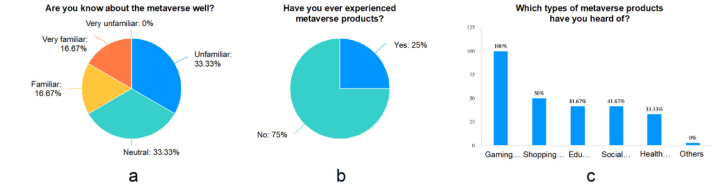
Figure 1 illustrates participants’ familiarity with the metaverse. 66.67% of participants had some understanding of the metaverse (Fig. 1a), yet only 25% had experienced metaverse products (Fig. 1b). Among the diverse cat- egories of metaverse products (gaming and entertainment, education and
Exploring the Willingness of Knowledge Workers to Use the Metaverse Office 125
learning, social interaction, healthcare, shopping, etc.), gaming and enter- tainment was the most well-known, with all participants having heard of them (Fig. 1c).
Figure 1: Participants’ familiarity with the metaverse.
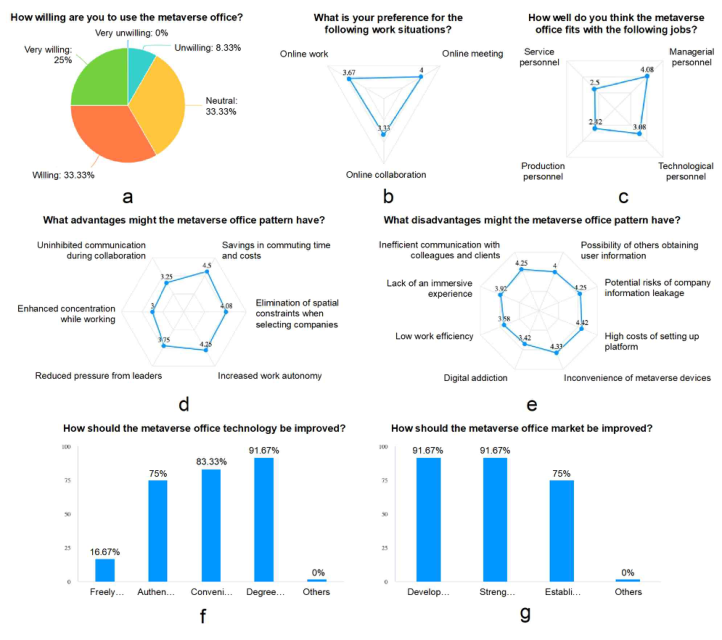
Figure 2 presents participants’ attitudes towards the metaverse office. Over half of the participants had a positive outlook on the metaverse office (25% were very willing, 33.33% were willing), 33.33% held a neutral stance, and only 8.33% expressed negative views (see Fig. 2a).
As shown in Fig. 2b, participants rated online meetings relatively highly (M = 4) but showed less preference for online collaboration (M = 3.33). This discrepancy may stem from the fact that meetings are often formal- istic. In face-to-face meetings, individuals are subject to supervision from colleagues, compelling them to feign attention even if uninterested in the meeting. Online meetings, however, offer the convenience of multitasking, such as browsing social media or replying to emails without being noticed by others, hence their popularity. On the other hand, online collabora- tion is typically aimed at advancing work projects. Yet, due to limitations of technology (e.g., network latency) and the absence of non-verbal inter- action elements (e.g., facial expressions), communication efficiency may decreased, leading to lower preference for online collaboration among participants.
Additionally, participants perceived the fit between the metaverse office and managerial personnel to be the highest (M = 4.08), while the fits with production personnel (M = 2.42) and service personnel (M = 2.5) were rela- tively lower (Fig. 2c). This may be because managerial roles typically involve decision-making, coordination, and supervision. In an online environment, managers could still perform their duties using tools like emails and vir- tual meetings. In contrast, the jobs of production and service personnel are more operational and practical, requiring on-site presence and face-to-face communication.
As depicted in Figure 2d, participants identified the main advantages of the metaverse office as savings in commuting time and costs (M = 4.5), increased work autonomy (M = 4.25), elimination of spatial constraints when select- ing companies (M = 4.08), and reduced pressure from leaders (M = 3.75). However, they didn’t think that working in the metaverse leads to better concentration (M = 3).
126 Wang and Yu
Figure 2: Participants’ attitudes towards the metaverse office.
Fig. 2e indicates that participants identified the main disadvantages of the metaverse office as the high costs of setting up platform (M = 4.42), the inconvenience of metaverse devices (M = 4.33), potential risks of company information leakage (M = 4.25), inefficient communica- tion with colleagues and clients (M = 4.25), the possibility of oth- ers obtaining user information (M = 4), and a lack of an immersive experience (M = 3.92).
As shown in Fig. 2f, 91.67% of participants believed that the most cru- cial improvement for the metaverse office technology should be the degree of office tools integration. Followed by convenience of wearing the devices and entering as well as exiting the metaverse (selected by 83.33% of participants), and the authenticity and immersion of the interaction experience (selected by 75% of participants). However, the ability to freely create personal or envi- ronment appearance wasn’t deemed as important (selected by only 16.67% of participants).
Furthermore, participants proposed that the metaverse office market must develop relevant laws and regulations (selected by 91.67% of participants) and strengthen the protection and supervision for privacy and property (selected by 91.67% of participants) (see Fig. 2g).
Exploring the Willingness of Knowledge Workers to Use the Metaverse Office 127
DISCUSSION AND CONCLUSION Grounded theory was employed to gain a profound theoretical insight into the key influencing factors of knowledge workers’ willingness to use the metaverse office (see Table 1). Level-1 codes were derived by breaking down, examining, comparing, conceptualizing, and categorizing the findings from the results and analyses section. Level-2 codes were subsequently generated by structuring and interconnecting the Level-1 codes. Level-3 codes were further summarized from Level-2 codes, generalizing all the core factors identified.
Table 1. Codes.
Table available in the original PDF paper.
Level-3 Level-2 Level-1 Current development level of metaverse technology.
Authenticity. Scene closely replicates reality. Simulation of somatosensory. Convenience. Devices are easy to wear and use. Use of brain-computer interface technology. Cost. Affordably priced devices. Low cost of platform setup.
Lack of supervision. Low communication efficiency.
Drawbacks of telecom- muting.
Completeness of functions in the metaverse office platform.
Integration. High degree of office tools integration. Thorough implementation of the meta- verse office. Simple operation processes. Security. Protection and supervision the privacy and property of companies and individ- uals. Well-developed laws and regulations.
Characteristics of the users.
Employee characteris- tics.
Introverted personality. Hopes to transcend reality. Fondness for the virtual world. Company characteris- tics.
Job is operational and practical. Cooperative company agrees with the metaverse.
According to the findings, despite participants generally holding a positive attitude towards the metaverse office, they all believed that widespread adop- tion is still a long way off. In response, this paper suggests accelerating the development of metaverse technology (e.g., improving the authenticity of the experience, enhancing the convenience of device use, and reducing costs) to increase users’ willingness to use the metaverse office. Additionally, improv- ing the metaverse office platform (e.g., integrating office tools, addressing the drawbacks of telecommuting, and enhancing the security of privacy and property) is also an effective way to boost user willingness.
Finally, this study has some limitations: firstly, the participants were pre- dominantly young individuals working in the scientific research industries.
128 Wang and Yu
Secondly, the sample size of the questionnaire survey is small. Thirdly, as the metaverse office haven’t yet been adopted, participants’ understanding and perceptions of it – derived from articles and videos – might not correspond precisely with actual usage.
APPENDIX
Table A1. The outline of the interviews.
Part Questions Metaverse. 1. Have you ever understood the metaverse? 2. What is your opinion on the metaverse? 3. How do you foresee the development of the metaverse? Will it affect people’s lives in the future? 4. If so, how will it impact? In which fields does the metaverse have the most potential for application? If not, why? Metaverse office.
5. Have you ever understood the metaverse office? Play an introductory video. 6. Compared to face-to-face working and telecommuting, what advantages and disadvantages do you think the metaverse office has? 7. Do you think the metaverse office is suitable for your job? What kind of jobs would it be suitable for? 8. What problems do you think may arise when using the metaverse office? 9. Do you have any concerns about the widespread adoption of it? 10. Overall, what is your opinion on the metaverse office?
Table A2. The questions of the questionnaire.
Part Questions One. 1. What is your gender? 2. What is your age? 3. What is your educational background? 4. What industry do you work in? 5. Which city do you live in? Two. 6. Are you know about the metaverse well? 7. Have you ever experienced metaverse products? 8. Which types of metaverse products have you heard of? Three. 9. How willing are you to use the metaverse office?
10. What is your preference for the following work situations? 11. How well do you think the metaverse office fits with the following jobs? 12. What advantages might the metaverse office pattern have? 13. What disadvantages might the metaverse office pattern have? 14. How should the metaverse office technology be improved? 15. How should the metaverse office market be improved? 16. What other suggestions do you have for the metaverse office?
Note: Questions 10–13 are to be answered using a 5-point Likert scale, with 1 represents ‘strongly disagree’ and 5 represents ‘strongly agree’.
Exploring the Willingness of Knowledge Workers to Use the Metaverse Office 129
ACKNOWLEDGMENT
This work was supported by the National Natural Science Foundation of China under grants [No. 72171130].
REFERENCES
Chen, Z. (2021). Influence of Working From Home During the COVID-19 Crisis and HR Practitioner Response. Frontiers in Psychology, 12. Di Pietro, R., & Cresci, S. (2021). Metaverse: Security and Privacy Issues. 2021
Third IEEE International Conference on Trust, Privacy and Security in Intelligent Systems and Applications (TPS-ISA), 281–288. Dwivedi, Y. K., Hughes, L., Baabdullah, A. M., Ribeiro-Navarrete, S., Giannakis, M., Al-Debei, M. M., Dennehy, D., Metri, B., Buhalis, D., Cheung, C. M. K., Con- boy, K., Doyle, R., Dubey, R., Dutot, V., Felix, R., Goyal, D. P., Gustafsson, A., Hinsch, C., Jebabli, I., … Wamba, S. F. (2022). Metaverse beyond the hype: Mul- tidisciplinary perspectives on emerging challenges, opportunities, and agenda for research, practice and policy. International Journal of Information Management, 66, 102542. Gajendran, R. S., & Harrison, D. A. (2007). The good, the bad, and the unknown
about telecommuting: Meta-analysis of psychological mediators and individual consequences. The Journal of Applied Psychology, 92(6), 1524–1541. Gent, E. (2022). Lessons From a Second Life > Before Meta, Philip Rosedale Created an Online Universe. IEEE Spectrum, 59(1), 19–19. Golden, T. D., & Eddleston, K. A. (2020). Is there a price telecommuters pay?
Examining the relationship between telecommuting and objective career success. Journal of Vocational Behavior, 116, 103348. Gursoy, D., Malodia, S., & Dhir, A. (2022). The metaverse in the hospitality and tourism industry: An overview of current trends and future research directions. Journal of Hospitality Marketing & Management, 31(5), 527–534. Hoque, K., & Bacon, N. (2022). Working from home and disabled people’s
employment outcomes. British Journal of Industrial Relations, 60(1), 32–56. Janis, I., Paimin, A. N., & Alias, M. (2021). Exploring the Theoretical Gap on Knowledge Work of Knowledge and Skilled Workers in TVET Practices: A Literature Review. Journal of Technical Education and Training, 13(4), Article 4. Lee, L. H., Braud, T., Zhou, P., Wang, L., Xu, D., Lin, Z., Kumar, A., Bermejo, C., &
Hui, P. (2021). All One Needs to Know about Metaverse: A Complete Survey on Technological Singularity, Virtual Ecosystem, and Research Agenda. Stephenson, N. (1992). Snow Crash. Wang, Y., Liu, Y., Cui, W., Tang, J., Zhang, H., Walston, D., & Zhang, D. (2021).
Returning to the Office During the COVID-19 Pandemic Recovery: Early Indi- cators from China. Extended Abstracts of the 2021 CHI Conference on Human Factors in Computing Systems, 1–6. Wang, Y., & Yu, R. (2023). The influence of spousal support on the outcomes and willingness of work from home for female knowledge workers. Ergonomics, 1–13. Wolf, T., Schroter, A., Damian, D., & Nguyen, T. (2009). Predicting build failures
using social network analysis on developer communication. Proceedings of the 31st International Conference on Software Engineering, 1–11. Xi, N., Chen, J., Gama, F., Riar, M., & Hamari, J. (2022). The challenges of entering the metaverse: An experiment on the effect of extended reality on workload. Information Systems Frontiers.
LISTED IN THE AHFE DIGITAL BOOKSTORE CATALOGUE
Explore the complete digital volume
Accessibility, Assistive Technology and Digital Environments
Read this individual research paper free through the original publisher, or explore the full digital proceedings book.
ISBN 978-1-958651-97-1
Explore this ISBN in the AHFE Bookstore ↗Listed in the July 2026 bookstore catalogue; search by ISBN to confirm current availability · Digital book purchase optional