Evangelos Markopoulos, Panagiotis Markopoulos, Akash Nandi, John Faraclas, Chris Leontopoulos, Stavros Meidanis, Dimitris Monioudis, Grigoris Filahtos (2024). The Impact of Digital Twins Technology in Maritime Fleet and Safety Management. In: Accessibility, Assistive Technology and Digital Environments. AHFE Open Access, vol. 121, pp. 109–119. https://doi.org/10.54941/ahfe1004619
The integration of advanced technologies in areas such as safety, navigation, maintenance, security, supply chain management, and environmental impact can enable shipping maritime companies to enhance operational efficiency, reduce costs, mitigate risks, and drive innovation in a highly competitive industry. This paper introduces the application of Digital Twins in the shipping and maritime sector, highlights its contributions to safety and fleet management with live ship monitoring on all operations and crew, and extends such applications with the integration of Virtual Reality and Artificial intelligence for immediate decision making, risk avoidance and corrective actions. Its concept is based on and follows the developments and improvements of SOLAS (Safety Of Life At Sea), the ISM (International Safety Management) and ISPS Codes (International Ship and Port Facility Security), and STCW (Standards of Training, Certification and Watchkeeping). Furthermore, this work analyzes user requirements from different actors in the shipping and maritime industry (officers, ship-agents, ship owners and ship managers, insurance companies, charterers, etc.) and creates a high-level operations framework to guide the design and implementation of successful maritime digital twin projects. Lastly, it highlights the relationship between the UN Sustainable Development Goals and the digital twin adaptation strategy in the maritime and shipping sector. The paper concludes with the impact and contributions of such intelligent and interactive Digital Twins technologies in the maritime and shipping sectors from operational and environmental sustainability perspectives.
The shipping and maritime sector has always been acknowledged for its contribution to the global economy, supply chain, trade, and prosperity.
The vast shipping market indicates continuous potential to further expand as global trade continues to grow. Its size is influenced by factors such as eco- nomic growth, globalization, geopolitics, climate, and changes in consumer behaviour. According to industry reports, the global maritime industry and the shipping industry growth is expected to extend, particularly in emerging markets and sectors such as e-commerce and offshore renewable energy.
Over the years the set of technologies integrated into shipping operations and fleet management have increased in functionality and complexity. A sim- ilar phenomenon can be seen in the shipbuilding industry, where the degree of the technology on the vessels reflects the effectiveness and safety of their operations.
However, despite the progress made, especially in the last twenty years, to bridge the gap of technological readiness between the shipping and other critical industrial sectors, the use of advanced and futuristic interactive tech- nologies has been treated with reluctance by the shipping and maritime sectors due to high safety and security costs, as well as due to the large amounts of potential collateral damage in case of technological/technical malfunctions.
The degree of scepticism has led to an environment where intelligent tech- nologies cannot be fully trusted in critical operations without the supervision of human experts. This can be seen in the limited progress made in the adap- tation of the promising maritime autonomous surface ships (MASS), or of less critical technologies such as Artificial Intelligence, Virtual Reality, or the Metaverse, whose benefits cannot be convincingly translated yet into imme- diate and tangible metrics, that are ready to capitalized and show a clear and significant return on investment.
THE TECHNOLOGICAL REVOLUTION OF THE SHIPPING INDUSTRY The shipping sector has seen significant advancements in recent years, leveraging various advanced technologies to enhance efficiency, safety, and sustainability. Some of the notable technological achievements and the incorporation of advanced technologies in the shipping industry are listed below:
Artificial Intelligence (AI) has been used in the shipping industry for some time now, mainly for purposes related to predictive maintenance, route opti- mization, cargo scheduling, and risk management. Based on machine learning algorithms and principles, vast amounts of data collected from sensors, weather forecasts, and historical shipping data, AI methods are used to opti- mize various aspects of shipping operations and improve decision-making processes.
VR and AR technologies are employed in maritime training and simula- tion, allowing seafarers to train in realistic environments without needing physical ships. VR and AR applications also assist in remote maintenance, repair tasks, and safety inspections by providing technicians with augmented
The Impact of Digital Twins Technology in Maritime Fleet and Safety Management 111
views of ship components and systems. Initial steps have already been made regarding a trial basis using advanced VR technologies that incorporate eye tracking (Luimula et al., 2020), hand tracking (Markopoulos et al., 2021a), (Markopoulos et al., 2020a), and neural networks (Markopoulos et al., 2021b). Green shipping is also in demand. The adoption of cleaner fuels such as liquefied natural gas (LNG), hydrogen, and biofuels, as well as the implementation of emission-reducing technologies like scrubbers and ballast water treatment systems, all serve to help the industry move towards more sustainable operations.
Data analytics enable better monitoring of ship performance, predictive maintenance, and optimized fleet management. Electric and Hybrid Propul- sion systems have gained supporters to reduce greenhouse gas emissions and improve energy efficiency. Lastly, autonomous ships/vessels, equipped with sensors and AI technology, promise increased efficiency and reduced operational costs by minimizing human error and optimizing routes-based decision-making.
Overall, the integration of advanced technologies such as AI, VR, AR, and the upcoming technology of digital twins, has transformed and will continue to transform the shipping industry rapidly while making shipping operations safer, more efficient, and environmentally sustainable. As these technolo- gies continue to evolve, the shipping sector is poised to undergo further innovation and disruption in the years to come.
RESEARCH METHODOLOGY The research methodology used involves interviews combined with surveys for the primary research to understand user requirements and expectations, and an extensive literature review for the secondary research for the design of a Digital Twins architecture.
During the interview process, ten high-impact industry experts and pro- fessionals participated by sharing valuable information to understand the technological readiness of the shipping and maritime sectors.
The adaptation of AI for most of the interviewees seems to be a plan, while others believe that maritime companies and shipping companies are increasingly adopting AI and other advanced technologies to improve their operations, increase efficiency, enhance safety, and reduce costs. AI appli- cations are being used for predictive maintenance, autonomous navigation systems, route and cargo optimization, and environmental impact consider- ations. AI and advanced technologies in the maritime industry are expected to continue to grow as companies seek to stay competitive, improve their operations, and meet evolving market demands.
Digital Twins is considered to be an upcoming technology, quite well known, but with significant applications in the shipping and maritime industry.
The industry has recognized that such technologies if used in parallel with traditional shipping activities, can benefit safety, security, monitoring,
energy efficiency, and environmental protection; in addition, such technolo- gies also have significant potential impacts on matters concerning navigation, maintenance, and business management.
In general, the industry is in a neutral or idle decision-making state for the adaptation of advanced technologies and futuristic interactive technolo- gies in particular. Safety, environmental impacts, new regulations, human element issues, specific training needs, excessive cost, technology readiness, investment capabilities, organizational culture, and return on investment are some factors that make shipping companies reluctant to use those new technologies. The industry is very careful with steps that consider legal, ethical and social implications. The legal framework has just started pick- ing up but things like ownership of data, liabilities and other issues need to be resolved. This might take three to ten years if we consider that the adoption of VR has recently been discussed at the International Mar- itime Organization (IMO, 2022). Leading classification societies however like DNV have prepared standards to facilitate the transition to virtual technologies in the shipping industry such as the DNV-ST-0033 on Mar- itime simulator systems and the DNVGL-ST-0008 on Learning programmes (Markopoulos et al., 2022).
It is expected that the adoption of advanced technologies in the shipping and maritime industry will continue to accelerate in the coming years as the benefits become more apparent and as technology solutions become more mature and accessible.
DIGITAL TWINS IN SHIPPING Even though Digital Twins seems to be an upcoming technology, its roots are traced back to the 1960s when NASA conducted simulation stud- ies between voyaging spacecraft and its associated exact replica on Earth. NASA developed a Digital Twin to assess and simulate conditions on board Apollo 13 (Miskinis, 2019). In 1991 David Gelernter published the Mirror Worlds (Gelernter, 1991) which was applied to manufacturing in 2002 and introduced the Digital Twins Software concept (Grieves, 2002). In 2010, NASA’s John Vickers introduced the term “digital twin” as we know it (Malshe et al., 2023).
Today the Digital Twins, a technology within the sphere of Futuristic Interactive and Intelligent Technologies (FIIT), can be an exception to this hesitation as it offers immediate and tangible results that can benefit the ship- ping and maritime operations in several areas; in particular, it can benefit matters related to safety management under multiples perspectives. Digital Twin technology creates digital representations of “assets,” which can be ships, objects, systems, or processes enabling real-time monitoring, simula- tion, and analysis of their performance. They use real-time data, historical data, and machine learning to mirror the real-world version’s functionality and status, and predict future states (Hofman 2023).
The shipping sector has started to use Digital Twins to optimize fuel consumption, monitor equipment health, and simulate scenarios for bet- ter decision-making. However, the term Digital Twin is frequently misused
The Impact of Digital Twins Technology in Maritime Fleet and Safety Management 113
in the shipping industry by confusing any virtual version of a model-based system as a Digital Twin of the ship. The continuous, live, and mutual data exchange between the physical and virtual environment is often missing, con- fusing a virtual model with a sophisticated living virtual environment (Mauro & Kana, 2023).
Some of the main Digital Twin providers in the shipping industry are Kongsberg, which provides a Digital Twin (DT) environment to monitor and simulate the ship in operation (Kongsberg, 2022), Eniram–Wärtsilä DT models for energy efficiency management, engine consumption, and pollutant emission reduction (Wärtsilä, 2020), Ericson, which provides a DT application for cargo handle on different ship types (Wang et al., 2021), Siemens, providing DT models to monitor the ship maintenance cycles (Cozmiuc, 2021), Dassault Systèmes, which provides a DT plat- form enabling a closed-loop connection between the virtual and physical environment allowing for testing products and processes (Systemes, 2022), China Classification Society (CCS), with its DT application to monitor the status of system onboard ships (Siqiang, 2019) and Shadong Ship- ping Corporation (SDSC), with its DT models to verify ship structures (Li et al. 2020).
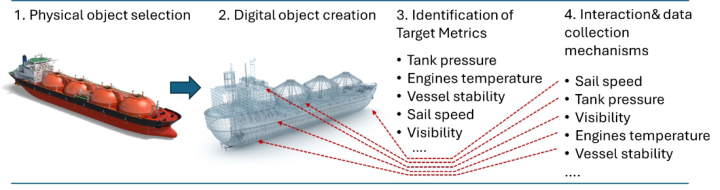
Building and operating a Digital Twin technology extends beyond the associated 3D model, sensor, and hardware. A key requirement is to first understand and structure the object to replicate, and then define the met- rics expected to be generated during the operations of the Digital Twin (see Figure 1).
Figure 1: Digital twin’s key building steps.
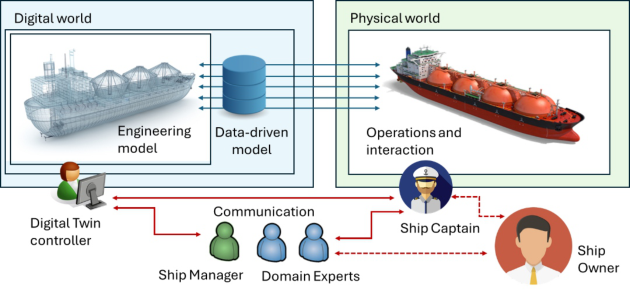
The metrics can then determine the data collection devices (sensors, readers, etc) and the data processing algorithms, which are all applied to the digital models, the replica of the physical ones. The engineer- ing and data-driven models form the architecture of the Digital Twin, while the data collection and processing process forms the operations (see Figure 2).
Key actors in the development and operation of a Digital Twin in shipping may entail the ship owner who sets the high-level permanence and safety metrics, the ship managers who set the operations metrics, and the system engineer responsible for the collection and transmission of data from the physical to the digital ship.
Figure 2: Digital twin’s, architecture, actors, and operations process.
DIGITAL TWINS FLEET MANAGEMENT ARCHITECTURE IN SHIPPING The applications of Digital Twins within the shipping industry continue to grow, revealing the need for faster adaptation of the technology, despite the hesitations of the industry related to terms of regulatory frameworks and wide proof of concept.
Fleet management, from the technical perspective, is an area of Digital Twins’ applications that incorporate most of the technological expectations, industry needs and concerns. The ability to monitor in real-time digitally and graphically from a central point on several ships across the world can reduce operations costs, prevent accidents, and provide performance analytics describing the behaviours of the ship at any instance during a journey.
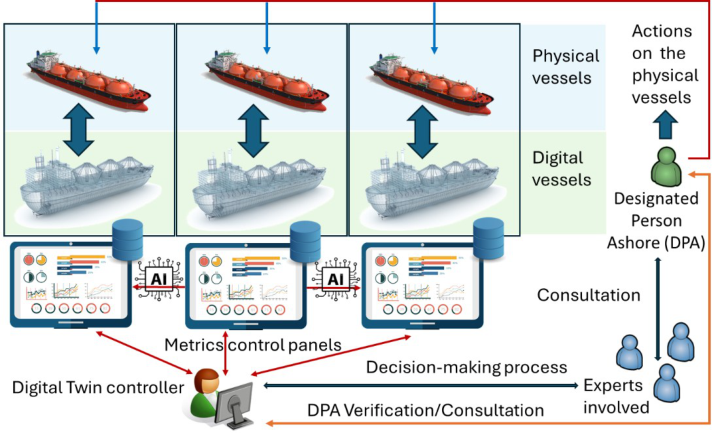
The architecture of such an approach is based on a fragmented display of the ships being monitored and the analysis of the data collected by highlighting readings outside the accepted metrics intervals.
The fleet controller stays focused on the real-time readings to identify or be prompted to the ones that need attention and decide the type of action to be taken based on experience, statistical maintenance data, maintenance and action procedures, and consultation with experts or the ship captains onboard or ashore. This decision-making process can be supported with AI expert systems for technical and procedural recommendations to be used in the discussions with the experts or to be automatically executed based on the type of recommendation or the criticality and urgency of the situation (see Figure 3).
The primary goal of any industry remains safety, a multidimensional con- cept related to security, maintenance, and operations. The Digital Twin fleet management architecture addresses all three safety dimensions by providing real-time checks and information on issues that are already under the atten- tion of the ship’s master onboard the vessel, or from the office by the Digital Twins Controller and the DPA (Designated Person Ashore), with the ultimate goal of preventing human errors that cause the majority of shipping accidents (Markopoulos et al., 2020b).
The Impact of Digital Twins Technology in Maritime Fleet and Safety Management 115
Figure 3: Fleet management with digital twins architecture.
COST-BENEFIT ANALYSIS OF DIGITAL TWINS Research indicates that Digital Twins, at this early stage, can help organi- zations increase revenue by 10%, accelerate time to market by up to 50%, and improve product quality by as much as 25% (Brossard et al., 2022). The primary research conducted in this work indicated the optimism of the ship- ping sector to adopt advanced technologies but also depicted their concerns. The investments needed for the development, operations, and maintenance of a Digital Twin technology however must be balanced against the tech- nical, operational, environmental, and safety benefits such technologies can provide.
The majority of the Digital Twin costs go into development and the digital assets, the quality and number of sensors used to provide the readings and ensure uninterrupted internet connectivity. Such activities can be outsourced to specialized organizations while the operations of the Digital Twins can be kept inside the shipping company.
The benefits of Digital Twins are divided into two stages. The first stage entails the avoidance of technical and human errors and the improvement of overall operations on the ship. This leads to the second stage of benefits, which is found in the improved profile that shipping companies can pro- vide to their investors and to insurance companies, who seek safe operations without any accidents or surprises.
These double-stage benefits extend to a third one, which is the develop- ment of a legal and operations framework by classification societies towards the adaptation of digital twins. This major concern has been highlighted in the primary research and can be resolved if there is proof of the Digital Twins’ efficiency in the shipping industry, namely proof that is strong enough to cre- ate such legal frameworks, support them, maintain them, and to an extent mandate them.
SUSTAINABILITY AND SOCIOECONOMIC IMPACT OF SHIPPING DIGITAL TWINS The integration of advanced technologies in legacy systems and traditional operations is highly related to the adaptation of the UN Sustainable Develop- ment Goals and considering the ESG score an organization can achieve (see Figure 4).
Figure 4: Degrees of Digital Twins compliance with the UN SDGs.
Digital Twins in the shipping industry can directly contribute to sustain- able goals 9 (Industry Innovation and Infrastructure), 13 (Climate Action), and 14 (Life below water). However, some other goals that can be indi- rectly addressed are goals 12 (Responsible consumption and production) and 8 (Decent work and economic growth). Taking this relationship a step fur- ther, a connection can also be found with goals 5 (Gender Equality) and 10 (Reduced Inequalities), as more employment opportunities can be offered to people with disabilities and women who are underrepresented with 20% of the shipping workforce (IMO, 2021).
The distance between organizational operations and the UN sustainable development goals impacts the ESG (Environmental, Social, Governance) score organizations can achieve due to the close correlation between the UN SDGs and the ESG index (Markopoulos et al., 2023). By briefly analysing the Refinitiv ESG criteria it can be noted that the adaptation of digital twins in shipping can impact the score relating to the requirements related to inno- vation and emissions in the Environmental pillar, the product quality and the workforce in the Social pilar and the CSR strategy in the Governance pillar (Refinitiv, 2022).
Therefore, besides the techno-economic benefits mentioned in this work, a fourth stage of benefits can be obtained from the various socio-economic impacts that derive from the relationships among the shipping company, the UN-SDGs, and the ESG score, through the adaptation of digital twins technology.
The Impact of Digital Twins Technology in Maritime Fleet and Safety Management 117
CHALLENGES AND AREAS OF FURTHER RESEARCH While Digital Twins and the industrial metaverse, offer significant benefits to shipping maritime companies, there can be several challenges and barriers that may hinder their adoption.
Implementing Digital Twins and building an industrial Metaverse infras- tructure can require a significant initial investment in technology, software, sensors, and data integration. The costs associated with developing and main- taining such systems can be a barrier for some companies, especially those that are smaller or less financially stable.
Many shipping and maritime companies operate on their existing legacy systems and infrastructure, which are largely incompatible with Digital Twin technologies due to technological reasons. Integrating new technologies with legacy systems can be complex and costly, requiring additional resources and expertise.
Challenges can also potentially arise in relation to data security and pri- vacy concerns. The collection and sharing of real-time data from ships, ports, and supply chain operations raise concerns about data security and privacy. Shipping companies need to ensure that sensitive information is protected and comply with regulations such as GDPR and other data protection laws.
Introducing new technologies like Digital Twins and the industrial Meta- verse in markets with traditional management and leadership cultures like the maritime and shipping might require significant organizational change to overcome resistance from employees who are accustomed to traditional methods of operation.
Lastly, developing and implementing Digital Twins and the industrial Metaverse requires specialized knowledge and expertise in areas such as IoT, data analytics, simulation, navigation, and virtual environments. Shipping and maritime companies have usually limited internal skills and resources to effectively develop such technologies.
Despite these challenges, the potential benefits of Digital Twins and the industrial Metaverse in improving operational efficiency, enhancing decision- making, and driving innovation, make them attractive investments for ship- ping maritime companies looking to stay competitive in a rapidly evolving industry.
This research will be extended to further analyse the challenges listed and propose an organizational culture, structure, leadership and change management approach that can integrate and utilize advanced and futuristic interactive technologies in the shipping sector.
CONCLUSION
In the maritime industry, Digital Twins can be used to create virtual replicas of ships, port facilities, supply chain operations, and other assets. By integrating real-time data from sensors and IoT devices onboard ships and in port facil- ities, shipping companies can monitor and analyse the performance of their assets, optimize routes and operations, and predict maintenance needs to improve efficiency and reduce costs.
The concept of the industrial Metaverse in maritime technology can involve creating a virtual environment where different stakeholders in the shipping industry can collaborate, share data, and simulate scenarios to improve overall operations. This interconnected digital ecosystem can enable better coordination between shipping companies, port authorities, logistics providers, and other partners to enhance maritime efficiency, safety, and sustainability.
By leveraging Digital Twins and the industrial Metaverse in maritime tech- nology, shipping companies can achieve benefits such as predictive mainte- nance, optimized route planning, real-time monitoring of vessel performance, enhanced safety and security, and improved supply chain visibility. These technologies play a crucial role in transforming the maritime industry and driving innovation about how goods are transported across the globe.
REFERENCES
Brossard M., Chaigne S., Corbo J., Mühlreiter B., Stein J (2022). Digital twins: The art of the possible in product development and beyond. McKinsey & Company. April 28, 2022. https://www.mckinsey.com/capabilities/operations/our-insights/ digital-twins-the-art-of-the-possible-in-product-development-and-beyond Cozmiuc, D. C., & Petrisor, I. I. (2021). The Siemens digitalization strategy in a value-
based management framework. In Managerial Issues in Digital Transformation of Global Modern Corporations (pp.183–209). IGI Global. Gelernter, D. (1991). Mirror Worlds: Or: The Day Software Puts the Universe in a Shoebox. How It Will Happen and What It Will Mean (NY, 1991; online edn, Oxford Academic, 12 Nov. 2022. https://doi.org/10.1093/oso/ 9780195068122.001.0001 Grieves, M., (2002). Completing the Cycle: Using PLM Information in the Sales and
Service Functions [Slides]. In SME Management Forum. October 2002. Hofman H. (2023). Four ways digital twins will shake up logistics. Maersk. 31 January 2023. https://www.maersk.com/insights/digitalisation/2023/01/31/digita l-twin IMO (2021). Driving diversity in maritime through data. International Maritime
Organization. May 18, 2022 https://www.imo.org/en/MediaCentre/PressBriefing s/pages/WIM-Survey-2021-report.aspx IMO (2022). Improving ferry safety through virtual reality technology. 19 December 2022 https://www.imo.org/en/MediaCentre/Pages/WhatsNew-1811.aspx Kongsberg (2022). Kongsberg digital launching digital twin for maritime industry to
transform shipping. 05 Sep 2022. https://k-fleet.kongsbergdigital.com/news/kdi- digital-twin-maritime-industry/ Li, L., Liu, D., Liu, J., Zhou, H. G. and Zhou, J., ( 2020). Quality prediction and control of assembly and welding process for ship group product based on digital twin. Scanning, 2020. Luimula M., Markopoulos E., Kaakinen J., Markopoulos P., Laivuori N. (2020).
Eye Tracking in Maritime Immersive Safe Oceans Technology. Proceedings of the CogInfoCom 2020. 11th IEEE International Conference on Cognitive Infocom- munications. Vol. 1, pp. 245–250. On-Line Conference. Sept. 23-25, 2020. Malshe H., Bapat S., Vickers J., Malshe A. (2023). Factories-in-space for servicing, assembly, & manufacturing. Manufacturing Letters. Volume 38, November 2023, Pages 24–28. https://doi.org/10.1016/j.mfglet.2023.08.142
The Impact of Digital Twins Technology in Maritime Fleet and Safety Management 119
Markopoulos E., Markopoulos P., Laivuori N., Moridis C., Luimula M. (2020a).
Finger tracking and hand recognition technologies in virtual reality maritime safety training applications. Proceedings of the CogInfoCom 2020. 11th IEEE International Conference on Cognitive Infocommunications. Vol. 1, pp. 251–256. On-Line Conference. Sept. 23–25, 2020. Markopoulos E., Luimula M., Porramo P., Pisirici T., Kirjonen A. (2020b) Virtual Reality (VR) Safety Education for Ship Engine Training on Maintenance and Safety (ShipSEVR). In: Markopoulos E., Goonetilleke R., Ho A., Luximon Y. (eds) Advances in Creativity, Innovation, Entrepreneurship and Communication of Design. AHFE 2020. Advances in Intelligent Systems and Computing, pp. 60–72, vol. 1218. Springer, Cham. https://doi.org/10.1007/978-3-030-51626-0_7 Markopoulos E., Luimula M., Ravyse W., Ahtiainen J., Aro-Heinilä V. (2021a)
Human Computer Interaction Opportunities in Hand Tracking and Finger Recog- nition in Ship Engine Room VR Training. Advances in Creativity, Innovation, Entrepreneurship and Communication of Design. AHFE 2021. Lecture Notes in Networks and Systems, vol. 276, pp. 343–351. Springer. Markopoulos E., Luimula M., Calbureanu-Popescu C., Markopoulos P., Ranttila P., Laukkanen S., Laivuori N., Ravyse W., Saarinen J., Nghia T. (2021b). Neural Network Driven Eye Tracking Metrics and Data Visualization in Metaverse and Virtual Reality Maritime Safety Training. Conference: 12th IEEE International Conference on Cognitive Infocommunications (CogInfoCom) (pp. 537–544), 2021. Markopoulos, E., Nordholm, A., Iliadi, S., Markopoulos, P., Faraclas, J., Luimula,
M. (2022). A Certification Framework for Virtual Reality and Metaverse Training Scenarios in the Maritime and Shipping industry. In: Evangelos Markopou- los, Ravindra S. Goonetilleke and Yan Luximon (eds) Creativity, Innovation and Entrepreneurship. AHFE Open Access, vol. 31. pp. 36–47. AHFE (2022) International Conference, USA. Markopoulos, E., Katheeri, H., Qayed, H. (2023). A decision support system architecture for the development and implementation of ESG strategies at SMEs. In: Tareq Ahram, Waldemar Karwowski, Pepetto Di Bucchianico, Redha Taiar, Luca Casarotto and Pietro Costa (eds) Intelligent Human Systems Integration (IHSI 2023): Integrating People and Intelligent Systems. AHFE (2023) Inter- national Conference. AHFE Open Access, vol. 69. AHFE International, USA. http://doi.org/10.54941/ahfe1002916 Mauro F., Kana A. (2023). Digital twin for ship life-cycle: A critical system-
atic review. Ocean Engineering. Volume 269, 1 February 2023, 113479. https://doi.org/10.1016/j.oceaneng.2022.113479 Miskinis C. (2019). The history and creation of the digital twin concept. Challenge Advisory, March 2019. https://www.challenge.org/insights/digital-twin-history/ Refinitiv (2022). Environmental, social and governance scores from Refini- tiv. https://www.refinitiv.com/content/dam/marketing/en_us/documents/method ology/refinitiv-esg-scores-methodology.pdf?elqCampaignId=14314 Siqiang, L., (2019). China Classification Society-Sailing Gloriously to the Farthest
End of the Earth, CCS is on the Way. Marine Engineering, 54(1), pp. 33–37. Systemes D. (2022). 3DEXPERIENCE Platform. https://www.3ds.com/sites/default/ files/2021-11/3dexperience-ebook-final.pdf Wang, K., Hu, Q., Zhou, M., Zun, Z., & Qian, X. (2021). Multi-aspect applications
and development challenges of digital twin-driven management in global smart ports. Case Studies on Transport Policy, 9(3), 1298–1312. Wärtsilä, J. (2020). Wärtsilä Annual Report. Available at Wärtsilä Corporation’s Annual Report 2020. https://mb.cision.com/Main/15003/3283475/1370530.pdf
LISTED IN THE AHFE DIGITAL BOOKSTORE CATALOGUE
Explore the complete digital volume
Accessibility, Assistive Technology and Digital Environments
Read this individual research paper free through the original publisher, or explore the full digital proceedings book.
ISBN 978-1-958651-97-1
Explore this ISBN in the AHFE Bookstore ↗Listed in the July 2026 bookstore catalogue; search by ISBN to confirm current availability · Digital book purchase optional