Panagiotis Markopoulos, Jouni Smed (2025). A Metaverse where Users, NPCs and AI Agents can coexist. In: Human-Computer Interaction & Emerging Technologies. AHFE Open Access, vol. 195, pp. 174–183. https://doi.org/10.54941/ahfe1006235
The Metaverse is a rapidly evolving virtual ecosystem that offers endless possibilities for enhancing user experiences, encouraging interactivity, and allowing the exploration of immersive digital environments. This paper examines the critical role of NPCs (non-player characters) and AI agents in achieving these goals, emphasizing their ability to simulate lifelike behaviours and interactions that enrich the Metaverse. By drawing on recent advancements, such as the integration of AI bots on platforms like Facebook and Instagram, the paper explores how these agents can provide appropriate user support, entertainment, and companionship, while also enhancing the believability and vibrancy of virtual spaces.The paper also highlights a significant challenge. The overpopulation of user-created bots. Much like the rise of automated accounts on traditional social media platforms, an uncontrolled influx of these bots in the Metaverse could disrupt user social dynamics, dilute authentic interactions, and overcrowd the virtual environments. The resulting imbalance threatens to undermine the Metaverse's potential to deliver meaningful and enjoyable experiences. By researching and analysing the coexistence of NPCs, AI agents, users, and regulated bots, this paper promotes the idea of a Metaverse that supports artificial and human interactions, ensuring a dynamic, engaging, and sociable virtual environment for all participants.
The Metaverse is transforming digital interactions, creating expansive virtual spaces where users can socialize, explore, and engage with immersive content. A crucial component of this evolution is the integration of NPCs and AI agents, which serve as guides, interactive characters, and service providers, ensuring that virtual environments remain engaging and functional at all times (Yampolskiy, 2022).
However, while AI-driven entities enhance user experiences, their presence remains controversial. Many users prefer human-only interactions, resisting the introduction of artificial agents (Bellaiche et al., 2023). Additionally, the rise of user-created bot accounts poses a new challenge, as uncontrolled automation can distort engagement, reduce authenticity, and diminish the quality of virtual interactions (Sénécal, 2024).
A Metaverse Where Users, NPCs and AI Agents Can Coexist 175
This paper explores the balance required for the successful coexistence of users, AI-driven agents, and regulated automation. By addressing ethical, social, and technical concerns, it proposes solutions that encourage a dynamic yet human-centered Metaverse, ensuring that AI enhances rather than detracts from digital experiences.
THE EVOLUTION OF THE METAVERSE.
The Metaverse is a fast-changing virtual ecosystem that opens up endless possibilities for improving user experiences, fostering interactivity, and exploring immersive digital spaces (Koohang et al., 2023). While the idea has been around for decades, advancements in technology, especially artificial intelligence (AI) and extended reality (XR), have transformed it into something far more dynamic and influential (Guo et al., 2022), (Kucuksarac, 2023). The term “Metaverse” first appeared in Neal Stephenson’s 1992 novel Snow Crash (Joshua, 2017), where it described a digital universe where people interacted through avatars. Early examples of this concept include online virtual worlds like Second Life (2003), which allowed users to socialize, create, and even engage in virtual economies (Kaplan and Haenlein, 2009). However, at the time, technological limitations such as weak graphics processing and slow internet speeds held back its full potential.
With improvements in computing power, cloud technology, and decentralized digital assets, the Metaverse has expanded far beyond gaming. Today, it’s being used in education, healthcare, business, and social networking (Lin et al., 2022). Companies like Meta, Microsoft, and Epic Games are heavily investing in creating more immersive digital spaces through virtual reality (VR) and augmented reality (AR). AI-driven characters, also known as NPCs (None Player Characters) and AI agents, and digital replicas of real-world locations make these environments even more engaging and interactive (Pariy et al., 2023).
As the Metaverse continues to evolve, it also raises important questions about digital identity, privacy, and ethics (Spence, 2008), (Yasuda, 2024). While it offers exciting new ways to connect, work, and play, its rapid growth means that rules and regulations need to catch up to ensure safety, inclusivity, and responsible use. Looking ahead, the Metaverse is set to reshape how we interact with digital spaces, blurring the lines between the physical and virtual worlds in ways we’re only beginning to understand.
NPCS AND AI AGENTS.
Non-playable characters (NPCs) and AI agents play a crucial role in Metaverse-like applications, enhancing interactivity and making virtual worlds feel more dynamic and immersive (Chamola et al., 2024). Currently, NPCs in games and virtual spaces follow scripted behaviours, often responding predictably to user inputs (Anderson, 2005). However, advancements in artificial intelligence (AI) are making these digital entities more sophisticated, allowing them to simulate lifelike behaviours, adapt
176 Markopoulos and Smed
to user interactions, and contribute to richer experiences in virtual environments.
In today’s Metaverse-like platforms, AI-powered NPCs can act as guides, traders, companions, or even autonomous participants in social and gaming experiences. AI agents, equipped with natural language processing and machine learning capabilities, can engage in meaningful conversations, learn from user interactions, and react more naturally to different scenarios (Lemon, 2022). This makes virtual worlds feel less static and more like living, breathing spaces where users can interact with digital personas beyond human players.
Looking ahead, AI-driven NPCs and agents could evolve into fully autonomous entities capable of developing their own personalities, goals, and social relationships. They could assist users in complex tasks, provide personalized experiences, and even generate new storylines or content dynamically. As AI models become more advanced, these virtual characters may blur the line between scripted responses and genuine, unscripted interactions.
Recently, Facebook and Instagram have integrated AI agents with AI- generated accounts to boost platform engagement and increase interactions (Zhang et al., 2024). These AI accounts mimic human-like behaviours, engaging in conversations, responding to comments, and creating content to enhance user experience. This trend highlights how AI-driven entities are not just shaping the Metaverse but also transforming traditional social media into more interactive, AI-enhanced digital spaces. As AI continues to advance, NPCs and AI agents will become even more integral to how people experience and interact with virtual worlds.
USER CREATED BOT ACCOUNTS User-created bot accounts are automated profiles designed by individuals or organizations to perform specific tasks, such as posting content, engaging with users, or simulating human interactions (Dracewicz et al., 2024). Unlike AI agents or NPCs, which are typically developed and integrated by platform creators to enhance user experiences, these bot accounts are independently made and often serve purposes beyond the intended design of the virtual space.
NPCs and AI agents in Metaverse-like applications are explicitly designed to interact with users in controlled, beneficial ways. In contrast, user-created bot accounts are not always transparent, making it difficult for users to distinguish between real human interactions and automated engagement (Aguilera et al., 2023). This difference can have significant consequences, particularly when bot accounts flood a platform, leading to artificial engagement and distorting the authenticity of interactions.
A major concern with user-created bot accounts is their potential to overpopulate social platforms and Metaverse-like environments (Chang et al., 2021). When automated accounts dominate discussions, interactions become less meaningful, reducing the overall user experience. This can create an artificial sense of activity, where engagement metrics are inflated, but
A Metaverse Where Users, NPCs and AI Agents Can Coexist 177
genuine human interactions are scarce. Additionally, platforms that rely on organic social connections may see a decline in user trust, as individuals struggle to determine whether they are interacting with real people or programmed responses.
To maintain transparency, companies that develop Metaverse platforms or social media applications typically label AI-generated accounts and NPCs, ensuring users know when they are engaging with artificial entities. However, when users create bot accounts for automation, profit, or engagement, there is no clear distinction. This lack of transparency can dilute the immersive potential of the Metaverse, making it harder for users to form meaningful connections and fully enjoy digital experiences (Hajli et al., 2022).
CO-EXISTANCE BETWEEN AI AGENTS AND USERS As Metaverse-like applications evolve, the presence of user-created bot accounts presents a growing challenge. While NPCs and AI agents developed by platform creators enhance user engagement and provide structured, transparent interactions, uncontrolled bot proliferation by users can degrade the experience. When bot accounts overpopulate a virtual space, they distort engagement metrics, dilute authentic interactions, and reduce the meaningfulness of user experiences (Moore, 2023). Addressing this issue requires a balanced approach that preserves the benefits of AI-driven engagement while mitigating the risks posed by excessive automation.
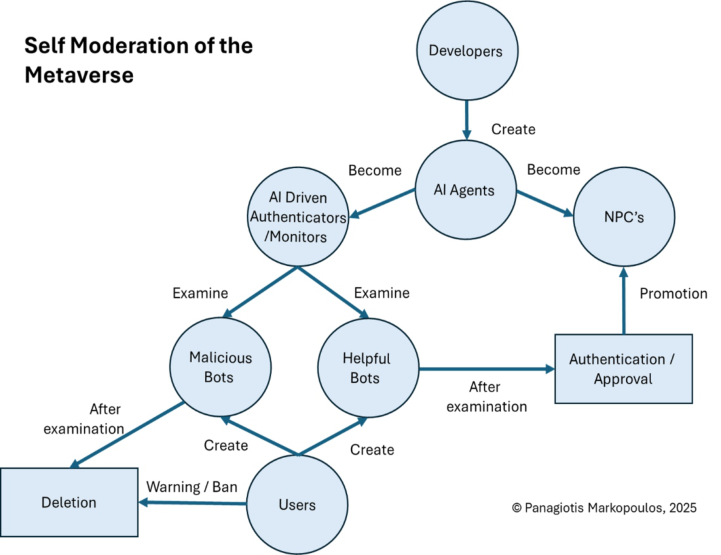
One effective strategy is to establish stricter moderation policies that regulate the creation and use of automated accounts. AI-driven authentication systems could serve as a proactive measure against bot overpopulation (Costa and Coelho, 2024). By leveraging machine learning and behavioural analysis, these systems could distinguish between human users and automated accounts. Document verification, CAPTCHA challenges, and real-time behavioural pattern recognition could prevent unauthorized bots from flooding the platform. Instead of outright banning user-created bots, platforms could implement tiered verification, where highly interactive accounts must periodically verify their human presence. This approach would reduce deceptive automation while still allowing creative and functional bot usage within ethical limits.
Rather than restricting all user-generated bots, platforms could introduce guidelines that encourage responsible automation. Verified bot creation programs could allow users to develop and deploy bots within controlled parameters, ensuring that they contribute positively to the ecosystem.
For example, users who create educational, assistive, or entertainment- focused bots could receive platform support or incentives. These bots would be then promoted to official AI Agents or NPCs of the respective platform. Providing development tools that ensure bots adhere to ethical interaction standards would enable innovation without compromising authenticity. This would also make their implementation less invasive. Additionally, limiting the number of bot accounts an individual user can create would help prevent bot overpopulation and ensure a balanced virtual environment.
178 Markopoulos and Smed
Figure 1 presents an ideal version of a self-moderating system in a metaverse.
Although regulating bot creation is necessary for preserving meaningful interactions, it raises ethical concerns about restricting user creativity and autonomy. Some users may argue that automation is an integral part of digital expression, enabling them to create unique experiences, conduct research, or enhance engagement (Wang, 2025). Striking a balance between regulation and freedom is crucial to maintaining an open yet structured digital space.
However, despite all efforts of moderation and integration many users of Metaverse-like platforms express a strong preference for interacting exclusively with human users and employees, rather than engaging with NPCs, AI agents, or bot accounts. This preference stems from the perception that digital interactions feel more meaningful when they occur between real people, as opposed to automated entities. Some users find AI- driven characters unnatural or intrusive, especially when their presence is overwhelming or poorly integrated into the virtual world (Ghiur˘au and Popescu, 2024). However, despite these concerns, the inclusion of AI agents and NPCs remains a necessity due to the unique demands of always-online digital environments.
Figure 1: Self-moderation of the Metaverse.
Unlike real-world establishments that operate within fixed hours and rely on human staff, virtual spaces in the Metaverse exist in a continuous, 24/7 online state. Users from different time zones can access these platforms at
A Metaverse Where Users, NPCs and AI Agents Can Coexist 179
any time, making it unfeasible to maintain a workforce of human employees around the clock. Hiring individuals to perform roles such as virtual customer service, in-game assistance, or content moderation full-time within the Metaverse would be resource-intensive and difficult to sustain. AI agents and NPCs, therefore, serve as essential facilitators, ensuring that users receive guidance, assistance, and engagement whenever they enter the digital space.
However, for AI-driven entities to be accepted by Metaverse users, their introduction must be handled with care. If platforms integrate NPCs and AI agents too aggressively, users may feel as though the virtual world is being overrun by artificial interactions, reinforcing their reluctance to engage with these entities. Instead, AI characters should be introduced gradually and in a way that aligns with the natural flow of the platform. By ensuring that AI agents complement rather than dominate human interactions, platforms can foster a sense of coexistence, where users gradually become comfortable with their presence.
Over time, as AI-driven characters become more sophisticated and human-like in their interactions, users may begin to see them less as intrusive bots and more as functional parts of the digital ecosystem. When implemented in moderation, AI agents can enhance the Metaverse experience without diminishing the authenticity of human engagement, leading to a balanced virtual world where AI and human users coexist harmoniously.
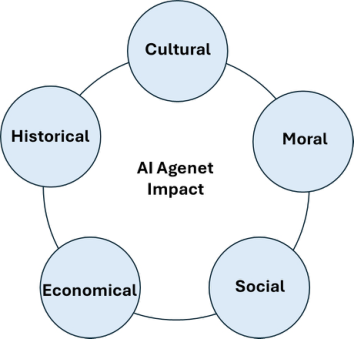
MULTI DIMENSIONAL IMPACT AI agent and NPC integration in digital spaces and Metaverse-like applications is a major technological advancement that will only continue to increase its importance and impact as AI technology advances. Their ability to simulate lifelike behaviours, adapt to user interactions, and autonomously engage in virtual environments makes them far more dynamic than traditional scripted digital entities. Figure 2 presents the multi dimensional impact of AI agents in virtual worlds. Unlike static programs, these AI-driven characters can learn, evolve, and respond in ways that feel increasingly natural, opening new possibilities for interactive storytelling, education, and commerce.
Culturally, AI agents redefine how people interact in virtual worlds, blurring the lines between human and artificial engagement. They introduce new forms of digital companionship, artistic expression, and even ethical dilemmas regarding AI identity and agency.
Historically, AI-driven interactions mark a shift from passive digital experiences to active, evolving ecosystems that can function independently of direct human input.
Morally, their widespread adoption raises questions about digital rights, ethical AI development, and the balance between human and artificial labour.
Economically, they provide cost-effective solutions for businesses operating in the Metaverse, enabling constant user engagement without the constraints of human staffing.
180 Markopoulos and Smed
Figure 2: Multi-dimensional impact of AI agents in virtual worlds.
Socially, they challenge traditional communication norms, shaping the future of online interactions. As they continue to evolve, AI agents will fundamentally alter the way people work, socialize, and experience digital spaces.
PRE AND POST CONDITIONS For NPCs and AI agents to be widely accepted in Metaverse-like applications, the world must establish clear foundations in digital literacy, regulation, and ethical AI integration. Socially, users need structured education on AI’s role in virtual spaces, ensuring they understand when they are interacting with AI-driven entities and what their limitations are (Bach et al., 2024). Platforms should implement visible AI labels and interactive tutorials, allowing users to build familiarity and trust with virtual agents gradually. Additionally, AI-human interaction research should inform and adapt best practices to make these digital beings feel natural rather than intrusive.
Economically, businesses and developers must design AI systems that enhance, rather than replace, human involvement. One approach is hybrid work models where AI agents handle repetitive tasks while human employees oversee complex decision-making and creative roles, such as managing and designing said AI agents and promoting the virtual platform. Governments and regulatory bodies should enforce AI usage standards, preventing AI overpopulation in digital spaces, user created or official, while ensuring companies maintain and prioritise human employment opportunities outside the virtual world (Kingsman et al., 2024). Investment in responsible AI development, ethical programming, and oversight committees would create a balanced integration.
For long-term sustainability, AI agents must evolve based on real user feedback from the users of their platform. Platforms should incorporate dynamic AI adaptation systems, ensuring virtual agents remain engaging
A Metaverse Where Users, NPCs and AI Agents Can Coexist 181
and relevant. Regular updates, ethical AI reviews, and community- driven improvements will help maintain balance, ensuring AI-driven virtual environments remain immersive, trusted, and beneficial to its users.
AREAS OF FURTHER RESEARCH Future studies can examine how virtual economies evolve when AI-driven NPCs and user-created bots participate alongside human users. Virtual marketplaces have existed since the first online games and virtual spaces. This work intents to be extended towards exploring the degree and possibility of how AI agents influence in-game markets, and how should platforms regulate automated trade to prevent exploitation.
Another critical area revealed from this research is the user behaviour study in AI-populated virtual worlds. Therefore, it is important to examine how do social dynamics shift when AI-driven NPCs become indistinguishable from human players. This can indicate if NPCs should be kept indistinguishable by the system by withholding their NPC status from users. Furthermore, research can analyse the presence of AI companions affect user retention, engagement, or even the emotional connection to digital spaces.
Lastly, this work can be also be directed towards the exploration the long-term sustainability of virtual environments. An approach to this is the identification of the architectural or computational limits exist when populating the Metaverse with complex AI agents, and how can developers optimize world-building to prevent server overload and AI redundancy.
CONCLUSION
As the Metaverse continues to develop, the integration of advanced NPCs and AI agents remains an emerging challenge and opportunity. The potential for AI-Agents and NPCs to simulate lifelike interactions, provide assistance, and enrich digital spaces has yet to be fully realized but it is possible. However, as this technology evolves, another problem can emerge. Without careful regulation, the uncontrolled creation of AI-driven bots could disrupt user engagement, diminish authenticity, and overpopulate virtual spaces.
For these technologies to be successfully implemented, platforms must establish ethical AI frameworks, transparent user guidelines, and adaptive moderation systems. Additionally, users must be gradually introduced to AI agents through clear labelling and structured interactions to build trust and familiarity. If executed responsibly, AI-driven characters could significantly enhance the Metaverse, making it more immersive and dynamic without compromising human-centered experiences.
By prioritizing balance, regulation, and user experience, virtual environments can evolve into sustainable ecosystems where human users and AI agents coexist in meaningful and beneficial ways.
REFERENCES
Aguilera, A., Quinteros, P., Dongo, I. and Cardinale, Y., 2023. CrediBot: Applying bot detection for credibility analysis on twitter. IEEE Access, 11, pp. 108365–108385.
182 Markopoulos and Smed
Anderson, E. F., 2005. Scripting behaviour—towards a new language for making NPCs act intelligently. In Proceedings of the zfx-CON05 2nd Conference on Game Development. Bach, T. A., Khan, A., Hallock, H., Beltrão, G. and Sousa, S., 2024. A
systematic literature review of user trust in AI-enabled systems: An HCI perspective. International Journal of Human–Computer Interaction, 40(5), pp. 1251–1266. Bellaiche, L., Shahi, R., Turpin, M. H., Ragnhildstveit, A., Sprockett, S., Barr, N., Christensen, A. and Seli, P., 2023. Humans versus AI: Whether and why we prefer human-created compared to AI-created artwork. Cognitive research: Principles and implications, 8(1), p.42. Chang, H. C. H., Chen, E., Zhang, M., Muric, G. and Ferrara, E., 2021. Social
bots and social media manipulation in 2020: The year in review. In Handbook of Computational Social Science, Volume 1 (pp. 304–323). Routledge. Chamoli, V., Bansal, G., Das, T. K., Hassija, V., Sai, S., Wang, J., Zeadally, S., Hussain, A., Yu, F. R., Guizani, M. and Niyato, D., 2024. Beyond reality: The pivotal role of generative AI in the metaverse. IEEE Internet of Things Magazine, 7(4), pp. 126–135. Costa, A. F. and Coelho, N. M., 2024, June. Evolving Cybersecurity Challenges in the
Age of AI-Powered Chatbots: A Comprehensive Review. In Doctoral Conference on Computing, Electrical and Industrial Systems (pp. 217–228). Cham: Springer Nature Switzerland. Dracewicz, W. and Sepczuk, M., 2024. Detecting Fake Accounts on Social Media Portals—The X Portal Case Study. Electronics, 13(13), p. 2542. Ghiur˘au, D. and Popescu, D. E., 2024. Distinguishing Reality from AI: Approaches
for Detecting Synthetic Content. Computers, 14(1), p. 1. Guo, Y., Yu, T., Wu, J., Wang, Y., Wan, S., Zheng, J., Fang, L. and Dai, Q., 2022.
Artificial intelligence for metaverse: A framework. CAAI Artificial Intelligence Research, 1(1), pp. 54–67. Hajli, N., Saeed, U., Tajvidi, M. and Shirazi, F., 2022. Social bots and the spread of disinformation in social media: The challenges of artificial intelligence. British Journal of Management, 33(3), pp. 1238–1253. Joshua, J., 2017. Information bodies: computational anxiety in neal stephenson’s
snow crash. Interdisciplinary Literary Studies, 19(1), pp. 17–47. Kaplan, A. M. and Haenlein, M., 2009. The fairyland of Second Life: Virtual social worlds and how to use them. Business horizons, 52(6), pp. 563–572. Kingsman, N., Kazim, E., Chaudhry, A., Hilliard, A., Koshiyama, A., Polle, R.,
Pavey, G. and Mohammed, U., 2022. Public sector AI transparency standard: UK Government seeks to lead by example. Discover Artificial Intelligence, 2(1), p. 2. Koohang, A., Nord, J. H., Ooi, K. B., Tan, G. W. H., Al-Emran, M., Aw, E. C. X., Baabdullah, A. M., Buhalis, D., Cham, T. H., Dennis, C. and Dutot, V., 2023. Shaping the metaverse into reality: A holistic multidisciplinary understanding of opportunities, challenges, and avenues for future investigation. Journal of Computer Information Systems, 63(3), pp. 735–765. Kucuksarac, B., 2023. The extended reality technology and its utilization in
metaverse. In Metaverse: Technologies, Opportunities and Threats (pp. 65–81). Singapore: Springer Nature Singapore. Lemon, O., 2022. Conversational AI for multi-agent communication in natural language: Research directions at the interaction lab. AI Communications, 35(4), pp. 295–308.
A Metaverse Where Users, NPCs and AI Agents Can Coexist 183
Lin, H., Wan, S., Gan, W., Chen, J. and Chao, H. C., 2022, December. Metaverse in education: Vision, opportunities, and challenges. In 2022 IEEE International Conference on Big Data (Big Data) (pp. 2857–2866). IEEE. Moore, M., 2023. Fake accounts on social media, epistemic uncertainty and the need
for an independent auditing of accounts. Internet Policy Review, 12(1). Pariy, V., Lipianina-Honcharenko, K., Brukhanskyi, R., Sachenko, A., Tkachyk, F. and Lendiuk, D., 2023, November. Intelligent Verbal Interaction Methods with Non-Player Characters in Metaverse Applications. In 2023 IEEE 5th International Conference on Advanced Information and Communication Technologies (AICT) (pp. 67–71). IEEE. Sénécal, D., 2024. The Reign of Botnets: Defending Against Abuses, Bots and Fraud
on the Internet. John Wiley & Sons. Spence, E. H., 2008. Meta ethics for the metaverse: The ethics of virtual worlds. Current issues in computing and philosophy, 175(3), pp. 3–12. Wang, J., 2025. Digital Curation and Evaluation: Affective Evaluation Strategies under the Perspective of Human-AI Interaction. In Digital Futures in Human- Computer Interaction (pp. 149–166). CRC Press. Yampolskiy, R. V., 2022. Metaverse: A solution to the multi-agent value alignment
problem. Journal of Artificial Intelligence and Consciousness, 9(03), pp. 297–307. Yasuda, A., 2024. Metaverse ethics: Exploring the social implications of the metaverse. AI and Ethics, pp. 1–12. Zhang, X., Zhu, R., Chen, L., Zhang, Z. and Chen, M., 2024. News from Messenger? A Cross-National Comparative Study of News Media’s Audience Engagement Strategies via Facebook Messenger Chatbots. Digital Journalism, 12(3), pp. 336–355.
Read this individual research paper free through the original publisher, or explore the full digital proceedings book.
ISBN 978-1-964867-71-7
Explore this ISBN in the AHFE Bookstore ↗Listed in the July 2026 bookstore catalogue; search by ISBN to confirm current availability · Digital book purchase optional