Evangelos Markopoulos, Panagiotis Markopoulos, Akash Nandi, Tong Wu, Kui Zhao, Mascha Samkova, Menglei Huang (2024). Using the UN SDGs and the ESG Index towards the development of a Unified Building Information Modelling Language and Culture for Sustainable Construction. In: Sustainable Construction in the Era of the Fourth Industrial Revolution. AHFE Open Access, vol. 149, pp. 1–10. https://doi.org/10.54941/ahfe1005269
Publisher statistics will load when you open Metrics.
AHFE OPEN ACCESS OPEN ACCESS CONFERENCE PROCEEDINGS PAPER
Using the UN SDGs and the ESG Index towards the development of a Unified Building Information Modelling Language and Culture for Sustainable Construction
The Building Information Modelling (BIM) concept was invented in the last ten years to bridge the technological gap between the construction sector and other sectors and contribute to the sustainability targets of the built environment. However, it seems that there is a significant difference in the application and adaptation of the BIM technology between organizations and countries as well. This paper addresses these key BIM challenges and identifies technological and cultural requirements for developing a Unified BIM Language & Culture (UBIML-C) that can enhance the implementation and adaptation process of BIM technology. Furthermore, it indicates the integration and alignment of UBIML-C with the UN SDGs and the ESG index to highlight the direct return on the effort and investment placed to implement UBIML-C. The paper introduces a preliminary process framework for the adaptation and operations of UBIML-C in terms of knowledge elicitation, technology and process execution, performance metrics, and its alignment with the UN SDGs and the ESG Index.
Since introducing the ESG index, the concept of sustainable, social and ethi- cal operations, management, and governance has become a global trend and the most significant valuation criteria for companies’ performance and risk management.
ESG redefined the way investments are made, funding is given, attention is drawn, acceptance is granted, projects are delivered, and success is com- municated. Such a radical restructuring of business strategies, operations and communication must be supported with the related technology for data col- lection and utilization, but also with a common corporate culture for the compliance of the corporate operations to the ESG criteria. This need seems to be more significant, and critical as well, for organizations in emerging countries in their attempt to bridge the gap from the developed (Alkatheeri, 2023). Integrating the needed technology and the required culture must be coordi- nated with a common language that either exists and must be adopted or does not exist and must be invented. Such a need seems to be of high importance in the construction industry and the built environment. On the one hand, there is the low productivity of the sector and its current distance from the effec- tive use of advanced technologies; however, there is also the pressure to move towards sustainable construction, driven and inspired by the UN SDGs that can lead construction companies to higher ESG scores (Markopoulos et al., 2023a).
IMPACT OF THE ESG INDEX AND THE UN SDGS IN CONSTRUCTION From a reputational perspective, ESG and the UN SDGs build up a com- pany’s brand and reputation, which in turn has a positive impact on their business (Jeffrey et al., 2019). It has been found that there is a positive link between ESG performance and company reputation, and as investor atten- tion increases, it amplifies the positive influence of ESG performance on reputation (Meng et al., 2023).
Another study also found that social responsibility demonstrated by the tweets on SDGs by CEOs of the companies may have led to a better rep- utation (Grover et al., 2019) attracting responsible investors (Hadro et al., 2022); global sustainable investment topped $30 trillion in 2019 — up 68 per cent since 2014 and tenfold since 2004. This significant surge in invest- ment is propelled by a heightened focus from social entities, governments, and consumers on the societal and environmental impacts of corporate activities. Additionally, it has been fuelled by investors and executives who realize that a strong ESG proposition is important for ensuring the enduring long-term success of a company (Koller et al., 2019).
From the strategy perspective, the ESG and UN SDGs compile the compa- nies to find creative strategies that maximize the public good (Markopoulos and Markopoulos, 2023b). They align their strategy with goals such as sus- tainable cities and communities (SDG 11) and responsible consumption and production (SDG 12). They evaluate the ESG impact and risk associated with their business, and create new construction methods (LePage & Renaerts, 2023). From the process perspective, the construction industry is progressively embracing sustainable practices and standards. They use sustainable materi- als, increase energy efficiency, reduce water wastage, reduce or re-use waste,
Using the UN SDGs and the ESG Index Towards the Development 3
and innovate new construction techniques. They also provide a good work- life balance (SDG 3) (Opoku, 2022). They encourage the same practices to be adopted in their supply chain.
The new construction projects now incorporate renewable energy sources (SDG 7), provide affordable housing, and include better indoor air quality, lighting, and green spaces (SDG 11).
BIM FOR SUSTAINABLE CONSTRUCTION BIM has become a key pillar within sustainable construction; a new method of construction involving the use of recycled materials, minimiz- ing energy usage and controlling future carbon output (Deng et al., 2021). Jackson (2021) defined sustainable construction as using resources more wisely and designing healthier, more energy-efficient spaces, while also min- imizing the ecological imprint of buildings and emphasizing their impact on the environment. BIM can store and manage building project data on energy consumption and offer detailed work-flow data during construction operations (Najjar, 2017). Some key groups of associated technologies and examples are mentioned below.
The BIM technologies Autodesk Revit (AI-enhanced), Graphisoft Archi- CAD (AI-powered) and Solibri (AI for Quality Control), all utilize AI for optimizing design processes, such as generative design, where multiple design solutions are generated based on specific goals and constraints. Their key purpose is to improve accuracy and reduce repetitive work.
Virtual reality (VR) and Augmented reality (AR) technologies have also made their way into space: VR Collaboration Tools (e.g., IrisVR, Varjo), Enscape (Real-time Rendering and VR), AR for Construction (e.g., Microsoft HoloLens, ARki), Smart Helmets (e.g., Daqri Smart Helmet) and Unity Reflect for Real-time 3D & AR/VR are key technologies used today. They allow stakeholders to immerse themselves in 3D BIM models, enhancing understanding and collaboration on design and construction projects. They also improve accuracy, collaboration, visualization, and training for onsite personnel.
More mature BIM technologies that have the purpose of modelling include Drones and Photogrammetry, Trimble Tekla (Robotics Integration), IoT for Building Performance Monitoring, Laser Scanning, Digital Fabrication and Assembly (e.g., Asmbld) and Point Clouds and Bentley Systems (Digital Twins). These technologies are used for creating updated and/or real-time, high-resolution images of a construction site, which are then integrated with BIM (digital twins) for accurate site analysis and monitoring. Bentley Systems leverages IoT data for real-time analytics, heightening the synergy between the office models and site recordings. Another technology that is tightly linked to the trio is 3D modelling, which uses BIM to directly print build- ing components or entire structures, promoting innovation in sustainable choices for construction. One new software which was developed solely for monitoring real-time sustainable performance (based on material usage and construction) is Sefaira, which is becoming increasingly popular within sustainable construction.
On the machine learning and data front, these technologies are currently being utilized to optimize collaboration between teams, such as between a design team and a contractor. They aim to predict future design cases, issues, and risks and reduce wasted materials whilst keeping the team safe by man- aging the predicted risk throughout projects. Some examples are Autodesk BIM 360 (Cloud Computing) and Machine Learning for Predictive Analysis, Blockchain for BIM Data Security and Point Clouds and Generative Design Tools (e.g., Autodesk Dynamo).
Overall, BIM has been adopted in sustainable construction to contribute to lowering environmental impacts while encouraging social and environmental development in early design phases, integrated technology, and knowledge. (Díaz and Antón, 2014) Better collaboration between architects, engineers, contractors, and owners—among other stakeholders involved in a construc- tion project—is made possible by BIM, which provides essential informa- tion and conducts the necessary analysis. By simulating different scenarios, designers may find the most energy-efficient solutions and maximize the per- formance of the building. This can lead to significant reductions in energy use and embodied carbon emissions over the building’s lifecycle. Moreover, obtaining green building certifications (e.g. LEED and BREEAM) and prov- ing compliance with environmental requirements are made easier with the help of BIM.
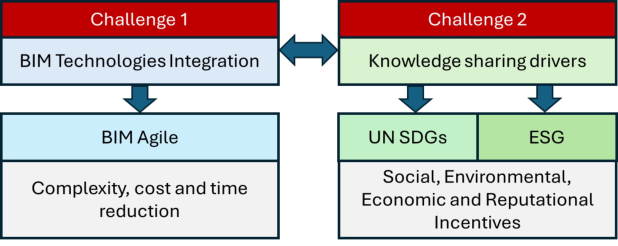
UNIFYING THE BIM TECHNOLOGIES TOWARDS ESG AND UN SDG COMPLIANCE Two significant challenges of the use of BIM technology are the identifica- tion of the minimum technological architecture that needs to be implemented for a BIM technology to be considered sufficient to contribute to the organi- zation’s operations and sustainability targets, and the development of the needed organisation’s culture to support digital information creation and sharing among all those involved in a project.
The first challenge requires a selective and agile integration of the needed BIM technologies per project and customer. This can avoid implementation overcomplexity and high costs in expertise and technologies which seems to be the main reason for BIM being partially developed and applied today (Liao et al., 2022).
The second challenge requires a common goal that will drive the knowledge-sharing efforts towards successful project implementation and maintenance. This common goal can be the alignment of BIM technology with the UN Sustainable Development Goals and the ESG Index. The UG SDGs aim towards social and environmentally sustainable benefits, while the ESG extends the environmental and social benefits to economic and financially sustainable benefits for those involved (Markopoulos et al., 2023) (see Figure 1).
Using the UN SDGs and the ESG Index Towards the Development 5
Figure 1: BIM challenges and resolution approaches.
An initial attempt to integrate the two challenges is presented in Table 1. The first column indicates key BIM technologies that are considered to con- tribute to construction projects highly and critically. The second column indicates the UN SDGs that are mostly related to the use of each technol- ogy, while the columns indicate the ESG Pilar category and theme based on the Refinitiv ESG scoring methodology (Refinitiv, 2022). The analysis pro- vided is indicative and can be further developed with other direct or indirect BIM technologies available in the industry. It can also be explored more in- depth in terms of the UN Sustainable Development Goals and ESG criteria being addressed, namely by extending the key ones indicated in the table.
Table 1. BIM technologies alignment with the UN SDGs and the ESG criteria.
Table available in the original PDF paper.
BIM Technology Key UN SDGs Key ESG Pillar (E, S, or G); Theme Autodesk Revit Industry Innovation and Infrastructure (9)
(9) Product Innovation (E), Product Quality (S).
Product Innovation (E), Product Quality (S), Career development and training (S) Graphisoft ArchiCAD (AI-powered) VR Collaboration Tools Climate Action (13), Reduced Inequalities (10), Gender Equality (5) Emission (E), Environmental Management Systems (E), Energy (E), Diversity and Inclusion (S), Human Rights (S), and Management Structure (G). AR for Construction
Sustainable Cities and Communities (11), (9)
Product Innovation (E), Product Quality (S). Drones and Photogrammetry
Health and Safety (S), Product Innovation (E), Product Quality (S). Working conditions (S)
Decent work and economic growth (8), Responsible consumption and Production (12) Digital Twins Gender equality (5), (10), (8), (9), (12), Health and Safety (S), Product Innovation (E), Product Quality (S), Diversity and Inclusion (S). Cloud computing Industry Innovation and Infrastructure (9), (8).
Product Innovation (E), Product Quality (S), Career development and training (S), Data privacy (S) (Continued)
Table 1. Continued BIM Technology Key UN SDGs Key ESG Pillar (E, S, or G); Theme
Table available in the original PDF paper.
Industry Innovation and Infrastructure (9), (8), (12),
Machine Learning for Predictive Analysis
Product Innovation (E), Product Quality (S), Career development and training (S) 3D Printing Good Health and Well Being (3), (8), (9), (11) (12)
Health and Safety (S), Product Innovation (E), Product Quality (S). Working conditions (S) IoT for Building Performance Monitoring
(8), (9), (11), ESG reporting transparency (G), Product Innovation (E), Product Quality (S), Career development and training (S) Blockchain for BIM Data Security
(8), (9), (11), (12) ESG reporting transparency (G), Product Innovation (E), Product Quality (S), Career development and training (S), Data privacy (S) Digital Fabrication and Assembly
(5), (10), (8), (9), (11), (12) Working conditions (S), Product Innovation (E), Product Quality (S), Career development and training (S)
The combinations made among the selected technologies are related to the internal and external strategic goals of the organization. Such goals can be related to the implementation cost, time, effort, available expertise, human resources, and other parameters. The selected technologies automatically cre- ate the social and sustainable impacts of the project and its implementation process. The use of VR technology in BIM for example contributes to goals 13 (Climate Action due to energy preservation and transportation time reduc- tion), and goal 10 (Reduced Inequalities as people with disabilities) can be part of the project implementation process, among other goals (Dulau et al., 2020). The same technology is associated with the ESG themes Emission (E), Environmental Management Systems (E), Energy (E), Diversity and Inclusion (S), Human Rights (S), and Management Structure (G).
THE UBIML-C FRAMEWORK The integration and alignment of the BIM technologies with the UN SDGs and ESG criteria form the base of a Unified Building Information Mod- elling Language, which must be applied based on the circumstances to secure effective communication.
These circumstances differ significantly among organizations and are impacted by factors that go beyond business operations, in fact reaching cul- tural norms, religion, social norms, climate, geography, legislation, financial institutions, corruption, and others. A project can use enhanced VR and AI if delivered in a country with strict religious and social norms such as prevent- ing women from working on-site or delivering heavy work (Markopoulos and Luimula, 2020). Drones can be used more often in difficult geographic locations. Blockchain can be a good option for financial transactions and monitoring in regions with unstable economies and financial institutions. On the other hand, Cloud Computing or digital twins cannot work in regions with limited and unstable communication infrastructure.
Using the UN SDGs and the ESG Index Towards the Development 7
The circumstances can also be UN-SDG and ESG impacted. There are many decent, professionals and ethical companies in the construction sector across the work that do not follow the SDGs and the ESG as mandatory prac- tice. This however does not make them environmentally harmful, unsocial, or unethical as they operate based on their cultural and social norms.
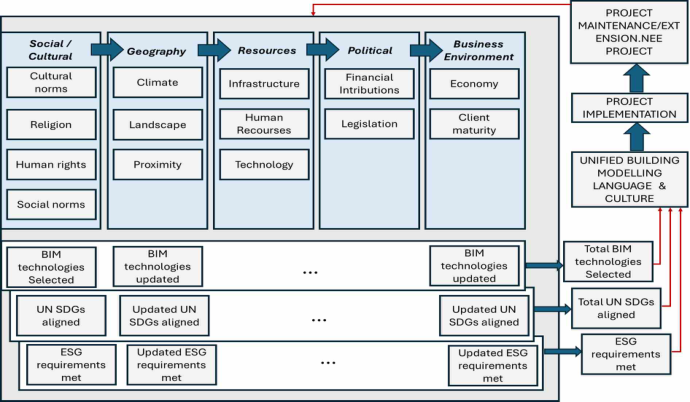
Based on the above, the conditions form the semantics of the language, the technologies form the words, and the goals form the culture. Understanding this triplet of parameters and by communicating properly the right and goals a common language is created among those involved in a project, anywhere in the world. Figure 2 presents a high-level framework that works as a UBIML- C generator per case.
The framework operates with five categories of conditions. Each category generates the BIM technologies to be used based on those conditions, but also the UN SDGs aligned with the selected BIM technologies and the ESG requirements met. As each category gets completed, the BIM technology, UN SDGs and EST requirements get updated. Upon the completion of the pro- cess, the final set of technologies has been derived, the UN SDGs alignment has been done, and ESG requirements have been identified. These results cre- ate the UBIML-C for the specific project to execute. Any project extension, maintenance, or update based on the new requirements repeats the process.
Figure 2: UBIML-C generator architecture.
ORGANIZATIONAL CULTURE PRE AND POST-CONDITIONS OF THE ADAPTATION OF UBILM The Unified Building Information Modelling Language can be a tool for the development of common understanding and expectations when adopt- ing BIM on a project, especially on international projects. Thomas Friedman in his work “The Flat World” makes several assumptions that a technologi- cally interconnected world can deliver any project and conduct international
business by anyone anywhere and at any time (Friedman, 2007). However, Pankaj Ghemawat in his work “Distance Still Matters” indicated that the world is not really flat, as there are several cultural, administrative, geo- graphic and economic factors that don’t allow generalized assumptions that make the world bumpy (Ramnath, 2011).
As such distances exist, there are certain pre and post-conditions for the effective creation and execution of the right UBIML-C for the right project in the right place.
Some of the Pre-Conditions for using the UBIML-C are the existence of BIM expertise in the project, the regulatory framework a project is being developed, the maturity of the client to accept the time, effort and cost needed for a project to be developed using BIM, incentives to comply with the UN SDGs, ESG reporting requirements and other. UBIML-C can be considered beneficial towards finding a common understanding for at least the minimum BIM implementation in countries where the faster-cheaper-better methodol- ogy rules, where quality and reliability are cost centres rather than profit centres.
On the contrary, some of the post-conditions can be the utilisation and dissemination of the UBIML-C benefits to gain reputational gains at local, regional and international levels. The impact of such promotional activities can be enough for UBIML-C to be applied in another project, and over time BIM to replace UBIML-C when the common understanding of the benefits of BIM will not need the UN-SDGs or ESG incentives.
LIMITATIONS AND AREAS OF FURTHER RESEARCH The research conducted in this paper emphasized the identification of the parameters that can form a unified building information modelling language and culture (UBIML-C), the overall concept and need for such language and the overall language composition framework. This limited the practical dimension of this research, as the UBIML-C have not been tested to evaluate output per case.
Further research will be conducted on developing a prototype based on which a UBIML-C will be generated per case. The prototype will follow the expert system-type approach presented in this work, providing an explana- tory logic of why the specific output has been generated. Expert systems and the explanatory mechanisms that existed since the 1980s are coming back as a new innovative technology under the term Explanatory Artificial Intelligence or XAI for human-cantered explanations (Sovrano and Vitali, 2022).
CONCLUSION
Since the introduction of BIM first and as a collection of technologies, we have seen organizations try to identify the mode of balanced adaptation of BIM that will provide the BIM benefits with a manageable and affordable cost. On one hand, there is the industry pressure to move faster and more holistically towheads the BIM adaptation, while on the other hand, there
Using the UN SDGs and the ESG Index Towards the Development 9
are parameters that are not easy to consider when international projects are developed (Migilinskasa et al., 2013).
This paper introduced the Unified Building Modelling Language powered by BIM technologies, the UN Sustainable Development Goals and the ESG index. Each of the three components contributes towards understanding the organizational strategy and the expected outcome financially, reputation- ally, and internationally, where project implementation strategies are heavily impacted by cultural norms. This initial version of UBIML-C at a conceptual level is an attempt to think of BIM adaptation by considering such param- eters. Researchers are welcome to build on this work towards making BIM welcomed on any project across the world.
REFERENCES
Alkatheeri, H., Markopoulos, E., Al-qayed, H. (2023). An organizational and operational capability and maturity assessment for SMEs in emerging markets towards the ESG criteria adaptation. In: Tareq Ahram and Redha Taiar (eds) Human Inter- action & Emerging Technologies (IHIET 2023): Artificial Intelligence & Future Applications. AHFE (2023) International Conference. AHFE Open Access, vol. 111. AHFE International, USA. http://doi.org/10.54941/ahfe1004075 Díaz, J. and Antön, L. Á. (2014) ‘Sustainable construction approach through integra-
tion of LCA and BIM Tools’, Computing in Civil and Building Engineering (2014) [Preprint]. doi: 10.1061/9780784413616.036. Deng, M., Menassa, C. C. and Kamat, V. R. (2021a) ‘From bim to Digital Twins: A systematic review of the evolution of intelligent building representations in the AEC-FM Industry’, Journal of Information Technology in Construction, 26, pp. 58–83. doi: 10.36680/j.itcon.2021.005. Dulau E., Botha-Ravyse C. R., Mika Luimula, Panagiotis Markopoulos, Evangelos
Markopoulos. (2019). A virtual reality game for cognitive impairment screening in elderly: a user perspective – Proceedings of the 10th IEEE International Confer- ence on Cognitive InfoCommunications. CogInfoCom 23-24-25 October 2019. Naples, Italy. https://doi.org/10.1109/CogInfoCom47531.2019.9089973 Friedman T. (2007). The World is Flat: The Globalized World in the Twenty-first Century. Picador. New York. Grover, P., Kar, A. K., & Ilavarasan, P. V. (2019). Impact of corporate social respon-
sibility on reputation—Insights from tweets on sustainable development goals by CEOs. International journal of information management, 48, 39–52. Hadro, D., Fijałkowska, J., Daszy´nska- ˙Zygadło, K., Zumente, I., & Mjakuškina, S. (2022). What do stakeholders in the construction industry look for in non- financial disclosure and what do they get?. Meditari Accountancy Research, 30(3), 762–785. Jackson, C. (2021) What is sustainable construction?, construction21.org. Available
at: https://www.construction21.org/articles/h/what-is-sustainable Jeffrey, S., Rosenberg, S., & McCabe, B. (2019). Corporate social responsibility behaviors and corporate reputation. Social Responsibility Journal, 15(3), 395–408. Koller, T., Nuttall, R., & Henisz, W. (2019). Five ways that ESG creates value. The
McKinsey Quarterly. LePage, D., & Renaerts, E. (2023). Achieving the UN SDGs Through the Integration of Social Procurement in Construction Projects. In The Role of Design, Construction, and Real Estate in Advancing the Sustainable Development Goals (pp. 129–147). Cham: Springer International Publishing.
Liao, L.; Zhou, K.; Fan, C.; Ma, Y. Evaluation of Complexity Issues in Building Information Modeling Diffusion Research. Sustainability 2022, 14, 3005. https: //doi.org/10.3390/su14053005 Markopoulos, E., Zhao, K., Samkova, M., Vanharanta, H. (2023). ESG and UN
SDGs Driven Strategy Generation Process for Green and Pink Oceans. In: Vesa Salminen (eds) Human Factors, Business Management and Society. AHFE (2023) International Conference. AHFE Open Access, vol. 97. AHFE International, USA. http://doi.org/10.54941/ahfe1003878 Markopoulos, E., Zhao, K., Samkova, M., Vanharanta, H. (2023a). ESG and UN SDGs Driven Strategy Generation Process for Green and Pink Oceans. In: Vesa Salminen (eds) Human Factors, Business Management and Society. AHFE (2023) International Conference. AHFE Open Access, vol. 97. AHFE International, USA. http://doi.org/10.54941/ahfe1003878 Markopoulos, E.; Luimula, M. Immersive Safe Oceans Technology: Developing Vir-
tual Onboard Training Episodes for Maritime Safety. Future Internet 2020, 12, 80. https://doi.org/10.3390/fi12050080 Markopoulos, P., Markopoulos, E. (2023b). Addressing the UN 2030 sustainable development agenda and the ESG index with serious games in virtual environ- ments. In: Tareq Ahram and Christianne Falcão (eds) Human Factors in Virtual Environments and Game Design. AHFE (2023) International Conference. AHFE Open Access, vol. 96. AHFE International, USA. http://doi.org/10.54941/ahfe 1003862 Meng, T., Yahya, M. H. D. H., Ashhari, Z. M., & Yu, D. (2023). ESG performance,
investor attention, and company reputation: Threshold model analysis based on panel data from listed companies in China. Heliyon. Migilinskasa D., Popovb V., Juoceviciusc V., Ustinovichiusd L. (2013). The Benefits, Obstacles and Problems of Practical Bim Implementation. Procedia Engineering 57 ( 2013) 767–774. Najjar, M.; Figueiredo, K.; Palumbo, M.; Haddad, A. Integration of BIM and LCA:
Evaluating the environmental impacts of building materials at an early stage of designing a typical office building. J. Build. Eng.2017, 14, 115–126. Opoku, A. (2022). 10. Construction industry and the Sustainable Development Goals (SDGs). Research Companion to Construction Economics, 199. Ramnath N. (2011). Pankaj Ghemawat: The World is Not Flat. So What. Forbes
India. June 30, 2011. https://www.forbesindia.com/article/special/pankaj-ghema wat-the-world-is-not-flat-so-what/26292/1 Sovrano, F., Vitali, F. (2022). Explanatory artificial intelligence (YAI): Humancentered explanations of explainable AI and complex data. Data Min Knowledge Discovery (2022). https://doi.org/10.1007/s10618-022-00872-x
LISTED IN THE AHFE DIGITAL BOOKSTORE CATALOGUE
Explore the complete digital volume
Sustainable Construction in the Era of the Fourth Industrial Revolution
Read this individual research paper free through the original publisher, or explore the full digital proceedings book.
ISBN 978-1-964867-25-0
Explore this ISBN in the AHFE Bookstore ↗Listed in the July 2026 bookstore catalogue; search by ISBN to confirm current availability · Digital book purchase optional