Evangelos Markopoulos, Kui Zhao, Mascha Samkova, Hannu Vanharanta (2023). ESG and UN SDGs Driven Strategy Generation Process for Green and Pink Oceans. In: Human Factors, Business Management and Society. AHFE Open Access, vol. 97, pp. 11–20. https://doi.org/10.54941/ahfe1003878
The paper introduces an applied and practical methodological framework for mapping the ESG criteria on the UN SDGs, and vice versa, and applies the results in developing organizational strategies based on sustainable and social innovations that can lead to Green or Pink oceans. Such an approach can be a dynamic multiplier on the organizational efforts to comply with the ESG criteria that impact their valuation and performance, and the alignment with the UN SDGs that impact the ESG score and the reputation of the organization. Any organization can use the proposed methodology to develop realistic and operational strategies in line with the UN 2030 Agenda for Sustainable Development and the ESG criteria. Such strategies can increase the organization's competitiveness and deliver reputational benefits from their social and sustainable operations, but also financial benefits from their ESG score achievements. The paper suggests the pre and post-conditions on using the proposed method, research limitations, and areas of further research to be conducted for the application of the proposed methodology.
Since the introduction of the United Nations Sustainable Development Goals (UN SDGs), social and sustainable innovation and entrepreneurship obtai- ned a practical and applied definition, offering opportunities to innovate for the benefit of the planet and society. On a similar route, the new Environmental, Social, and Governance (ESG) index, introduced nearly ten years ago, empowered the need, integration, and utilization of the UN SDGs in any organization’s short and long-term strategic plans. As a result, the ESG score is considered today one of the most, if not the most, essential organizational valuation indexes, (US/SIF, 2018). High ESG sco- res attract corporate investments and partnerships; increase clientele; reflect
on the organization’s stock value; and significantly impact organizational performance and development (Markopoulos et al., 2020a).
To demonstrate the impact, the opportunities, and the inspiration offered by the SDGs, goal 9 is selected as an example. SDG 9 deals with Infrastru- cture, Industrialization, and Innovation and emphasizes the need to build resilient infrastructure, promote inclusive and sustainable industrialization and foster innovation (UN, 2023a). Investments in Research & Development (R&D) related to SDG 9 have increased from 1.4 trillion in 2010 to $2.2 trillion in 2017 with Europe and Northern America gathering 47.6% of the global R&D investments.
Increases in R&D are especially sought in the pharmaceutical industry where new technologies such as artificial intelligence (AI) contribute to drug development and discovery and health process management, counteracting the negative impacts of COVID-19 and achieving sustainable, long-term eco- nomic development. The COVID-19 pandemic had a massive impact on the manufacturing, transport, and aviation industries by causing disruptions in global value chains, the supply of products, losses in jobs, and declining work hours. All these are areas where innovations related to SDG 9 can be developed and applied. The world seeks infrastructure and industrialization innovation and SDG 9 provides inspiration, ideas and needs for those who can and wish to contribute.
THE UNITED NATIONS SUSTAINABLE DEVELOPMENT GOALS The United Nations’ 2030 Agenda for Sustainable Development, adopted by all United Nations Member States in 2015, provides a shared blueprint for peace and prosperity for people and the planet, now and into the future. It drives the sustainable and social innovation efforts of Small and Medium Sizes organizations (SMEs), Non-Governmental Organizations (NGOs), and Public Sector organizations but also large-scale and Multinational Enterprises (MNEs).
At its heart are the 17 Sustainable Development Goals (SDGs), which are an urgent call for action by all countries - developed and developing - in a global partnership. Organizations and individuals recognize that ending poverty and other deprivations must go hand-in-hand with strategies that improve health and education, reduce inequality, and spur economic growth – all while tackling climate change and working to preserve oceans and forests. The SDGs are built on decades of work by countries and the UN, including the UN Department of Economic and Social Affairs.
Furthermore, the UN Global Compact supports companies to do business responsibly by aligning their strategies and operations with its Ten Principles on human rights, labor, environment, and anti-corruption, to take strate- gic actions toward advancing broader societal goals with an emphasis on collaboration and innovation (UN, 2023b) The SDGs inspired a new generation of social and sustainable entrepre- neurs, many of whom ignited their entrepreneurial journey and ventures internally, within their organizations (intrapreneurship), or (entrepreneur- ship) as independent, passionate, and open-minded individuals aiming to change the world.
ESG and UN SDGs Driven Strategy Generation Process for Green and Pink Oceans 13
THE GREEN AND RED OCEAN STRATEGIES The intense swift towards social and sustainable innovation extended the successful Blue Ocean Strategy to Green Ocean Strategy for sustainable inno- vation and Pink Ocean Strategy. Both strategies are powered by the Company Democracy Model using democratic principles to build organizational cultu- res that reduce inequalities, increase freedom of speech, safeguard knowledge sharing, and provide ethical opportunities for all to innovate and benefit their organization, the environment, and society.
The ocean metaphor was initially introduced in 2004 with the Blue Ocean Strategy (Chan & Mauborgne, 2005) for innovation that creates uncontested market spaces, make the competition irrelevant, and creates and captures new demand, among other characteristics. Blue oceans are driven by strong VRIO resources that create a clear and significant distance from any competitor or any attempt to imitate the innovation.
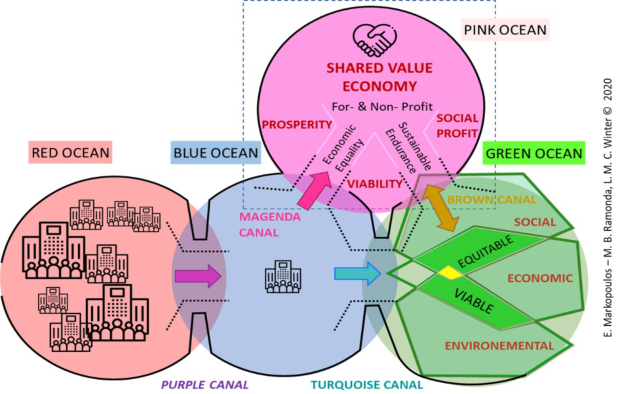
On the other hand, all blue oceans will eventually turn red over time. The success of a blue ocean can be measured by the distance from Blue to Purple and from Purple back to Red (Gandellini and Venanz, 2011). To extend inno- vation competitiveness organizations need to utilize their time while being in the blue ocean and design the next strategy to follow once or before the blue ocean becomes purple. Such strategies are the Green Ocean Strategy (Marko- poulos et al, 2020b) and the Pink Ocean Strategy (Markopoulos et al, 2020c) as shown in Figure 1.
Green Ocean Strategy seeks to capture the environmental, social, and economic demand by creating sustainable market spaces through conti- nuous innovation. To achieve such innovation continuity, a democratic organizational culture needs to be in place to encourage unbiased intellectual capital flow within an organization (Markopoulos and Vanharanta, 2014), (Markopoulos and Vanharanta, 2015).
Figure 1: The innovation oceans.
The Green Ocean Strategy takes the Blue Ocean strategy a step further. Blue Ocean Strategy creates new market space and avoids competition by cre- ating or capturing new customer value, while the Green Ocean Strategy seeks to keep this new blue ocean from turning red through continuous sustainable innovation that aligns the company with the most pressing environmental challenges many of which can be found in the UNSDGs and the UN2030 sustainable development agenda.
Green Oceans are also connected and related to the ESG index as their innovations fit the environmental (E) pillar. While the organization progres- ses under a democratic culture that keeps UN SDGs as part of its mission, ESG environmental criteria are automatically fulfilled.
The Pink Ocean Strategy is similar to the Green Ocean Strategy, and another extension or evolution of the Blue Ocean strategy. While the envi- ronmentalist Green Ocean Strategy focuses mainly on creating a clean and carbon-free world, the Pink Ocean Strategy focuses on social and huma- nitarian challenges. It creates shared social value by promoting love, care, and above all, human dignity. A democratic organizational culture is also required to reach Pink Oceans. This is the co-opetition that collectively and responsibly drives shared value innovations.
While the Blue Ocean Strategy makes the competition irrelevant by cre- ating a new uncontested market space, the Pink Ocean Strategy creates a compassionate market space that coincides with the competition. This does not necessarily mean that Pink Oceans are less profit-oriented, as they remain value-driven business initiatives (Altuna et al, 2015). On the contrary, Pink Oceans can be very rewarding, and their success is related to the motivation, fairness, care, and benefits a pink innovation strategy offers to people and society.
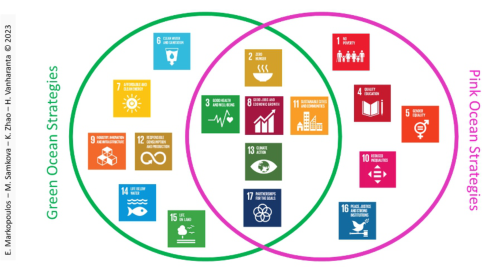
MAPPING THE UN SDS ON THE GREEN AND PINK OCEANS While all UN SDGs lead to sustainable and social innovations some can be considered greener and others pinker. Figure 2 presents a Vann diagram with the most appropriate SDGs per type of strategy. Furthermore, Table 1 pro- vides a textual presentation of the UN SDGs in the Green and Pink Ocean strategies.
Figure 2: Categorization of the UN SDGs in the Green and Pink Ocean strategies.
ESG and UN SDGs Driven Strategy Generation Process for Green and Pink Oceans 15
Table 1. Allocation of 17 global goals to innovation strategies and ocean.
Table available in the original PDF paper.
UN SDGs closest to Social / Pink Ocean Strategies
UN SDGs related to both Sustainable/Social Strategies and both Green/Pink Ocean
UN SDGs most related to Sustainable / Green Ocean Strategies
UN SDG1: End poverty in all its forms everywhere
UN SDG6: Ensure availability and sustainable management of water and sanitation for all.
UN SDG3: Ensure healthy lives and promote well-being for all at all ages.
UN SDG2: End hunger, achieve Food Security and improve nutrition and promote sustainable agriculture. UN SDG7: Ensure access to affordable, reliable, sustainable and modern energy for all.
UN SDG4: Ensure inclusive and equitable quality education and promote lifelong learning opportunities for all.
UN SDG5: Achieve gender equality and empower all women and girls.
SDG9: Build resilient infrastructure, promote inclusive and sustainable industrialization and foster innovation.
SDG 10: Reduce inequality within and among countries.
UN SDG8: Promote sustained, inclusive and sustainable economic growth, full and productive employment and decent work for all. SDG12: Ensure sustainable consumption and production patterns.
UN SDG11: Make cities and human settlements inclusive, safe, resilient and sustainable.
UN SDG8: Promote sustained, inclusive and sustainable economic growth, full and productive employment and decent work for all. SDG14: Conserve and sustainably use the oceans, seas and marine resources for sustainable development.
SDG16: Promote peaceful and inclusive societies for sustainable development, provide access to justice for all and build effective, accountable and inclusive institutions at all levels.
SDG13: Take urgent action to combat climate change and its impacts.
SDG15: Protect, restore and promote sustainable use of terrestrial ecosystems, sustainably manage forests, combat desertification, and halt and reverse land.
SDG17: Strengthen the means of implementation and revitalize the global partnership for sustainable development.
MAPPING THE SDGs AGAINST ESG PILLARS To further utilize the opportunities offered by the SDGs, businesses need to prioritize their goals based on strategic importance and business development planning. Therefore, identifying business operations to incorporate SDGs’ impact and contribute to ESG scoring is a significant challenge.
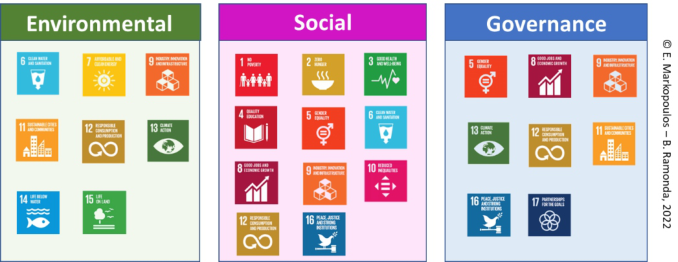
Figure 3: SDGs mapping on the ESG pillars.
Continuous engagement with external and internal stakeholders is vital during the ESG and SDGs mapping process. Attention must be given to stakeholder issues, interests, concerns, and expectations to comprehensi- vely understand and build the organization’s impact. Figure 3 indicates the mapping of the SDGs within the ESG pillars. Some SDGs such as SDG 12, “Responsible Consumption and Production”, can be placed in more than one pillar.
ESG-SDG STRATEGY GENERATOR METHODOLOGY Organizational strategies are dynamic, driven by several factors related to the short- and long-term goals but also internal and external factors, that impact the financial and reputational development of an organization. Strong ESG scores and SDGs adaptation contribute significantly towards achieving competitive advantages.
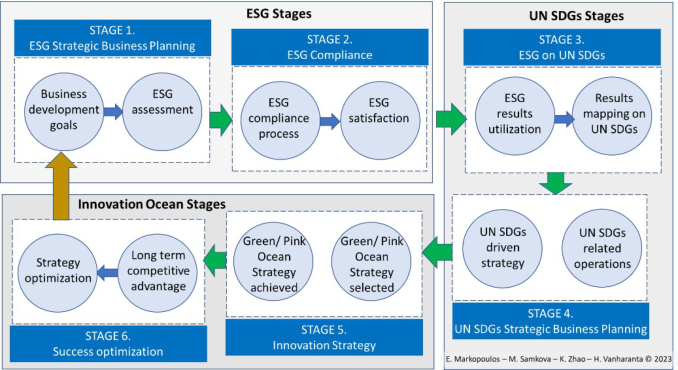
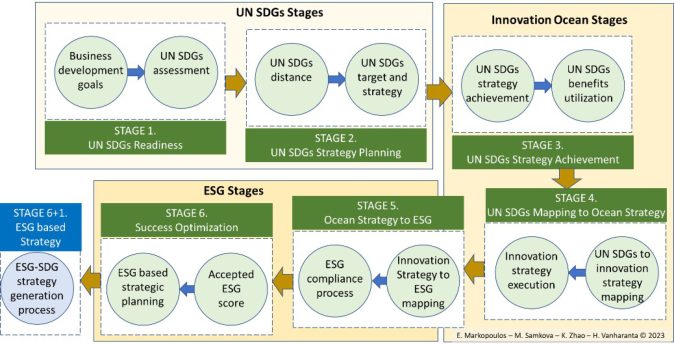
However, since organizations need to be financially sustainable before con- tributing to society and the environment, a strong ESG score must proceed with the adaptation of any SDG, which might have been partially adopted depending on the degree of ESG compliance. Figure 4 presents an ESG-SDG strategy generation process composed of 6 stages.
The first stage is the identification of the organization’s business develo- pment goals and how a good ESG score can contribute to the development of those goals but also in the leadership, management, and operations.
The second stage assesses the results of the first stage and extends the ESG criteria compliance effort to build on the success gained or to correct the ESG compliance process in case the score is not satisfactory.
Having an ESG score that secures organizational competence, profitability, and social awareness, the organization can evaluate its strategy to identify the SDGs that are more related to its operations. This can be achieved with the ESG-SDGs mapping process.
The results are based on the degree to which the ESG activities of the orga- nization cover one or more SDGs. The SDGs that are mostly covered with the organizational operations will be the ones that will lead the organization’s efforts to align with the UN 2030 Sustainable Development Agenda.
ESG and UN SDGs Driven Strategy Generation Process for Green and Pink Oceans 17
Figure 4: The ESG-SDG strategy generation process.Figure 5: The reversed ESG-SDG strategy generation process.
Having identified the SDGs, the organization can map them against the green and pink ocean strategies to identify the most suitable strategy to follow and direct its innovation efforts toward reaching a green or a pink ocean.
The achievement of a green or a pink ocean secures organizational long- term competitive advantage and enhances compliance with the ESG requi- rements resulting in a higher ESG score from the impact its Pink or Green innovation has on society or the environment.
Based on the type of organization and its broader strategy the methodo- logy can be applied reversive, starting from the UN SDGs instead of the ESG (Figure 5). If an ESG score is not the prime goal of an organization then the assessment of the organization’s existing process can start from their distance to the SDGs.
Identifying the SDGs closer to the way an organization operates can help the organization develop the needed processes to reduce this distance and achieve closer alignment with one or more SDGs.
Such an alignment will result in reputational benefits that can encourage efforts and investments toward reaching a green or pink ocean. Investors and benefactors can contribute to organizations with pink or green ocean strategies especially if they are aligned with one or more UN SDGs.
The achievement of such an ocean can help the organization develop inter- national activities and strategic partnerships leading them to further success. In this case alignment with the ESG criteria is needed to maintain this success and reinvent itself with a new ESG-SDGS-driven strategy towards new green and pink oceans.
Therefore, the proposed methodology cannot be considered a privilege for large-scale organizations, but a development vehicle for smaller ones to be developed and grow by respecting first the environment and human dignity, than the ESG requirements which are not possible to be met without the size of the critical operations.
SOCIO-ECONOMIC IMPACT The proposed methodological approach can be adopted by any organization of any size, industry, or sector. Public organizations can also use the method to indicate social and sustainable awareness although an ESG score might not be within their wider organizational strategy (Nripendra et al., 2014). The same applies to SMEs and Non-governmental organizations where both have a significant role in the development of the local and regional society. Being aligned with the UN Sustainable development goals is the minimum contribution an organization can make to the environment and society. Ada- pting the proposed methodology collectively, by professional unions, industry associations, and federations a movement can be created, strong enough to redefine the operations mode and goals of any type of organization in any economy and society.
LIMITATIONS AND AREAS OF FURTHER RESEARCH The success of the green and pink ocean strategy ultimately depends on the return on their investment in environmental and social values. This requi- res social awareness and cognition about the Green and Social values these oceans are all about. Organizations that reach such oceans receive public awareness, recognition, and acceptance. Public support helps organizational promotion, increases sales, creates brands, and attracts talent to further deve- lop their successful strategies. (Eisenberger et al., 1986). It also incentivizes the government to promote favorable policies for organizations that adopt green and pink ocean strategies.
The proposed methodology also requires a democratic and non- hierarchical organizational culture to be in place. The Company Democratic Model, or other similar models, can be used to encourage innovation, co-opetition, knowledge, and wisdom generation.
Organizations that intend to adopt the proposed model must ensure the financial sustainability needed to explore their journey towards pink or green innovation oceans. This is a time-consuming transformation that impacts the
ESG and UN SDGs Driven Strategy Generation Process for Green and Pink Oceans 19
productivity and funding of the organizations. Space for democracy can be expensive (Markopoulos and Vanharanta, 2016) especially if a democratic organizational culture is absent.
These limitations shall not be seen as strategy obstacles but as pre and post-conditions to adopt the method effectively and successfully. They also outline the areas for further research to be conducted toward resolving such challenges.
CONCLUSION
Since all organizations claim respect to society and the environment several opportunities are available to prove this and receive social recognition that can significantly impact their development and growth (Jones, and González- Cruz, 2017).
The UN 2030 sustainable development agenda and the UN Sustainable Development Goals provide a framework and tools for all types of organi- zations to prove their social and environmental sensitivity. Furthermore, the ESG index is a rewarding mechanism for those targeting, ethical, social, and sustainable-based organizational strategies. The Pink and Green Oceans stra- tegies contribute as well towards this direction by extending the Blue Ocean strategy with social and sustainable-driven innovations.
Therefore frameworks, tools, and practices are available resources to be used constructively and rewardingly. The methodology proposed in this rese- arch attempts to synchronize the available resources and opportunities and help build organizational strategies, based on the UN 2030 sustainable deve- lopment agenda and the ESG index, by those who want, and can, make the world a better place for all.
REFERENCES
Altuna, N., Contri, A. M., Dell’Era, C., Frattini, F.and Maccarrone, P. (2015), “Managing social innovation in for-profit organizations: the case of Intesa Sanpa- olo”, European Journal of Innovation Management, Vol. 18 No. 2, pp. 258–280. Chan, K. W., & Mauborgne, R. A. (2005). Blue ocean strategy. Harvard Business
Review Press. Gandellini G. and Venanz D (2011). Purple Ocean Strategy: How To Support SMEs’ Recovery. Procedia - Social and Behavioral Sciences. Volume 24, 2011, Pages 1–15. Eisenberger, R., Huntington, R., Hutchison, S., & Sowa, D. (1986). Percei-
ved organizational support. Journal of Applied Psychology, 71(3), 500–507. https://doi.org/10.1037/0021-9010.71.3.500 Jones, P.and González-Cruz, T. F. (2017), “Seeking recognition and growth”, International Journal of Entrepreneurial Behavior & Research, Vol. 23 No. 6, pp. 846–849. https://doi.org/10.1108/IJEBR-10-2017-410 Markopoulos E., Kirane I. S., Gann E. L., Vanharanta H. (2020a) A Demo-
cratic, Green Ocean Management Framework for Environmental, Social and Governance (ESG) Compliance. In: Ahram T., Taiar R., Gremeaux-Bader V., Aminian K. (eds) Human Interaction, Emerging Technologies and Future Applications II. IHIET 2020. Advances in Intelligent Systems and Computing. pp. 21–33, vol. 1152. Springer, Cham.
Markopoulos, E., Ramonda, M. B., Winter, L. M., Vanharanta, H., & Al Katheeri, H. (2020b). Pink Ocean Strategy: Democratizing Business Knowledge for Social Growth and Innovation. In: Markopoulos E., Goonetilleke R., Ho A., Luximon Y. (eds) Advances in Creativity, Innovation, Entrepreneurship and Communica- tion of Design. AHFE 2020. Advances in Intelligent Systems and Computing, pp. 39–51, vol. 1218. Springer, Cham. Markopoulos, E., Kirane, I., Piper, C., & Vanharanta, H. (2020c). Green Ocean Stra-
tegy: Democratizing Business Knowledge for Sustainable Growth. In: Ahram T., Karwowski W., Pickl S., Taiar R. (eds) Human Systems Engineering and Design II. IHSED 2019. Advances in Intelligent Systems and Computing, chapter 20, pp. 115–125. vol. 1026. Springer, Cham. Markopoulos E., Vanharanta H. (2017) Space for Company Democracy. In: Kantola J., Barath T., Nazir S., Andre T. (eds) Advances in Human Factors, Business Mana- gement, Training and Education. Advances in Intelligent Systems and Computing, vol. 498. 275–287. Springer, Cham, Markopoulos E. and Vanharanta H. (2015). ‘Company Democracy Model for Deve-
lopment of Shared Value’, Elsevier, Procedia Manufacturing, Volume 3, Pages 603–610. Markopoulos E., and Vanharanta H. (2014). ‘Democratic Culture Paradigm for Organizational Management and Leadership Strategies - The Company Demo- cracy Model.’ In: Charytonowicz J. (ed) Advances in Human Factors and Sustai- nable Infrastructure. 5th International Conference on Applied Human Factors and Ergonomics. vol. 20. pp. 190–201 (2014). Nripendra P. Rana, Vishanth Weerakkody, Yogesh K. Dwivedi & Niall C. Pie-
rcy (2014) Profiling Existing Research on Social Innovation in the Public Sector, Information Systems Management, 31:3, 259–273. US/SIF (2018). Sustainable investing assets reach $12 trillion as reported by the US SIF Foundation’s biennial Report on US Sustainable, Responsible and Impact Investing Trends. UN (2023a). Business as a Force for Good. United Nations Global Impact. UN
Website, https://www.unglobalcompact.org/what-is-gc/mission UN (2023b). Build resilient infrastructure, promote inclusive and sustainable industrialization and foster innovation. UN Website. https://unstats.un.org/sdgs/repo rt/2020/goal-09/
LISTED IN THE AHFE DIGITAL BOOKSTORE CATALOGUE
Explore the complete digital volume
Human Factors, Business Management and Society
Read this individual research paper free through the original publisher, or explore the full digital proceedings book.
ISBN 978-1-958651-73-5
Explore this ISBN in the AHFE Bookstore ↗Listed in the July 2026 bookstore catalogue; search by ISBN to confirm current availability · Digital book purchase optional