Vikash Madduri, Alika Vandtke, Yolanda Martinez, Margus Mägi, Nele Leosk, Nico Lueck, Sherman Kong (2023). Legal Readiness for Open Source Software Adoption in Public Sector. In: Human Factors, Business Management and Society. AHFE Open Access, vol. 97, pp. 135–142. https://doi.org/10.54941/ahfe1003890
The importance of Open-Source Software (OSS) is growing vehemently in the public sector. OSS has a key role in governments’ digital transformation towards achieving Sustainable Development Goals (SDGs) as it reduces the Total Cost of Ownership (TCO), provides the opportunities of economies of scale and economies of scope, and promotes digital infrastructure by adopting Open Stack technology capabilities. However, the OSS adoption readiness has been measured on the basis of technology, organizations, and economic prerequisites, as of now. The current paper reviews the existing literature and suggests most critical factors from the perspectives of legislation, governance, and policy so that the governments which are traversing towards digital transformation can adopt them for social good.
Open-source software (OSS) is referred to as free and open collaborative software, which can be used, implemented, and changed for any purpose. Today, OSS can be found in many governmental policies, initiatives, and digital masterplans. For example, digital public goods (DPGs), and interna- tional collaborations such as GovStack, are the flag bearers of the adoption of OSS solutions in digital government transformation by the world nati- ons to achieve the Sustainable Development Goals (SDGs). The public sector strives to adopt OSS to release themselves from proprietary owned, vendor-locked software to enhance digital autonomy, cost-efficiency and introduce more thorough transparency. To adhere to the OSS approach,
governments have to adjust and examine the level of regulations, infrastru- cture, potential legacy system exit costs, availability of expert consultants, procurement and acquisition decisions, and maturity of software support (Shaikh, 2016).
OSS adoption readiness has been evaluated chiefly based on technological, organizational, and economic prerequisites (Sánchez et al., 2020). The tech- nological prerequisites tend to include compatibility, reliability, and usability (Ibid). The complete switch to a whole OSS approach in the organization during the first phase is highly unlikely; therefore, there is a need to deter- mine if the chosen OSS solution will be compatible with proprietary solutions which are already in place (Sowinska et al., 2021). The organizational prere- quisites consist of support, training, and attitude towards change, among others (Sánchez et al., 2020). Training and attitude towards change have a strong correlation with each other, as the first one, in case of a correct delivery, may enhance the attitude towards change and eliminate adverse outcomes (Sowinska et al., 2021). Lastly, economic prerequisites include the total cost of ownership, operational cost, and support (Sánchez et al., 2020). Studies suggest that cost-efficient licensing cost is often one of the main factors for adopting full OSS infrastructure, which still, however, does require sustainable funding and technical support throughout the full OSS lifecycle (Sowinska et al., 2021).
As per the literature review above, one of the main barriers to OSS ado- ption is the lack of explicit guiding materials and a unified list of accessible prerequisites. In this paper, authors have explored the existing legal prere- quisites facilitating OSS policies, regulations in many countries and advise the most critical factors for OSS general regulation. The derived recom- mendations will be used to formulate a sample regulation that can guide countries’ OSS adoption. The authors anticipate that the expected outcome will be helpful in recommending OSS adoption while developing digital public goods, implementing the GovStack approach based digital government transformation.
OPEN SOURCE SOLUTIONS AND SUSTAINABLE DEVELOPMENT GOALS (SDGS) Most governments are making rapid strides in accelerating the slow rate of achievement of SDGs through digital transformation strategies. UN has noticed the key features of OSS i.e., Sharing, Contributing, Empowering, Sustainability, Security and Decentralization (Karlitschek, 2019), that would play a key role in lowering the digital infrastructure investment costs for the governments. UNCTAD also observes the benefits of the open sou- rce in public sectors i.e. (i) lower costs and improve local value creation, (ii) promotion of local learning with universal information and communica- tion technology (ICT) access, (iii) less dependence on specific technologies or vendors (e.g., no lock-in), (iv) easy adaption to meet local needs with customi- zability to local languages and cultures, and (v) addresses concerns of national security and long-term availability (UNCTAD, 2012).
Legal Readiness for Open Source Software Adoption in Public Sector 137
It has promoted the use of OSS for addressing SDGs through vari- ous initiatives such as Open-source appropriate technology (OSAT) and The United Nations Technological Innovation Lab (UNTIL). OSAT is an appropriate technology that contributes to the achievement of sustainable development goals (SDGs) while being designed in ways synonymous with free and open-source software (FOSS) and free and open-source hardware (FOSH) (UNCTAD, 2021). For example, an open-source software applica- tion “ImageJ” is developed to examine the microscopic organism, remote sensing work by aerial drones, interim helpful in achieving the targets under SDG15. The Appropedia1 Foundation is hosting collaborative solutions for achieving the SDGs (Pearce, 2012), which have profound impact on many SDGs. UNTIL has developed the OS Strategy and Policy and suggests that OSS should have no dual licensing, open core, proprietary extensions, and limited access models so that everyone has the same access and capabilities.
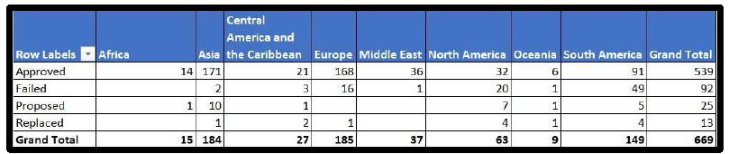
The Current Status of OSS Policies in the World Countries have understood the importance of OSS and have issued various forms of legislations, strategies, and directives since 1999. It is observed that there is a growing increase in the number of policies2 from 354 in 2010 (Lewis, 2010) to 669 policies in 2022 (Eugenia Lostri, 2022). These have been prepared and issued at national, state, local level governments and have different statuses such as ‘Approved’, ‘Proposed’ and ‘Failed’.
The below diagram indicates regional-wise break-up for the OSS policies, as of 2022.
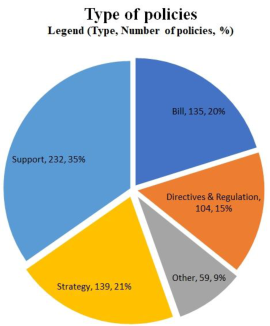
As we see in Figure-2, there were a total of 35% support documents, 21% strategy documents, 20% bills, and 15% directives and regulations, out of these 669 policy documents.
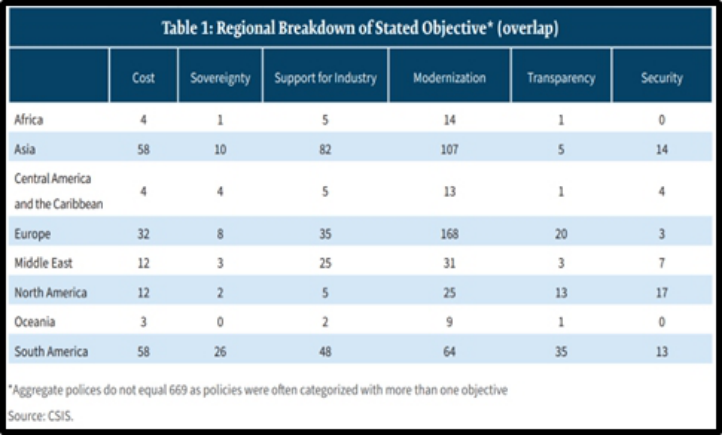
The Figure-3 indicates the region-wise break-up of the stated objectives of OSS policies. The analysis also informs us that the chief stated objectives of the OSS policies are cost, sovereignty, support for industry, modernization, transparency, and security (Eugenia Lostri, 2022).
The paper continues to explore the main reason why the governments sou- ght to promote OSS, for each of the above-specified objectives. Digitization, eGovernment, Interoperability, capacity building/training, and awareness, 1www.appropedia.org 2The term “policy” has the broad coverage of regulations, bills/laws, strategy documents in this article. 3The CSIS website has shared the open data excel sheet and the authors of this article has prepared the above Figure-1.
Figure 2: Types of OSS policies4 (Eugenia Lostri, 2022).Figure 3: Regional wise break-up of the stated objectives of OSS policies (Eugenia Lostri, 2022).
are the keywords under the “Modernization” category. Cost savings/opti- mization, bringing transparency, technology sovereignty and security are the important reasons for promoting the use of OSS.
Research Gap for Laying the Foundations of Legal Prerequisites While the current literature provides a strong base for the promotion of OSS, it is not very clear how this knowledge is expected to be aligned w.r.t digital transformation and achieving SDGs, in the backdrop of GovStack initiative.
4The CSIS website has shared the open data excel sheet and the author of this article has prepared the above Figure-2.
Legal Readiness for Open Source Software Adoption in Public Sector 139
Towards addressing this concern, the authors have chosen the nations listed in Table 1, using a random sampling technique and collected the data to understand the existing regulatory set-up, compare the OSS maturity levels of GovStack’s participating countries, evaluate the most important factors for OSS general regulation and propose the finalized research outcomes for the public sector’s use. The expected outcome will be effective while adopting the OSS and drafting the OSS-related strategies, thus harnessing the digital transformation. It is important to mention that documents in the English language are only referred for this study.
Key Recommendations The following recommendations are greatly useful for the countries who are going to adopt the GovStack approach in their digital government tran- sformation. It is pertinent to mention that some of the parameters such as capacity building, quality control, do come under the preview of Governance but not under the legal ambit. However, the authors suggest having a holistic approach in establishing a facilitating ecosystem. Therefore, the legislation division is assured of the governance division’s readiness.
1. Overarching Legislation
There shall be accommodating/overarching legislation for the electronic records, data protection, and privacy in the nation. This helps clarify the issues between OSS and Non-OSS data related legal, execution related issues. The Information Technology Act (2000, 2008) by the Government of India, and The Electronic Government Act 2008 by Bulgaria, are a few exam- ples. Further, reusable software components can come under the legal ambit. Ownership, Intellectual Property rights related issues may also be addres- sed. A mechanism for dispute resolution and grievance redressal must be provisioned.
2. Economy and OSS
Mandatory procurement policies have the highest policy rate failures (Eugenia Lostri, 2023). The public procurement policy should find the root
Table 1. List of countries and their policy documents.
Table available in the original PDF paper.
Country Open-source software regulation/policy Bulgaria The Electronic Governance Act (article 58a) Canada Directive on Management of Information Technology, Annex C EU Open Source Software Strategy 2020 – 2023 India Policy on Adoption of Open Source Software for the Government of India Italy Guidelines on the acquisition and reuse of software for public administrations New Zealand NZGOAL Software Extension Policy Singapore Digital Government Blueprint UK UK Government Licensing Framework, Open Software Licences; Open Standards Principles USA Securing Open Source Software Act
cause and see how the policy can become successful, economically. The insti- tutions shall also focus on market creation; and provide support for industry, modernization (digitization, interoperability) of governments, and transpa- rency (on government’s procurement). Where relevant, the economic vitality shall be oriented towards the public good since OSS is an integral part of digital infrastructure and is expected to reduce the Total Cost of Ownership (TCO) of public projects. Further, the OSS must be royalty-free, mandatory, and reusable.
3. OSS and SDGs (Particularly for Developing, Low-Income Nations)
The OSS strategies might consider looking at the UN initiatives such as OSAT, UNTIL; and leverage the best advantages of them. This will avoid the initial cost of investment, time delays. Further, it is also important to see how re-usability can achieve the SDG 17.14 “Policy Coherence for Sustainable Development”. The countries shall identify the common areas (such as cross-border services); conceptualize and implement “Technology Transfer”programs. Sustainability (green procurement; re-usability of softw- are components) shall be ensured. For example, the technological capabilities in the GovStack initiative have been developed by using OSS, to the extent of the highest feasibility.
4. Institutions
There shall be an institutional set-up and leadership team to direct the opera- tions i.e., policy framework conceptualization, implementation, monitoring, related to OSS. The existing institutions (Director of the Cyber Security and Infrastructure Security Agency, as in the case of the USA), may undertake these operations.
5. OSS and Public Policy
The policy conceptualization shall involve key stakeholders including active open communities, citizens, public and private sectors. The policy shall reflect the legal, political (digital sovereignty), socio-economic context and techno- logy maturity of a nation. Industrial competitiveness, economics of OSS shall be considered. It is equally important to align the OSS policies w.r.t national level Digital Transformation or SDG plans.
6. Emphasis on Security
The OSS policies shall be inclusive of cyber security and information security. The compatibility, local language, usability shall be ensured.
7. Quality Control
The quality of the OSS shall be assessed. The standards shall support interoperability, data exchange (Govt of UK, 2018) and other digital tran- sformation features.
8. Research, Development, and Innovation
The institution shall focus on performing R&D activities, particularly on developing OSS or Open Stacks of emerging information and communication
Legal Readiness for Open Source Software Adoption in Public Sector 141
technologies such as Artificial Intelligence, Internet of Things, Blockchain, Quantum computing; evolution of Open Source Hardware (OSH), Open Data Formats and so on. Also, Open Coding, Bug Bounty events shall be conducted to promote the awareness of the OSS. Students, private sector, academic research communities may identify to leverage the advantages of both OSS and Open Data. For example, how OSS (Machine Learning Algorithms) can identify the patterns in open data sets (health) and offer suggestions to the Department/Ministry of Health on a disease pattern. Entrepreneurship shall be encouraged. It is also important to see how the OSS research and innovation is aligned w.r.t Science and Technology policy of the country.
9. Human Capital Development
A Skill Development centre shall be established, and sufficient funding must be ensured for fulfilling its objectives. The centre must focus on building the capacities, increasing the digital competitiveness of public administration, small and medium scale enterprises (SMEs) and key stakeholders including citizens (to reduce the digital divide). The topics can be inclusive of public procurement, OSS advantages, digital infrastructure, scaling, Intellectual Property Rights, Open communities, security. Communities of Practice (CoP) or Knowledge Management systems may be created for exchanging knowledge, technologies within a nation or among nations.
CONCLUSION
The journey of OSS legislation will continue and will experience diverse approaches and angles towards the ways of potential regulation within the public sector. Based on the researched materials, it is a fact that OSS will continue to be an irreplaceable part of public sector policies and govern- ments’ strategies which strive to implement digital transformation into daily function. The authors suggest nine key recommendations while conceptuali- zing OSS legislation by a country. Countries adopting the digital transforma- tion through GovStack approach are recommended to undertake the above nine key recommendations into consideration and test mentioned policies approaches adapting them to their own distinctive needs.
ACKNOWLEDGMENT
The results of this research were supported by the Government of Germany through GIZ (Deutsche Gesellschaft für Internationale Zusammenarbeit), the Estonian government, Digital Impact Alliance (DIAL), were supported by the International Telecommunication Union (ITU), the Estonian government.
REFERENCES
Eugenia Lostri, G. W., 2022. Government Open Source Software Policies. Eugenia Lostri, G. W., 2023. Government’s role in promoting open source software, Washington DC: Center for Strategic and International Studies.
European Commission, 2021. The impact of Open Source Software and Hardware on technological independence, competitiveness and innovation in the EU eco- nomy, Luxembourg: European Commission. Govt of UK, 2018. Open Standards Principles, London: Govt of UK. Karlitschek, F., 2019. 6 remarkable features of the new United Nations open source
initiative. Lewis, J. A., 2010. Government Open Source Policies, Washington DC: Center for Strategic International Studies. M Sowinska, B. K. M. V. D. C. D., 2021. Guidelines for Sustainable Open Source
Communities in the Public Sector: 5 key lessons Practical guidelines for public sector representatives on how to join or establish and maintain sustainable open source communities. Pearce, J. M., 2012. The case for open source appropriate technology. Environ Dev Sustain, pp. 425–431. Shaikh, M., 2016. Negotiating open source software adoption in the UK public
sector. UNCTAD, 2012. Information Economy Report, Geneva: United Nations. UNCTAD, 2021. Note on a proposed UN Centralised Database of Open Source Appropriate Technologies, Geneva: UNCTAD. VR Sánchez, P. A. J. E. B., 2020. Open source adoption factors - A systematic
literature review.
LISTED IN THE AHFE DIGITAL BOOKSTORE CATALOGUE
Explore the complete digital volume
Human Factors, Business Management and Society
Read this individual research paper free through the original publisher, or explore the full digital proceedings book.
ISBN 978-1-958651-73-5
Explore this ISBN in the AHFE Bookstore ↗Listed in the July 2026 bookstore catalogue; search by ISBN to confirm current availability · Digital book purchase optional