Josephine Lusi, Yolanda Martinez, Ingrid Pappel (2024). Empowering Women in the Public Sector: A Challenge-Based Learning Approach to Achieving Gender Equity. In: Human Factors, Business Management and Society. AHFE Open Access, vol. 135, pp. 122–130. https://doi.org/10.54941/ahfe1004937
The public sector is under increasing pressure to deliver efficient citizen-centric services, accentuating the significance of innovative GovTech solutions. Gender disparities, however, persist in the public sector, more so in leadership positions, impeding women's capacity to co-design and implement inclusive public services. To address this imbalance, the GovStack Initiative launched the "Women in GovTech Challenge", a pioneering program aimed at supporting a more diverse and inclusive GovTech ecosystem. Drawing on relevant literature, this paper investigates the necessity for the "Women in GovTech Challenge" program. The analysis delves into the theoretical foundations that shaped the program's six-stage development and novel design, with its emphasis on moulding digital transformation leaders through mentorship-enriched, challenge-based learning experiences. The study acknowledges the need for further research, particularly on how to expand the program beyond the pilot, how to sustain it in the future, and the program's influence on participants' professional development and the broader GovTech ecosystem.
The digital age has brought a new form of inequality. While digital tech- nologies have the potential to promote equitable access and social inclusion, achieving digital inclusion remains an illusion due to women’s underrepre- sentation in leadership positions. According to The World Economic Forum (WEF), in 2023, women made up 41.9% of the workforce, yet they only occupied 25% of C-Suite positions (WEF, 2023).
Gender gaps persist in leadership positions in both the private and pub- lic sectors. In the public sector, women make up only 40.8% of leadership positions despite representing 58.9% of the public workforce (OECD, 2023). Moreover, only 11% of government Chief Information Officers (CIOs) worldwide are women (World Bank, 2023). Gender inequality in the pub- lic sector has far-reaching implications, including limited diverse perspectives which can stymie innovation (van Acker et al., 2018), biased decision-making
Empowering Women in the Public Sector: A Challenge-Based Learning Approach 123
in policy formulation and service provision (Macarie & Moldovan, 2014; Munive et al., 2023), and negative economic impacts (U.N. Women, 2022) which impede the attainment of equitable outcomes.
Gender equality is a fundamental aspect of sustainable development, and public institutions play a critical responsibility in narrowing the gender gap to ensure inclusivity. One potential avenue for addressing the gender gap is investing in proactive capacity-building programs designed explicitly for the underrepresented genders. However, there can be several challenges in developing and implementing such programs. For instance, formal learn- ing opportunities are often limited, and countries face resource constraints (U.N., 2022), thus; limiting their capacity to invest in such targeted learning programs. Therefore, collective action is required from diverse stakeholders, including private sector entities, international organisations and the civil soci- ety. Such collaborations, also known as global partnerships, provide powerful mechanisms that facilitate digital skills acquisition and knowledge sharing (U.N., 2015), as well as addressing frequently under-represented and cross- cutting sustainability goals such as gender equality (SDG 5) (Glass et al., 2023). This paper introduces the “Women in GovTech training program”, initiated by one such partnership: the GovStack Initiative. The paper adopts the definition of GovTech provided by Dener et. al. (2021) as “a whole-of- government approach to public sector modernisation that promotes simple, efficient and transparent government with the citizen at the centre of the reforms.” This paper serves as an introduction to the critical role that global partnerships play in mitigating the gender digital divide in the public sector through targeted capacity-building initiatives. It introduces a novel method- ology that combines Challenge-Based Learning (CBL) with mentorship to accelerate learning and knowledge sharing.
KNOWLEDGE SHARING IN THE PUBLIC SECTOR A critical challenge facing the public sector GovTech landscape is the unequal access to knowledge sharing opportunities for women. This disparity is com- pounded by factors such as entrenched bureaucratic structures (Johns et al., 2023), gender bias in knowledge sharing, cultural barriers, and limited train- ing opportunities (U.N. Women, 2022). These factors exacerbate the digital competency gap, further disadvantaging women who often start with a lower baseline in digital skills compared to men.
Closing the gender gap in knowledge access is critical for a thriving Gov- Tech landscape. Inclusive digital ecosystems rely heavily on strong digital lit- eracy and knowledge sharing (Broadband Commission for Sustainable Devel- opment, 2022). Lee et al. (2010) emphasize that leadership directly influences how employees share knowledge. Leaders with strong digital competencies, such as artificial intelligence (AI) and technological literacy, can effectively mentor and influence their teams to develop new skills (Lee et al., 2010). By fostering knowledge sharing, these leaders create a collaborative environ- ment that promotes innovation, informed decision-making, and a continuous learning culture for everyone.
Gender Gaps in the Skills of the Future The digital divide poses a significant barrier to bridging the future skills gap in the public sector. While digital learning platforms offer inclusivity, diversity, and equity in learning opportunities, unequal access to these platforms limits their effectiveness (WEF, 2023). The divide is partly attributed to the fact that more men than women own mobile devices (U.N. Women, 2022). Further- more, women’s participation in technical fields such as AI and big data lags behind that of men, as evidenced by lower enrolment rates on online learning platforms (Coursera (2022) as cited in WEF, 2023). The gap in proficiency between genders widens as skill levels become more advanced, suggesting women may lack the resources or support needed to achieve higher profi- ciency. This widening skill gap may translate into fewer women reaching top leadership positions within GovTech. To bridge this gap, solutions beyond mere access are needed. Learning and mentorship initiatives that address con- fidence building and provide targeted support for female learners in these technical fields are crucial.
Challenge-Based Learning as an Innovative Learning Framework The ever-growing demand for digital skills and capabilities in the public workforce highlights the need to reevaluate and align educational approaches to reflect the evolving demands of modern society. Challenge-Based Learning (CBL) emerges as a promising pedagogical approach for empowering learn- ers, especially in Science, Technology, Engineering and Mathematics (STEM) related roles (Taconis & Bekker, 2023), as there is high potential for societal impact after learning (Kohn et al., 2020; Loohuis, & Chapel, 2021).
Unlike traditional teacher-centred learning methods, CBL immerses stu- dents in real-world problem-solving scenarios that necessitate critical think- ing, innovation and creativity, collaboration, and technological competency (Gallagher & Savage, 2023). By allowing learners to define and solve the identified problems, CBL boosts skill-based and conceptual understanding. Thus, in contrast to traditional teaching techniques, this dynamic learning process encourages critical thinking which can potentially lead to a more enriching and authentic experiences for learners (Taconis & Bekker, 2023).
Mentorship as a Supportive Approach for CBL Mentorship programs are important for career development in the public sec- tor (Mcilongo & Strydom, 2021). Mentorship programs bridge the skills gap by fostering the transfer of expertise and practical knowledge from mentors to mentees (Ragins, 2012). This, in turn, enhances individual capabilities and strengthens the overall skills development of the public sector work- force. Mentors also offer invaluable insights from their own experiences, providing mentees’ with advice on how to navigate professional challenges (Mcilongo & Strydom, 2021). This holistic support strengthens career foun- dations and positions employees, regardless of gender, for leadership roles (Olsen & LaGree, 2023).
Empowering Women in the Public Sector: A Challenge-Based Learning Approach 125
In GovTech, mentorship programs can be strategic interventions to foster a diverse and inclusive workforce that dismantle systemic barriers. Recogniz- ing the importance of cultivating leaders within the public sector (Bozeman & Feeney, 2009), organizations should therefore create supportive environ- ments that encourage both formal and informal mentorship relationships. This fosters a more inclusive and fulfilling workplace culture, which is likely to contribute to retention of talented employees within the public workforce.
THE WOMEN IN GOVTECH TRAINING PROGRAMME GovStack Initiative, a global multi-stakeholder collaboration, prioritizes dig- ital upskilling as a core pillar for accelerating the digital transformation of government services worldwide. The “Women in GovTech Challenge” pro- gram emerged from a strong foundation built on research and identified skills gap from the partner countries. Firstly, a comprehensive literature review identified core digital capacities, and relevant competence and qualification frameworks (Pappel et al., 2023). The program’s structure also considered the “Artificial Intelligence and Digital Transformation Competencies for Civil Servants Report (2022)” and GovStack’s research team’s expertise. To pin- point specific knowledge gaps, the program conducted a collaborative needs assessment with countries involved with GovStack since its inception. Part- nering with digital learning platforms like Coursera and Atingi provided participants with access to complementary learning resources, addressing the identified knowledge gaps.
The curriculum was developed with a leading expert from Tallinn University of Technology (TalTech), a renowned institution in educating digital transformation leaders. Their well-regarded master’s program in e-Governance, offered since 2013 (Pappel et al., 2017; Labanava et al., 2023), serves as a testament to their expertise in the e-governance domain.
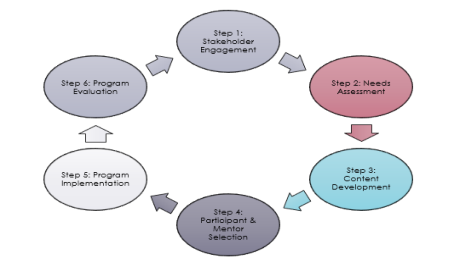
The program’s development and implementation followed a six-step process, as detailed in Figure 1 below.
Figure 1: The development of the women in GovTech programme.
The Challenge lasted eight weeks (October 2023-March 2024) with an intermediary four-week break. Three networking workshops were held dur- ing the program (October 2023-February 2024). These workshops featured
round-table discussions in which prominent female leaders in the Gov- Tech domain shared their experiences and provided valuable insights and mentorship to the participants.
At the end of the challenge, the three best teams will would get an oppor- tunity to showcase the team’s prototype at the World Summit on Information Society (WSIS) 2024.
Pedagogy and Structure of the Programme The CBL approach employed in this online learning program enabled the participants to contextualise their learning experiences (Kohn et al., 2020). Furthermore, real-life simulations using the GovStack Sandbox comple- mented the training content, prompting critical reflection on present issues and showcasing how the fundamental Building Blocks (B.B.s) function in an actual-world context. This approach was designed to provide stimu- lating and challenging content that would help develop the critical think- ing and problem-solving skills essential for leading digital transformation projects. Following each session, participants were able to access Power- Point presentations and lecture recordings to reinforce their exposure to new knowledge.
The curriculum, comprising eight modules, addressed both the structural challenges and knowledge gaps hindering public sector digital transforma- tion. The curriculum specifically focused on advancing knowledge of the critical BBs of digital transformation, as well as addressing the critical aspects of change management and leadership within public sector organizations. The programme was structured as shown in Table 1 below:
Table 1. Program structure.
Table available in the original PDF paper.
Week Learning Objectives Week 1 Introduction to GovStack’s Building Blocks and Core Concepts. Week 2 Digital Service Design and Prototyping. Week 3 Service architecture, non-functional requirements, and security requirements. Week 4 Information Mediator BB and cross-border services. Week 5 Digital Identity and Security BB Week 6 Payments B.B. Week 7 Change management. Week 8 Leadership development.
Each week, participants attended lectures and completed group exercises designed to promote asynchronous learning, informal interactions, and group collaboration (Colombari et al., 2021). These exercises served as practical applications of the newly acquired knowledge, culminating in the co-design of a prototype addressing a digital societal issue in the chosen country. The emphasis was on redesigning or designing a new user-centred digital gov- ernment service that would be more accessible to the country’s citizens and residents alike.
Empowering Women in the Public Sector: A Challenge-Based Learning Approach 127
Participant & Mentor Selection To create a diverse and impactful learning experience, the first cohort for the “Women in GovTech Challenge” implemented a rigorous selection pro- cess for both participants and mentors. Candidates for the participant pool underwent a selection process guided by the criteria presented in Table 2 below.
Table 2. Participant selection criteria.
Table available in the original PDF paper.
Criteria Description Experience Experience working in the public sector or multi-stakeholder organisations focusing on digital transformation Service Proposal Compelling use case submission demonstrating their commitment to spearheading change in their government digital teams. Language Comfortable working in the English language
Following a rigorous selection process, 106 participants from five con- tinents were selected, forming 20 teams, different regions and with varied technical backgrounds. Each team consisted of 4–6 individuals, with at least one member possessing strong I.T. expertise. Table 3 below details the geographical distribution of the selected participants.
Table 3. Number of selected applicants by region.
Table available in the original PDF paper.
Region Number of Participants Asia 47 Africa 29 Europe 9 North America 8 South America 13 TOTAL 106
Similarly, 40 mentors were carefully chosen based on the criteria outlined in Table 4 below. This meticulous selection ensured that mentors had the expertise and experience to guide and support participants effectively.
Table 4. Mentor selection criteria.
Table available in the original PDF paper.
Criteria Description Experience Experience working in the public or private sector, and currently working at senior levels in GovTech. Skills Prior mentoring experience Language Comfortable working in the English language
DISCUSSION
The program’s development process offered valuable insights into the com- prehensive planning, research, and resource allocation (both financial and expert knowledge) required to curate timely and impactful programs such as the GovStack “Women in GovTech Challenge”. In addition to the insights gained, it’s important to acknowledge that the program faced its fair share of challenges. Firstly, launching a program of this magnitude on a global scale within the defined timeframe required meticulous planning and rigorous coordination. Secondly, selecting a diverse and qualified pool of partici- pants and mentors adhering to the established criteria (outlined in Table 2 and Table 4, respectively) proved to be a challenging process. The program drew a large number of eligible applicants, especially from the private sector. However, due to the emphasis on the need to upskill female public sector employees and the limited participant capacity, only a limited number of participants could be accepted. Therefore, for the second cohort, the pro- gram intends to widen the applicant pool to include participants from the private sector. This broader approach acknowledges the critical role that both public and private sector employees in GovTech play in driving digital trans- formation within their respective countries and across the global ecosystem. Similarly, identifying suitable mentors was a challenge. GovTech is a rela- tively new field, so there was a limited pool of experienced candidates who could guide the participants. One potential workaround for future iterations is to incorporate participants from the inaugural cohort to serve as mentors in the subsequent cohorts.
Despite these initial hurdles, the pilot program’s approach showed promis- ing potential. Knowledge sharing is crucial in addressing the gender gap in public sector leadership and building inclusive and sustainable digital ecosystems, and the program successfully created a global knowledge-sharing ecosystem. Moving forward, the valuable insights gleaned from both the participants and mentors will be instrumental in redesigning the learning experience for subsequent cohorts. Furthermore, the positive response to the program’s launch fuels optimism for its future impact.
CONCLUSION
In conclusion, this paper stresses the necessity of designing and implementing authentic learning experiences that catalyse learning and knowledge sharing and nurture the growth of future leaders of digital transformation. As prior studies have highlighted, CBL is an impactful learning approach with a high potential to generate significant societal impact after learning (Kohn et al., 2020; Loohuis & Chapel, 2021). While this approach has been widely hailed, particularly in STEM courses, the enrichment of the learning experience by adding mentors serves as a powerful approach to learning and professional development. Recognising the limitations that most governments face, i.e. limited resources, this research sheds light on the necessity of global partner- ships as facilitators of knowledge sharing and leadership development of the female public workforce through the GovStack “Women in GovTech Chal- lenge”pilot program. While future research is needed to analyse and measure
Empowering Women in the Public Sector: A Challenge-Based Learning Approach 129
the program’s long-term effectiveness, the initial feedback from this pilot pro- gram paves the way for designing authentic learning experiences for learners, specifically in the GovTech space.
ACKNOWLEDGMENT
This research was supported by the Government of Germany through (Deutsche Gesellschaft für Internationale Zusammenarbeit), the Estonian government, and International Telecommunication Union (ITU).
REFERENCES
Bozeman, B., and Feeney, M. K. (2009). Public management mentoring: A three-tier model. Review of Public Personnel Administration, 29(2), pp. 134–157. Broadband Commission for Sustainable Development, Working Group on A. I.
Capacity Building (2022): “Artificial Intelligence and Digital Transformation. Competencies for CivilServants.” https://www.broadbandcommission.org/wp-c ontent/uploads/2022/09/Artificial-Intelligence-and-Digital-Transformation-Com petencies-for-Civil-Servants.pdf Colombari, R., D’Amico, E. and Paolucci, E. (2021). Can challenge-based learning be effective online? A case study using experiential learning theory. CERN Idea Square Journal of Experimental Innovation, 5(1), pp. 40–48. Dener, C., Nii-Aponsah, H., Ghunney, L. E., & Johns, K. D. (2021). GovTech
maturity index: The state of public sector digital transformation. World Bank Publications. Gallagher, S. E. and Savage, T. (2023). Challenge-based learning in higher education: an exploratory literature review. Teaching in Higher Education, 28(6), pp. 1135–1157. Glass, L. M., Newig, J. and Ruf, S. (2023). MSPs for the SDGs–Assessing the collabo-
rative governance architecture of multi-stakeholder partnerships for implementing the Sustainable Development Goals. Earth System Governance, 17, p. 100182. GovStack Initiative. (2023). Women in GovTech Challenge. Retrieved from https://www.govstack.org/women-in-govtech-challenge. Johns, K., Acker, W. V., Vasconcelos, J. R., Das, S. B. (2023). Bridging the gender gaps in GovTech. World Bank Blogs. https://blogs.worldbank.org/governance/bri dging-gender-gaps-govtech Kohn Rådberg, K., Lundqvist, U., Malmqvist, J. and Hagvall Svensson, O. (2020).
From CDIO to challenge-based learning experiences–expanding student learning as well as societal impact?. European Journal of Engineering Education, 45(1), pp. 22–37. Labanava, A., Liiv, I., & Pappel, I. (2023). e-Governance education for sustainable development: prioritising sustainable development goals and building capabilities to drive progress. In Proceedings of the 16th International Conference on Theory and Practice of Electronic Governance (pp. 206–213). Lee, P., Gillespie, N., Mann, L. and Wearing, A. (2010). Leadership and trust: Their
effect on knowledge sharing and team performance. Management learning, 41(4), pp. 473–491. Loohuis, R. and Chapel, L. (2021). Strategising with Challenge-Based Learning to boost student’s transferable competence development A white paper. Macarie, F. and Moldovan, O. (2014). The Glass Ceiling in the Public Sector: A
case Study Regarding Romanian Elected and Appointed Officials. Managerial Challenges of the Contemporary Society, 7(2), pp. 10–16.
Mcilongo, M. and Strydom, K. (2021). The significance of mentorship in supporting the career advancement of women in the public sector. Heliyon, 7(6). Munive, A., Donville, J. and Darmstadt, G. L. (2023). Public leadership for
gender equality: A framework and capacity development approach for gender transformative policy change. Eclinicalmedicine, 56. OECD (2023), Public Employment and Management 2023: Towards a More Flexible Public Service, OECD Publishing, Paris, https://doi.org/10.1787/5b378e11-en. Olsen, K. and LaGree, D. (2023). Taking action in the first five years to increase
career equality: the impact of professional relationships on young women’s advancement. Gender in Management: An International Journal. Pappel, I., Lusi, J., Hauptmann, N., Stadnic, V., Mägi, M., Sang, D. and Kong, S.
(2023). Capacity building as an important key aspect to support countries’ digi- talisation endeavours. Human Factors, Business Management and Society, 97(97). Pappel, I., Oolu, K., Pappel, I., & Draheim, D. (2017). Driving forces and design of THE Ttü e-Governance technologies and Services Master’s Program. In Elec- tronic Government and the Information Systems Perspective: 6th International Conference, EGOVIS 2017, Lyon, France, August 28–31, 2017, Proceedings 6 (pp. 278–293). Springer International Publishing. Ragins, B. R. (2012). Understanding diversified mentoring relationships: Definitions,
challenges, and strategies. In Mentoring and diversity (pp. 23–53). Routledge. Taconis, R. and Bekker, M. M. (2023). Challenge Based Learning as authentic learning environment for STEM identity construction. In Frontiers in Education (Vol. 8, p. 1144702). Frontiers Media S. A. U. N. Women. (2022): Progress on the sustainable development goals: The gender
snapshot 2022. https://www.unwomen.org/sites/default/files/2022-09/Progress-o n-the-sustainable-development-goals-the-gender-snapshot-2022-en_0.pdf United Nations. (U. N.) (2015). Transforming our world: The 2030 Agenda for Sustainable Development. https://sustainabledevelopment.un.org/content/ documents/21252030%20Agenda%20for%20Sustainable%20Development% 20web.pdf United Nations. (U. N.) (2022). Thematic Action Track 5: Financing of education Discussion Paper. https://transformingeducationsummit.sdg4ed ucation2030.org/system/files/2022-07/Thematic%20Action%20Track%205% 20on%20Financing%20of%20education%20discussion%20paper%20June% 202022%20EN.pdf van Acker, W., Wynen, J. & Op de Beeck, S. (2018). Illuminating the gender divide
in public sector innovation: Evidence from the Australian public service. Public Personnel Management, 47(2), pp. 175–194. World Bank. (2023). Women, Business, and the Law 2023. https://wbl.worldbank.org/ World Economic Forum (WEF) (2023). The Global Gender Gap Report 2023. https: //www3.weforum.org/docs/WEF_GGGR_2023.pdf
LISTED IN THE AHFE DIGITAL BOOKSTORE CATALOGUE
Explore the complete digital volume
Human Factors, Business Management and Society
Read this individual research paper free through the original publisher, or explore the full digital proceedings book.
ISBN 978-1-964867-11-3
Explore this ISBN in the AHFE Bookstore ↗Listed in the July 2026 bookstore catalogue; search by ISBN to confirm current availability · Digital book purchase optional