Heikki Ruohomaa, Vesa Salminen (2024). Fair Data Economy for Digital Service Development. In: Human Factors, Business Management and Society. AHFE Open Access, vol. 135, pp. 1–10. https://doi.org/10.54941/ahfe1004925
The rapid growth of explosive amounts of data and the development of new technology are causing radical changes in all industries. With the increase in data volumes and technology, new companies are born that better meet customer expectations, sustainable development goals, etc. The change does not take place only in products and services, but in supply chains and as new business models and as new customer expectations. With the development, many traditional companies lose their competitiveness. Renewal is particularly challenging for SMC companies, which have to rethink their company's operating environment (supply chains, services and business models, customers).The situation highlights the importance of data availability for company renewal. Key challenges are competence-related resources, identifying changing customer expectations, and competence.) According to Sitra's report, only about 1% of data is utilized in new business models.The key building blocks of the change are the economic issues related to the use of data (fair data economy) and the choices related to the use of data (data spaces).
The rapid growth of explosive amounts of data and the development of new technology are causing radical changes in all industries. With the increase in data volumes and technology, new companies are born that better meet customer expectations, sustainable development goals, etc. The change does not take place only in products and services, but in supply chains as new business models and as new customer expectations. With the development, many traditional companies lose their competitiveness. Renewal is partic- ularly challenging for SME companies, which must rethink their operating environment (supply chains, services and business models, customers).
The situation highlights the importance of data availability for company renewal. Key challenges are competence-related resources, identifying chang- ing customer expectations, and competence. According to Sitra’s report (Sitra, 2021), only about 1% of data is utilized in new business models. The key building blocks of the change are the economic issues related to the use of data (fair data economy) and the choices related to the use of data (data spaces). Cities are presented in many contexts as platforms for devel- opment and innovation, because they contain quite a wide range of different activities, and because cities, with their resources, can implement measures
that companies cannot. The participation of cities in innovation activities and being platforms for development is justified.
In the urban structure, the wider use of rapidly increasing data pro- vides opportunities for new business products, production of new products, renewal of supply chains and new (sustainable) business models. However, data sharing requires new rules related to data sharing, ownership and utilization.
It is natural for cities to act as platforms and drivers of development, not only because they represent the users of services produced from data, but also because cities produce a huge amount of data that still has a lot of potential and because cities’ data is also largely produced with taxpayers’ money. At the same time, the foundations for the development of the business environment in cities are laid.
Cities are also large entities that purchase services and have their divisions, companies, and subcontracting networks. Cities have extensive opportunities to influence the formation of a fair data economy and data spaces locally through their operations. The quickest way to get started is to use data sources that are open, such as traffic data (some data sources may be more difficult to get informed, health data). Opening city-owned data for pub- lic use is, of course, a political decision, the implications of which must be weighed.
THEORETICAL FRAMEWORK The data spaces in smart city development revolve around the concept of data governance and management within urban areas. That encompasses the cre- ation, storage, integration, and utilization of data in the smart city context. Data governance relies on policies, processes, and frameworks that, govern data collection, storage, access, and usage. That also verifies data quality, privacy, security, and compliance with regulations. Various stakeholders, gov- ernment agencies, businesses, and citizens, use the common dataspace in sharing of data with each other. That enables the co-creation of services and solution development for citizens.
Physical and digital infrastructure with sensors, networks, cloud services, databases, and data analysis services support the collection, storage, and pro- cessing of data in a smart city. Data in multiple formats is integrated to create a holistic view of the city’s functions and operations. The governance model is based on collaboration between government agencies, private sector entities, academic institutions, and community organizations. Roles and responsi- bilities have to be determined in decision-making processes related to data spaces. Data management and usage of data in smart cities have to take into consideration also ethical considerations. In data-driven decision-making has to take into account data privacy, protection of communities, and issues of bias and discrimination.
‘The more into a databased business a company is, the better it implements fair data principles (privacy, ethical code of conduct, transparency, etc.) in their organization’ (Sitra, 2021).’ ‘Cities aim to help ensure trust and fairness.
Fair Data Economy for Digital Service Development 3
They set up the framework of fair data space, in which it is possible to oper- ate.’ ‘In a fair data economy, individuals, governments, and businesses need to take into consideration the legal and technological limitations in addition to societal and economic expectations related to data usage. These on the one hand may narrow the possibilities of data use, while on the other they’ help ensure trust and fairness. They set up the framework in which it is possible to operate’ (Saaristo et al., 2022).
‘Regionally development work provides understanding, identifies problem areas, clarifies the common will, creates opportunities for the birth of new business and innovations, and thus enables more efficient utilization of the data spaces that are created. That’s why the regions should create their pilot implementations for the development of data spaces, which are implemented in the right environments of the real world, and thus become familiar with the challenges of a complex and rapidly changing environment’ (Ruohomaa & Salminen, 2023).
‘The digital economy indirectly promotes industrial upgrading through technological innovation and human capital’ (Ding et al., 2021). ‘Differ- ent contexts of the AI project lifecycle raise different fairness concerns. This allows us to identify several types of AI Fairness (Data Fairness, Application Fairness, Model Design and Development Fairness, Metric-Based Fairness, System Implementation Fairness, and Ecosystem Fairness) that form the basis of a multi-lens approach to bias identification, mitigation, and management’ (www.turing.ac.uk, 23.1.2024).
Overall, the theoretical framework for data spaces in smart city develop- ment is designed to ensure efficient, inclusive, and responsible data manage- ment practices that maximize the benefits of data-driven solutions for urban development.
OBJECTIVES AND RESEARCH QUESTIONS The main goal of this applied research has been to analyze the utilization of the data generated in the city and its urban structure so that data serves the development of the city, the services for citizens, and the companies that develop and offer their services to the city.
This is important for regional development to identify and create capabili- ties for utilizing fair data spaces in a complex, rapidly changing, environment. The main research questions are:
What is the earning logic of parties in a fair data economy?
How the cities in the region are supporting the fair data economy?
How is the fair data economy supporting regional development activities on the regional focus area of smart specialization?
The concept for the development of the regional fair data economy is based on literature analysis and previously conducted pilots and practical situa- tions. The data for the creation of the concept of a fair data economy has been collected from several regional applied science and development projects.
The article examines a fair data concept in which, from the point of view of regional development, the steps of three regions located in rural areas to
4 Ruohomaa and Salminen
utilize the data collected in the urban environment are examined, while small cities act as a platform for innovations by forming the sharing and utilization of data between cities.
SMALL CITIES AS A PLATFORM FOR DEVELOPMENT The growth of data generated in the urban environment is recognized, as well as the opportunities given by new ICT technologies in the development of cities. However, the limited resources and expertise in small towns slow down development. The development opportunities are also affected by the small size of business ecosystems in small towns, which limits the versatility and up-to-dateness of the available data. When looking at the digital services of small cities (based on the urban structure), lessons must also be learned from the measures of other cities and the development of the ecosystem structure of other cities.
The city and the urban structure itself produce a lot of versatile data that can be used in the development of the city’s actors and services. However, it is often forgotten that the city itself buys a lot of functions/services from the SME sector, in which case the development of SME companies and making their operations more efficient is important, and the data produced by the urban structure provides opportunities for the development of SME sector companies and their services.
SMEs also offer their own services to city dwellers on business grounds. By sharing its data openly, the city can significantly improve the services provided by the private sector and at the same time improve the competi- tiveness and renewal of companies and improve the city’s role as a platform for innovation, experiments, and RDI activities.
In Finland, there are three small towns located in the rural area of Kanta- Häme, which see it as important to use the data generated from the urban structure in the future and to create an overall picture of the entire province.
The strategic starting point of the development work is to develop the operations of their SME companies together with the urban structure data. with companies that provide services for the city or city residents. The strate- gic goal is better and more affordable services for city dwellers and more competitive SMEs.
The development and change process can be described as a systematic change process of the entire urban structure by utilizing digital opportunities (fast communication networks, new ICT-based technologies, artificial intel- ligence, etc.). Cities, companies, the university, and city residents participate in the development work by providing their data to enable RDI activities and services (Quadrable Helix model).
The development project concerns the development of the cities located in the province and the utilization of the data of all the cities in order to obtain an overall picture of the province to develop joint services and conduct joint R&D activities. The project started from the starting point of one pilot city because we wanted to understand the ecosystem of the city’s actors and the related data availability and needs.
The key assumption was/is that the most important innovations and ser- vices are created at the interfaces of different sectors when data and open
Fair Data Economy for Digital Service Development 5
data from different sectors and companies are combined. This again requires “common rules of the game”between different industries and cities regarding the availability and use of data.
Since the amount of data is growing sharply, it is important that the city, as an enabler and platform for development, enables the “rules of the game” of data and technology collected from the urban structure, which include, for example:
Data collection
Data warehouse
Data sharing (principles of a fair data economy)
Utilization of data
Data technical standards
Data interfaces/API
Used technologies.
The challenges of data obtained from urban structure in the current state are felt to be:
Data is siloed,
There are no comprehensive standards for data solutions,
Systems acquired in the long term are not compatible,
Business models do not necessarily support the development of data ecosystems,
There are not enough flexible interface solutions,
Data access rights management is complex,
The data program, i.e., the overall management, is missing.
For the reasons mentioned above, the benefits of the data economy cannot be enjoyed in companies or in the development work of cities.
In the development and piloting phase, industries that can be considered to be key players that touch many operational areas and industries from which data is easily and sufficiently available have been examined.
The following were selected as such areas:
Traffic/logistics
Services/travel/events
City infrastructure/
Open data.
FAIR DATA ECONOMY AS PLATFORM The central goal of platform solutions is to create common game rules. This includes e.g. data collection, sharing, storage, utilization, and other issues related to these activities. In this way, the city has the opportunity to support the birth of Data Space. The purpose of the open data on the data platform is to support the development of new services and innovations that rely on data related to urban infrastructure. On the other hand, companies can bring their data to the data platform and share it for a fee. In this way, the city enables the birth of a fair data economy.
6 Ruohomaa and Salminen
Innovations have been seen to arise at the interfaces of different sectors when data from different sectors is combined. Open data alone does not significantly enable new business, but when open data is combined with a company’s “own data”, open data has a key impact on the success of the product, service and business.
Developing services to be customer-oriented requires an accurate knowl- edge of customer needs. The assumption is that city residents can improve their services by opening up their data for service providers to utilize and combine with other data. Customer and fair data from an economic point of view, the customer receives better service in exchange for the data they provide.
From the point of view of cities, data sharing has many starting points:
The data has been collected from the urban structure and the data has been collected with tax funds paid by the citizens,
The data is used to develop the urban structure (there is no conflict of interest, even if the said data is shared openly),
The availability of data also improves the private services offered to city dwellers,
The availability of data improves the business and innovation environment and the attractiveness of the city,
Data enables the birth and development of new businesses.
The company’s point of view is to increase business profitability and turnover, in which case the company’s business can be collecting data to meet the needs of the market or bringing data accumulated from the company’s normal operations to the market for others to use against compensation. In this way, a fair data economy enables the entry of new data sources into the market and thereby the birth of new innovations and services. This also motivates companies to share their data.
CITIES SUPPORT THE FAIR DATA ECONOMY The key concrete and visible business-oriented results of the development work were defined as:
Emergence of a platform solution
Development of dashboards
Utilization of artificial intelligence
Developing a digital twin
Utilization of companies’ data In the following, these development targets are examined separately.
Smart Platform Development Regardless of the approach different actors have to the functionality and uti- lization of the data economy, there is a need for the utilization of data, which requires a common “space” (platform) and “rules of the game” related to data, which support a fair data economy and motivate different actors to bring their data to the use of others as well.
Fair Data Economy for Digital Service Development 7
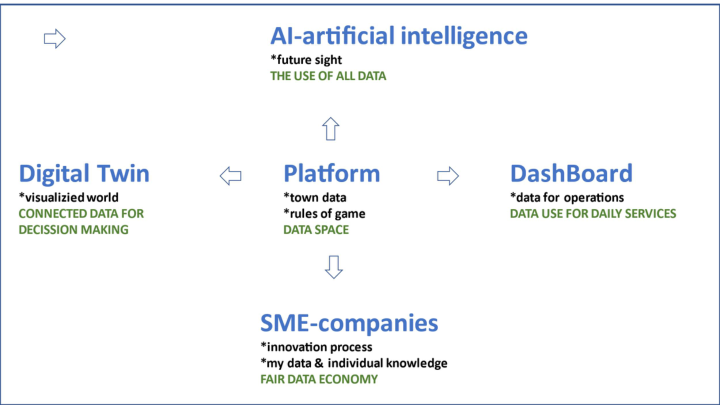
The data on the data platform creates the basis for data utilization and a fair data economy (Figure 1). The data brought to the platform combined with open data or companies’ data (my data) allows using it in different ways and for different purposes.
Figure 1: Data platform in the center of activities.
Since the amount of data is increasing the number of data sources is increasing, and the proliferation of new ICT technology provides opportuni- ties, the selected information systems and platforms must be able to meet this challenge. Therefore, the goal is a software structure and a technical solution that is:
Supplier independent
Platform independent and
Scalable.
Dashboard Implementation Dashboards can be used to easily bring and visualize things that make life easier; Concrete and useful, data-based perspectives for companies and city dwellers about the current situation, are described with a few variables.
Digital Twins In the urban structure, a huge amount of data is generated from different data sources. Some of the data is quite “stable”, such as zoning or building data. Part of the data traffic is changing (but becoming historical and trending in the future) like- data. It is difficult to grasp the physical and temporal interdependence of different data and functions in traditional ways.
Data from different sources and more data can be understood and analyzed when there is a digital two-part entity that compiles the data. This is how the digital twin works as a fire for decision-making.
A digital twin can be used to illustrate an entity created with different data, where things and their context and dependencies are seen as a whole.
8 Ruohomaa and Salminen
The digital twin creates a framework for development where all data must be compatible and where the data brought into the digital twin is correct and reliable. The digital twin can also be used so that the actions taken in the digital twin can affect the real world (bidirectionality).
AI – Artificial Intelligence Artificial intelligence is becoming common in all sectors of life and it enables various measures and processes. Artificial intelligence makes extensive use of all available information, and the usability of artificial intelligence depends on the available data (variety, quantity, correctness, timeliness, etc.)
The data brought to the platform therefore enables the best possible and reliable result. Based on data (historical data), artificial intelligence can create future scenarios as well. For this reason, artificial intelligence can serve as a valuable aid in making daily operational decisions (such as predicting traffic jams caused by roads.)
Data From Companies & Innovations New innovations have been seen to arise at the interfaces of different sec- tors when data from different sectors is combined. Open data alone does not significantly enable new business, but when open data is combined with its own “my data”, open data has a key impact on the success of the product/service/business.
SCALING PLATFORM However, scaling development measures carried out in one city to other cities is not only a “copy-paste” operation, even though common “rules of the game” and standards create a good foundation. In addition to the devel- opment work, the experience gained through piloting, and the standard, scaling must take into account the different starting points, history, culture, competence goals, etc. of different cities.
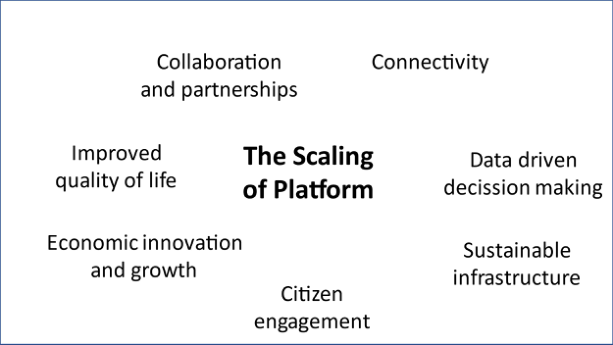
Figure 2: Things to consider when scaling platform development.
Fair Data Economy for Digital Service Development 9
Smart cities, as a platform for development, refers to the integration of technology, data, and connectivity in urban environments to improve the quality of life for residents and drive sustainable economic growth. By lever- aging digital infrastructure and innovative solutions, smart cities aim to enhance various aspects of urban living, including transportation, energy management, healthcare, public safety, and governance.
It is good to recognize some key aspects for scaling, and how smart cities act as a platform for development (Figure 2):
High-speed access and wireless networks mean seamless connectivity, which enables the setting-up of various digital solutions, which mar- shal citizens to access various kinds of services and more sophisticated information.
Cities can offer multiple new services: urban planning, resource opti- mization, and responding proactively to challenges, using data collected from sensors, IoT devices, and data analytics. It is possible to follow the data collected and influence on improving sustainability and reducing environmental impacts.
Digital platforms and mobile applications allow citizens to interact with city authorities, provide feedback, access services, and contribute to city development.
Cities have an opportunity to influence economic growth by supporting new start-up entrepreneurship or attracting new businesses and talents to come to the region.
Cities enhance vitality and well-being by providing efficient and easily accessible public services.
Quadrable helix collaboration and partnerships with public sector organi- zations, private sector organizations, academia, and citizens are essential to success.
A fair data economy is possible to achieve by scaling the data and developing and maintaining common data spaces.
Smart cities as a platform offer great potential to address regional devel- opment challenges, drive economic growth, and enhance the well-being of residents. It is essential to ensure equitable access to technology, protect data privacy, and address potential challenges related to cybersecurity and the digital divide to ensure inclusive development.
CONCLUSION
The success of a fair data economy is that good data is available on the mar- ket in a steady and predictable flow for customers to use. For data to become available to the market, the data suppliers must be motivated to do so. As a prerequisite for motivation, data producers must receive fair compensa- tion for their data. Compensation for data can be made in different ways, exchange, payment, etc. The demand and value of data for the buyer are based on the reliability of the data source, “the value of data” format, and continuity of data access.
10 Ruohomaa and Salminen
The “rules of the game” for the use of data at the platform provide the starting point for a functioning regional data economy and the production of services in the region, as well as for new start-ups and the renewal of business operations.
Scaling the platform to different regions requires, in addition to dupli- cating technical solutions, consideration of operating models and the cul- ture of regional peculiarities. This article has described small-city activities to support the creation of a regional fair economy to vitalize enterprise development.
REFERENCES
Alan Turing Institute (2024) AI Ethics and Governance in Practice: AI Fairness in Practice. https://www.turing.ac.uk/news/publications/ai-ethics-and-governanc e-practice-ai-fairness-practice (read 09.01.2024). Ding, C.; Liu, C.; Zheng, C.; Li, F. Digital Economy, Technological Innovation and
High-Quality Economic Development: Based on Spatial Effect and Mediation Effect. Sustainability 2021, 14, 216. Ruohomaa, H., Salminen, V. (2023) Data Space Ecosystem Development. AHFE International Open Access Publishing, Human Factors, Business Management and Society, Vol. 97, Issue 97, 21–29, https://doi.org/10.54941/ahfe1003879. Ruohomaa, H., Salminen, V. (2019) Ecosystem-based development on managing
digital transformation (Paper ID#: 113). Springer Nature Publication, Interna- tional Conference on Applied Human Factors and Ergonomics, AHFE 2019 the Washington Hilton, Washington D. C. USA, July 24–28, 2019. Saaristo, A., Heikkilä, A. (2023) A fair data-driven economy -The future of Europe. Turku University Publishing. Report number: CCR Insights 2/2022. doi: 10.13140/RG.2.2.31528.85761. Sitra (2021) Fair Data Economy. https://www.sitra.fi/en/themes/fair-data-economy/
(read 09.01.2024).
LISTED IN THE AHFE DIGITAL BOOKSTORE CATALOGUE
Explore the complete digital volume
Human Factors, Business Management and Society
Read this individual research paper free through the original publisher, or explore the full digital proceedings book.
ISBN 978-1-964867-11-3
Explore this ISBN in the AHFE Bookstore ↗Listed in the July 2026 bookstore catalogue; search by ISBN to confirm current availability · Digital book purchase optional