Heikki Ruohomaa, Vesa Salminen (2023). Data Space Ecosystem Development. In: Human Factors, Business Management and Society. AHFE Open Access, vol. 97, pp. 21–29. https://doi.org/10.54941/ahfe1003879
Societies are facing the huge change in its all sectors. Business drivers like; digital transformation and sustainability, are changing societies and all industries with increasing speed. The overflow of created data and technological opportunities are possible to turn managing by data solutions and business co-evolution.The efficient utilization of data is aimed at developing the data space with extensive EU-wide projects, European common data space development is on the programs, as GAIA-X, but there is also need for regional data space development.Domain-specific data spaces in Europe will not be implemented in a top-down approach. The European data space for a certain domain will materialize as the entirety of a variety of different bottom-up endeavors. (Otto et al (2021). Despite this fact, regional data space development work has been very limited. The objective of this article is to introduce the concept to increase knowledge and understanding by the development of regional data space.
The world is changing rapidly. It is difficult to form clear understanding of future challenges and opportunities when there are double transition in pro- gress on whole the society. Continuous demand on the main business drivers; digital transformation and sustainability, has changed societies and all indu- stries fast. The amount of usable data in business environment is at the same time exponentially increasing.
The fair and sovereign exchange of data has since increased its importa- nce across all sectors of the economy. It has also raised the visibility of the enormous potential of data sharing for spurring cross-sector innovation and the development of new business models. There is need substantive, intero- perable data spaces in industry and science that can be interlinked flexibly, based on demand and the respective business model, and enable reliable and sustainable data-driven economic activity (Otto et al. 2021).
Initiatives such as GAIA-X and International Data Spaces (IDS) are pro- grams toward a European data economy, but there are also demand for regional data space development, because the data spaces cannot be imple- mented only in a top-down approach, but certain domains have to materialize different bottom-up endeavors.
From a business point of view, data spaces are a multilateral form of colla- boration on data which is why communities in the mobility or manufacturing
domain form and take ownership of domain-specific data spaces as called for in the European strategy on data Nearly all business fields and enterprises face the need for transition tow- ards sustainable (circular economy) business models which are based on the use of data and continuous coevolution through digital ecosystem. However, we have to remember the importance of education, training and piloting in the data economy and data spaces.
THEORETICAL FRAMEWORK ‘Today, data spaces are a central means for the implementation of the Euro- pean strategy on data. From a business point of view, data spaces are a multilateral form of collaboration on data which is why communities in the mobility or manufacturing domain form and take ownership of domain- specific data spaces as called for in the European strategy on data. Finally, data spaces are also objects of regulation’ (Otto et al. 2021).
‘Domain-specific data spaces in Europe will not be implemented in a top-down approach with one large initiative taking care of all the various stakeholder interest and then deliver everything as one dedicated project. In contrast, the European data space for a certain domain will materialize as the entirety of a variety of different bottom-up endeavors which share the same principles and are interoperable’ (Otto et al. 2021).
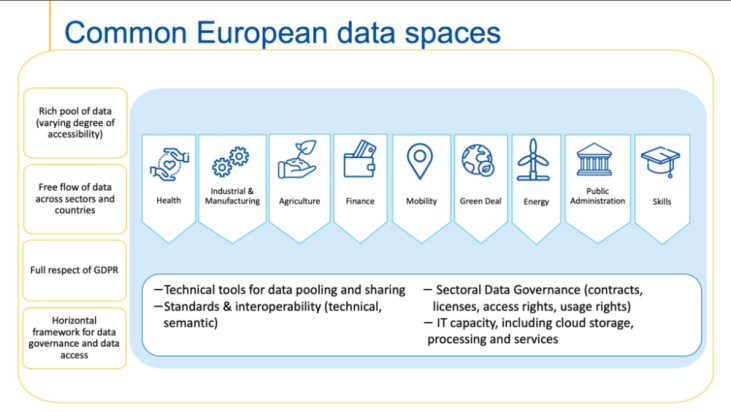
The implementation technologies and architectures of data spaces evolve rapidly. The data flow between companies and organizations in data ecosy- stems makes operations more efficient and enables entirely new services. A shared vision of cross-organizational data use and the first concrete use cases are the essential starting points for developing such data ecosystems (Sitra, 2023). Common European data spaces will ensure that more data becomes avai- lable for use in the economy and society, while keeping companies and individuals who generate the data in control. Data is an essential resource for economic growth, competitiveness, innovation, job creation and societal progress in general.
Data has many roles and meanings in business environment today. The types of roles can be identified.: (Otto, 2015)
Data is still an enabler of operational excellence within a company.
Data is a product which is sold in the market.
Data is a source of service and business innovation.
The value of data can only unfold when data is used.
Data sharing, in contrast, means a collaborate use of the data for a shared goal (Capiello et al. 2020). Ecosystems are a multilateral form of organizing to achieve a shared goal. In contrast to networks, ecosystems are more cen- tered around a customer innovation, more dynamic when it comes to their composition and characterized by a balance of prosperity of the individual members on the one hand and the ecosystem on the other hand (Gelhaar et al., 2021).
Data Space Ecosystem Development 23
Figure 1: Common European data spaces.
Business ecosystem should be viewed through the distribution of data between different actors, so that more efficient value chains and increa- sed reliability are created. Data spaces must be seen in the context of the ecosystem they support and the underlying software infrastructure. Data sovereignty (Hummel et al., 2021) must always be ensured for all participants in this data space.
The digital twin consists of the data of the individual digital twins and comprises, timetables, inventory levels and plans for individuals, etc. (Otto et al. 2021).
In the current agricultural digital ecosystem, numerous isolated, often non- interoperable solutions exist. It is obvious that there is continuous need for an “Agricultural Data Space, ADS”, which could bring added value through data for various participants in agriculture business (Kalmar et al., 2022).
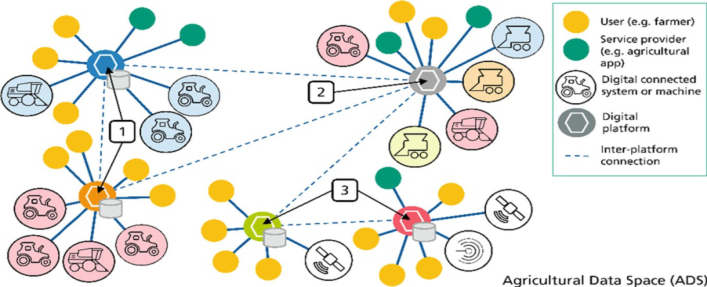
In order to exploit the full benefit from making data across platforms and systems accessible, the domain could build up an infrastructure for digital twins. For arable farming those would be digital field twins, while for live- stock farming, single animals could be twinned. In such a context, central functions like clearinghouse logging can be done in the twin directly to cap- sule data with access information. In addition, data usage policies would also be integrated in those twin objects. Such a twin concept supports the idea of a decentralized environment, where twins can exist at any arbitrary platform in the ADS (Figure 2) as long as they fulfill the requirements for interoperability and can be used across multiple platforms (Kalmar R, 2022).
The agricultural data space as a domain ecosystem with interconnected digital platforms and specific digital (sub-)ecosystems: machine manufactu- rers platforms (1), routing platform (2), and service specific platforms (3).
The Circular economy (CE) is a system that is designed to be restora- tive and regenerative in order to transition current linear production and
consumption patterns to cyclical ones that remove waste from the system. CE is increasingly seen as way to contribute to sustainable development. To contribute to redesign for the CE, we must all make changes in the way we produce, consume and manage waste.
‘When we analyze some common archetypes for circular economy models, we can argument that digital ecosystems and data spaces are essential to cre- ate efficient and sustainable and profitable business models. that will be able to challenge present linear business models.’ (HBR, August 2020.)
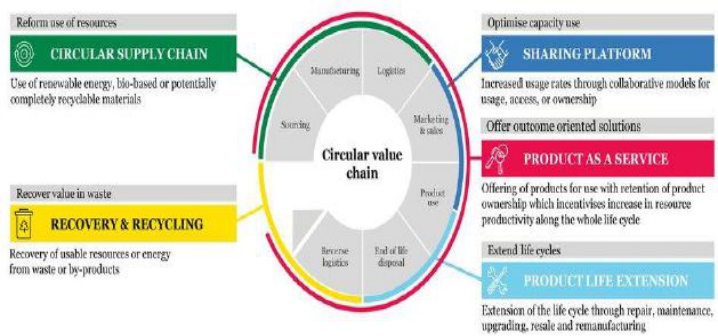
One way for organizations to contribute to the CE is through circular eco- nomy business models (CEBM). CEBMs work to reduce resource use and waste within production, but also to extend product life cycles and employ strategies that allow the consumer to do more than buy, use and dispose.
‘In the current agricultural digital ecosystem, numerous isolated, often non-interoperable solutions exist. It is obvious that there is continuous need for an “Agricultural Data Space”, which could bring added value through data for various participants in agriculture business.’ (Kalmar et al., 2022.)
Data Space Ecosystem Development 25
There is a double transition happening in society, which is based on sustainable development need/goals and the huge increase of data and also new ICT-based technologies. Green and digital transitions reinforce each other’s. Transition management is a form of process management against a set of goals set by society whose problem-solving capabilities are mobilized and translated into a transition program, which is legitimized through the political process (Rothman & Kemp, 2003).
To make the most out of the double transition, proactive and integra- tive management will be needed. The digital transition will be spearheaded mainly by the private sector due to its huge economic potential. To harness its benefits for greening and to limit its harmful effects, state and civil soci- ety engagement will be necessary.’ (EU Science Hub, 2022.) This will mean the change in consumer behavior from owning the goods toward using the services.
‘The business environment is becoming complex and rapidly changing, and ecosystem development has been perceived to best meet this challenge. Ecosy- stem innovation and development is because it brings competitiveness and profitability to the participating companies.’ (Salminen et al., 2022.)
‘By making larger volumes of data from multiple partners available to all participants in ecosystem in a trustworthy way, opens up exciting pros- pect that federated data ecosystem will be basis for thriving economy and makes possible value creation for enterprises and citizens alike more and more companies (Hecker et al., 2022).
RESEARCH QUESTIONS Through previous studies and pilots, data-related questions such as sharing, harmonizing, ownership, utilization, etc., have come to the fore, which need to be resolved in order to create opportunities for effectively utilizing data spaces. Although the initiatives and development work to create a common European data space is done from an EU perspective. In regional develo- pment, one should not rely on the fact that the instructions and policies given from above enable the effective utilization of data and the renewal of business.
The key is that regional development identifies and creates capabilities for utilizing data spaces in a complex, rapidly changing, environment. The main research questions are
1. Do regional strengths serve as a basis for data space work. 2. How does the commitment to creating a data space arise. 3. How is regional data space development implemented in a complex environment.
The concept for the development of the regional data space is based on previously conducted pilots and practical situations and literature. The data for creation of concept of data space for circular economy node has been collected from several regional applied science and development pro- jects. The data space supports enterprise network operation on circular business.
26 Ruohomaa and Salminen
REGIONAL DATA SPACE DEVELOPMENT ‘Societies in Europe are building human-driven, fair data economy based on European values. The use of data creates well-being and competitiveness and helps to develop societies. Fairness means that the interests of individuals, businesses and society are balanced.’ (Sitra, 2023.)
There has been an active discussion in Europe on common European data spaces and national activities to create data spaces. However, there has been only a few discussions on regional development of data spaces. In Europe has been given guidelines that regional development should concen- trate on development of smart specialization. Smart Specialization on the region has contributed in a positive way to the focus and prioritization of innovation strategies and impacted to the innovation performance of the regions. ‘However, it has been recognized that neither inter-regional col- laboration, Sustainable Development Goal implementation, nor economic transformation are yet a norm in the Baltic Sea Region.’ (Takala & Tukiainen, 2022.) Regional development has a characteristic, that it can’t be done according top-down- approach. Local development is essential, because local develo- pment does not go top-down, but development must be guided in small steps.
‘Since domain-specific data spaces in Europe will not be implemented in a top-down (Otto et al. 2021) but domain will materialize as the entirety of a variety of different bottom-up endeavors which share the same principles and are interoperable.’
Based on the earlier real-life piloting outcomes, the following issues are essential to the piloting of the regional data space and implementing the piloting project:
1. Real life piloting environments 2. Commitment from the actors on value chain 3. regional domain from the strengths of region (based on Smart speciali- zation strategy) 4. Building the business ecosystem on domain, which means that there is clear meaning for very member on ecosystems and that it will be fruitful for every participant 5. Building the innovation ecosystem for transfer of the knowledge 6. Agreeing the use of shared data (how to use, standards, etc) 7. Ensuring the share of results 8. Ownership of data 9. Scalability of piloting 10. Positioning in the life cycle 11. Visualization of results – digital twin 12. Common vision for further use/development As mentioned earlier the main objective is to identify challenges and pro- blems related to the development of the data space ecosystem This would also mean to possibility to create a common vision for future goals and needs in
Data Space Ecosystem Development 27
region. The goal of this development work is therefore to provide capabilities for “bottom-up” development as well.
Business ecosystem should be viewed through the distribution of data between different actors, so that more efficient value chains and increased reliability are created. Let’s look at the business ecosystem through the distri- bution of data from different actors, so that more efficient value chains and increased reliability are created Increasing amount of data should be visualized in easy understanding for- mat so that should be visualized in an easy-to-understand format so that outcome could be used in decision making. The integration of the virtual world and the real world by means of the digital twin and the metaverse gives the possibility of a reference framework that can be used to deliver and utilize data together in functional development.
The task of the stakeholders and partners of the digital ecosystem focuses on the interoperability of the devices and the creation of the best possible solution platform and the realization of the digital twin in collaboration. This works as an increaser of know-how and understanding in the regional development environment.
ANALYSIS - APPROACH FOR REGIONAL DATA SPACE Regional Focus at Tavastia Province
Tavastia Province is a rustic entity in southern Finland that is divided into three smaller population centers with good transport connections. From a national perspective, the Tavastia region’s main industries are livelihoods related to primary Industries production (agriculture, forestry and gardens), food industry and related education and know-how, which have quite long traditions.
In regional development, especially in accordance with the Smart Speciali- zation Strategy required by the EU structural funds, the following priorities have been selected:
Sustainable food systems
Circular natural resources and material cycles
Digital services and processes
Smart sustainable design Häme University of applied sciences (HAMK) has a very strong educa- tion role for primary production areas and strong in-house applied research (HAMK Bio) related to rural industries, can rightly be considered as “key stone” in the area’s innovation ecosystem. HAMK’s core expertise is also supported by the HAMK Smart research unit, whose mission is to support the utilization of the latest digital technology in selected industries.
Due to the mentioned grounds, it would be justified to develop pilot pro- ject to develop the agricultural data space. Due to HAMK’s strong position as an expert in the primary production and food industry, this development work would also be of national importance. This is also associated with long traditions, a strong organizational culture and established cooperation networks.
28 Ruohomaa and Salminen
The other possible domain for piloting could be Circular economy (natu- ral resources and material cycles), which is also the key area of Smart Scecialization strategy at Tavastia Province.
Circular economy to be piloting is quite a new field for businesses and there is great interest and societal need for it. Based on this background, the circular economy is free from “old business”traditions that would become an obstacle or slow down radical renewal. The new business models related to the circular economy are largely based on the efficient combination, proces- sing and utilization of data and are therefore more agile and more innovative and open to the pilot development of new data space.
DISCUSSION AND CONCLUSION The goal of this article has been to identify and define the regional deve- lopment process of data- space. At the same time, this article attempts to develop “road” for regional development work to prepare to take use Euro- pean scale data spaces. Domain-specific data spaces in Europe will not be implemented in a top-down approach. The European data space for a cer- tain domain will materialize as the entirety of a variety of different bottom-up endeavors (Otto et al. 2021). Although, European common data space deve- lopment is on the process, as GAIA-X, there is need for regional data space development.
However, the development work done regionally should be seen as a central goal of development because it provides understanding, identifies pro- blem areas, clarifies the common will, creates opportunities for the birth of new business and innovations and thus enables more efficient utilization of the data spaces that are created. That’s why the regions should create their own pilot implementations for the development of data spaces, which are implemented in the right environments of the real world, and thus become familiar with the challenges of a complex and rapidly changing environment.
It would be natural to choose targets for data space piloting where the areas have basic strengths and the goal of developing operations. On the other hand, the so-called: “strong industries in the regions” can have their own strong views on the direction of development and a strong organizational culture and business models for which no special change needs are perceived.
For this reason, data space pilots should find business areas that are still emerging and whose business is largely based on the utilization of data from different sources. Such an area in Tavastia Province could be considered to be the circular economy and the new business models of the circular economy.
REFERENCES
Accenture-report (2014) Circular Advantage: Innovative Business Models and Technologies to Create Value in a World without Limits to Growth, Accenture, 2014. Atasu, A., Dumas, C., Wassenhove, L. (2020) The Circular Business Model- Pick a
strategy that fits your resources and capabilities. HBR-Harvard Business Review, August 2020.
Data Space Ecosystem Development 29
Capiello, C., Gal, A., Jarke, M., & Rehof, J. (2020). Data ecosystems: Sovereign Data. Exchange among organizations (Dagstuhl Seminar 19391). https://doi.org/10.4230/
DagRep.9.9.66. EU Science Hub (2022) The twin green & digital transition: How sustainable digital technologies could enable a carbon-neutral EU by 2050. A JRC report. 29 June 2022 https://joint-research-centre.ec.europa.eu/jrc-news/twin-green-digital-tra nsition-how-sustainable-digital-technologies-could-enable-carbon-neutral-eu- 2022-06-29_enClimate (read 27.01.2023). Gelhaar, J., Groß, T., & Otto, B. (2021). A taxonomy for data ecosystems. In: Hawaii. International Conference on System Sciences 2021 (pp. 6113–6122). University of
Hawai’i at Manoa, Hamilton Library. Hecker, D., Voss, A., Wrobel, S. (2022) Data Ecosystems: A New Dimension of Value Creation Using AI and Machine Learning. Chapter13 in Designing Data Spaces Book, pp 222. Editors Otto, B., Hompel, M., Wrobel, S. Springer Publishing: https://doi.org/10.1007/978-3-030-93975-5 (read 27.01.2023), Hummel, P., Braun, M., Tretter, M., & Dabrock, P. (2021). Data sovereignty: A
review. Big. Data & Society, 8(1). https://doi.org/10.1177/2053951720982012. Kalmar, R., Rauch, B., Dörr, J., Liggesmeyer, P. (2022) Agricultural Data Spaces, Chapter17 in Designing Data Spaces Book, Editors Otto, B., Hompel, M., Wrobel, S. Springer Publishing https://doi.org/10.1007/978-3-030-93975-5 (read 27.01.2023). Otto, B. (2015). Quality and value of the data resource in large enterprises.
Information Systems. Management, 32(3), 234–251. https://doi.org/10.1080/10580530.2015.1044344. Otto, B., ten Hompel, M, Wrobel, S. (2021) Editors: Designing Data Spaces. The Ecosystem Approach to Competitive Advantage ISBN 978-3-030-93974-8 ISBN 978-3-030-93975-5 (eBook). https://doi.org/10.1007/978-3-030-93975-5 Rothman, J., Kemp, R. (2003) Managing Societal Transitions: Dilemmas and Uncer-
tainties: The Dutch energy case-study. OECD- Report: Workshop on the Benefits of Policy: Improving Information for Policy Maker. Salminen, V., Ruohomaa, H., Takala, M. (2022) Future Ecosystem Ensuring Competitiveness in Continuous Co-Evolution. AHFE International Open Access Publish- ing, Human Factors, Business Management and Society, Volume 56/2022, Editor Vesa Salminen, pp. 1–9 DOI: 10.54941/ahfe1002245. Sitra (2022) Fair Data Economy. https://www.sitra.fi/en/themes/fair-data-economy/
(read 27.01.2023). Sitra, (2023) https://www.sitra.fi/en/events/data-spaces-technology-landscape-2023/ #speakers-of-the-event. Takala, M., Tukiainen (2022) AHFE International Open Access Publishing, Human
Factors, Business Management and Society, Volume 56/2022, Editor Vesa Salmi- nen, pp. 17–24 DOI: 10.54941/ahfe1002247.
LISTED IN THE AHFE DIGITAL BOOKSTORE CATALOGUE
Explore the complete digital volume
Human Factors, Business Management and Society
Read this individual research paper free through the original publisher, or explore the full digital proceedings book.
ISBN 978-1-958651-73-5
Explore this ISBN in the AHFE Bookstore ↗Listed in the July 2026 bookstore catalogue; search by ISBN to confirm current availability · Digital book purchase optional