Heidi Ahokallio-Leppala, Vesa Salminen, Heikki Ruohomaa (2022). Change of Higher Education and Education Business in the Age of 5G. In: Human Factors, Business Management and Society. AHFE Open Access, vol. 56, pp. 145–152. https://doi.org/10.54941/ahfe1002262
Regions are facing a huge competition, to attract companies, businesses, inhabitants, students etc. and this way to improve living and business environment, which is rapidly changing due to the impact of digitalization.On the other hand, for the point of view of the industry, the availability of skillful labor force and innovation environment are crucial factors. In this context, qualified staff has been seen to be able to utilize the opportunities of digitalization and response the needs of future skills. World Manufacturing Forum has stated on year 2019- report, that in next five years 40% of workers have to change their core competences. Through digital transformation, the use of new technologies like cloud, mobile, big data, 5G- infrastructure, platform- technology, data- analysis, and social networks with increasing intelligence and automation, enterprises can capitalize on new opportunities and optimize existing operations to achieve significant business improvement.Digitalization is going to be an important part of everyday life of citizens, and present in the working day of the average citizen and employee in the future. For that reason, also education system and education programs on all levels of education from diaper age to doctorate have been directed to fulfill this ecosystem strategy. The Fourth Industrial Revolution will bring unprecedented change to societies, education organizations and business environments. The goal of this article is to identify how education, education content, the way education is proceeded and overall whole the education business is changing. Most important is how we should respond to this inevitable co- evolution.The purpose of the study is to verify how the learning process is boosted by new digital content, new learning software and tools and customer- oriented learning environments. The change of education programs and individual education modules can be supported by applied research projects. You can use them in making proof- of- concept of new technology, new way to teach and train and through the experiences gathered change education content, way to educate and finally education business as whole.Applied research projects can be used to make proof of concept- phases on real environment field labs to test technology opportunities and new tools for training purposes. Customer oriented applied research projects are also excellent environments for students to make assignments and use new knowledge and content and teachers to test new tools and create new ways to educate. New content and problem-based learning is used on future education modules.This research has used qualitative and conceptual analytic methodology. The data analyzed has been collected from case study environments and transdisciplinary digital transformation projects. Project settings have also been testing environments for new education tools and contents. In this article are introduced some case study experiences on customer oriented digital transformation projects and how gathered knowledge on new digital content and new way to educate has influenced on education supported. Case study is related on experiences of research projects, customer- oriented field labs/learning environments and education programs of Häme University of Applied Sciences.
Education business of Universities of Applied Sciences has in many areas traditionally concentrated basically on regions, which are facing a huge com- petition, to attract companies, businesses, inhabitants, students. The task of regions is to improve living and business environment, which is rapidly chan- ging due to the impact of digitalization and the increasing amount of data. There is as well lack of skillful labor force. Innovation environment is crucial factor for renewing. In this context, qualified staff has been seen to be able to utilize the opportunities of digitalization and response the needs of future skills. World Manufacturing Forum has stated on year 2019-report, that in next five years 40% of workers have to change their core competences.
Through digital transformation at the age of 5G, the use of new techno- logies like cloud, mobile, big data, 5G-infrastructure, platform-technology, data-analysis, and social networks with increasing intelligence and automa- tion, enterprises can capitalize on new opportunities and optimize existing operations to achieve significant business improvement.
Digitalization is going to be an important part of everyday life of citizens, and present in the working day of the average citizen and employee in the future. For that reason, also education system and education programs on all levels of education from diaper age to doctorate have been directed to fulfill this ecosystem strategy.
The Fourth Industrial Revolution will bring unprecedented change to soci- eties, education organizations and business environments. It will influence on education, education content, the way education is proceeded and ove- rall whole the education business. Most important is how we relate us on inevitable co-evolution.
The purpose of the study is to verify how the learning process is boosted by new digital content, new learning software and tools and customer- oriented learning environments. The change of education programs and individual education modules can be supported by applied research projects. You can use them in making proof-of-concept of new technology, new way to teach and train and through the experiences gathered change education content, way to educate and finally education business as whole.
Applied research projects can be used to make proof of concept- phases on real environment field labs to test technology opportunities and new tools for training purposes. Customer oriented applied research projects are also excel- lent environments for students to make assignments and use new knowledge and content and teachers to test new tools and create new ways to edu- cate. New content and problem-based learning is used on future education modules.
In this article are introduced some case studies, which are related on experiences of research projects, customer-oriented field labs, learning envi- ronments and education programs of Häme University of Applied Sciences.
THEORETICAL FRAMEWORK Theoretical framework is created on integrating following fields of theory, which are needed to understand the complex change in learning environment.
Data The 90% of the data, in the world has been created in the last two years alone, daily basis 2.5 quintillion bytes of data is collected.
It is predicted that the 60 % of the world’s data is collected via applica- tions relying on artificial intelligence, and machine-to-machine technologies, automation and the increase of data collection from smart devices.
It can be seen that “the average rate per capita of data-driven interactions per day is expected to increase 20-fold in the next 10 years as our homes, workplaces, appliances, vehicles, wearables and also implants become data enabled” (Reinsel et al., 2018).
The conclusion of the increase is that data is progressively a critical influe- ncer for all aspects of our lives. Smart devices and IoT are already promoting the amount of “life critical” data.
The ICD Research (Reinsel et al., 2018) has given some estimation by year 2025 that the average person will interact nearly 5000 times a day with a
Change of Higher Education and Education Business in the Age of 5G 147
connected device. Data will also be available everywhere immediately as real time data. Therefore, it is essential to ensure that businesses and business environments are aware of where and how data growth is happening and are ready to manage data effectively and ensure that benefits have achieved.
In addition to the societal impact, poorly managed increasing amount of data could result losing revenue in existing business by having operational inefficiencies and bad customer experience. By 2025 over 20% of the data collected globally could be useful for analytics (Reinsel et al., 2018).
In education environment there is opportunity to use increasing data in learning analytics, in supervising customized learning and in aligning educational business model.
5G The key features of 5G are high capacity, low latency, and the ability to con- nect a massive number of IoT sensors to the network. In addition, compared with the previous network generations, the 5G network makes it possible to implement tailored web services for different needs.
The capacity of 5G network serves exponentially accelerating growth of data. 5G is not only a faster network than the previous generations but a tech- nology that makes it possible to put many digital innovations into practical use.
5G enable the use new technologies (e.g. holograms, VR/AR/XR) in executing of education in completely new way.
New Technology Things are changing, when industries in the “physical economy” have begun their digital transformation. It is possible to recognize the opportunity for much bigger productivity boom. Now the Internet of Things (IoT), edge computing, deep analytics based on artificial intelligence/machine learning (AI/ML), augmented reality (AR), robotics, remote control and digital twin technologies are mature enough and can reach a critical mass of adoption, the opportunities to energize traditional industries are countless.
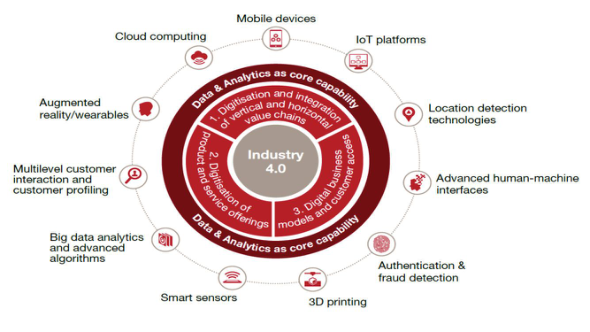
New ITC based technologies make Industry 4.0 development possible and give opportunities to reengineer value chains and create new business models.
The growth of connections brings the new possibilities and solutions for the business. Exponential growth of data brings also new challenges and indi- cates the birth of a new kind of business models. Figure 1 this “smartness” requires greater connection and collaborations. This is where the ‘explosion’ of platforms and ecosystems is occurring (Ruohomaa et. al 2018). New tech- nology opportunities have been implemented in many business sectors, but not too much in vocational education or in education business. Technology gives opportunities for transformation for everything in education sector.
Ecosystems “The business ecosystem produces goods and services of value to customers, who are themselves members of the ecosystem” (Moore, James F., 1996).
Figure 1: Industry 4.0 framework and contributing digital technologies (PwC, 2016).
Dramatic changes in organizations’ business ecosystems occurs, because digi- tal business make them, more complex, larger and essential to strategy (Burton Besty, 2017).
Jacobides (2019) defines digital ecosystems as “interacting organizations that are digitally connected and enabled by modularity and are not managed by a hierarchical authority”. Valdes-De-Leon Oman (2019) proposes a defi- nition of digital ecosystems as “loose networks of interacting organization that are digitally connected and enabled by modularity, and that affect and are affected by each other’s offerings”.
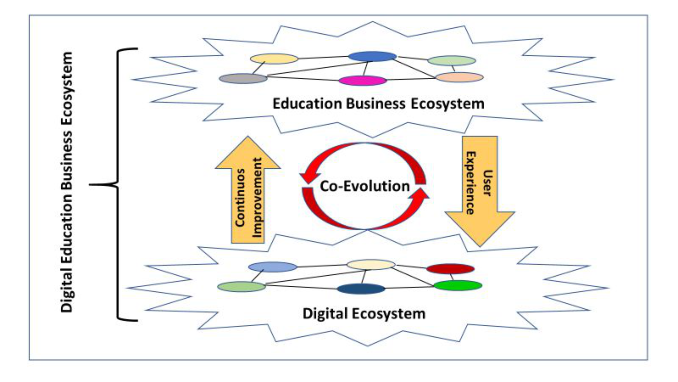
According the DBE Book introduce a Digital Business Ecosystem structure where the business ecosystem and digital ecosystem are coupled to form a viable dynamic innovation ecosystem. The digital ecosystem influences enter- prises, their social and business networks, and the business ecosystem affects the organisms of the digital ecosystem.
Ecosystem development creates the basis for the development of new value networks and business models in a rapidly changing and complex environ- ment. This also applies in education business. It is important to understand stakeholder value creation in education business environment (Innovation Ecosystems Initiative, 2020).
RESEARCH QUESTIONS The objective of this article is to identify how education, education content, the way education is proceeded and overall whole the education business is changing. Most important is how we should respond to this inevitable co- evolution.
The main research questions are
1. What is the relevance of gathered data in defining and executing future education? 2. What is the relevance of gathered data in implementing new educational business models?
Change of Higher Education and Education Business in the Age of 5G 149
Figure 2: Digital education business ecosystem.
3. How to turn gathered data as an educational module and service?
This research has used qualitative and conceptual analytic methodology. The data analyzed has been collected from case study environments and transdisciplinary digital transformation projects. Project settings have also been testing environments for new education tools and contents.
FUTURE EDUCATION BUSINESS IN THE AGE OF 5G New technologies are increasing the amount of data and the need for new knowledge and skills to put educational institutions at the forefront of a new type of competition.
Although educational institutions are at the forefront of development through their research, the new digital technology is often used quite mode- stly in the reform of the educational process and the provision of new educational products and, more generally, in the full-scale reform of the educational business.
New technologies, including new telecommunications networks, make it possible to make effective use of new technologies in education as well. Thus, 5G technology primarily enables the utilization of new ICT-based technologies.
When looking at the use of new technologies in other industries and pre- dictions about the use of new technologies and new operating models, it can be seen, that educational institutions are quite modest in their development (this development can, of course, be justified by tradition or private data ownership).
Education institutions should as well construct education business ecosy- stem and tie up digital ecosystem partners to influence on co-evolution of education environments and digital education business ecosystem (Figure 2).
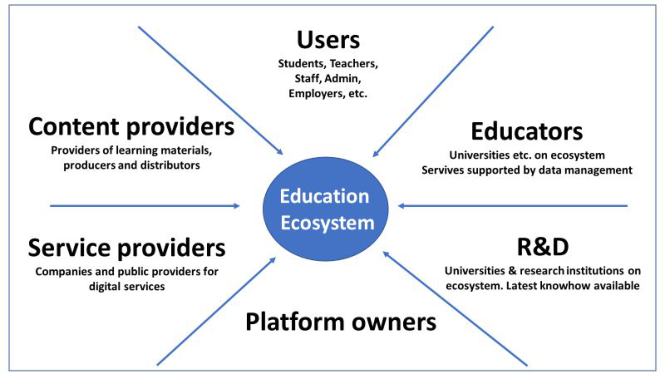
Figure 3: Education business stakeholders.
It is important to know the stakeholders in education business tow- ards ecosystem partners. It is also important to understand the need for co-operative digital ecosystem in maintaining sharing data and coworking platform and developing education environment (Figure 3). Stakeholder’s link and exchange information with each other through a common digital ecosystem and create co-evolution process between each other’s.
An example of ecosystem development is the project Digivision 2030, fun- ded by the Ministry of Education and Culture in Finland. The key objective of the project is to open up national learning data reserves for use by indivi- duals and society, enabling the development of pedagogy and the renewal of higher education institutes (Digivision 2030, 2021). It is building an educa- tion ecosystem and a related digital ecosystem. The student receives the IDs for use in the network and the student’s own data is stored in one of the data- bases. The network also builds a common image and brand. This potentially leads to the emergence of a new operating culture.
The growing amount of data in the future will provide new opportunities for the provision of personalized education and training support services, as well as other training-related measures.
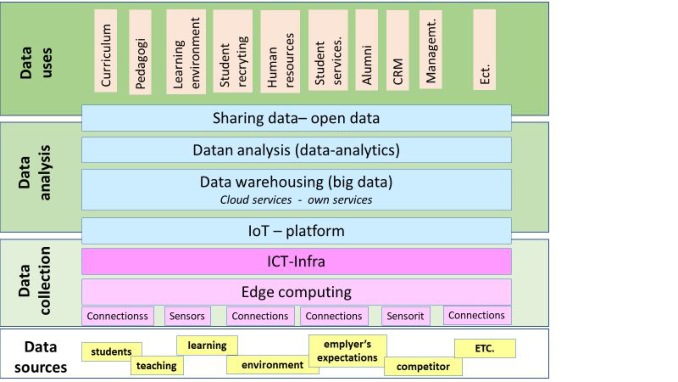
The strategic importance will be the collaboration and use/share/collect data, which will give the new landscape to manage education and learning, but also run education business and new business models (Figure 4).
The amount of data is growing, and real-time and historical information is available about students, teaching, employers’ needs, fellow students and future jobs and competence profiles. The data allows each student to be able to tailor a learning package and learning program that suits him or her and his or her needs.
It is possible to give the student immediate feedback on the skills he or she has learned and to demonstrate it to the possible employer.
The growing amount of data and the digitally networked environment are creating new customer interfaces that create the opportunity to generate
Change of Higher Education and Education Business in the Age of 5G 151
Figure 4: Future education network “framework”.
new innovations, value chains, and business models that are scaling rapidly. This development is likely to lead to a situation where the boundaries of educational organizations disappear and integrate integrally into larger entities.
An interesting question for the utilization of the proposed concept raises issues related to student’s individual data ownership and personal protection that were not considered in that concept. But it is conceivable that in order to have a better learning experience, the student will make his or her own personal data available to the institution.
The cost of studying can also be raised if the student makes his / her own data available to the institution and for the development of the insti- tution’s own business and services. The institution could form, for example, recruitment products based on the student’s data or marketing products.
When setting up individual online training, the training provider organi- zation must find its own place and role in the customer company’s value network and as part of ecosystem based on its own strengths.
In terms of education, digitalization works mainly regardless of time and place (VR/AR, hologram technologies). However, time-dependent training also takes place via the network, for example through dialogue training and group work.
New types of learning environments are being integrated into the develo- pment of corporate staff resources. In these learning environments, the virtual world and the real world are mixed, and the student receives immediate feedback on his/her learning. The learning environments of the future will be more like simulation environments.
DISCUSSION AND CONCLUSION Although the new technology will strongly support renewing of traditional higher education, it will change our thinking about education and bring
education and training towards individual, employer-friendly, cheaper and continuous life- long learning.
Increasing amount of data and new technology are also transforming edu- cational institution business models, organizations. Students are growing in digitalization already in nursery school and at home. The use of technical tools is taught, which provides a solid foundation for studying in a university where digital is seen as a broader tool for the development of society. At the age of 5G the use of new technologies is enabled in carrying out of educa- tion in completely new way and implementing new education business model. Educators need to evaluate their own role in educational value networks and ecosystems.
As the spread of data and many new technologies begin from linear to exponential growth, the reform of education and the development of busi- ness models for educational organizations will also shift from linear to exponential growth.
In this new situation, ecosystem development is thought to be the most effective way to manage this continuous co-evolution.
REFERENCES
Burton, Besty (2017), Eight Dimensions of Business Ecosystems, Gartner, June 2017 https://www.gartner.com/smarterwithgartner/8-dimensions-of-business-eco systems/ Digivision 2030 (2021) http://www.digivisio.fi (read 07.02.2022), Ministry of Edu-
cation and Culture in Finland. Fourth Industrial Revolution for the Earth Series (2018): Harnessing the Fourth Industrial Revolution for Life on Land- Towards an Inclusive Bio- Economy. World Economic Forum, January 2018, Geneva, Switzerland. Innovation Ecosystems Initiative, http://www.digital-ecosystems.org Jacobides, M. (2019), Designing Digital Ecosystems. In Jacobides, M. et.al. (2019),
Platforms and Ecosystems: Enabling the Digital Economy, Briefing Paper, World Economic Forum. Accessed May 12, 201: http://www3.wefo(rum.org/docs/WEF _Digital_Platforms_and_Ecosystems_2019.pdf Moore, James F. (1996). The Death of Competition: Leadership & Strategy in the Age of Business Ecosystems. New York: Harper Business.ISBN 0-88730-850-3. PwC’s 2016 Global Industry 4.0 Survey (2016) Industry 4.0: Building the digital
enterprise Industrial manufacturing key findings. www.pwc.com/industry40. Razavi, A., Krausen, P.J., Abbas Strommen-Bakhtiar, (April 2010), From Business Ecosystems toward Digital Ecosystems, Conference paper DOI: 10.1109/DEST.2020.5610633 Reinsel, D., Gantz, J., and Rydning, J. (2018), The Digitization of the World from Edge to Core, An IDC White Paper – #US44413318, November Sea- gate 2018. https://www.seagate.com/files/www-content/our-story/trends/files/idc -seagate-dataage-whitepaper.pdf Ruohomaa, H., Kantola, J., Salminen, V. (2018) Value Network Development in
Industry 4.0 Environment, Book Chapter. Advances in Human Factors, Business Management and Leadership, Springer International Publishing AG. Ruohomaa, H. (2020) Ecosystem-based Development in the Transition of Fourth Industrial Revolution. http://urn.fi/URN:ISBN:978-952-476-931-0 Valdez-De-Leon, O. (2019), How to Develop a Digital Ecosystem: a Practical
Framework. Technology Innovation Management Review August (Vol. 9, issue 8).
LISTED IN THE AHFE DIGITAL BOOKSTORE CATALOGUE
Explore the complete digital volume
Human Factors, Business Management and Society
Read this individual research paper free through the original publisher, or explore the full digital proceedings book.
ISBN 978-1-958651-32-2
Explore this ISBN in the AHFE Bookstore ↗Listed in the July 2026 bookstore catalogue; search by ISBN to confirm current availability · Digital book purchase optional