Shah Rukh Shakeel, Arto Rajala (2022). Transforming Energy Marketing Practices for Enhanced Solar PV Adoption. In: Human Factors, Business Management and Society. AHFE Open Access, vol. 56, pp. 107–115. https://doi.org/10.54941/ahfe1002258
The adoption and use of solar PV systems is a complex and multifarious process influenced by personal, social, economic, technical and regulatory factors. Solar PV companies involved in the sales and interaction with the customers can play an important role in facilitating adoption. Companies’ ability to effectively market the product, disseminate information, frame value offerings and address consumers concerns can play an important role in this regard. The small size of the domestic market, an amplified competition and limited resources highlight the need to alter the way companies have been carrying out their operations. The qualitative study explores how solar PV companies can transform their marketing operations by integrating through the use of advanced digital technologies to facilitate the process.
The rising energy needs, finite nature of the conventional hydrocarbons and issues concerning sustainable development, climate change and greenhouse gas emissions have highlighted the need to transform energy production and consumption patterns (Yergin, 2006; EU, 2018). Countries across globe are looking forward to adopt measures and ways to increase the share of clean, local and sustainable energy sources in their generation mix (IRENA, 2018; Shakeel, 2021). The huge generation potential, the improved technological efficiencies, reduced costs and the potential to be used for large scale com- mercial as well as at a household level has made solar as one of the leading forms of renewable energy, reaching at the production level of 707 GW in 2020, increasing almost twenty folds in past decade (BP, 2021). However, its widely believed that the growth is insignificant compared to its potential and efforts should be made by all stakeholders to promote its use and encourage adoption.
Solar PV companies, involved in the sales and installation of solar system becomes an important actor in this regard (Karakaya, Nuur and Hidalgo, 2016). A company’s ability to entice interest, address consumers concerns and devise value offerings that matches consumers’ needs plays a pivotal role in encouraging adoption. The disruptive nature of solar PV, technical
features, being at the earlier phases of diffusion and limited understanding about the economic and environmental benefits its use can entail warrants companies to undertake measures to address these issues (Alipour et al., 2020; Shakeel and Rajala, 2020). Companies’ marketing and communica- tion approaches can play a pivotal role in increasing the level of awareness, addressing consumers concerns and offering product and services that can encourage adoption (Shakeel and Rahman, 2018). However, to this end, a majority of the companies are following conventional approaches to market solar PV systems. Companies can effectively transform their marketing and communication approaches by integrating the use of advance technologies (Kumar, Ramachandran and Kumar, 2021). A review of the literature reve- als that an overwhelming majority of the existing studies have examined the effect of regulatory regime, financing options, industry practices and vari- ous socio-economic, personal, environmental, technical and related factors on the adoption (Lo, Wang and Huang, 2013; Tsoutsos et al., 2013; White, 2019; Alipour et al., 2020; Yousaf et al., 2021). Very little attention has been paid to exploring how effective marketing and communication strategies can facilitate adoption, particularly with regards to integrating advance techno- logies. The study adds the to the existing knowledge by exploring how solar PV companies can transform energy marketing practices stimulated through the use of novel technologies.
THE INFLUENCE OF ADVANCE TECHNOLOGIES ON COMPANIES’ OPERATIONS Companies’ ability to remain successful often depends on their capability to adapt to the changing industry needs. The emergence of industry 4.0 and the rise of advanced information and communication technologies has ope- ned new avenues as well as posed a number of challenges for companies (Schwab, 2016). Opportunities, if properly exploited can lead companies to the new heights, however, if looked over might poses existential threat for them. Fitzgerald et al. (2014) suggests that the impact of these tech- nologies can be observed on all facets of company’s operations including resource management, logistics and supply chain, communication, mar- keting, management and so on. The integration of advance technologies can lead to effective resource utilization, gaining operational efficiencies, obtaining data and insights and effectively utilize information to improving existing solutions as well as introducing new offerings. Dholakia et al. (2011) suggest that an enhanced integration of information producing, informa- tion manipulating, information distributing and information consumption technologies warrants companies to transform their organizational structu- res, processes and business models. Companies needs to transmute their operations to optimally benefit from the opportunities emerging from the integration of technologies, to gain efficiencies and remain ahead of the competition (Fitzgerald et al., 2014). However, the extent to which a com- pany is able to transform as a strategic response to these technologies are often influenced by organizational routines, business processes and resources (Lee and Grewal, 2004).
Transforming Energy Marketing Practices for Enhanced Solar PV Adoption 109
A number of studies have examined the effect of new digital technologies on various facets of businesses. Baker et al. (1998) and Storbacka and Moser (2020) suggest that marketing is one such aspect of the company’s operations that will be significantly influenced by the incorporation of the technolo- gies. Kumar (2018) states that that the use of digital technologies is likely to overhaul the way customers seek information, evaluate products and servi- ces, interact with the companies and make transactions. Hoyer et al. (2020) suggest that the use of new technologies can enhance consumers’ shopping experience and are likely to influence how sales and purchases were made previously. A study conducted by Grewal et al. (2020) shows that companies use of technologies can play a role in improving their connections and intera- ction with the existing and potential customers. Hoyer et al. (2020) exhibits that companies can improve their customer experience by steam lining their conventional purchase experience by introducing automation and automa- tic charging through online portal and applications. Storbacka and Moser (2020) proclaims that the use of advanced analytical capabilities helps com- panies devising more personalized recommendation systems and improving customer experiences. Kumar et al. (2021) states that integrating informa- tion from the use of existing solutions, usage behavior and patterns can be useful in framing products or service packages that are better suited to meet consumers demand. Varadarajan et al. (2010) suggests that the integration of technologies can support companies in making the overall purchase experi- ence immersive, aesthetically pleasing and enjoyable. Ertemel (2018) argues that a possibility to track the origin of the product and follow the stages it has gone through during the manufacturing and logistical operations is likely to strengthen consumers trust by making the system open and transparent.
RESEARCH METHODS AND EMPIRICAL SETTING The study is based on exploratory qualitative research method. The method provides an opportunity to employ an explorative lens to investigate the problem in a natural setting. The use of advance technologies on transfor- ming companies’ marketing strategies are a relatively new phenomenon. The employed design provides an opportunity to explore the problem without pre-conceptualized hypothesis or assumptions limiting the scope or findings of the study. This research has used purposeful sampling approach to iden- tify respondents for data collection. Primary data has been collected through eight semi-structured interviews from the representatives of the solar PV com- panies operating in the Finland. The respondents included CEOs, managing directors, sales and marketing experts and other high-level professionals. The industry reports, published literature, companies’ website, magazines and other grey literature is used for secondary data. Data analysis has been carried out in a systematic process following Saldana’s codes, categories and conce- pts framework to explore and interpret emerging themes (Saldana, 2015). Coding offers an opportunity to consolidate data for meaning and explana- tion (Miles and Huberman, 1994). The study has used both a priori codes coming from the literature and codes emerging from the data (Litchman, 2014).
110 Rukh Shakeel and Rajala
Finland has been chosen as the context of this study. The country is a par- ticularly interesting as solar PV market is currently in its earlier phases of development. Conventionally, Finland’s geographical location and the long, cold and dark winter periods made solar a less suitable technology. Howe- ver, the assessment suggesting a decent potential and generation from earlier installations highlights the role it can play in increasing the share of clean energy generation. According to IEA’s estimate the use of solar PV in Fin- land has increased many fold during last five years (IEA, 2020). The reduced prices, increased awareness and a recent change in the regulatory regime – facilitating development of energy communities – is likely to intensify the growth in the foreseeable future. The change in legislation has made it pos- sible for the connected homes or apartment buildings to form a network on a local power generation source. Currently, approximately forty percent of the people live in the apparent buildings (Statistics Finland, 2021). The inclusion of these in the generation nexus is likely to open up the market in the country. This ongoing development and the forecasts expecting growth has led to an increase in a number of companies operating in the industry. This rise in the number necessitate that companies should improve their functioning to be able to better serve customers’ needs and remain ahead of the competition. Transforming companies’ marketing approach and inte- grating the use of novel digital technologies can play an important role in this regard.
RESULTS AND DISCUSSION
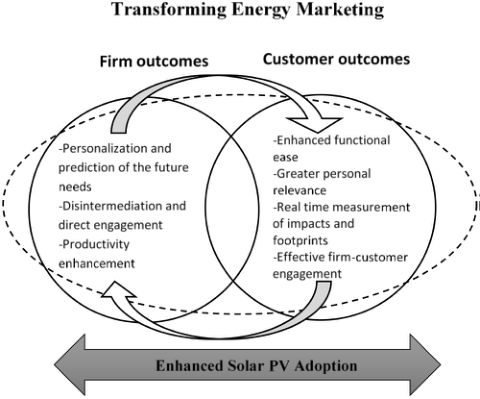
This section presents main themes emerging from the data. Following Kumar et al.’s (2021) assertion that the impact of digital technologies can be vie- wed from the perspective of firms and consumers, section “Firm Outcomes” presents how solar PV companies can transform their operations and gain operational efficiencies while section “Customer outcomes” highlights tech- nology’s impact on consumers and the nature of their interaction with the firm (Figure 1).
Firm Outcomes Personalization and Prediction of Future Needs Personalization and prediction of future needs can help companies’ in fra- ming their value offerings and ensuring optimal utilization for both existing and perspective customers (Gupta and Ramachandran, 2021). The data gene- rated from the use can assist companies in understanding energy needs, consumption behavior and an approximation on existing or perspective needs the effective utilization of the system can yield. For instance, the need of complimentary uses such as linking solar systems to electric charging station, energy utilization for heating and cooling purposes, net metering and similar uses can ensure an effective and optimal utilization of generated energy. The gained insights can also help in suggesting what would be an optimal time for a household to self-consume, transfer to the grid or use energy for other purposes. Likewise, the data can also help companies in devising packages and transforming value offerings that can better serve perspective customers’
Transforming Energy Marketing Practices for Enhanced Solar PV Adoption 111
Figure 1: Impact of transformative energy marketing on solar PV business.
needs. The personalization based on needs, demographics, geographical loca- tion and related factors can help companies devising the services that are more suited to an individual customer.
Disintermediation and Direct Engagement One of the biggest challenge solar PV companies beset with concerns with the time and efforts companies needs to put in to secure a single sale. Previously, a number of companies chose to reach out to customers through telephonic marketing, door to door sales and similar approaches that involved direct interaction. The approach worked as companies were able to generate sales, however, the time or efforts often required to secure a single sale make the approach less desired one for companies seeking growth and high volume of sales. The time needed to discuss the expected generation potential, size of equipment, system price, the change in price or generation capacity with change in size of the systems, a possible use of complimentary services or related considerations often makes the process resource intensive and exhau- stive for the companies. On the contrary, the high cost of the conventional mass medium such as television, newspaper and similar outlet leaves very little options for a majority of companies to opt for these. Only large size companies, for which solar PV is one part of the portfolio has been able to use that for a limited period of time. The use of advance technologies can also help companies in this regard. Companies can integrate these to their website were consumers can self-design the system, see the generation poten- tial based on the location data, feed information, assess estimated prices and savings the use of the system can entail. The measure will help companies easing burden on its sales team, ensure efficient utilization of the resources, and a possibility to serve a wider segment of the market.
Productivity Enhancement The increased automation, interconnectedness of the devices and the use of advance applications and software can help companies in ensuring that
112 Rukh Shakeel and Rajala
system functions optimally. The use of digital devices and smart solutions has made it possible for the companies to remotely oversee if there are any issues with the system functionality, connectivity, output or other operational issues. Companies can assess the situation, assist in troubleshooting or pro- vide needed assistance to ensure the system functions optimally. Likewise, the increased automation and less human interaction means companies can have more resources at their disposal that can be utilized at other avenues that can improve companies’ performance.
Customer Outcomes Enhanced Functional Ease The technical and disruptive nature of the solar PV often cause reluctance in the widespread adoption and use of the technology (Alipour et al., 2020). The use of IOT based devices, remote monitoring through the use of mobile applications and smart devices, notifications in case of errors or failures can play an important role in ensuring the ease of use. The individuals can follow the actual generation and can seek assistance in case something is not working in accordance to the system specifications. Likewise, the graphical and user- friendly display of output, the amount of grid energy saved, reductions in the emissions and potential savings can address perceived complexities associated with the use by making system user-friendly.
Greater Personal Relevance A better understanding of the consumers’ needs, energy consumption beh- avior, the demographic situation and related factors can provide important information to tailor solutions according to customers’ needs (Kumar, 2018). The obtained information can help personalizing what kind of system and devices may work the best for the household. Likewise, the data generated from the use can also help understanding when energy demands peaks, when there is excess energy in the system that can be used for other purposes such as heating or cooling needs, charging of the vehicles or can be put to any other use. The personalization content becomes vital as the economic gains form the system can be maximized if the amount of energy is used at site instead of transmitting it to the grid as the price of outbound electricity is generally lower than the electricity bought from the grid.
Real Time Measurement of Impacts and Foot Print It is often important for the consumers to understand the actual impact their use of system is generating. For instance, the amount of clean energy pro- duced by the system actually means less generation related emissions. The information can help consumers realizing their impact in a tangible form by knowing the reduction in emissions and getting a comparison on e.g. equiva- lent to number of trees planted or gallons of gasoline saved. The information and assessment can help consumers understand and gauge their impact as well as provides a good source of information to measure their footprint.
Transforming Energy Marketing Practices for Enhanced Solar PV Adoption 113
Effective Firm-Customer Engagement The integration of the technologies can also help in strengthening the bond between consumers and the firm (Kumar, Ramachandran and Kumar, 2021). The tailoring of product or services packages according the customers’ needs, remote monitoring to ensure the effective functioning of the system, the use of gained insights for the personalization, effective management and use of the energy, follow-up services and complimentary solutions and smooth flow of information can enhance customer engagement. The adoption of solar PV is often influenced by factors such as the neighbor or peer effect. Companies’ abilities to serve existing customer can often lead to the positive repute that can generate a positive word of mouth effect for companies.
CONCLUSION
The adoption and use of a technology is a complex process influenced by a number of factors grounded in personal, social, economic, technical, environ- mental and regulatory considerations (Shakeel, Takala and Zhu, 2017). The high cost, technical nature and being at the earlier phases of diffusion makes it important for companies to devise information campaigns and offerings that can address the barriers influencing the adoption. One of the biggest challenges solar PV companies are facing concerns with increasing customer reach and reducing customer acquisition costs. The high cost of conventional means of marketing and issues pertaining directly reaching customers war- rants companies to transform marketing approaches by integrating advance and digital technologies to facilitate the process. The use of digital techno- logies can help reaching customers, reducing transaction costs by providing companies an opportunity to digitalize the process, reducing the involvement of sales personal during, especially during early phases for information deli- vering and carrying out basic activities. Likewise, the use of technologies can help addressing customers concerns by using the real time data, based on the geographical location, assessing the generation potential at site, enabling companies to devise the package and offering that can match the customers’ needs. Moreover, the use of smart applications and the devices can provide the valuable insights on consumption patterns, enabling an efficient utilization of the generated energy as well as providing insights on the complimentary usages to increase the effective use of the system.
REFERENCES
Alipour, M. et al. (2020) ‘Predictors, taxonomy of predictors, and correlations of predictors with the decision behaviour of residential solar photo- voltaics adoption: A review’, Renewable and Sustainable Energy Reviews. doi: 10.1016/j.rser.2020.109749. Baker, M. J., Buttery, E. A. and Richter-Buttery, E. M. (1998) ‘Relationship mar-
keting in three dimensions’, Journal of Interactive Marketing, 12(4), pp. 47–62. doi: 10.1002/(SICI)1520-6653(199823)12:4<47::AID-DIR5>3.0.CO;2-B. BP (2021) Statistical Review of World Energy - 70th Edition. Available at: https://www.bp.com/content/dam/bp/business-sites/en/global/corporate/pdfs/ energy-economics/statistical-review/bp-stats-review-2021-full-report.pdf.
114 Rukh Shakeel and Rajala
Dholakia, N., Detlev, Z. and Janice, D.-K. (2011) ‘Technology, Consumers, and Marketing Theory’, in Maclaran, P. et al. (eds) The SAGE Handbook of Marketing Theory. Sage Publications, pp. 494–511. Ertemel, A. (2018) ‘Implications Of Blockchain Technology On Marketing’, Journal
of International Trade, Logistics and Law, 4(2), pp. 35–44. EU (2018) The European Commission’s science and knowledge service, EU SCIENCE HUB. Available at: https://ec.europa.eu/jrc/en/research-topic/hazards-and-risks-c limate-change-impacts. Fitzgerald, M. et al. (2014) ‘Embracing digital technology: A new strategic impera-
tive’, MIT sloan management review, 55(2), p. 1. Grewal, D. et al. (2020) ‘The future of technology and marketing: a multidisciplinary perspective’, Journal of the Academy of Marketing Science, 48, pp. 1–8. doi: 10.1007/s11747-019-00711-4. Gupta, S. and Ramachandran, D. (2021) ‘Emerging Market Retail: Transitioning
from a Product-Centric to a Customer-Centric Approach’, Journal of Retailing, 97(4), pp. 597–620. doi: 10.1016/j.jretai.2021.01.008. Hoyer, W. D. et al. (2020) ‘Transforming the Customer Experience Through New Technologies’, Journal of Interactive Marketing, 51, pp. 57–71. doi: 10.1016/j.intmar.2020.04.001. IEA (2020) National Survey Report of PV Power Applications in FINLAND
2019. Available at: https://iea-pvps.org/wp-content/uploads/2020/09/NSR_Finl and_2019.pdf. IRENA (2018) Global Energy Transforamtion : A Roadmap to 2050. Abu Dhabi. Available at: https://www.irena.org/-/media/Files/IRENA/Agency/Publica tion/2018/Apr/IRENA_Report_GET_2018.pdf. Karakaya, E., Nuur, C. and Hidalgo, A. (2016) ‘Business model chal- lenge: Lessons from a local solar company’, Renewable Energy, 85. doi: 10.1016/j.renene.2015.07.069. Kumar, V. (2018) ‘Transformative marketing: The next 20 years’, Journal of Marketing. doi: 10.1509/jm.82.41. Kumar, V., Ramachandran, D. and Kumar, B. (2021) ‘Influence of new-age tech-
nologies on marketing: A research agenda’, Journal of Business Research, 125, pp. 864–877. doi: 10.1016/j.jbusres.2020.01.007. Lee, R. P. and Grewal, R. (2004) ‘Strategic responses to new technologies and their impact on firm performance’, Journal of Marketing, pp. 157–171. doi: 10.1509/jmkg.68.4.157.42730. Litchman, M. (2014) Qualitative Research for the Social Sciences. Sage Publications. Lo, C. C., Wang, C. H. and Huang, C. C. (2013) ‘The national innovation system in the Taiwanese photovoltaic industry: A multiple stakeholder per- spective’, Technological Forecasting and Social Change, 80(5), pp. 893–906. doi: 10.1016/j.techfore.2012.08.016. Miles, M. B. and Huberman, M. A. (1994) Qualitative data analysis: An expanded
sourcebook. 2nd edn. Sage Publications. Saldana, J. (2015) The Coding Manual for Qualitative Researchers. 2nd editio.
Edited by J. Seaman. London: Sage. Schwab, K. (2016) The fourth industrial revolution. Geneva: World Economic Forum. Shakeel, S. R. (2021) ‘Cleantech: Prospects and challenges’, Journal of Innovation
Transforming Energy Marketing Practices for Enhanced Solar PV Adoption 115
Shakeel, S. R. and Rahman, S. ur (2018) ‘Towards the establishment of renewable energy technologies’ market: An assessment of public acceptance and use in Paki- stan’, Journal of Renewable and Sustainable Energy, 10(4), pp. 045907(1–15). doi: 10.1063/1.5033454. Shakeel, S. R. and Rajala, A. (2020) Factors Influencing Households’ Intention
to Adopt Solar PV: A Systematic Review, Advances in Intelligent Systems and Computing. doi: 10.1007/978-3-030-50791-6_36. Shakeel, S. R., Takala, J. and Zhu, L.-D. (2017) ‘Commercialization of renewable energy technologies: A ladder building approach’, Renewable and Sustainable Energy Reviews, 78, pp. 855–867. doi: 10.1016/j.rser.2017.05.005. Statistics Finland (2021) Housing. Available at: https://www.stat.fi/tup/suoluk/suolu
k_asuminen_en.html. Storbacka, K. and Moser, T. (2020) ‘The changing role of marketing: transformed propositions, processes and partnerships’, AMS Review, 10(3–4), pp. 299–310. doi: 10.1007/s13162-020-00179-4. Tsoutsos, T. D. et al. (2013) ‘Training and certification of PV installers in Europe’,
Renewable Energy, 49. doi: 10.1016/j.renene.2012.01.027. Varadarajan, R. et al. (2010) ‘Interactive technologies and retailing strategy: A review, conceptual framework and future research directions’, Journal of Inte- ractive Marketing, 24(2), pp. 96–110. doi: 10.1016/j.intmar.2010.02.004. White, L. V. (2019) ‘Increasing residential solar installations in California: Have local
permitting processes historically driven differences between cities?’, Energy Policy, 124, pp. 46–53. doi: 10.1016/j.enpol.2018.09.034. Yergin, D. (2006) Ensuring energy security. The Council of Foreign Affairs 2006.
Available at: https://www.foreignaffairs.org/articles/2006-03-01/ensuring-energ y-security. Yousaf, H. et al. (2021) ‘Addressing Financial Barriers Influencing the Adoption of Solar PV: The Role of Business Models’, in Lecture Notes in Networks and Systems, pp. 42–49. doi: 10.1007/978-3-030-80876-1_7.
LISTED IN THE AHFE DIGITAL BOOKSTORE CATALOGUE
Explore the complete digital volume
Human Factors, Business Management and Society
Read this individual research paper free through the original publisher, or explore the full digital proceedings book.
ISBN 978-1-958651-32-2
Explore this ISBN in the AHFE Bookstore ↗Listed in the July 2026 bookstore catalogue; search by ISBN to confirm current availability · Digital book purchase optional