John M Ikome (2023). A Conceptual Review of the Constraints to Global Competitiveness of the South African Automotive Industry. In: Human Factors, Business Management and Society. AHFE Open Access, vol. 97, pp. 143–150. https://doi.org/10.54941/ahfe1003891
Vaal University of Technology (VUT), Industrial Engineering &Operation Management and Mechanical Engineering (IEOMME) Vanderbijlpark Main Campus-South Africa, South Africa ↗
The South African automotive industry is a very important organisation that assist with the well being of the nation, as it contribute to the economic growth of the country and also creates employment for the citizens, this show that this organisation is a key industry for the nation and any constraint to it global competitiveness is of a major consent, that needs a holistic approach to identify the factors that prevent it from achieving the objectives and goals of global competitiveness, a well structured questionnaire was developed and administered in a number of selected South African automotive industry for data collection and according to the results, the political, economic, social, technological and environment has a major influence to the industry’s global competitiveness.
Manufacturing efficiency and competitiveness are major challenges for manufacturing organizations, particularly the South African automotive industry which has to deal with complex automotive components in order to assemble vehicles of different categories to meet the constantly changing customers demand. According to Ikome et al. (2022), the future of the future of automotive industries in developing nations depends on their ability to manufacture product in the smoothest possible way in order to achieve the goal of global competitiveness.
Objective The objective of this research is to analyze and identify the constraint to glo- bal competitiveness in the South African automotive industry, with a focus of developing a rescheduling model that can minimize unforeseen manu- facturing disruptions, in order to improve productivity which in return, help the industry gain competitiveness after meeting the constantly changing customers demand.
RESEARCH METHODOLOGY From an engineering point of view, reliability can also be used to determine the impacts of disruptions in a production line or industry lay-out. Time is used as a function to express the probability of failure. The expression of reli- ability was adopted from the work of Hartzenberg, & Marudzikwa, (2012) and under this section, configurations of the different systems were conside- red, namely; (system in series, parallel and combination of series and parallel). According to Hartzenberg, & Marudzikwa, (2012) the relationship between reliability and failure is as given as equation (1):
R(t) = 1 −λ = e−λt (1) Where; λ is the system failure rate during automotive components manu- facturing and R(t) is the reliability function, and can also be given as R. The reliability of a “series system”, when considered, can be given as expressed in equation (4.18):
Equation reproduced from the original PDF.
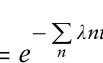
Where Rn = (e−λnt) From expressions (1) and (2), it follows that the overall failure during tiles manufacturing also known as F as given in equation (3):
Equation reproduced from the original PDF.
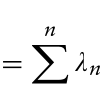
Hence, for a system containing independent components in series, the fai- lure rate of the system becomes the sum of the system failure or the individual components.
By considering a “parallel system or components in parallel”, reliability is determined using equation (3):
Rp = 1 −(1 −R1)(1 −R2)(1 −R3).....(1 −Rn) (4) From equation (4.16) and (4.19) it follows that the system failure is determined using equation (4.20):
Equation reproduced from the original PDF.
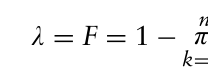
nπ k=1(1 −λk) (5) All the machines or resource configurations above are in series or in parallel or a combination of both. Disruption indices or weights per sche- duling period are introduced using the combination of the above scenarios. The scenario where both series and parallel components operate in a single
A Conceptual Review of the Constraints to Global Competitiveness 145
configuration, expression (5) can be used.
R = wsRs ⌣wpRp (6) Where; ws represent weight for series configuration, represent the reliabi- lity function for a series configuration, represent the reliability function for parallel configuration and wp represents weight for parallel configuration.
Production Line in South African Automotive Industry This lay-out is that of a series configuration and the reliability or failure rate is presented in expression (2). Expression (3) is that of the traditional upper bound approach where after failure emerged the automotive components are damaged and are therefore removed from the production line. For the lower bound approach, when failure occurs automotive components are not dama- ged and as such would continue down the production line. In a case like this, the overall failure rate is given by a similar expression to that of machines in parallel, or expression (5).
Product Family Layout in South African Automotive Industry With this layout, machines and/or resources are configured in either series or parallel or the union of both. With the union of both configurations expres- sion (4) is applicable. Expression (3) and (4) are applicable for series and parallel layout respectively.
Process Department in South African Automotive Industry Resources performing similar functions are grouped together in this layout and it can be assumed that the effective machines arrangement is in parallel. This assumption is due to the fact that the effective reliability of a series of machines can be obtained and can be called the reliability of that line (or that machine). Thus a reliability of a process line is given by first emplo- ying expression (2) for individual lines and then aggregating by employing expression (4).
Fixed Position Layout in South African Automotive Industry In this layout resources are brought to the product that is being processed during automotive components manufacturing. It can be viewed that there is only one workstation available. Thus expression (1) applies.
The following sections deal with applications of expressions (1) to (5) on different industry-layouts in the South African automotive manufacturing industry’s structure. Some of the top leading disruptive factors that affect dif- ferent industry-layouts in most of the automotive manufacturing industries are listed in Table 1. These are the findings from employing expressions (1) to (5) and data obtained from the questionnaire.
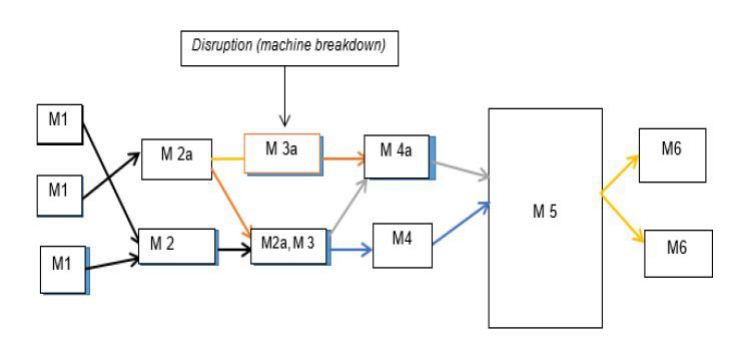
A Case Study Manufacturing Industry The production scheduling diagram in Figure 1 was used for the various pro- cesses of the case study manufacturing industry, where (M1 is the extruder, M2 are the moisture extractors, M3 application, M4 grinding, M5 inspection
146 Ikome
Table 1. Various disruptive factors per industry-layout in South African automotive manufacturing industry.
Table available in the original PDF paper.
Industry- Layout Characteristics Leading Disruptions Production-Line Department in South African automotive manufacturing industry
Made up of machines in a series working on the same raw material during automotive components manufacturing Machines processing similar products are grouped together
Machine Breakdowns Material Shortage Employee Absenteeism Part Damages Order Changes Product Family Layout in South African automotive manufacturing industry
Resources performing similar function are grouped together
Machine Breakdowns Material Shortage Storage Facility Employee Absenteeism Part Damages Process Department Layout in South African automotive manufacturing industry
Resources and materials are brought to the product during the manufacturing process
IT Outages Adverse Weather Machine Breakdowns Shift Changeovers Part Damages Fixed-position Layout in South African automotive manufacturing industries
Adverse Weather Order Changes Transportation Networks Storage Facility Machine Breakdowns Part Damages
Figure 1: Production scheduling diagram to minimise disruption.
and M6 packaging). The aim is to minimise disruption by diverting or by- passing unfinished processed automotive components to another production line if there is a disruption, other than a power failure.
The scheduling model processes the automotive components according to the initial scheduling as indicated from machine 1 to machine 6. Each of the
A Conceptual Review of the Constraints to Global Competitiveness 147
automotive components has to follow a specific production line (L1 or L2) and should there be a disruption as shown in work station or machine (M3a), to (M2a) the production flow will automatically diverted to production line 2 and if the disruption is only on (M3a), (M2a) will switch back to its original production line and continue with (M4a) in other words, (M3a) has been by-passed. The same vain applies to all the other production lines.
It should also be noted that this model does not incorporate the fact that a breakdown can postpone one or more batches of automotive components to the next rescheduling period.
Testing the Model In the test, two production lines were used. Both of them were running under an ideal state and producing the same type of automotive components and when the extruder extrudes the melted component, there run through the various production lines, the transportation times were considered to be zero since these are included in the processing times. The capacity of the machi- nes and production lines were considered to be unlimited. The transportation time between two machines or workstations were assumed to be zero because all the machines or workstations are located in the same building, so the tran- sportation times are short and ignorable. The results are shown graphically in the second part of Chapter 6. It was also observed that the model has some limitations which are, NO by-pass or deviations can be done before the extruder and if there are power failure, the whole system continuers’ with the initial scheduling even though there may be some damage components or parts on the production lines caused by the disrupted power supply.
Line balancing during automotive components manufacturing is directly proportional to the reliability function, which is inversely proportional to a system failure during components manufacturing. Reliability is expressed as a function of failure that has a direct impact on the systems’ performa- nce. Since disruptions may be seen as system failures during components manufacturing, and failure is related to reliability which is mathematically tractable, it is imperative to present the theory of reliability as applicable to this conceptual model.
RESULT
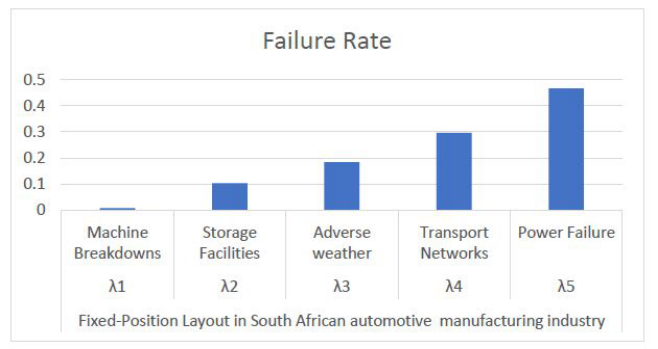
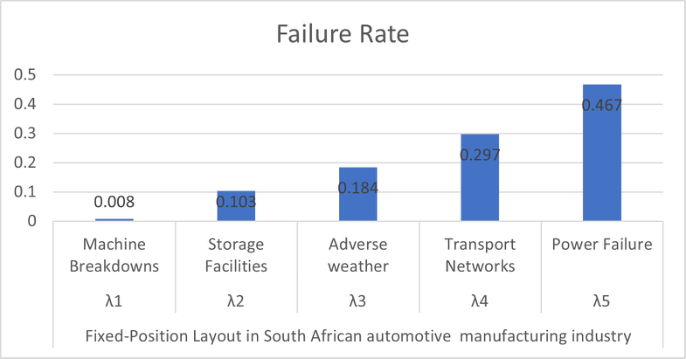
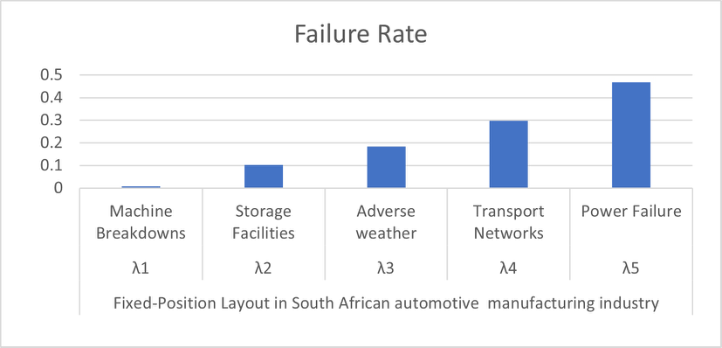
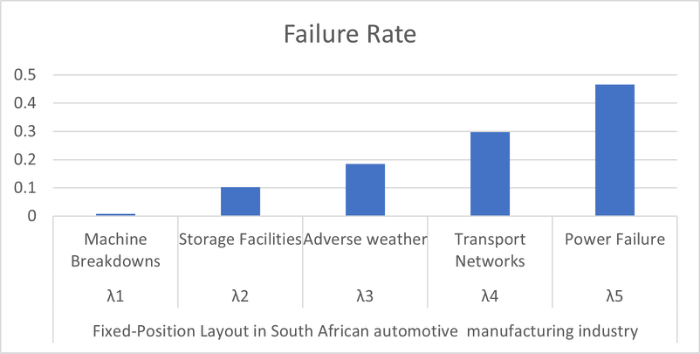
Results of Disruptions in Different Types of South African Automotive Manufacturing Industry Layout For the scientific analysis and validation, data was collected from diffe- rent South African automotive manufacturing industry’s layouts and grouped based on their similarities (i.e., similarities in terms of the products/compo- nent that they produce). The average failure rate was obtained for each type of disruptive factor. The averaging is due to the fact that they produce similar types of automotive components/products and may have machines of diffe- rent ages and as such their reliabilities will also vary. The aggregate results are presented in Figure 2 to 5 how different types of disruptions affect the production performance per industry layout.
148 Ikome
Figure 2: Fixe position layout failure rate.Figure 3: Failure rate.
From the results, it shows that the total failure rate for the production line in the South African automotive manufacturing industry is, λPL = 0.099 while the total failure rate for the process department in the South African automotive manufacturing industry is λPR = 0.123.
Furthermore, for product family layout in the South African automotive manufacturing industry, the total failure rate is λFP = 0.045 while the total failure rate for the process department in the South African automotive manufacturing industry is λFP = 0.194.
From the data analysis, the results reveal that fixed-position layout in the South African automotive manufacturing industry suffers more due to dis- ruptions than other industry layouts, followed by the process department, production line and product family layouts as the last one. It can be obse- rved that power failure, transport networks, machine breakdown, adverse
A Conceptual Review of the Constraints to Global Competitiveness 149
Figure 4: Failure rate.Figure 5: Failure rate.
weather and storage facilities are the leading factors of disruptions on fixed position layout in the South African automotive manufacturing industry.
Power failure and Machine breakdown were recorded to have the maxi- mum impact of disruptions when compared to the impact it has on other industry- layouts. It can be seen from the results of Figure 2 to 5 that disruption of one type (e.g. machine breakdown) can have a great produ- ctivity effect on a certain industry- layout, whilst similar disruption can have devastating effects on another type.
Machine breakdown, material shortages and employee absenteeism are found to be the most leading disruptions candidates in the production line department in the South African automotive manufacturing industry. Product-family layout in the South African automotive manufacturing indu- stry is not tied down by material shortages, because if the material is out of stock at a particular workstation, it can be sourced from workstations within the group.
150 Ikome
CONCLUSION
From the analysis, a number of Industrial and Mechanical engineering tech- niques were applied namely reliability and rescheduling models in order to identify and minimize unforeseen manufacturing disruption in the South African automotive industry, with the objective of improving productivity out-put and competitiveness. The results, suggests that in order to enable a transition to smooth manufacturing competitiveness, the South African auto- motive industry needs to embrace modern technology in order to minimize the number of unforeseen disruption which renders the entire production system obsolete, particularly machine breakdown and power failure which are the major disruptive factors during production.
REFERENCES
Booher Ikome, J. M., Laseinde, O. T. and Katumba, M. G. K., 2022. The Future of the Automotive Manufacturing Industry in Developing Nations: A Case Study of its Sustainability Based on South Africa’s Paradigm. Procedia Computer Science, 200, pp. 1165–1173. ELSEVIER. Hartzenberg, T. & Marudzikwa, S. (2012) Transfer of technology for successful inte-
gration into the global economy: A Case study of the South African automotive industry transfer of technology. New York: United Nations.
LISTED IN THE AHFE DIGITAL BOOKSTORE CATALOGUE
Explore the complete digital volume
Human Factors, Business Management and Society
Read this individual research paper free through the original publisher, or explore the full digital proceedings book.
ISBN 978-1-958651-73-5
Explore this ISBN in the AHFE Bookstore ↗Listed in the July 2026 bookstore catalogue; search by ISBN to confirm current availability · Digital book purchase optional