Gioele Micheli, Seda Aydogdu (2026). Understanding the Voice of the Press. A KPI-driven Approach to Analyzing Press Requirements for Technology Development. In: Advances in Human Factors of Transportation. AHFE Open Access, vol. 224, pp. 234–240. https://doi.org/10.54941/ahfe1007850
Automotive press reviews contain rich descriptions of vehicle behavior, yet their qualitative nature limits their use in human-factors engineering. This paper introduces a concise and reproducible method for converting press narratives into structured criteria relevant to vehicle development. The approach transforms unstructured journalistic text into actionable human-factors insights through a structured qualitative analysis process including systematic statement extraction, thematic coding, sentiment tagging, and expert validation. A curated sample of review articles from a single automotive publication forms the dataset. Each article is screened for evaluative statements describing aspects of drivability, user experience, comfort, handling, braking, acoustics, and related vehicle attributes. Extracted statements are coded by sentiment, discipline, and thematic content. This process yields a large pool of unique descriptive expressions, which are then clustered into coherent themes through iterative qualitative analysis. The themes form the foundation of discipline-specific criteria that capture how journalists describe vehicle qualities such as steering precision, ride comfort, interface usability, and perceived performance. Sentiment tagging highlights which attributes are often criticized, which are praised only when exceptional, and which draw balanced commentary. Although no quantitative results are reported, the method shows how press perceptions can reveal asymmetries in user expectations and areas of potential dissatisfaction. Expert workshops refine the criteria to ensure technical consistency and reduce coder bias. The method provides a scalable framework for integrating experiential press language into early-phase requirements engineering, benchmarking, and user-centered product development, offering human-factors practitioners a structured way to interpret the press voice and derive criteria that reflect real-world perceptions of vehicle performance.
When choosing a product on the market, consumers face an increasingly large selection of alternatives. Among these, media is an important and underused resource (Guo et al., 2022). While some OEMs in the automotive industry consider grading metrics, a structured approach that also incorporates the voice of the press is missing.
Understanding the Voice of the Press – A KPI-Driven Approach 235 In a period of increasing automation of driving functions, growing digitalization, and higher connectivity, customer-centric feedback is urgently required. Human-centered development not only affects HMIs but is also important for designing system functionality such as ADAS (Aydogdu, 2025). For instance, results from FIA (Fédération Internationale de l’Automobile; 2025) Region I indicate that LKAS, a widely used ADAS system, receives poor trust evaluations due to its functional behavior.
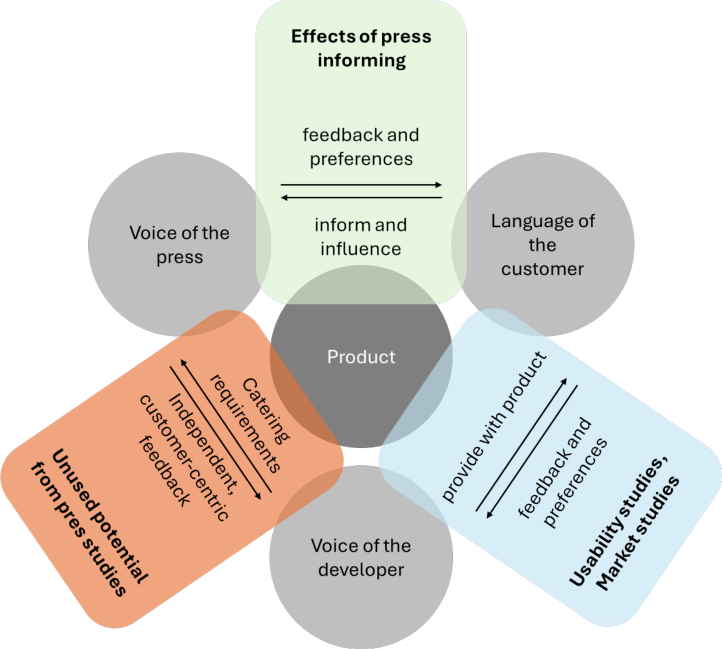
Figure 1: Relation between different stakeholders’ languages.
The voice of the press (Fig. 1) can be regarded as a valuable source of data informing developers in two ways:
Press provides independent, developer-agnostic feedback centered around customer preferences and influenced by customer experiences.
Press represents a major source of customer preference and can therefore serve as an important information channel.
Relying solely on numeric scores supported by company-internal test values is insufficient to fulfill press requirements. Considering the native voice of the press offers a clearer perspective on how certain metrics are composed and what matters most to evaluators when giving subjective scores. Evaluating
236 Micheli and Aydogdu individual statements alone would lead to an abundance of unstructured and partially contradictory opinions. To produce actionable results, information must be structured and summarized. For this purpose, we propose a method to transform native-language press reviews into a hierarchical KPI model using qualitative analysis.
OVERVIEW AND METHODS Developers need information to design products tailored to customer needs. With respect to Figure 1, this requires an overview of the voice of the press within their segment. This shapes the overarching research question:
What verdicts and comments does the press voice on our products and those of relevant competitors, and what are these statements based on?
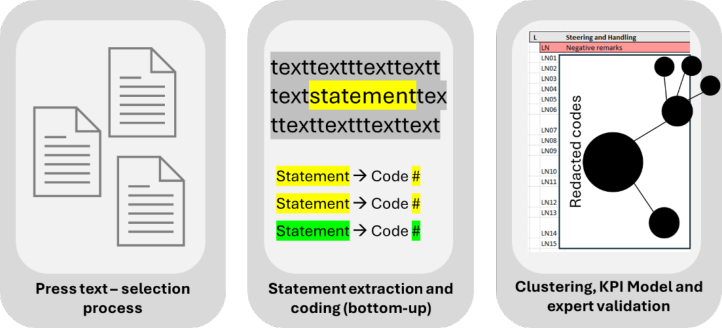
Fig. 2 offers an overview on the methods used in this paper.
Figure 2: Overview of method of KPI extraction.
TEXT SELECTION PROCESS From the overarching research question, a specific scope can be formulated by narrowing down the relevant industry (e.g., automotive, medical) or segment (e.g., A-segment, station wagons). After defining the scope, an analysis of media resources should be conducted to understand which media relevant consumers consult in their iinformation-gathering process. This may involve total circulation data or online studies on media consumption.
The resulting pool of publications can then be narrowed using the defined scope and by selecting an appropriate timeframe that balances data volume, recency, and processing effort. From the remaining issues, relevant article formats can be selected, resulting in a final set of articles.
STATEMENT EXTRACTION AND CODING Once a set of articles is selected, the extraction and coding of statements begins. Every evaluative statement about either the product or its direct competitors is added to a database. A relevant statement is defined as any remark about the product or its competitors. Prosaic or unrelated content is
Understanding the Voice of the Press – A KPI-Driven Approach 237 excluded. For transparency, each entry includes details such as publication name, year, issue number, article type, and page number. Statements may also be classified by discipline (e.g. UX, chassis, drivetrain).
In the case of a benchmark, the model name of the product is noted. Although the process is manual, we recommend using an automated approach to improve efficiency.
Statements are categorized by sentiment:
Neutral: Mentions an aspect of the product without evaluation
Positive: Praises an aspect
Negative: Criticizes or suggests improvement
Expression: Dependent on customer preference (e.g., a stiff suspension valued by sporty drivers but disliked by comfortoriented users) The collected information helps quantify sentiment ratios by discipline and vehicle. While this reveals what is good and what needs improvement, it does not explain why one discipline performs better than another. To uncover these reasons, we apply a bottum-up (Bingham, 2023) coding, approach. Statements are sorted by sentiment and discipline, and each unique content category is assigned a code. New statements receive new codes repeated ones are assigned existing codes. The resulting frequencies help prioritize areas within each discipline.
CLUSTERING AND KPI MODEL While sentiment data identifies broad areas of improvement (often aligned with departments), qualitative coding identifies specific issues. For complex products, such as automobiles, this level of detail is insufficient. Two statements within the same discipline may affect distinct development teams. Since some improvements require substantial resources, prioritization within a discipline is essential.
To support this, we employ a hierarchical KPI model (Van de Ven, 2023). Codes are clustered into overarching themes, each associated with a KPI. KPIs may be defined in two ways:
Strictly applying company-internal KPIs that are relevant to each department and cluster the press data accordingly. This approach yields best consistency with company-internal development routines but might lose the press understanding.
Defining press-KPIs that mainly rely on the article contents. These KPIs are generated by clustering the codes into coherent, measurable KPIs, thereby ensuring that all results rely on the source content only. While press-KPIs might be less associated with internal processes and thereby require more validation effort, they pose the most accurate way to reflect the voice of the press.
Press KPIs offer a clear way to measure success in press-related fields across disciplines. They allow teams to identify core issues requiring priority and to understand which subjective attributes influence performance.
238 Micheli and Aydogdu To make the press KPIs functional, in a last step an expert verification workshop takes place with the task of verifying that the KPI model is sound. In this workshop, experts are led through the model structurally to verify:
That the codes accurately represent the mentions and their naming follows standard expert terminology.
That the clustered KPIs are assembled with the correct codes and that the KPI naming also follows standard expert terminology.
RESULTS AND EVALUATION METHOD For the first article set, we selected 20 articles from an automotive publication. From these, more than 1,000 individual product mentions were extracted, producing more than 1,500 assigned codes from a code sheet containing over 200 unique codes. These codes were clustered into more than 30 press KPIs.
Although specific results are subject to intellectual property protection, we propose an evaluation approach with two levels:
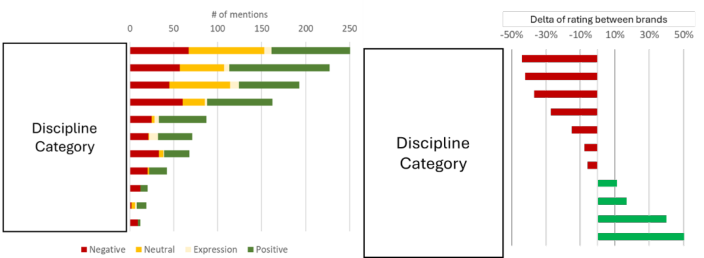
High-level overview dashboard (Fig. 3). Overview on mention frequencies, benchmark comparisons, and discipline importance.
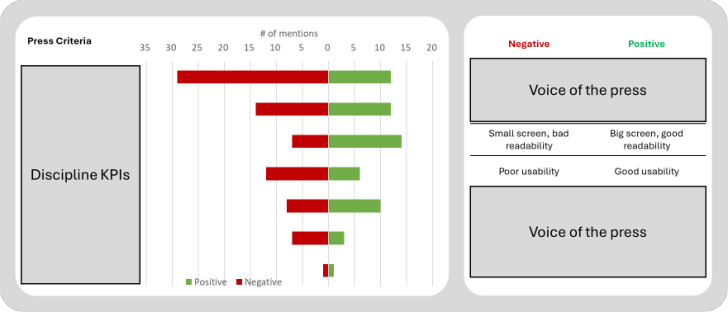
Within-discipline KPI dashboard (Fig. 4). Summary of positive and negative mentions for each KPI, summary of language used.
As frequencies of product mentions are a result of the database entries, an overview benchmark (Fig. 3) of media representation can be made. If different disciplines are considered, an overview of importance by discipline can be made. This overview can be further expanded by adding the sentiment scales. Sentiment bars can then efficiently display importance and show which problems matter most. We display results absolutely to visualize relevance of negative/positive feedback of each discipline, and relatively to visualize each discipline’s press performance.
Figure 3: Insights on overview dashboards. Specific disciplines and brands redacted for intellectual property protection.
Understanding the Voice of the Press – A KPI-Driven Approach 239 Within each discipline, a KPI dashboard (Fig. 4) is displayed. The KPI dashboard summarizes the sum of all positive or negative mentions within each KPI and provides a summary of the language used to describe what makes up positive or negative feedback.
Figure 4: Insights on structure of a KPI dashboard. KPIs and voice of the press redacted for intellectual property protection.
CONCLUSION AND OUTLOOK The analysis of press reviews offers a complementary information source for evaluating technologically complex products such as vehicles equipped with advanced driver assistance systems (ADAS). By systematically analyzing media feedback, developers can identify perceived strengths and weaknesses of vehicle functionalities and derive insights for customer-centered product improvements. The presented approach demonstrates how qualitative press statements can be transformed into structured evaluation criteria through coding, sentiment analysis, and thematic clustering. However, press feedback should not replace direct customer feedback, as journalists often evaluate vehicles from a technical or engineering perspective rather than from everyday user experience. Future work could extend the framework by integrating additional data sources such as customer reviews, social media feedback, and structured user studies. Furthermore, natural language processing methods could support the analysis of larger datasets and enable scalable evaluation across different vehicle segments and markets. These extensions would contribute to a more comprehensive understanding of how advanced vehicle technologies are perceived and would support human-centered vehicle development and requirements engineering.
REFERENCES
Aydogdu, S., Kersten, T., Schuler, K., Schick, B., & Micheli, G. (2025). Holistic evaluation methodology of the user experience of driver assistance systems in the combination of human–machine interface and functional performance. In 15th International Munich Chassis Symposium 2024 (pp. 65–77). Springer. https://doi. org/10.1007/978-3-662-71064-7_6
240 Micheli and Aydogdu Bingham, A. J. (2023). From data management to actionable findings: A five-phase
process of qualitative data analysis. International Journal of Qualitative Methods, 22, 1–11. https://doi.org/10.1177/16094069231183620 Fédération Internationale de l’Automobile (FIA) Region I. (2025). Final report: ADAS & DCAS evaluation. https://www.fiaregion1.com/wp-content/uploads/2026/01/ Final_Report_ADAS_DCAS_FIA_2025.pdf Guo, F., Chen, J., Li, M., Ye, G., & Li, J. (2022). How do expert reviews and
consumer reviews affect purchasing decisions? An event-related potential study. Journal of Neuroscience, Psychology, and Economics, 15(2), 101–118. https://doi. org/10.1037/npe0000157 Van de Ven, M., Machado, P. L., Athanasopoulou, A., Aysolmaz, B., & Turetken, O.
(2023). Key performance indicators for business models: A systematic review and catalog. Information Systems and e-Business Management, 21, 753–794. https:// doi.org/10.1007/s10257-023-00650-2
LISTED IN THE AHFE DIGITAL BOOKSTORE CATALOGUE
Explore the complete digital volume
Advances in Human Factors of Transportation
Read this individual research paper free through the original publisher, or explore the full digital proceedings book.
ISBN 979-8-950676-00-0
Explore this ISBN in the AHFE Bookstore ↗Listed in the July 2026 bookstore catalogue; search by ISBN to confirm current availability · Digital book purchase optional