John M Ikome, Opeyeolu Timothy Laseinde (2023). A Conceptualised Rescheduling Approach to Minimise Manufacturing Disruptions in the South African Automotive Industry. In: Production Management and Process Control. AHFE Open Access, vol. 104, pp. 108–116. https://doi.org/10.54941/ahfe1003058
1 Vaal University of Technology (VUT), Industrial Engineering and Operation Management and Mechanical Engineering (IEOMME) Vanderbijlpark Main Campus-South Africa ↗
2 The University of Johannesburg, Mechanical and Industrial Engineering Technology, DFC Campus, 2028, South Africa ↗
Manufacturing organisations are very important industry globally as the goods that are produced and supply for fills the day to day demand of customers and any disruption within the manufacturing sub system, can be very detrimental to the organisation, as it will create a bottleneck that can put a constraint to the entire system and render it obsolete, particularly as observed from the South African automotive industry, using a number of productivity, reliability and failure techniques. According to the results, it shows that manufacturing disruption can be minimized if the proper reliability strategies and rescheduling models are put in place.
The global automotive industry is a very critical organization as it careters for the need of every country which includes transportation, agriculture, including supply chain of day to day activities and many other. Due to the importance of this industry particularly in emerging nations, the production process must be done in an orderly manner with the most smoothest possible way in order to obtain the desire productivity outputs and competitiveness. From the aforementioned, any disruption within these manufacturing pro- cess, can be a devastating constraint to the entire production system which may lead to limited competitive advantage for the organization.
LITERATURE REVIEW
HSI as a Supportive Framework for Design and Modeling Humphrey and Memedovic (2013:2) remarked that the effect of globalisation on the automotive industry of emerging nations not just occurs because of
A Conceptualized Rescheduling Approach to Minimized Manufacturing Disruptions 109
policies, trade regulations and the international procedures, including strate- gies of leading businesses, but in addition as a result of automotive industries value chain changes and improvements.
According to Sturgeon et al. (2019), the automotive industry is unique due to extremely focused and structure of its firm. Very few immense orga- nisationsations apply a remarkable measure of control over smaller firms). Previous research was done by Naude and Badenhorst-Weiss (2016b), how- ever, state clearly that OEMs do not wish to manage an enormous number of suppliers since this usually results in expanded use in organisationsation, additional expenses and quality issues. Henceforth as opposed to managing numerous suppliers, suppliers are arranged out into levels, where first-level suppliers are left to manufacture and design a large number of the assemblies themselves and second-level suppliers to help with designing and manufactu- ring the parts or components. This inclination from the OEM has reduced the size of suppliers regarded as qualified to partake in the automotive value chain in order to improve productivity.
Globalisation has additionally made two classes of suppliers in the auto- motive industry, this includes global and local suppliers. Previously, lead firms either sent out automotive parts to automotive manufacturing indu- stries or relied on suppliers within the local geographical location (Sturgeon et al., 2019). But today according to Sturgeon and Lester (2014), we have the surfacing of new types of suppliers called global suppliers.
According to an ongoing investigation of the global automotive industry, there is a focus on rebuilding and restructuring, aimed at creating an associa- tion of manufacturing capability, technological expert and capital access for global suppliers (UNCTAD, 2015). Few global suppliers create local netw- ork systems of second-and third-tier subcontractors, prompting supply chain network improvements and updating.
Spread According to Sturgeon and Van Biesebroeck, (2015), Industries that manu- factures automotive parts are organized both nationally and regionally to be closer to the final assembling plants. This strategy optimizes the speed of deli- very and the production of more standard or generic light parts and also take advantage of low labour cost (Sturgeon & Van Biesebroeck, 2015).
Normally, emerging nations are used by technologically advanced nations for their low-cost labour and a large number of resources. Baldwin (2012) said due to this, nations have been linked together including the advantage of speeding up growth in poor nations as a result of permitting them segments into already existing supply chains management systems).
Emerging nations have obtained access to take part in the supply chain because of supply chain disintegration. According to Sturgeon and Van Biesebroeck (2015), this is specifically because of the genuine correla- tion and development of potential markets, including immense access ranging from a good number of experts, low cost, and skilful labour in bigger nations in the emerging world. Sturgeon and Van Biesebroeck, (2015), said this inclu- des examples such as India, Singapore, China and Brazil that have attracted
110 Ikome and Laseinde
influxes of investment, and equally supply emerging markets and also export back to technologically advanced economies.
Role Changes Sturgeon et al., (2019) explained that the globalisation of leading automo- tive manufacturing industries has also stimulated demands for the production of local parts but as a tender or wining of contracts. They further added that due to the increased global demand, OEMs prefer the presence of a number of their largest suppliers as requirements for new automotive parts manufacturing (Sturgeon & Florida, 2012).
Original Equipment Manufacturers (OEMs) or automakers are the lead firms within the automotive industry. They manufacture and manage the production of most automotive engines, product and modular design, tran- smission and assembling of automotive vehicles within their plants and also have potential buying power within the supply chain Management system (Sturgeon et al., 2019).
According to Sturgeon and Van Biesebroeck (2015), outsourcing has prom- pted the formation of huge international suppliers from the early 1990s, which have taken on a progressively broad section of manufacturing, foreign direct investment and design flexibility.
This has likewise created a trend pattern of putting together a lot of activi- ties within the suppliers’ value chain (Sturgeon, Memedovic & Gereffi, 2019). For instance, suppliers have taken on the most important role within the desi- gning process, including the establishments of their very own focused areas and designs centres near those of their significant customers to encourage a joint effort (Sturgeon and Van Biesebroeck, 2015).
Within this process, quality and design specifications are either done toge- ther with the customer and the suppliers, and equally proper information on the quantity and what to produce. Initially, engineers and designers from lead and suppliers work in collaboration to design and develop automotive parts that are required to function within the overall design contest of the vehicle.
Future Changes Research work done by Sturgeon and Van Biesebroeck (2015), concluded that there will be a long-term growth and development particular in:
1. A shift of automotive manufactures to emerging nations, where the will be robust sales and growth. 2. Alliance within the international supply chain management system (SCM) and final assembly. 3. Internationalisation of emerging nations’ indigenous automakers brands (example included; state-owned automotive manufacturing industry in the Republic of China, Geely’s the takeover vehicle units in Sweden, Volvo & Ford of Ford’s).
Humphrey and Salerno (2014), asked one critical question if the com- mitment of global manufacturing frameworks prompts practical increments in wages and job creation in emerging nations. Furthermore Sturgeon and
A Conceptualized Rescheduling Approach to Minimized Manufacturing Disruptions 111
Van Biesebroeck (2015), also asked if alliance and globalisation of supply base pose any serious threat to the future of small, lower-ties and local suppliers.
In a separate context, Marchese et al. (2019), also said taking part in the value chain is a strategy for them to get useful information related to the required approach needed to enter the global automotive markets, as it is difficult for local firms to enter this market.
An Overview of Immerging Nations in the Automotive Industry Due to the limitation of the research work, we are only going to do an overview of Indonesia, and China which are emerging nations, as they have some positive input and history within the automotive industry compared to other developing countries.
The Indonesia Automotive Manufacturers The growth of Indonesia’s economy was influenced by mining agriculture and manufacturing, which are the main dominant industries. Among them, manufacturing industries play a very vital role in Indonesian economic gro- wth, particularly the automotive which creates employment and also export finished products. According to Rahmat and Dwi (2015), the automotive industry is global so the Indonesian automotive industry must compete with other automotive industries around the world in order to grow.
However, the automotive industry of Indonesia, after Thailand and Malaysia became the third country in the ASEAN region to attract a lot of investments. And for them to compete globally, they had to improve on their competitiveness. On the other hand, the growth of the Indonesian automo- tive market was followed by the growing number of imported automotive components especially in 2010 (Munawaroh, 2011).
The China Automotive Manufacturers According to Fuentes et al. (2013), the automotive components manufa- cturer plays a vital role, they supply about 70% of components used in assembling automotive vehicles. Sambharya and Banerji (2016) in a similar research work where the performance of the Japanese automotive indu- stry was examined, further stated that much research work on automotive has been conducted by scholars but research work focusing on automotive components manufacturing industries ad its global competitiveness has been limited.
This clearly shows the gap and need for a research particularly in the South African automotive industry, with special emphasis on performance to increase its competitiveness using many manufacturing strategies that can lead to better performance in competitiveness. On the other hand, one of the paradigms in manufacturing strategy is competition through manufacturing capability (Voss, CA. 1995).
112 Ikome and Laseinde
South African Automotive Industry The Democratic system of South Africa occupies most portion of the Afri- can landmass and is the most elevated state alongside the biggest economy in Africa. South Africa properly came to be an associate state of BRICS on December 24, 2010, afterwards being officially welcomed by the BRIC (Brazil, Russia, India and China) nations to join them. Its significance inside the automotive industry comes from the country’s abundance of the wealth of raw materials and it is residence to over 70% of the world’s chromium, which is a vital ingredient in the stainless steel used to house the catalyst and produce auto exhausts in our modern cars (The Department of Trade & Industry, 2018).
According to Barnes et al. (2018, p. 797), the automotive cluster is the most vibrant and significant manufacturing industry in the country. Though as onset, since opening the economy and entering into the international markets due to globalisation, South Africa is confronted with tremendous challenges relating to competitiveness as it endeavors to go into external marketplaces and tries to retain along with those present in the local marketplace.
Research Objectives One of the research objectives was to analyze the South African automotive industry competitiveness, with a focus of constrains within the manufacturing systems.
Research Methodology In this section, some Industrial Engineering tools were used, namely schedu- ling, theory of constraints and also a number of questionnaires were admi- nistered in order to identifying the cause of competitive problems within the South African Automotive industry. In addition, a conceptualised production rescheduling model was developed in order to minimise unforeseen disrupti- ons during the production process, which as a result, will help improve the global competitiveness of the South African Automotive Industry. Unforeseen disruption during production is a major problem for manufacturing organi- sationsation, as it may lead to zero productivity if possible, solutions are not implemented on time.
The results were tested in a selected case study automotive industry in South Africa to ascertain how various unforeseen disruptions affect the indu- stries respectively and recommendations were made on how the industries should react subsequently when faced with unforeseen disruption which is a competitive challenge. According to available literature, these joint approaches (multi-phased approaches) differ from other approaches.
The manufacturing system should normally produce products based on market demand (i.e. demand triggers production to commence). Knowing that the number of raw materials needed to meet the market demands can be obtained, the input functions can serve as a production command to available machines to satisfy customers demand, i.e. disruption of operation during the first stages of production in a flow-line will hold down other production processes downstream.
A Conceptualized Rescheduling Approach to Minimized Manufacturing Disruptions 113
Occurrences of disruptions in the manufacturing systems should affect the production of the industries involved.
These unforeseen disruptions yield longer actual cycle time on the produ- ction lines, causing delays in delivering customers’ demands which leads to unhappy customers, loss of customers and competitive advantage.
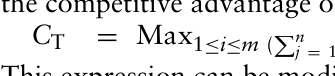
Therefore, the formulation of a mathematical scheduling model as expres- sed in equation (4.5) to (4.12), that can minimize this disruption and improve the competitive advantage of the South African automotive industry is c
Pm
Equation reproduced from the original PDF.
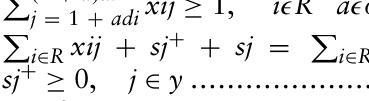
w = 1 tjw/Xij Ytw …………………………….(4.5) This expression can be modified as follows; Minimise P1 j∈y (sj+ + sj−)………………………………….…..….…... (4.6) P jϵy xij = fi, iϵR, ………………………………………….……..... (4.7) P(1 + a)di
Equation reproduced from the original PDF.
di −1 ………………….….(4.8) P
Equation reproduced from the original PDF.
i∈R fi/12, j ∈y ………………………... (4.9) sj+ ≥0, j ∈y ………………………………..….………………........ (4.10) sj ≥0, j ∈y …………………………………..…..……..………….... (4.11) xij ∈(1, 0), i ∈R j ∈y ………………………..……..………….…......(4.12) The constrains (123b) ensures that automotive component i is produced fi times during the scheduled period and constrain (133c) are formulated to keep a maximum distance between each automotive component in the production line.
The distance between each automotive component in the production lines obtained from the formula di = (12/(fi)).
How the Model Operates All the batches of automotive components or parts that are produced every day must be included in the schedule for the month. Different types of components are produced with a different design according to customers demand.
The set of all the batches of components are represented by B, which is indicated in Table 4.1.2. All the processing machines are considered to be inset M and each of the processing machines are included in the model. Every other machine is also considered to be a machine in the set M.
As previously mentioned, time is considered to be discrete. The set of time is finite and indicated by T. The duration of time T should be long enough, otherwise, the model will be infeasible, and it will be impossible to schedule
Table 1. (Definition of the variables for i ∈R, j ∈y).
Table available in the original PDF paper.
Notation Definition Xij 1 if type i is produced in month T, 0 otherwise sj+ How many automotive components can be produced more than P
i∈R fi/12 in Month j sj− How many automotive components can be produced less than P i∈R fi/12 in Month j
114 Ikome and Laseinde
all the batches of components. On the other hand, if the value of T is too long, the computation time can become too long. A formulated experiment has been developed to show a practical solution of the model which leads to a suitable value for the parameter T. By decreasing the length of time, T will be increased, and the solution time increases rapidly.
Each machine of the production line process all the components that pass through the production lines. Therefore, when a batch of automotive compo- nents enters a machined channel, it is assigned a specific route among a subset of the machines. The parameters -λbm indicate which batch passes through which machines channel.
The new set of components will wait in a queue for the first batch of components to be processed before they can pass through the machine for processing. Therefore, according to the definition of -λbm in Table 4.1.2, -λbm = 1.
RESULTS
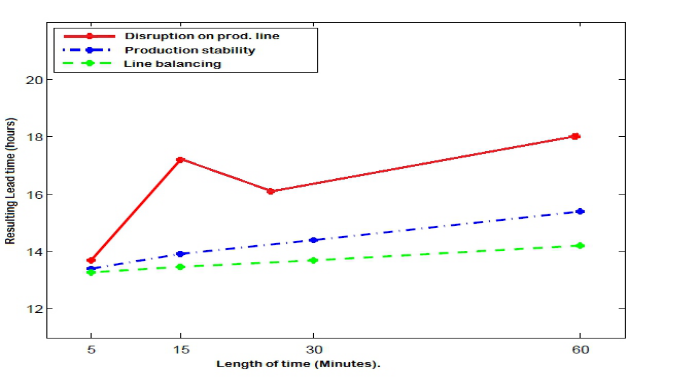
Figure 1 shows the results of the schedule model using a by-pass method (line balancing). The schedule is feasible using expression (4.12 to 4.15) which is a time-indexed model. In the test, two production lines were used. Both of them were running under an ideal state and producing the same type of automotive components and when the extruder extrudes the melted component, there run through the various production lines, the transportation times were conside- red to be zero since these are included in the processing times. The capacity of the machines and production lines were considered to be unlimited.
The transportation time between two machines or workstations were assu- med to be zero because all the machines or workstations are located in the same building, so the transportation times are short and ignorable. It was also observed that the model has some limitations which are, NO by-pass or
Figure 1: Minimising disruptions in SA automotive Industry’s production lines using a by-pass scheduling model.
A Conceptualized Rescheduling Approach to Minimized Manufacturing Disruptions 115
deviations can be done before the extruder and if there is power failure, the whole system continuous’ with the initial scheduling even though there may be some damage components or parts on the production lines caused by the disrupted power supply.
Furthermore, line balancing during automotive components manufactu- ring is directly proportional to the reliability function, which is inversely proportional to a system failure during components manufacturing.
This is evidence from the result as it can be seen that the batches of auto- motive components, enter the machines at the beginning of the production process. Each machine does not process more than one batch of automotive components at the same time. When disruption occurs on the production line, the productivity drops and when line balancing is initiated, the pro- duction flow becomes stable but not at maximum speed until the disrupted production line is repaired.
CONCLUSION
The goal of this paper was to analyze the global competitiveness of the south African auto motive industry using Industrial engineering techniques to iden- tify constraints and disruptions within the manufacturing system in a case study industry, limiting the industry from achieving the goals of global com- petitiveness. According to the results, disruption within the production lines is a huge constraint, which creates a bottleneck that limits the producti- vity out-put. A conceptual by-pass rescheduling was developed and tested on a selected automotive industry and the results reveals that manufacturing disruption can be minimized by apply the re-scheduling model through the application of a by-pass technique within the model.
REFERENCES
Baldwin, R. (2012), ‘Trade and Industrialisation after Globalisation’s Second Unbundling: How Building and Joining a Supply Chain are Different and Why it Matters’, in. Barnes, J. & Kaplinsky, R. (2018) Globalisation and the death of the local firm?
The automobile components sector in South Africa. Regional studies, 34(9), pp. 797–812. Department of Trade & Industry. (2018) Current developments in the automotive Brazilian industry. Research policy, Vol. 31, pp. 1431–1433. Fuentes, A., Gonzalez-Perez, I., Sanchez-Marin, F. T., & Hayasaka, K. (2013). On the
behaviour of asymmetric cylindrical gears in gear transmissions. In Proceedings of the FISITA 2012 World Automotive Congress (pp. 143–150). Springer, Berlin, Heidelberg. Humphrey, J & Memedovic, O. (2013) The global automotive industry value chain: what prospects for upgrading by developing countries. United Nations Industrial Development Organisation (UNIDO): Vienna. Humphrey, J, & Salerno K (2014) Globalisation and supply chain networks: The
auto industry in Brazil and India. Global Networks. 3(2), pp. 121–141. Marchese Petr & Ženka, Jan. (2019). Upgrading in the automotive industry: Firm-level evidence from Central Europe. Journal of Economic Geography. 11. 559–586. 10.1093/jeg/lbq023.
116 Ikome and Laseinde
Munawaroh, S. BPS: Impor Kendaraan Bermotor Melonjak. Jakarta: Bisnis Indonesia; 2011. Naude, Micheline & Badenhorst-Weiss, Johanna. (2016). Supply chain management problems at South African automotive component manufacturers. 15. Rahmat and Dwi (2015). Perceived organisationsational support and leader-member
exchange in cultivating innovative behaviour in South African organisationsati- ons. African Journal of Science, Technology, Innovation and Development, 13(5), 559–571. Sturgeon and Lester, (2014), Automotive Industry in Russia: Impact of Foreign. Sturgeon, T. J., & Florida, R. 2012. Globalisation, deverticalisation, and employment in the motor vehicle industry. In M. Kenney & R. Florida (Eds), Locating global advantage: Industry dynamics in the international economy: 52–81. Stanford, CA: Stanford University Press. Sturgeon, T. J., & Van Biesebroeck, J.: Global value chains in the automotive indu-
stry: an enhanced role for developing countries? Int. J. Technol. Learn. Innov. Dev. 4(1/2/3), 181–205 (2015). Sturgeon, T. J., Memedovic, O., Biesebroeck, J. V. & Gereffi, G.: Globalisation of the automotive industry: main features and trends. Int. J. Technol. Learn. Innov. Dev 2(1/2), 7–24 (2019). UNCTAD. (2015), Statistics, vailableat: https://unctadstat.unctad.org/wds/ReportFo
lders/reportFolders.aspx. (Accessed December 5, 2019). Voss, CA. : Operations Mangement from Taylor to Toyota and beyond ? British Journal of Management, Vol.6, Issue, S17 – S29 (Decemebr 1995). Zhang, Q., Irfan, M., Khattak, M. A. O., Zhu, X. & Hassan, M., 2012, ‘Lean Six
Sigma: A literature review’, Interdisciplinary Journal of Contemporary Research in Business 3(10), 599–605.
LISTED IN THE AHFE DIGITAL BOOKSTORE CATALOGUE
Explore the complete digital volume
Production Management and Process Control
Read this individual research paper free through the original publisher, or explore the full digital proceedings book.
ISBN 978-1-958651-80-3
Explore this ISBN in the AHFE Bookstore ↗Listed in the July 2026 bookstore catalogue; search by ISBN to confirm current availability · Digital book purchase optional