Adrian Morales Casas, Amparo López Vicente, Lorenzo Solano-García, Jose Laparra (2023). 3 sprints from zero to innovative medical device in 16 months: Benefits of combining Human Factors and Agile. In: Production Management and Process Control. AHFE Open Access, vol. 104, pp. 8–18. https://doi.org/10.54941/ahfe1003047
This study aims to lay out an Agile product development case study-oriented research with core tenets on the process mapping and the methodologies involved in the solution implementation. The developed prototype is used for measuring the principal vital signs, without contact, only through video images. The measured vital signs are heart rate, respiratory rate, oxygen saturation, temperature, and blood pressure contactless at 2 meters (6.5 ft). The developed solution was presented in the framework of public bidding for the emergency service of the autonomous community of Andalucía (in Spain). The Agile project management approach has been integrated to overcome the limitations of medical devices' commonly accepted Stage-Gate project management approach. During the prototype's concept and detailed design phases, eight designs for Usability (DfU) tools were implemented to generate value. These tools were implemented in the concept phase in parallel with developing the IP strategy, contextual research, risk management strategy, and regulatory strategy development to identify the user's needs in an iterative process. The users in this case study were paramedics, EMT’s and EMC’s. Further, during the detailed design phase, the DfU helped detect design flaws and usability issues before the validation phase. A multifunctional team of eight specialists was consolidated to develop the solution, with role distribution according to the scrum team model. This team has been working together for 16 months. In the last sprint, first responders tested the prototype with a TRL 7 in laboratory and field trials simulating real conditions. The results were collected through several requirement acquisition techniques. The prototype was continuously improved by collecting value-generating data along the project and establishing strategic checkpoints. Thus, many design flaws and usability issues were prevented throughout the concept and development phase. Besides, reducing the development time without compromising all the necessary design traceability and quality requirements according to ISO 13485 standards
Recent studies have shown that up to 95% of the MedTech and Pharma indu- stry has benefited from some type of Lean, Six Sigma or LSS management (McGrane et al., 2022). Case studies, although insufficient, also show that
3 Sprints From Zero to Innovative Medical Device in 16 Months 9
there is some operational freedom to implement management methodologies and engineering approaches that help work towards clear goals and obje- ctives in an efficient way in the MedTech field. Management methodologies such as Lean (Anderson et al., no date; Slattery et al., 2022), Lean Six Sigma (Byrne, McDermott and Noonan, 2021), Agile (Gerber et al., 2019; Martens et al., 2022), Stage-Gate (Pietzsch et al., 2009) and hybrids (Cooper and Sommer, 2016) are some of the leading management mythologies applied in the medical device development (MDD) and medical device implementation (MDI) project management.
MDD’s projects differ from MDI’s projects as, although booths are medical devices, they start from a different premise, leading to a different management and methodologies freedom. The authors in (Slattery et al., 2022) describe MDD or new product developments (NPD) as products that emerge from a concept, and their lifecycle mostly ends when they reach the validation phase. At this point, the knowledge achieved in the NPD stage provided the necessary inputs to work on the MDI project or new product implementation. Therefore, all activities commencing after the initial product conception up until the point of mass manufacture belong to an MDI project management and are out of the scope of this work.
A project that is well-designed and managed has the potential to deliver high-quality results, meet or exceed stakeholder expectations, and achieve its intended goals and objectives. However, many factors contribute to a pro- ject’s success. From defining clear goals and objectives and ensuring effective leadership and communication to having the right resources and a solid plan in place, every aspect of a project must be carefully considered and managed. Therefore, well-executed project management in MedTech is increasingly important as it requires careful planning, organization, and execution.
In this article, we will explore the key elements necessary for the project management of MDD to succeed.
Background
The MedTech and Pharma industry is one of the most innovation-oriented fields with products that, on average, have a lifecycle of only 18–24 months before an improved product becomes available (MedTech Europe’s Facts and Figures 2022 - MedTech Europe, no date). Although the lifecycle of those pro- ducts is relatively short, the ever-increasing level of research and development within the industry and academic research demonstrate a high motivation among all the stakeholders in the field. However, novel products can be chal- lenging to launch. The changes and improvements in the design or processes often require a new validation and submission of the changes to authorities for verification (McGrane et al., 2022).
Furthermore, management strategies based on concurrent engineering and the commonly accepted Stage-Gate system are focused on what needs to be done and when rather than why and how (more on this later) (Design Con- trol Guidance For Medical Device Manufacturers | FDA, no date; Pietzsch et al., 2009; Slattery et al., 2022). Lastly, implementing project manage- ment methodologies or improvements in the MedTech field is slower than
in the lower-regulated industry. Regardless of whether the project is an MDD or MDI, the legislation is strict and thorough throughout the medical device lifecycle, with clearly defended control systems (Boylan, McDer- mott and Kinahan, 2021). MedTech project developments require a large amount of documentation that needs to be generated throughout the pro- ject to ensure traceability of the design process and compliance with the legislation.
All these management approaches and boundary conditions, pecific from the MedTech and Pharma fields, can conflict with a project’s ideal time- cost ratio and the final user’s actual needs. Consequently, the potential risk of causing adverse effects related to usability issues can increase, causing severe time delays and cost increments in the project or dropping the pro- ject. The literature on adverse effects is vast (Lin, Vicente and Doyle, 2001; Fairbanks and Caplan, 2004; Mitchell, Williamson and Molesworth, 2015; Roma and de Vilhena Garcia, 2020). Luckily, industry and numerous investi- gations in academic research explore the possibilities to drive new products from idea to market faster with fewer mistakes using continuous improve- ment management and engineering methodologies. Although, there is still a limited amount of case study-oriented research with a fair absence of well- defined process mapping and listing of the techniques involved in the solution implementation in each case.
This study aims to lay out a product development case study-oriented rese- arch with core tenets on process mapping and the methodologies involved in the solution implementation. The results are divided into four sections the management methodologies, requirement acquisition techniques, the methodology followed in the case study and the conclusions.
Management Methodologies Many methodologies have been created and evolved from the necessity to provide managers and developers with the thinking structure, analysis toolkit and work processes to find the optimum solutions. All the existing mana- gement techniques are created to improve quality, meet customers’ needs, reduce delivery times, reduce costs and achieve regulatory compliance to a different extent. Regardless of the management technique defining the tech- nical requirements and users’ needs is one of the most challenging phases in the entire development process of a product. As mentioned earlier, a misa- lignment of the elected requirements can incur an adverse event, the user’s dissatisfaction with the product or the withdrawal of a product from an advanced development phase back to a detailed design or concept phase.
The five main principles of requirements definition are (1) understanding of the knowledge domain, (2) identifying the main stakeholders, (3) analyses of the characteristics and behaviour of stakeholders, (4) defining the pro- cess to acquire the requirements from the stakeholder’s through a technique or a combination of techniques and (5) extract the requirements from the stakeholders or end users (Salleh and Nohuddin, 2019). These requirement definition principals are commune activities in all management methodolo- gies. Virtually the main difference between the management methodologies
3 Sprints From Zero to Innovative Medical Device in 16 Months 11
is the extent to which they are suited to integrate requirements acquisition techniques and the thinking structure behind them to address problem- solving. Besides, the extent of freedom to integrate iterations or checkpoints to improve the product as the process moves forward continually.
Starting with the first and most accepted management method, Stage-Gate is both a conceptual and operational model for moving a new product from idea to lunch (Pietzsch et al., 2009; Slattery et al., 2022). This method does not consider iterations or repeating previous phases’ activities. However, it has been successfully implemented and helped achieve regulatory compliance when the product is not extremely complex.
Next, concurrent engineering is a widely accepted methodology that acce- pts iteration and clearly defines what and when activities need to be done (Goldenberg and Gravagna, 2018). This methodology often gets confused with the Stage Gate as there is some overlap or coexistence in the design and development phase (Pietzsch et al., 2009). However, iterations are mainly possible in the end stages of the design and development phase, and as in the Stage-Gate methodology, once deployed, it is difficult to repeat prayer activities.
Third, lean management and its hybrid form Lean Six Sigma (LSS), are methodologies that do allow iterations from early phases. They are constant improvement-oriented and have been implemented in MDD’s and MDI’s (Anderson et al., no date; Freire and Alarcón, 2002; de Rossi, 2012; Khan et al., 2013; Pacheco et al., 2015; Byrne, McDermott and Noonan, 2021; McGrane et al., 2022). Therefore, they can be implemented in an MDD if they are well aligned with the risk-oriented approach of the regulating entities.
Last, agile management methods are also applied in the MDD. However, the number of case studies on this subject is fewer as it was mainly applied in software development. Nonetheless, medical software development pro- jects managed through Agile have found acceptance among FDA and ISO regulations (Rasmussen et al., 2009). Besides, Agile is also finding its acce- ptance among projects which develop products (Status Quo (Scaled) Agile 2020, no date). According to the legislation, three principles need to be cove- red by the project management methodology to ensure the product’s safety, proper risk management, quality management and engineering. Agile pro- ject management addresses these three principles in a way that is superior to traditional waterfall project management—besides, Lean and its hybrids also address these three principles. However, Agile offers superior adaptabi- lity to the MedTech MDD process and has proven its viability for developing complex products that combine software and hardware.
Requirements Acquisition Techniques As described, the management methodologies provide problem-solving stru- ctures. Accordingly, inside those structures, the requirements acquisition techniques (RAT) are the tools and guidelines to transfer the requirements to the product in the form of essential design outputs (EDO). The RAT is booth design approaches and methodologies. The primary methodologies used in the requirements definition process are interviews, discussions, focus groups,
surveys, observations, requirements workshops, prototyping and others (Sun et al., 2019). The RAT design approaches, like the methodologies, are helpful tools to convert customers’ requirements into quantifiable product chara- cteristics from the design aspect. The most common design approaches are Design for Reliability (DfR), Design for Quality (DfQ), Design for Validation (DfV) and Design for Usability (DfU) (Slattery et al., 2022).
Materials and Methodology The developed solution by the Institute of Biomechanics of Valencia (IBV) was presented in the framework of the EQUILIN project in collaboration with biosignals solution company Plux. The project was promoted by the 061 Health Emergencies Centre of the Andalusian Health Service, with a total budget of 1 million euros, 80% co-financed by the European Regional Development Fund (ERDF) through the Pluri-regional Operational Program of Spain (POPE) 2014-2020, aid granted by the Ministry of Science and Inno- vation through the FID program “Promotion of Innovation from Demand” of 800,000 euros. The aim was to develop a TRL 7-stage, non-contact vital signs measuring system from the conceptual phase. Therefore, the system had to demonstrate its functionality in a relevant environment. The camera device had to measure the principal vital signs without contact, only through video images. Those vital signs were heart rate, respiratory rate, oxygen saturation, temperature, and blood pressure contactless at 2 meters (6.5 ft). The system included an APP installed on a local dashboard that controlled and received data from a camera device.
A multifunctional team of eight specialists was consolidated to develop the solution, with role distribution according to the scrum team. This team has worked together for 16 months under an Agile project management appro- ach combined with human factor engineering (HFE) or DfU RAT. These tools were implemented in the concept and detailed design phases. The prototype was continuously improved by collecting value-generating data along the project by establishing strategic checkpoints. The DfU helped detect design flaws and usability issues before the validation phase.
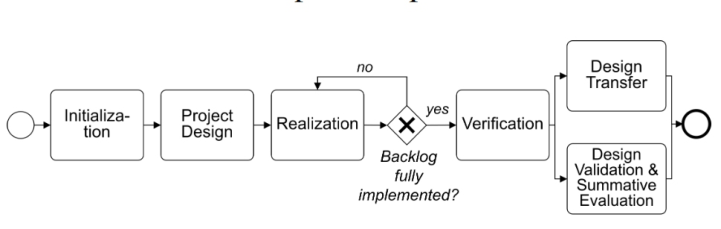
The following roadmap shown in Figure 1 details the Agile Development of Medical Devices (ADmed) main structure proposed by the authors in (Mar- tens et al., 2022). The structure details the five main phases of a MedTech project which are the initialization, concept phase, detailed design, verifica- tion, validation and release. The last two are happening normally almost simultaneously therefore they are represented in parallel. In Figure 1 the concept phase is called project design and the detailed design phases is called realization.
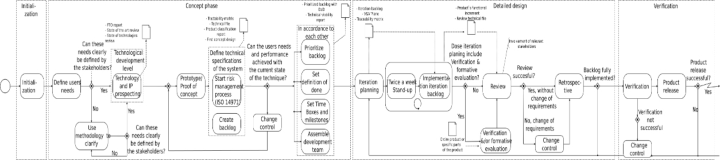
Figure 2 shows a detailed view of the ADmod model adapted to the case study presented in this work. The phases cover in this project are the ini- tialization, concept, detail design and verification phases with their defined activities within each phase as sown in Figure 2. It can be noticed that the project ends in the verification phase, as usually expected in an MDD.
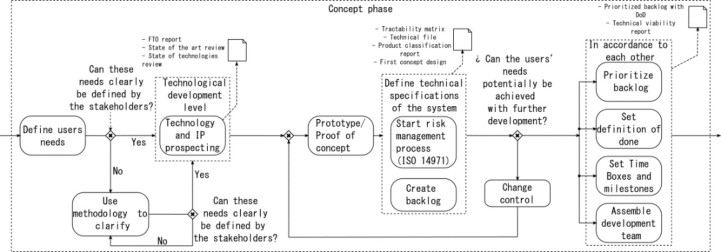
In Figure 3, it can be observed that the phase has two main checkpoints, one to collect the stakeholder’s needs and a second to put in place a proof
3 Sprints From Zero to Innovative Medical Device in 16 Months 13
Figure 1: Main structure of the ADmed model (Martens et al., 2022).Figure 2: Detailed view of the ADmed roadmap adapted by (Morales et al., 2023).Figure 3: Concept phase by (Morales et al., 2023).
of concept to demonstrate the ground technical capabilities from early on. During the acquisition of the stakeholder’s needs, the following RAT were applied: field observation, focus groups, two separate co-creation sessions, one with experts and one with the final users and surveys following the technology acceptance model (TAM).
The first RAT applied was the field observation to identify the standard procedures applied to a patient in an emergency intervention, the parame- dics, EMT’s and EMC’s requirements that could influence in the design and functionality of the system. The sample used in this RAT were eight subjects in total divided in two teams on two different days. Each team was constitu- ted of one paramedic, one EMT and one EMC. Special attention was given to the work sequence and the equipment the team had to carry in each interven- tion throughout the shift. Second, a focus group session took place after each observation session to identify and prioritize requirements and indicators,
which lead to the generation of a follow-up proposal for the people treated by the emergency service, which covers the demands of the agents involved in an emergency service.
Third, two co-creation session were done to generate the concepts of the camera device and the interface of the APP. Besides defining the expected functionalities and work on the technology acceptance among professionals in the emergency sector. In the first co-creation session nine specialist of IBV worked on the concept from the engineering and human factors point of view. In the second session with four paramedics, four EMT’s, one EMC, the project manager and one moderator the participants also worked on the concept development but from the user’s necessity point of view. At the end of both sessions the results were compared and the first concept design drafts, material acquisition requirements and EDOs generated. Lastly, a TAM survey to predict the usability, functionality and acceptance level of new technologies (Garmer, Ylvén and Karlsson, 2004; Maranguni´c and Grani´c, 2015) were shear among 120 participants from which 97 gave feedback.
In parallel to the main requirements acquisition during the first iteration point of Figure 3, a freedom to operate (FTO) analysis, state of the art and state of the technology review were performed. By the end of the process, a first backlog, FTO report, state-of-the-art review and state-of-technology review were generated as outputs.
Once the main requirement of the product was established in the second checkpoint, as shown in Figure 3, the first sprint started. The goal of this first sprint was to develop a first proof of concept prototype based on the acquired knowledge in the first checkpoint. The prototype not only allowed building the ground level of expectations among stakeholders but also allowed setting up the first physical device to start the experimentation. Besides, the pro- totype confirmed the potential disability of achieving the user’s requirements from its concept phase and provided hands-on knowledge of potential risks that had to be mitigated. The outcomes of this iteration were the product classification report, technical file draft and traceability matrix in alignment with ISO 13485 and the first design concept.
After the first sprint was completed and the technical feasibility was pro- ven, the priority backlog was set up, and a technical viability report was generated. The technical viability report detailed the expected outcomes with the then achieved knowledge on none-contact vital signs measurement. Besi- des, throughout the RAT storytelling, the expected user interaction and workflow were mapped out in the viability report and unified among stake- holders in a final revision before moving into further development. However, some outcomes still were contingent on further development during the detai- led design phase and further experimentations. At the same time, the schedule was adjusted, and the assembly of the team was redefined. The team worked as a scrum team of eight members.
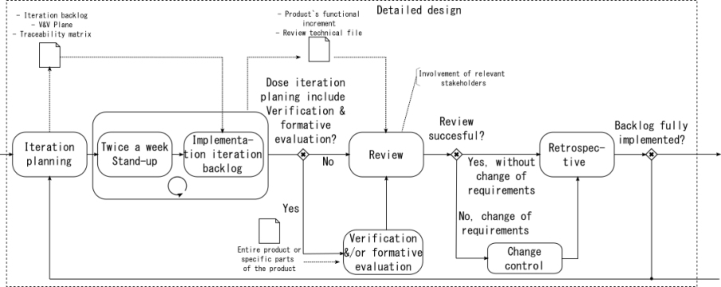
In the detailed design phase, see Figure 4, the scrum team would worked intensively on the project together twice a week. The backlog was revised at the beginning of the first meeting, and new tasks were added to the weekly iteration planning. By the end of the week, a pooled retrospective analysis was done to change control and plan next week’s iteration. Each week the
3 Sprints From Zero to Innovative Medical Device in 16 Months 15
Figure 4: Detailed design phase by (Morales et al., 2023).
iteration backlog, traceability matrix, product’s functional increment file and technical file were revised and updated by the scrum master.
The second sprint was to set up a PLC and casing design as close as possi- ble to the size and shape of concept design drafts. The goal was to prepare a dummy test formative evaluation to ensure that the size, shape and expected weight would be acceptable. Besides, proposing different attachment options on the body or backpack of the paramedics and transport nurses during an emergency service. The outcomes of the evaluation helped to asset the best fixation point, get feedback on the device’s acceptance among the professi- onals and observe the first-time handballing and grip of the device by the users. Last, the dummy prototype went through a heuristic analysis to verify the handballing and grip of the device.
Finally, in the last sprint, the camera device and APP’s first version were tested as a system in a demo. The test took place in the facilities of the emer- gency service of Malaga. The demo was part of the system’s pre-verification and formative usability evaluation as shown in Figure 4. The demo resulted in no usability flaws from the camera device and minor usability and con- nectivity related flaws on the APP that could be changed inside the detailed design phase.
CONCLUSION
The shown case study presented an HFE and Agile product development case study-oriented research with core tenets on the process mapping and the methodologies involved in the solution implementation. It shows that an MDD can be pushed from concept to verification in a three-sprint process in a term of 16 months. Although not highlighted in the methodology section during the project development, all the necessary design trackability docu- ments were implemented and updated according to ISO 13485 standards. Throughout this work, in the roadmap of the Agile methodology followed, the risk and quality aspects of medical devices are introduced at each level of the product’s lifecycle and updated in each iteration. It should be noted that the FDA nor other regulating entities require a waterfall-driven development
methodology. However, many standards, such as IEC 62304, propose such waterfall development which could lead to confusion.
The Agile methodology combined with HFE has shown potential in MDD to reduce time, costs and errors; and increase user and stakeholder’s satisfa- ction and acceptance. Although the final verification is in progress by the time of this publication, the prognosis is optimistic, and a low or zero error verification is expected with high user satisfaction. This prognosis is based on the results of the formative usability evaluation done during the detailed design phase were all users could execute the primary tasks, measurements and correctly use the camera system body fixations in the first attempt.
ACKNOWLEDGMENT
The authors would like to acknowledge the European Regional Develo- pment Fund (ERDF) through the Pluri-regional Operational Program of Spain (POPE) 2014-2020, aid granted by the Ministry of Science and Inno- vation through the FID program “Promotion of Innovation from Demand”. The coordination work of the 061 Health Emergencies Centre of the Anda- lusian Health Service (in Spain) provided access to their facilities and inside knowledge from the professionals of the emergency service workers. Also, we thank our colleagues from Plux Pedro Duque and Goçalo Telo. Lastly, I thank our colleagues from IBV, Úrsula Martinez, Juanma Belda, Daniel Gómez, Cristina Díaz, David Rubio, David Moro, Amparo Lopez and Car- los Chirivella who provided insight and expertise that greatly assisted the research.
REFERENCES
Anderson, K. M. et al. (no date) Using Lean Product Development to Speed Time to Market for Medical Devices. Boylan, B., McDermott, O. and Kinahan, N. T. (2021) ‘Manufacturing control
system development for an in vitro diagnostic product platform’, Processes, 9(6). Available at: https://doi.org/10.3390/pr9060975. Byrne, B., McDermott, O. and Noonan, J. (2021) ‘Applying Lean Six Sigma Methodology to a Pharmaceutical Manufacturing Facility: A Case Study’, Processes 2021, Vol. 9, Page 550, 9(3), p. 550. Available at: https://doi.org/10.3390/PR 9030550. Cooper, R. G. and Sommer, A. F. (2016) ‘The Agile–Stage-Gate Hybrid Model: A
Promising New Approach and a New Research Opportunity’, Journal of Pro- duct Innovation Management, 33(5), pp. 513–526. Available at: https://doi.org/ 10.1111/JPIM.12314. de Rossi, D. (2012) An Overview of Lean and Six Sigma A Framework for Organisational Development! Available at: https://www.academia.edu/11660265/An_Overv iew_of_Lean_and_Six_Sigma_A_Framework_for_Organisational_Development (Accessed: 25 January 2023). Design Control Guidance For Medical Device Manufacturers | FDA (no date). Availa-
ble at: https://www.fda.gov/regulatory-information/search-fda-guidance-docum ents/design-control-guidance-medical-device-manufacturers (Accessed: 9 March 2022).
3 Sprints From Zero to Innovative Medical Device in 16 Months 17
Fairbanks, R. J. and Caplan, S. (2004) ‘Poor Interface Design and Lack of Usability Testing Facilitate Medical Error’, The Joint Commission Journal on Quality and Safety, 30(10), pp. 579–584. Available at: https://doi.org/10.1016/S1549- 3741(04)30068-7. Freire, J. and Alarcón, L. F. (2002) ‘Achieving Lean Design Process: Impro-
vement Methodology’, Journal of Construction Engineering and Manage- ment, 128(3), pp. 248–256. Available at: https://doi.org/10.1061/(ASCE)0733- 9364(2002)128:3(248). Garmer, K., Ylvén, J. and Karlsson, I. C. M. A. (2004) ‘User participation in requirements elicitation comparing focus group interviews and usability tests for eliciting usability requirements for medical equipment: a case study’, Inter- national Journal of Industrial Ergonomics, 33(2), pp. 85–98. Available at: https://doi.org/10.1016/J. ERGON.2003.07.005. Gerber, C. et al. (2019) ‘Agile development of physical products—A case study of
medical device product development’, in Smart Innovation, Systems and Techno- logies. Springer Science and Business Media Deutschland GmbH, pp. 823–834. Available at: https://doi.org/10.1007/978-981-13-5977-4_69. Goldenberg, S. J. and Gravagna, J. (2018) ‘A real-world perspective: Building and executing an integrated customer engagement roadmap that bridges the gaps in traditional medical device development processes’, Journal of Medical Marketing [Preprint]. Available at: https://doi.org/10.1177/1745790418770598. Khan, M. S. et al. (2013) ‘Towards lean product and process development’, Inter-
national Journal of Computer Integrated Manufacturing, 26(12), pp. 1105–1116. Available at: https://doi.org/10.1080/0951192X.2011.608723 Lin, L., Vicente, K. J. and Doyle, D. J. (2001) ‘Patient safety, potential adverse drug events, and medical device design: A human factors engineering appro- ach’, Journal of Biomedical Informatics, 34(4), pp. 274–284. Available at: https://doi.org/10.1006/JBIN.2001.1028 Maranguni´c, N. and Grani´c, A. (2015) ‘Technology acceptance model: a literature
review from 1986 to 2013’, Universal Access in the Information Society, 14(1), pp. 81–95. Available at: https://doi.org/10.1007/S10209-014-0348-1/TABLES/3. Martens, M. et al. (2022) ‘ADmed: An Adaptive Technical Process for the Agile Development of Medical Devices’, in Proceedings of the 14th International Joint Conference on Knowledge Discovery, Knowledge Engineering and Knowledge Management. SCITEPRESS - Science and Technology Publications, pp. 177–184. Available at: https://doi.org/10.5220/0011543100003335. McGrane, V. et al. (2022) ‘The Effect of Medical Device Regulations on Deploying
a Lean Six Sigma Project’, Processes, 10(11), p. 2303. Available at: https://doi.or g/10.3390/pr10112303. MedTech Europe’s Facts and Figures 2022 - MedTech Europe (no date). Available at: https://www.medtecheurope.org/resource-library/medtech-europes-facts-a nd-figures-2022/ (Accessed: 8 February 2023). Mitchell, R. J., Williamson, A. and Molesworth, B. (2015) ‘Use of a human factors
classification framework to identify causal factors for medication and medi- cal device-related adverse clinical incidents’, Safety Science, 79, pp. 163–174. Available at: https://doi.org/10.1016/J. SSCI.2015.06.002. Pacheco, D. et al. (2015) ‘18 comparative aspects between Lean and Six Sigma: Complementarity and implications’, International Journal of Lean Six Sigma, 6(2). Available at: https://doi.org/10.1108/IJLSS-05-2014-0012.
Pietzsch, J. B. et al. (2009) ‘Stage-Gate Process for the Development of Medical Devices’, Journal of Medical Devices, 3(2). Available at: https://doi.org/10.1115/1. 3148836. Rasmussen, R. et al. (2009) ‘Adopting agile in an FDA regulated environment’,
Proceedings - 2009 Agile Conference, AGILE 2009, pp. 151–155. Available at: https://doi.org/10.1109/AGILE.2009.50. Roma, M. S. G. and de Vilhena Garcia, E. (2020) ‘Medical device usability: literature review, current status, and challenges’, Research on Biomedical Engineering, pp. 163–170. Available at: https://doi.org/10.1007/s42600-019-00037-8. Salleh, N. M. and Nohuddin, P. N. E. (2019) ‘Comparative study between lean six
sigma and lean-agile for quality software requirement’, International Journal of Advanced Computer Science and Applications, 10(12). Available at: https://doi. org/10.14569/ijacsa.2019.0101230. Slattery, O. et al. (2022) ‘A Review of Lean Methodology Application and Its Integration in Medical Device New Product Introduction Processes’, Processes. MDPI. Available at: https://doi.org/10.3390/pr10102005. Status Quo (Scaled) Agile 2020 (no date). Available at: https://www.hs-koblenz.de/
bpm-labor/status-quo-scaled-agile-2020 (Accessed: 6 February 2023). Sun, X. et al. (2019) ‘A review of methodologies for integrating human factors and ergonomics in engineering design’, International Journal of Pro- duction Research. Taylor and Francis Ltd., pp. 4961–4976. Available at: https://doi.org/10.1080/00207543.2018.1492161.
LISTED IN THE AHFE DIGITAL BOOKSTORE CATALOGUE
Explore the complete digital volume
Production Management and Process Control
Read this individual research paper free through the original publisher, or explore the full digital proceedings book.
ISBN 978-1-958651-80-3
Explore this ISBN in the AHFE Bookstore ↗Listed in the July 2026 bookstore catalogue; search by ISBN to confirm current availability · Digital book purchase optional