John M Ikome, Opeyeolu Timothy Laseinde (2023). An Analysis of the South African Automotive Industry Local Content as an Approach to Global Competitiveness. In: Production Management and Process Control. AHFE Open Access, vol. 104, pp. 117–126. https://doi.org/10.54941/ahfe1003059
1 Vaal University of Technology (VUT), Industrial Engineering and Operation Management and Mechanical Engineering (IEOMME) Vanderbijlpark Main Campus - South Africa ↗
2 The University of Johannesburg, Mechanical and Industrial Engineering Technology, DFC Campus, 2028, South Africa ↗
This paper attempt to analyse the global competitiveness of the South African automotive industry with a major focus of it local content and importation of automotive components, a well-structured questionnaire was developed after a careful literature review and administered in the case studies automotive industries, the analysis indicates that importation of cheap automotive components have a negatively impact on the South African automotive industry and proper control of importation will be a possible solution for a well balance and competitive improvement for the South African automotive industry.
The automotive industry of South Africa is a key contributor to the country’s GDP as it helps with the economic of the country and also creates employ- ment. According to Kaggwa, et al. (2007), Improving export and gaining knowledge of the trade balance of the global automotive industry is very cri- tical as it helps to underpin any policy attempts of increasing the dependency on imports. Damoense and Alan (2014) in a separate instance said despite the significant increase in export of CBUs, including the automotive compo- nents, the automotive industry of South Africa has remained a net user of foreign exchange, due to the product importation.
Major components including gearboxes, engines and electronic compo- nents are imported and just a few other components are locally sourced in the domestic market, therefore these industries are fully reliant on imported tooling, sophisticated technological plants, global design and machinery.
In Africa as a continent, the South African automotive industry’s has alw- ays worked towards increasing its shares as a leading manufacturing sector in Africa. Since the implementation of MIDP in 1995, the South African auto- motive have changed ranging from an increase in the number of imports that affects the country’s trade balance negatively on one side and positively on
Net forex usage (R billion) 2020 136,1 86,9 (49,2) EU 62,6 34,0 (28,6) NAFTA 10,7 20,9 10,2 AFRICA (incl. SADC) 0,2 17,8 17,6 MERCOSUR 4,5 1,5 (3,0) OTHER 58,1 12,7 (45,4) Year Imports (R billion)
Exports (R billion)
51,4 36,9 (Combined)
(49,6) (Combined)
Net forex usage (R billion) 2020 136,1 86,9 (49,2) CBUs 49,6 50,0 0,4 Original equipment components Aftermarket components
the other side by increased exporting of automotive resulting in a total of 12.1% export in the year 2020. According to AIEC, (2020), South African trade has a deficit within the automotive industry to the turn of R3.8 billion in 2020, compared to R4.2 billion in 2011. The trade balance of the domestic market under MIDP shows an increase of export of the automotive industry from R54.7 billion in 2006 to R86.9 billion in the year 2020, which sum-up to 36.8% growth. But on the other hand, within this same period, the total number of imports also grow from R88.5 billion in the year 2006 to R136.1 billion in 2020 which show a total import growth rate of 35% (AIEC, 2021:23).
A huge number of the imported automotive components comprise ori- ginal equipment’s, which are subsequently exported as a complete vehicle after assembling, and since the vehicles in South Africa includes imported parts, vehicles manufactured for exporting to other countries requires some compensation due to the imported components and materials. According to DTI (2017), the models and vehicle parc in South Africa have profound after-market implications.
A research work done by Gastrow (2015:5901) states that that the most important trading partner of the South African automotive industry is Europe, as, in 2014, they accounted for 48% of the country’s total import of automotive vehicles, to the tune of R97,5 billion and within the same year made a total of R203 billion for export. And in a separate scenario, he said
An Analysis of the South African Automotive Industry Local Content 119
the principal factor that is set to dominate the automotive industry’s local markets is its environment as there is an impact of the European debt crisis.
For the South African automotive industry to improve its competitiveness, components and vehicle manufacturers need to rationalise higher volume that ranges from smaller products and also try to penetrate new markets where they can export new products size present opportunities of trade agreements (Pitot, 2011).
According to Alfaro et al. (2012), the US, Japan and the EU are the main automotive trading parts with South Africa but the currency value between the rand and these countries have a significant impact on the South African domestic market.
Looking at the small size the automotive industry of South Africa, about global market, one can fully justify that any inflation in the currency will as a result have a negative impact on the automotive industry in the form of lower export prices and higher import prices, relation to the movement of the rand (Gastrow, 2012). According to a report from AIEC (2012), nominal CBUs tariffs have and original equipment components have gradually decli- ned under the MIDP from 25% to 20% in 2012 respectively, hence as the automotive industry of South Africa tariffs decreased, the domestic markets are being dominated by imports as there are gaining greater shares of the market.
Exports of South African Automotive Components The automotive component sector of South Africa is a multi-tiered base to the OEMs in South Africa, its capability in terms of export from 1995 has increased from R30.8 billion in 2013 to R38.8 billion in 2017, but unfortu- nately, according to AIEC (2018), this figures went down in 2017 due to a decline of R1.95 billion to 36.87 billion. Products that were exported to the European Union particularly declined by R4 billion which majority is related to catalytic converters.
The fortunate part is that despite all, the European Union remain South African largest global trading partner that absorbs close to 25% of the total export of the nation. The ranking categories from 2013 to 2017 of the automotive components sector is illustrated in Figure 2.8.
Import of South African Automotive Components According to AIEC (2012) report, South Africa OEMs are trying to optimise their duty position by using a strategy of minimizing duty payments; however, this can only be feasible using the following strategies:
1. An upward adjustment of local content is present in locally produced vehicles. 2. Limitation of or minimize the number of imported vehicles by OEMs. 3. Expand vehicle exports, including automotive components by OEMs and by so doing, increase exports and reduce the liability of paying imports duty fees.
120 Ikome and Laseinde
South Africa imported automotive components comprised of original equi- pment components, that are later exported as complete assembled or build up unit (CBU’s) after adding a lot of value. In 2012, a total of R51.4 billion was imported by OEM’s and this was due to the manufacturing increase of automotive vehicles (AIEC, 2013).
Germany, Thailand and Japan were the main countries where the impor- tation of original equipment components originated from, according to the analysis in Table 2.10.
Germany alone in 2012, exported a total of 35% components to South Africa (AIEC, 2020:85). The increasing trend of imported replacement parts to compliment the products not manufactured in the local market are shown on Table 2, particular to service the rapidly increasing imported vehicle for which most parts are imported.
As Table 2 illustrates, the importation of automotive components trend is aggravated and this is mainly from cheap parts importation from China. According to Table 2 and statistics from AIEC (2021), the was a huge increase of 20.4% of imported replacement parts in 2015 compared to 2014, ranging from tires and engine parts that constitute a significant proportion, followed by automotive tooling and crank shafts/transmission shafts.
Furthermore, in 2014, it shows that the automotive tooling declined from R2, 269 million to R1, 596 million in 2019. In divergence, the was an import increase of 32.6% in 2019. This clearly shows that the importation of engine parts and tires have increased drastically from 2014 to 2019 (AIEC, 2021).
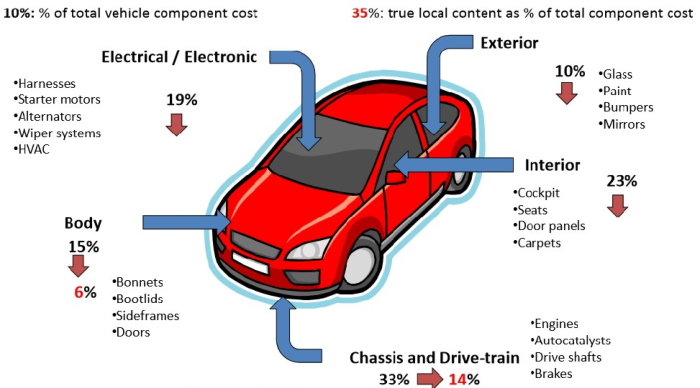
Figure 1, shows a composition of a complete vehicle assembled, represen- ting just 35% of local content as a percentage of total imported components and Local components for the assembling of a vehicle in a domestic market.
South Africa, is known for its mineral resource but however in analysing the total cost of local content that is present in manufacturing a vehicle, it is alarming as only a maximum of 35% of local content costs is present in the production of a motor vehicle within the South Africa automotive industry, as demonstrated on figure 1.
Table 2. The top 10 imported replacement automotive parts (R Million). Source: Adapted IAEC (2021).
An Analysis of the South African Automotive Industry Local Content 121
Figure 1: Indications of local content decreases in the automotive vehicle in SA. Source: National Association of Automotive Component and Allied Manufacturers website, Newsletter no. 28, November 2015.
Given the above context, it clearly shows the urgency and a need for rese- arch to develop decision support and a competitive model that can help improve the global competitiveness of the South African (SA) automotive industry. According to an observation made by (Mazzarol & Choo, 2003), states that location is one of the major challenges faced by businesses. Loca- tion strategy is a very critical decision that any organisationsation has to make wisely as a poor selection of locations can have devastating effects to an orga- nisationsation or business success, ranging from, market access, supplies of raw materials and labour.
The South African (SA) automotive industry, over the past year has grown progressively over some time, having automotive assembling plants in Johan- nesburg, Pretoria, East London, Durban and Port Elizabeth. And as a result, having their supplier base scattered all over the country with the greatest concentration in Port Elizabeth and Gauteng.
According to Barnes & Marris (2018), how to become competitive is a very important question that does not only applies to South Africa alone but also includes other developing nations. This is further justified by a report from Auto World (2010), that the South African (SA) automotive industry is regret- tably not well-known for world-class service. Afaro et al., (2012) state that production facilities are being established in countries by Original Equipment Manufacturers (OEMs) particularly because of the attraction of their dome- stic markets, while it is not economically viable as production capacity is not large enough for outside market exportation.
Automotive Sector Competitiveness and Different Impacting Factors The transfer of modern manufacturing capabilities (both in terms of produ- ctivity and quality) to low-wage nations or emerging economies is one of the key factors behind the globalisation trend (Sutton et al., 2015).
122 Ikome and Laseinde
The National Manufacturing Competitiveness Commission’s National Manufacturing Strategy (2016) identifies six elements that influence an automotive industry’s manufacturing competitiveness, namely: a) operatio- nal efficiencies are lower and transactional costs are higher; b) operational levels are sub-optimal; c) lower labour productivity and greater capital costs; d) import tariffs are higher, with an inverted duty structure on raw materials; e) indirect tax incidence is greater; and inadequate infrastructure.
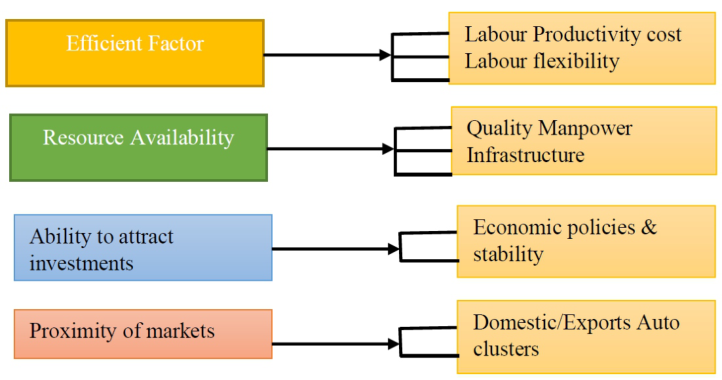
This is further illustrated in Figure 2, where the key factors that can contri- bute to a country’s competitiveness including several factures such as (Labour productivity, Quality, Policies, Domestic and export were showcased).
Efficiency, radical innovation, incremental change, and proficiency are the five elements that enhance competitiveness, making them indications of competitiveness. Research work done by Mutsiya (2018): highlights five cha- racteristics of competitiveness namely: a) people: those who perform product introduction; b) process: activities by which the people and tools create pro- duct introduction; c) control: the mechanisms by which the introduction of new products is controlled; d) structure: relationships between the people who perform product introduction; and e) technology/tools: tools that are used in product technology.
Operations have an impact on competitiveness through the development and implementation of strategies such as quality management, process effici- ency improvement, new process technology, customer-supplier collaboration, and the use of benchmarking, all of which have a significant impact on company performance (Sirikrai & Tang, 2016:77).
Industrial competitiveness is a critical problem for nations adopting export-oriented industrialisation strategies, according to Sirikrai and Tang (2016:77), since market competition encourages organisationsations to acquire and deploy resources to produce value.
Figure 2: Key factors that can contribute to the competitiveness of a country. Source: adapted from Joshi and Dixit (2012).
An Analysis of the South African Automotive Industry Local Content 123
Companies must emphasise speedier and more efficient development pro- cesses, more cost-effective design cycles, and efficient delivery timelines to accomplish their objectives and goals of value addition (Ndamase and Steyn, 2011). Supplier development programs are required to maintain a capa- ble and high-performance base with collaborative inter-organisationsational communication, which is an important supporting factor in transforming an organisationsation’s efforts to improve supplier performance and thus maintain its competitiveness in the industry (Mutsiya 2018).
South Africa has a distinct competitive edge when it comes to low volumes, and hence the potential to create short production runs more economically than many other nations whose manufacturing is geared up for lengthy, high- output runs, due to its flexibility. These benefits are frequently attractive in terms of fostering multidirectional trade, as South Africa’s local demand is insufficient to support the cost-effective manufacture of a wide range of models per OEM.
METHODOLOGY
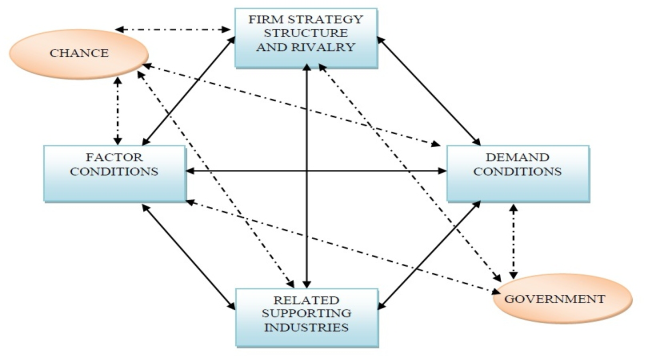
According to Franklin (2013), many techniques can be applied in research- ing a specific phenomenon, to collect the required data. Besides, the chosen method will have a direct influence or guiding principle on the type of que- stions that can be asked including the responses received, which as a result, will have a great impact on the research findings. The diamond competi- tive model of Porter (1995) in figure 3 was also adapted in order to further analyze different conditions related to the South African automotive industry.
Furthermore, a well-structured questionnaire was developed, for data collection purposed, the data was later used to analyse the South African automotive industry in correlation with the Diamond model which has four major dimensions that can be used for competitive analysis. This includes demand conditions, a firm strategy and rivalry, related industries support
Figure 3: Porter’s Diamond model. Source: adapted from Porter (1990).
124 Ikome and Laseinde
and factor conditions. This is illustrated in Figure 3 with an analytical fra- mework using multi-measurements for industry competitiveness with and emphasis that industries must focus on areas where the diamond factors are most favorable.
Factor Conditions: an industry requires infrastructure and inputs that are crucial for competition, namely:
1. Human resources: Quality and quantity of skilled labour personnel and expert workers. 2. Physical resources: accessibility of raw materials, water land, and other physical qualities. 3. Knowledge resources: scientific and technical knowledge residing in research institutions. 4. Capital resources: availability of funds and cost to finance industries. 5. Infrastructure: availability and quality of infrastructure, transportation systems (road, railway systems, water and air).
From this model, it is asserted that a nation has factors that are not inhe- rited, but created by the country, which includes highly educated personnel such as engineers and scientists who often involve huge investments and are therefore difficult to duplicate. From the aforementioned, it shows that their presence in a nations’ economy leads to a competitive advantage.
RESULTS
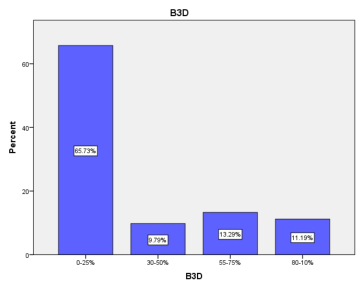
The results of the data analysis are discussed below, including graphical depiction. Figure 4a and 4b shows that 65.7% of the respondents indicated that 0-25% of their inputs are sourced globally, while 13.2% of respon- dents indicated that 55-75% of their inputs are sourced globally, 11.1% of respondents indicated that 80-100% of their inputs are sourced worldwide and 9.7% of respondents indicated that 30-50% of their inputs are sourced internationally.
Overall, the analysis of the findings indicates that the highest number of inputs are imported into the country. According to AIEC (2013:84), a large portion of the automotive imports to South Africa are comprised of origi- nal equipment components, which are then exported as completely built-up units after a significant value-adding process. AIEC (2013:84) also highlights that the growth of cheaper products, mainly from China has aggravated the import trend in South Africa, which forms a significant part of the imports. Therefore, the results of this finding are complimenting the statistics of the Automotive Industry Export Council, which indicate a significant percen- tage of components are imported into South Africa. According to Figure 4b, 70.6% of respondents considered profitability as a major factor affecting competitiveness; 13.2% of respondents deemed profitability as a medium factor; 10.4% were neutral, 2.8% considered it as a minimum factor and 2.8% as a no factor. Figure 5a shows that 63% of respondents considered research and deve- lopment as a major factor affecting competitiveness; 18.1% of respondents
An Analysis of the South African Automotive Industry Local Content 125
Figure 4: (a) The percentage of raw materials sourced globally, (b) profitability factor.Figure 5: (a) Research and development spending, (b) skills.
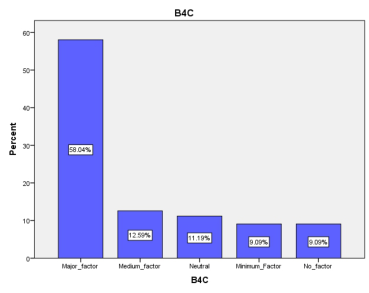
indicated that it is a medium factor; 11.1% were neutral; while 4.28% consi- dered it as a minimum factor and 1.4% as a no factor. Figure 5b reports that 58.4% of respondents considered skills as a major factor that affects com- petitiveness; 12.5% of respondents considered it as a medium factor; 11.1% were neutral; while 9% considered it as a minimum factor and 9% as a no factor.
CONCLUSION
The result suggests that enabling strategies and policies within the nation that will limit the number to cheap imported and counterfeit automotive produ- cts, will require significant attention and if that is done, the South African automotive industry global competitiveness will improve.
REFERENCES
Alfaro, A. L., Bizuneh, G., Moore, R., Ueno, S. and Wang, R. (2012), “South Africa: automotive cluster, microeconomics of competitiveness”, Harvard Business School, Kennedy School of Government: PED-329.
126 Ikome and Laseinde
Auto World. (2010). Motor industry needs to address challenges. Retrieved from http://www.autoworld.co.za/newsarticle.aspx?article=3706. Automotive Industry Export Council (AIEC). (2012) Automotive Export Manual
2012 - South Africa. Pretoria: AIEC. Automotive Industry Export Council (AIEC). (2013) Automotive Export Manual 2013 - South Africa. Pretoria. Barnes, J. & Morris, M. (2018) Staying Alive in the Global Automotive industry:
What can developing Economies Learn from South Africa about linking into Global Automotive Value Chains? European Journal of Development Research, 20(1): 31–55. Damoense, M. Y. & Alan, S. (2014) An analysis of the impact of the first phase of South Africa’s Motor Industry Development Programme (MIDP), 1995–2010. Development Southern Africa 21(2) June: 264. Deepika Joshi, Bimal Nepal, Ajay Pal Singh Rathore, Dipti Sharma, On supply chain
competitiveness of Indian automotive component manufacturing industry, Inter- national Journal of Production Economics, Volume 143, Issue 1, 2013, Pages 151-161, ISSN 0925-5273, https://doi.org/10.1016/j.ijpe.2012.12.023. Department of Trade and Industry (DTI). (2017b) Industrial Policy Action Plan (IPAP), The International Trade Administration of South Africa, Pretoria. Gastrow, M. A review of trends in the global automotive manufacturing industry
and implications for developing countries. Afr. J. Bus. Manage. 6(19), 5895–5905 (2012). Hook H, Kaggwa, M., Pouris, A. & Steyn, J. L. (2007) Sustaining automotive industry growth in South Africa: A review of the first five years of the Motor Industry Development Programme, University of Pretoria, Vol. 22. Lipovatz, S. (2010), The Competitive Advantage of nations: is Porter’s Diamond fra-
mework a new theory that explains the international competitiveness of countries? South African Business Review. Volume 14 Number 1 2010. Money D, Steyn, J. & Sommerville, J. Concurrent engineering and the automotive supplier industry in South Africa. PICMET 2012 Proceedings, Cape Town, SouthAfrica, pp. 1265–1272. Pitot, R. (2011) South Africa’s auto component battle intensifies as rand and Asia
strengthen. Engineering News. [Online]. Available: https://www.engineeringnew s.co.za. (Accessed 10 March 2013). Sirikrai, S. B. & Tang, J. S. C. (2016) Industrial competitiveness analysis: Using the analytical hierarchy process. Journal of High Technology Management Research, Vol. 17, pp. 71–83. Sirikrai, S. B. & Tang, J. S. C. (2016) Industrial competitiveness analysis: Using the
analytical hierarchy process. Journal of High Technology Management Research, Vol. 17, pp. 71–83.
LISTED IN THE AHFE DIGITAL BOOKSTORE CATALOGUE
Explore the complete digital volume
Production Management and Process Control
Read this individual research paper free through the original publisher, or explore the full digital proceedings book.
ISBN 978-1-958651-80-3
Explore this ISBN in the AHFE Bookstore ↗Listed in the July 2026 bookstore catalogue; search by ISBN to confirm current availability · Digital book purchase optional