Esra Dinler, Ceren Karagoz Kati (2023). After-Sales Obsolescence Risk Management In Long-Life Defense Projects. In: Production Management and Process Control. AHFE Open Access, vol. 104, pp. 97–107. https://doi.org/10.54941/ahfe1003057
In the defense industry, products are often complex systems developed and maintained with detailed and complex business processes. In such systems, management and planning are difficult and complex in cases such as parts supply or production. The end-of-life phase of products is the final stage of the product lifecycle, which begins with product retirement and ends with the expiration of all service contracts. Obsolescence will occur at the end of its useful life, where remanufacturing used or obsolete products can be an alternative source of obtaining spare parts. For this reason, the proper methods should be selected and applied for each stage. This study proposes an obsolescence management model of critical materials to be determined in a large-scale defense industry company. The model aims to reduce the adverse effects of problems throughout the life cycle of products and also to eliminate existing communication and integration deficiencies in processes. With this model, outputs such as purchasing a sufficient number of products to meet the system's requirements during its predicted life, minimizing the cost by optimizing the process, and maximizing the availability of spare parts have been achieved.
Obsolescence is the unavailability of parts from their original providers because of the completion of their product lifecycles. When maintaining systems, the lack of components causes problems with obsolescence. Defense projects typically have such a broad, complicated, and costly scope. As a result, companies need a structured method for handling obsolescence pro- blems that arise in this project complexity. Spare parts play a crucial role in ensuring the product life cycle in large-scale defense industry companies. The operational state of vehicles and systems is one of the key performance indica- tors of projects. In large-scale defense industry projects, the unavailability of data due to the complexity and diversity of data to be analyzed is inevitable. Companies are obligated to meet the demand for faulty or worn-out parts from customers and end-users during the warranty period, as specified in the signed contract. However, incorrect demand prediction may result in a large
unavailability or inventory risk at the end of the warranty period, leading to financial losses. Cost of spare parts accounts for a large share of the pro- ducts’ life cycle cost: the value of spare parts annually consumed by a piece of machinery, which might have a lifetime of around 30 years, amounts to nearly 2.5% of the original purchasing price (Hu et al., 2017). In reality, it is necessary to predict and estimate when and in which parts failures will occur. Additionally, the criteria used for part selection can vary based on the size of the project and the terms of the contract. In the literature, many methods have been proposed for determining the best stock quantity in spare parts manage- ment. The variety of characteristics of a company and project have provided opportunities for many researchers to work in this field. Hu et al. (2018) revi- ewed studies that use operations research in spare parts management. The article covers classifying spare parts, demand forecasting, optimization, and supply chain. Rojo et al. (2012) assessed the risk of parts in a product’s bill of materials that could prevent maintenance of the system. The study states that by analyzing key factors for each part in the risk assessment process and removing remaining parts from the list, decision-makers should focus only on important parts. Auweaer et al. (2019) argue that information from the current system could impact the demand generation process. Supçiller and Çapraz (2011) developed a solution to the supplier selection problem that contains multiple criteria by using AHP (Analytical Hierarchy Process) and TOPSIS (Technique for Order Preference by Similarity to Ideal Solutions) Multi-Criteria Decision-Making methods. Dhakar et al. (1994) argue that spare part estimation can be made at a high rate with scheduled and periodic maintenance, but a small amount of safety stock is necessary for unexpected failures. Kasap et al. (2010) studied determining critical spare parts used in the repair of machinery using ABC and optimization methods. They impro- ved the demand forecasting method by considering the importance of parts determined by the ABC method, the frequency of orders, and service level constraints. Ghare (1963) studied the quantity of failures over time under constant demand using the economic order quantity formula.
The aim of this study is to determine the selection criteria for parts that need to be kept as backup after sales for a medium-sized project of an armo- red vehicle manufacturer operating in Turkey and to reduce the shortage risk. The most popular criteria considered by decision-makers for spare parts to be kept in stock are the lead time of the part, the cost of the part, the failure rate of the part, the need for an export license for parts imported from abroad, and the requirement for complex engineering skills for the parts to be ready- to-use. The decision-making process for spare parts includes the evaluation of different criteria, making it a multi-criteria decision problem. To solve this problem, the AHP and TOPSIS multi-criteria decision-making methods were used together. A mathematical model has been developed for the manage- ment of components obsolescence risk in the after-sales phase of a company operating in the Turkish Defense Industry. With the model proposed in the study, results such as purchasing enough products to meet the requirements of the system during its predicted life-cycle time, optimizing the process to determine the number of components needed to minimize the cost and maxi- mizing spare parts availability will be achieved. The method developed in
After-Sales Obsolescence Risk Management in Long-Life Defense Projects 99
this study can be used by armored vehicle manufacturers operating in this sector to reduce unavailability risk and improve decision-making processes for spare parts.
OBSOLESCENCE RISK MANAGEMENT METHOD AND APPLICATION It is critical to keep enough product in the system to meet the requirements for the predicted life cycle of the components. At this stage, it is necessary to identify the crucial components. It is important to consider certain criteria in the determination of crucial parts and to determine the order of importance of these criteria.
In this study, in a project in a defense industry company, obsolescence risk management is carried out for components. There are 5678 components in the project. Assessment is made on three criteria and importance coefficients are determined according to these three criteria for the components.
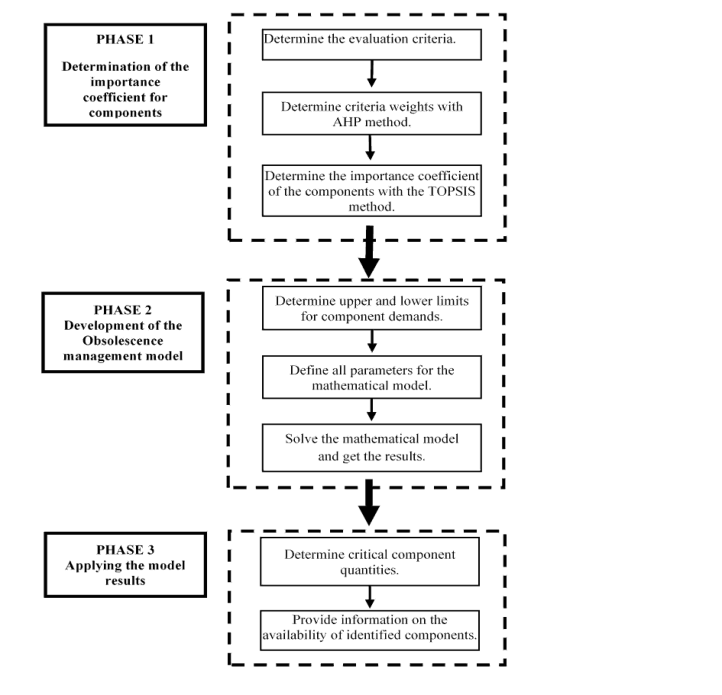
In the proposed method, the AHP-TOPSIS method is used to determine the weights of the criteria and the weights of the components according to these criteria. The AHP approach is used to determine the relative releva- nce levels of the criteria. Afterwards, the TOPSIS method for component weights is determined to give more importance to the possession of crucial components based on criteria. Components’ importance coefficient deter- mined by AHP-TOPSIS are used as parameters for the objective function in the mathematical model. After determining the importance coefficient of the components, mathematical models and solutions are obtained. The flow chart of the proposed method is given in Figure 1.
Assessment Criteria for Components In this study, 3 criteria were evaluated for the AHP-TOPSIS method, and the explanations of these criteria are given below.
Lead Time: The Lead Time of the Component From the Supplier Lead time refers to the interval between the placement of an order and the receipt of the corresponding product. The lead time for projects holds signi- ficant importance as it impacts the comprehensive maintenance schedule. A prolonged lead time for sub-components may result in maintenance delays and missed deadlines. Conversely, a short lead time can lead to excessive inventory, increased inventory expenses, and decreased profitability. As a result, effective management of lead time for sub-components is essential for the viability of a business.
Subject to Export License: Subject to Export License in Supplying the Component A component being subject to an export license means that it is regulated and controlled by the government for international trade. The government can limit or prohibit the export of certain components to certain countries. The decision process for obtaining these licenses may be elongated or the licenses themselves may be denied. For this reason, it is critical to order the part on time.
100 Katı and Dinler
Figure 1: Framework of proposed method.
Part Class: Whether the Component Is a Commercial Off-the-Shelf (COTS) Product or Not The Commercial Off-The-Shelf (COTS) product, which is a product that is pre-packaged and available for immediate sale, has a low rate of failure upon placement of an order. This product does not necessitate additional enginee- ring verification processes. Conversely, if the product is not a COTS product, there may be an increased risk of encountering such issues.
Integrated AHP-TOPSIS Method for Importance Coefficient In the study, the assessment criteria determined are weighted with the AHP method, and the importance coefficients of the components are determined with the TOPSIS method.
AHP is a multi-criteria decision-making technique developed by T. Saaty in the 1970s (Wind and Saaty, 1980). This method includes the evalua- tion of more than one qualitative and quantitative criteria, and this is the most important factor in its use in the selection process. This method has a wide range of applications and is used in many decision-making problems.
After-Sales Obsolescence Risk Management in Long-Life Defense Projects 101
First, the objective is determined and the criteria affecting this objective are determined. After the criteria are determined, pairwise comparison decision matrices are created to determine the importance of the criteria among them- selves. The nine-point scale of importance developed by T. Saaty is used in the creation of these matrices. This scale helps in determining the degree of importance between the criteria by evaluating the opinions of the survey or experts.
TOPSIS (Technique for Order Preferences by Similarity to an Ideal Solution) method, developed by Hwang and Yoon (1994), is one of the multi- criteria decision-making techniques that performs the ranking of alternatives according to specified criteria. The optimal alternative is selected by sorting the alternatives according to their closeness to the positive ideal and their distance from the negative ideal.
In the AHP method, the criteria weights were determined by taking the judgments of three different decision makers. The judgments of the decision makers for the criteria are given in Table 1.
The criteria weights are determined by the AHP method using the evalua- tions given in Table 1 and these weights are given in Table 2.
The relative importance of each criteria are provided by the normaliza- tion of this matrix, which is a critical part for using the TOPSIS approach.
Table 1. The judgments of the decision makers.
Table available in the original PDF paper.
Decision Maker 1
Export License Lead Time Class Export License 1 3 5 Lead Time 1/3 1 7 Class 1/5 1/7 1
Decision Maker 2
Export License Lead Time Class Export License 1 3 4 Lead Time 1/3 1 2 Class 1/4 1/2 1
Decision Maker 3
Export License Lead Time Class Export License 1 2 4 Lead Time 1/2 1 1/3 Class 1/4 3 1
Table 2. The criteria weights.
Table available in the original PDF paper.
Criteria Weights Export License 0.619 Lead Time 0.238 Class 0.143
102 Katı and Dinler
Both positive and negative ideal solutions are obtained and ordered after the decision matrix of alternatives is normalized and weighted using the relative weights of the AHP approach. The distance between each alternative and the ideal solution is then determined, both positively and negatively. The esti- mation of each alternative’s distance from the ideal solution follows. After classifying the alternatives, Table 3 is obtained. Due to the large number of components, some of them can be given in Table 3.
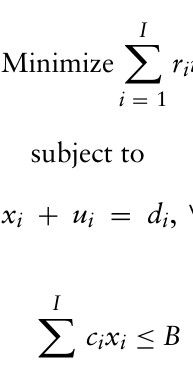
Formulation of Obsolescence Management Model In this study, a mathematical model has been proposed for obsolescence risk management, which minimizes the total risk if the required components are not available. In the model, the objective function and constraints are determined to give priority to the procurement of components with high importance coefficients. The sets, parameters and decision variables are as follows: Sets
I Set of components, indexed by i Parameters ci: the unit cost of component i di: the amount determined to be available from the component B: Total budget ri: importance coefficient of component i Decision Variables
xi: the quantity to be ordered for component ui: the amount not available from component i The obsolescence risk management model is below.
Equation reproduced from the original PDF.
xi, ui ≥0 and integer, ∀i (4) Eq. (1) is to minimize the total risk if the required components are not avai- lable. With Constraints (2), the amount of unavailable component, in other words, the amount of deviation from the determined component amount is determined. Constraint (3) ensures that the total budget is not exceeded. Constraints (4) are non-integrality constraints. With this model, the amount of components that should be purchased is determined in a way that does not
After-Sales Obsolescence Risk Management in Long-Life Defense Projects 103
i Coefficient i S−
Table 3. Component data.
Table available in the original PDF paper.
Sub Part Number Export Licence (EL) W1* EL norm Lead Time (LT) W2*LT norm Class W3* Class Norm S+
exceed the total budget and minimizes the risk by considering the amount of components determined.
In this study, the amount determined to be available from the component (di) are obtained from the fault records of the past one year. If there is no failure record of any components, then 10% of this amount is determined for how many sales were made within the scope of the project for this parameter. The importance coefficient values (ri), which are another parameter, are the values determined by the AHP-TOPSIS method. The total budget parameter (B) is the budget allocated for the current project. A mathematical model for the project’s 5678 components is developed using the defined parameters and decision variables, and the results are obtained.
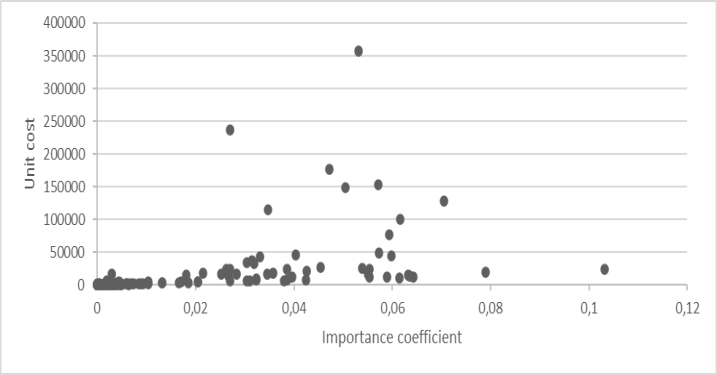
RESULTS AND ANALYSIS The results of the components not available as a result of the mathematical model are given in the Table 4. The demands of the components other than those in this table have been met. According to the results in Table 4, it is seen that the demands of the components with low importance coefficient and high unit cost are mostly not met. In addition, the comparison of the unit cost and importance coefficient of the components that unavailable is given in the graph in Figure 2. Figure 2 shows that density is observed in components with a low importance coefficient.
Figure 2: Unit cost vs. importance coefficient for unavailable products.
CONCLUSION
The development and maintenance of products in the defense industry can include sophisticated systems that require complex business procedures. When it comes to situations like part supply or production, such systems’ management and planning are difficult and complex. The product lifetime, which starts with product retirement and ends with the expiration of all
After-Sales Obsolescence Risk Management in Long-Life Defense Projects 107
service contracts, has an end-of-life phase that denotes the end of that life- cycle. Remanufacturing used or obsolete products can be a different method of getting spare parts when obsolescence occurs at the end of its useful life. Because of this, the appropriate techniques ought to be chosen and used at each stage. In this study, a suitable method has been proposed to provide obsolescence management. he method developed in this study can be applied by armored vehicle producers in this industry to lower the risk of spare part shortages and enhance decision-making.
REFERENCES
Dhakar, T. S., Schmidt, C. P., Miller, D. M. (1994). Base stock level determination for high cost low demand critical repairable spares. Computers & operations research, 21(4), 411–420. Ghare, P. M. (1963). A model for an exponentially decaying inventory. J. ind. Engng,
14, 238–243. Hu, Q., Boylan, J. E., Chen, H., Labib, A. (2018). OR in spare parts management: A review. European Journal of Operational Research, 266(2), 395–414. Hu, Q., Chakhar, S., Siraj, S., Labib, A. (2017). Spare parts classification in industrial
manufacturing using the dominance-based rough set approach. European Journal of Operational Research, 262(3), 1136–1163. Kasap, N., Biçer, ˙I., Özkaya, B. (2010). Stokastik envanter model kullanılarak i¸s makinelerinin onarımında kullanılanılan kritik yedek parçalar için envanter yöne- tim sistemi olu¸sturulması. ˙Istanbul Üniversitesi ˙I¸sletme Fakültesi Dergisi, 39(2), 310–334. Lai, Y. J., Liu, T. Y., & Hwang, C. L. (1994). Topsis for MODM. European journal
of operational research, 76(3), 486–500. Rojo, F. R., Roy, R., Kelly, S. (2012, May). Obsolescence risk assessment process best practice. In Journal of physics: conference series (Vol. 364, No. 1, p. 012095). IOP Publishing. Supçiller, A., Çapraz, O. (2011). AHP-TOPSIS yöntemine dayali tedarikçi seçimi
uygulamasi. Istanbul University Econometrics and Statistics e-Journal, (13), 1–22. Van der Auweraer, S., Boute, R. N., Syntetos, A. A. (2019). Forecasting spare part demand with installed base information: A review. International Journal of Forecasting, 35(1), 181–196. Wind, Y., & Saaty, T. L. (1980). Marketing applications of the analytic hierarchy
process. Management science, 26(7), 641–658.
LISTED IN THE AHFE DIGITAL BOOKSTORE CATALOGUE
Explore the complete digital volume
Production Management and Process Control
Read this individual research paper free through the original publisher, or explore the full digital proceedings book.
ISBN 978-1-958651-80-3
Explore this ISBN in the AHFE Bookstore ↗Listed in the July 2026 bookstore catalogue; search by ISBN to confirm current availability · Digital book purchase optional