Adrian Morales Casas, Jose Laparra, Nicolás Palomares, Carlos Atienza, Lorenzo Solano-García (2022). Medical Devices Analysed from the Human Factors and Ergonomics in Engineering Design Point of View: Case Study. In: Production Management and Process Control. AHFE Open Access, vol. 36, pp. 17–24. https://doi.org/10.54941/ahfe1001615
Here two real case studies of design and development with different grades of complexity are presented. A medical instrument prototype of a pneumatic retraction and holding system for surgical procedures and an electromedical device for non-invasive glucose measuring developed both from a TRL 4 to reach a TRL 7. The products were designed in the frame time of six months and fifteen months, respectively. The medical instrument was developed using a conventional Lean project and engineering design approach. Meanwhile, the electromedical device was created using Lean project management alongside a human-centred design and person-oriented innovation approaches. Based on the Lean approach, both products were built on a common ground project development path that the IBV follows. Besides, both projects had a common limiting factor, the need to meet a very demanding schedule of deadlines. The paper details the development stages followed in both products to compare how the human-centred design methods are integrated and could have been incorporated in the medical instrument case. Based on the Institute of Biomechanics’ (IBV) background in project management in the design, development and innovation of medical devices, this paper seeks to share applied knowledge on successfully implementing human factors plan and ergonomics in the engineering design process.
From the project management point of view, the development of medical devices is a task that requires the application of processes, skills, methods, knowledge, and experience from many expertise disciplines. These produ- cts need to reach the European Union and the USA standards (Privitera, Evans, and Southee 2017), which force the developers to gather together a team of designers, engineers, scientists, manufacturing, regulatory, medical, legal, and business specialists. Even though the contribution of each one of the interdisciplinary team members through the project towards a common goal is equally important, the experience and literature are showing us that the user is not always placed in the same priority level (Shaheen et al. 2021; van der Peijl et al. 2012). However, awareness of the role of the human- centred design approach is rising (Adams 2018; Hegde 2013; “Medical Device Innovation Initiative White Paper | FDA” n.d.; Story 2012; “Design Control Guidance For Medical Device Manufacturers | FDA” n.d.; “IEC/TR
62366-2:2016 Medical Devices — Part 2: Guidance on The ...” n.d.; “ISO - ISO 14971:2019 - Medical Devices — Application of Risk Management to Medical Devices” n.d.; “ANSI/AAMI HE75:2009 (R2018) - Human Factors Engineering - Design of Medical Devices” n.d.) despite it still often having to overcome project managers’ and engineers’ acceptance.
Regulatory entities enforce more strict regulations to unify user-centred design methodologies applicable to medical device products. Subsequently, the industry adapts its project management tactics and methods to improve its products and services while staying competitive and reducing the risk of harm. M. Roma et al. (Roma and de Vilhena Garcia 2020) reported that medical devices with a no-fault-found report often presented hidden design flaws once submitted to a usability test. Other authors support this state- ment by writing about non-fatal adverse clinical incidents involving patient loss of function or requiring increased patient care levels relating to medi- cation and medical devices (Mitchell, Williamson, and Molesworth 2015; Flewwelling et al. 2014). Some papers also report user-oriented design flaws related to specific products, such as a Patient-controlled analgesia pump (Lin, Vicente, and Doyle 2001). Therefore, it is worth considering the desirabi- lity of early-phase implementation of human factors plans in the product life cycle.
Most of the precedent works collect standard known human factor meth- odologies and success cases besides previous efforts from regulatory entities to unify usability assessment which are mainly focused in mitigate or reduce risks. At the same time all the evidence of non-fatal adverse effects linked to design flaws related to usability, one can notice that probably from the medical devices project management point of view, the human factors plan was not sufficiently and effectively addressed. Therefore, outlining valuable guidelines about when to implement the standard known human factor meth- odologies through the project management process of medical devices to gain the most helpful design inputs are essential to succeed in the development process. As well as trying to evaluate the impact of an avoided failure.
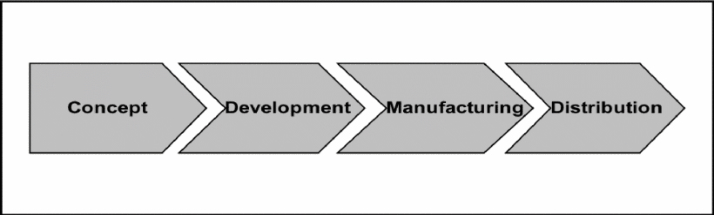
PROJECT MANAGEMENT AND MEDICAL DEVICE PATH Any product development goes through four project phases regardless of its complexity from a general perspective. These phases are concept, deve- lopment, manufacture and distribution (Gilman, Brewer, and Kroll 2009). Inside those phases many tasks need to be executed to achieve the desired outcomes. Usually, the length and implied technical development goal defi- nes the overall complexity of the product and the regulatory requirements. Figure 1 shows the sequence of the four mentioned phases placed in order of priority. The distribution phase is splinted normally into two subphases in a medical device product development process. First is the so-called pre-market step, where the product needs to undergo a clinical validation phase. Second, the market release or distribution so that the product can be reliably produ- ced in the quantities planned for in the sales forecast. Last, the development phase, to clarify, should instead be appointed as the “detailed design” phase.
Medical Devices Analysed from the Human Factors and Ergonomics in Engineering Design 19
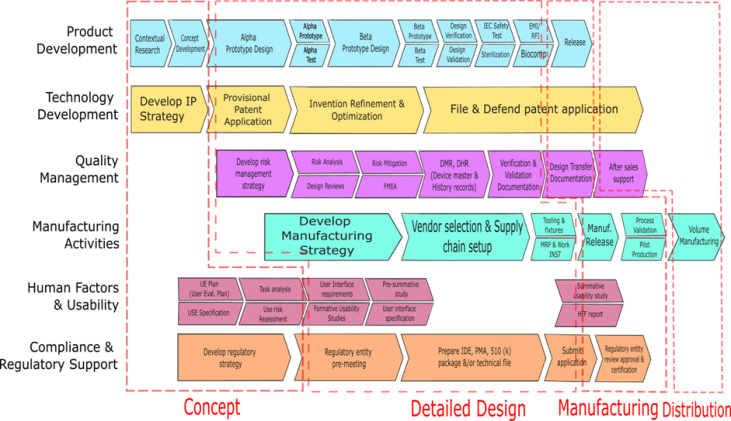
Figure 1: Simplest phases of product development (Gilman, Brewer, and Kroll 2009).Figure 2: Processes in parallel with the most straightforward phases of development overlapped (“The Design Process of Medical Devices at DeviceLab | Part 4” n.d.; “5 Top Annual Plan Medical Device Design and Development Process Improvements - StarFish Medical” n.d.).
The development process of any medical device requires a very tight col- laboration between up to six development tracks. In Figure 2, we can see an elegant reformulation of the road map created by considering the road map presented in 2020 (“The Design Process of Medical Devices at DeviceLab | Part 4” n.d.) and the road map shown in 2014 (“5 Top Annual Plan Medical Device Design and Development Process Improvements - StarFish Medical” n.d.) by two different medical device design and development companies. On the road map of Figure 2, one can see the six interdisciplinary tracks that work together in the medical product development process. Over the road map drawn in dished line, four boxes are locking the tracks in Figure 1 presented development phases.
Consequently, it can be seen that companies that are successful in develo- ping medical devices are not only those that fulfil the regulatory requirements demanded by regulatory entities. Instead, those companies which embody a
user-centred culture in their project management place the human factors and usability plan in the early stages. Therefore, gathering as much as possible design inputs in the concept phase and implementing user-centred strategies are essential, at least partially, from the concept phase through the development process. Unlike other tracks of the development process of medical devices, the HF&U (Human Factors and Usability) track does not strictly require implementation through the entire development phase. Instead, it can be implemented at the beginning and the end for final vali- dation, as shown in Figure 2 and the regulatory entities guidelines point out (Mount-Campbell et al. 2017). Moreover, the HF&U plan can be identified as another support tool for the product development track of the medical device.
THE HUMAN FACTORS LEAN APPROACHES Lean manufacturing is well known for its seeking to eliminate any activity that does not add value to the process. In other words, lean manufacturing is about getting rid of the so-called waste and keeping the things needed to achieve the fixed goal. The role of human factors, even though it is still to be defined, is led to become the tool to seek out, among others, the design flaws of medical products and ensure safety performance while maintaining functionality (Adams 2018; Hegde 2013). At the same time, lean methods are more likely to be seen as a traditional value of human factors engineering based on fundamental respect to people (Vukadinovic et al. 2019). Citing the well-known mantra of Lean concept “develop people, and then build products”, which in essence, it aligns with the human factors’ pursuit of maxi- mising safety by keeping the expected or enhanced performance of a product (van der Peijl et al. 2012).
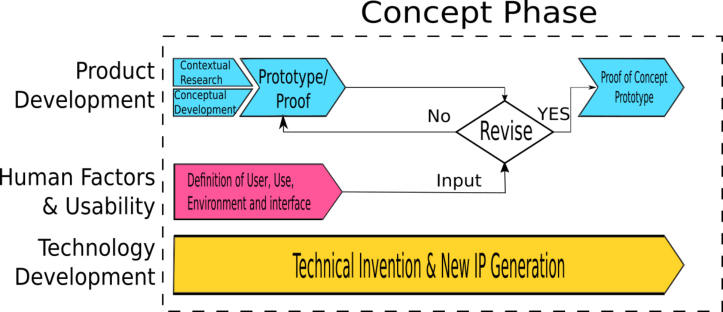
According to these well-documented synergies between human factor-lean approaches, from the applied point of view, the constant improvement of a product from the proof-of-concept phase through the detailed development can only be achieved if it is almost constantly revised and backed up with testing. The quick testing using rapid prototyping methods, such as 3D prin- ting, setting and artefact simulations, and discussions with users and experts are essential mechanisms to revise the usability through the process. Ideally, these principles are also demanded by regulatory entities (“Design Control Guidance For Medical Device Manufacturers | FDA” n.d.). Nonetheless, the putting into practice presented by the regulatory entities following a water- fall model might not be very convenient to apply. Therefore, in Figure 3, one can see a common ground-based project development path proposed in the concept phase.
Although more research is needed, estimating and defining the design inputs at the concept phase, as shown in Figure 3, parallel to the conce- ptual development and prototyping, has a positive impact. The concept behind the illustrated diagram in Figure 3 is to start as soon as possible an iterative process where the usability is continuously revised before a final proof-of-concept prototype is developed.
Medical Devices Analysed from the Human Factors and Ergonomics in Engineering Design 21
Figure 3: Human factors-lean approach.
CASE STUDY To show a first introduction of the process development approach follo- wed in the concept phase presented in Figure 3, two real case studies of the design and development of medical devices with different grades of comple- xity are presented. A medical instrument prototype of a pneumatic retraction and holding system for surgical procedures and an electromedical device for non-invasive glucose measuring developed both from a TRL 4 to reach a TRL 7. The products were designed in the frame time of six months and fifteen months, respectively. The medical instrument was developed using a conventional Lean project and engineering design approach. Meanwhile, the electromedical device was created using Lean project management alongside a human-centred design and person-oriented innovation approaches.
The pneumatic retraction and holding system aimed to design and develop a modified version of an already existing technology by focusing on enh- ancing the movement range and reducing the overall length of the device. The pneumatic device consisted of three articulated segments with a typi- cally looked ball joint at its end. By pressing one button on the handle, where the quick-lock instrument holder was located, the pneumatic device unlocks and can be moved to the desired position while the button is pressed. Once in the chosen place, the user had to release the finger from the button, and the device stayed static. As the only two design specifications were to reduce dimensions and increase the movement range of the ball articulation slightly, no further human factors engineering was implemented.
Subsequently, a proof-of-concept prototype was developed that fulfilled the given specification known by the time. Next, an Alpha prototype was manufactured with close to a pre-series finish. Due to usability issues, the Alpha prototype was submitted to a usability analysis performed by an expert and a user environment study. The resulting human factors experts’ tests and research concluded with several ergonomic flaws in the handle design rela- ted to the dimensions of the activation mechanism. At the same time, the user environment study presented a fundamental design specification that the cli- ent and engineer team had unknown through the entire project related to
the peak load capacity. Therefore, as insufficient attention was given to defi- ning the user and user environment in the concept phase, a no-fault-found proof-of-concept prototype presented hidden design flaws once submitted to a usability test.
In the second case, an electromedical device was designed and developed following the project management presented in Figure 3 through the entire concept phase. To begin with, the product was analysed in three steps using three different approaches—first, a qualitative analysis using a netnography innovation study through the PERSONA technique. Second, a risk analysis was done in a focus group of experts. Last, a qualitative study was done through a survey aimed at diabetes type I and II and healthcare professionals regarding the acceptance of a non-invasive measurement solution and some performance-related questions to assess user preferences.
According to the preliminary risk analysis and the users’ specifications, a concept development, prototyping, and revision iteration started. The three slightly different concepts were immediately subjected to usability tests. In the end, one idea stood out due to usability advantages. This concept made it through the proof-of-concept prototype stage and was further developed through the detailed design development phase. Lastly, it passed all formative and summative tests on the first attempt.
CONCLUSION
An adequately argued description of how the constant improvement from the proof-of-concept phase through the detailed development can only be achieved if it is almost constantly revised and backed up with testing. The quick testing, in this case, was done through rapid prototyping methods, such as 3D printing, setting and artefact simulations, and discussions with users and experts as an essential mechanism to revise the usability of a medi- cal device through the development process. At the same time, the value of integrating human factors & usability engineering in the concept phase and a common ground project development path that the presented work fol- lows in the concept phase were shown and implemented in a case study. The outcome seemed promising.
On top of that, strong evidence supported by regulatory entities, adverse effects publication on medical devices with usability flaws and medical device designers and developers points out that the human factors and usability plan are more efficient to be implemented in early stages. However, further work will consider examining the other three phases of the project and assessing when and how each development track can be more effectively implemented. Furthermore, further work will focus on assisting the impact of accomplish- ing the goals of each development track in its corresponding project phase versus not performing it.
ACKNOWLEDGEMENT
The authors would like to acknowledge the research was partially supported by Igluco Tech S.L and BB Surgical Devices S.L. We thank our colleagues from IBV who provided insight and expertise that greatly assisted the research.
Medical Devices Analysed from the Human Factors and Ergonomics in Engineering Design 23
However, they may not agree with all of the interpretations/conclusions of this paper.
REFERENCES
“5 Top Annual Plan Medical Device Design and Development Process Improvements
- StarFish Medical.” n.d. Accessed March 3, 2022. https://starfishmedical.com/bl og/medical-device-product-design-development/. Adams, David. 2018. “Human Factors and Usability Engineering: MHRA Guidance for Devices and Combination Products.” Regulatory Rapporteur 15 (4): 9–13. “ANSI/AAMI HE75:2009 (R2018) - Human Factors Engineering - Design of Medi-
cal Devices.” n.d. Accessed March 9, 2022. https://webstore.ansi.org/standards/ aami/ansiaamihe752009r2018. “Design Control Guidance For Medical Device Manufacturers | FDA.” n.d. Accessed March 9, 2022. https://www.fda.gov/regulatory-information/search-fda-guid ance-documents/design-control-guidance-medical-device-manufacturers. Flewwelling, C. J., A. C. Easty, K. J. Vicente, and J. A. Cafazzo. 2014. “The Use of
Fault Reporting of Medical Equipment to Identify Latent Design Flaws.” Jour- nal of Biomedical Informatics 51 (October): 80–85. https://doi.org/10.1016/J.JB I.2014.04.009. Gilman, Byron L., James E. Brewer, and Mark W. Kroll. 2009. “Medical Device Design Process.” Proceedings of the 31st Annual International Conference of the IEEE Engineering in Medicine and Biology Society: Engineering the Future of Biomedicine, EMBC 2009, 5609–12. https://doi.org/10.1109/IEMBS.2009. 5333644. Hegde, Vaishali. 2013. “Role of Human Factors / Usability Engineering in Medi-
cal Device Design.” In Proceedings - Annual Reliability and Maintainability Symposium. https://doi.org/10.1109/RAMS.2013.6517650. “IEC/TR 62366-2:2016 Medical Devices — Part 2: Guidance on The ...” n.d. Accessed March 9, 2022. https://tienda.aenor.com/norma-iso-iec-tr-62366-2-2016- 069126. “ISO - ISO 14971:2019 - Medical Devices — Application of Risk Management to
Medical Devices.” n.d. Accessed March 9, 2022. https://www.iso.org/standard /72704.html. Lin, Laura, Kim J. Vicente, and D. John Doyle. 2001. “Patient Safety, Potential Adverse Drug Events, and Medical Device Design: A Human Factors Engine- ering Approach.” Journal of Biomedical Informatics 34 (4): 274–84. ehttps: //doi.org/10.1006/JBIN.2001.1028. “Medical Device Innovation Initiative White Paper | FDA.” n.d. Accessed March 3, 2022. https://www.fda.gov/about-fda/cdrh-innovation/medical-device- innovation-initiative-white-paper. Mitchell, Rebecca J., Ann Williamson, and Brett Molesworth. 2015. “Use of a
Human Factors Classification Framework to Identify Causal Factors for Medi- cation and Medical Device-Related Adverse Clinical Incidents.” Safety Science 79 (November): 163–74. https://doi.org/10.1016/J.SSCI.2015.06.002. Mount-Campbell, Austin F., Dan Hosseinzadeh, Metin Gurcan, and Emily S.
Patterson. 2017. “Applying Human Factors Engineering to Improve Usabi- lity and Workflow in Pathology Informatics.” Proceedings of the International Symposium on Human Factors and Ergonomics in Health Care 6 (1): 23–27. https://doi.org/10.1177/2327857917061007.
Peijl, Jorien van der, Jan Klein, Christian Grass, and Adinda Freudenthal. 2012.
“Design for Risk Control: The Role of Usability Engineering in the Manage- ment of Use-Related Risks.” Journal of Biomedical Informatics 45 (4): 795–812. https://doi.org/10.1016/J.JBI.2012.03.006. Privitera, Mary Beth, Mark Evans, and Darren Southee. 2017. “Human Factors in the Design of Medical Devices – Approaches to Meeting International Stan- dards in the European Union and USA.”Applied Ergonomics 59 (March): 251–63. https://doi.org/10.1016/J.APERGO.2016.08.034. Roma, Marylene Sousa Guimarães, and Euler de Vilhena Garcia. 2020. “Medical
Device Usability: Literature Review, Current Status, and Challenges.” Research on Biomedical Engineering. https://doi.org/10.1007/s42600-019-00037-8. Shaheen, Momina, Tayyaba Anees, Muhammad Junaid Anjum, and Aimen Anum.
2021. “Usability Engineering Process for Medical Devices.” In Advances in Intelli- gent Systems and Computing, 1290:365–81. Springer Science and Business Media Deutschland GmbH. https://doi.org/10.1007/978-3-030-63092-8_25. Story, Molly Follette. 2012. “FDA Perspectives on Human Factors in Device Development: Understanding Regulatory Requirements for Human Factors Usability Testing.” RAPS Webinar. “The Design Process of Medical Devices at DeviceLab | Part 4.” n.d. Accessed
March 10, 2022. https://www.devicelab.com/blog/the-design-process-of-medical- devices-at-devicelab-part-4/. Vukadinovic, Saveta, Ivan Macuzic, Marko Djapan, and Marko Milosevic. 2019.
“Early Management of Human Factors in Lean Industrial Systems.” Safety Science 119 (November): 392–98. https://doi.org/10.1016/J.SSCI.2018.10.008.
LISTED IN THE AHFE DIGITAL BOOKSTORE CATALOGUE
Explore the complete digital volume
Production Management and Process Control
Read this individual research paper free through the original publisher, or explore the full digital proceedings book.
ISBN 978-1-958651-12-4
Explore this ISBN in the AHFE Bookstore ↗Listed in the July 2026 bookstore catalogue; search by ISBN to confirm current availability · Digital book purchase optional