Adrian Morales Casas, Clara Solves Camallonga, José Manuel Rojas, Vanessa Jimenez, Mathieu Feuilliade (2026). Implementing a Human Factors Plan for an Augmented Reality Eyewear: Field-Based Usability and Ergonomics Evaluation Methods. In: Usability and User Experience. AHFE Open Access, vol. 232, pp. 319–327. https://doi.org/10.54941/ahfe1008060
Augmented Reality Eyewear (ARE) is advancing toward professional deployment, yet the translation of Human Factors principles from conceptual frameworks into operational evaluation protocols remains insufficiently documented. Prior work has established a comprehensive Human Factors Plan (HFP) for the POPULAR platform, an ARE system with prescription optics frames and lenses targeting healthcare, logistics, and sports, and reports preliminary results from its first evaluation phases.Building on this foundation, the present contribution details the methodology developed to transfer the HFP from conceptual definition to systematic field implementation.Preliminary results confirm the validity of this approach. A pre-trial survey (n = 869, five European countries) revealed differentiated adoption intention across sectors (NPS: healthcare +35, sports +26, logistics +7) and established that over 50% of the target population requires optical correction, validating prescription integration as a core design requirement. The full evaluation of the prototype M17+ (n = 27) yielded an overall satisfaction score of 74.1, an effectiveness score of 71.9, and an efficiency score of 72.9, indicating task flow as a refinement target. Projected content ratings diverged substantially across sectors (logistics: 4.8/5, healthcare: 4.1/5, rowing: 3.6/5), and initial field trials in healthcare and logistics identified domain-specific requirements not anticipated during the laboratory phase. These findings formalise a transferable, evidence-based approach for implementing Human Factors Plans in multi-domain ARE development programmes.
Digitalisation is increasingly adopted across a variety of human activities, embedding people in a world of digital connections that drives the design of diverse smart devices. (Kraus et al., 2022). Within this technological evolution, Augmented Reality Eyewear (ARE) has emerged as a transformative tool for professional environments, offering hands-free access to real-time,
context-sensitive information that enhances task efficiency and decision- making (Cheng et al., 2024; Hernández et al., 2024). However, despite significant technical advancements, the widespread adoption of ARE remains limited by critical human factors, such as physical discomfort, cognitive overload, and the historical inability to integrate personalised ophthalmic correction into lightweight, see-through and conventionally looking frames.
Previous research emphasises that for AR technology to achieve social acceptance, it must move beyond bulky prototypes toward devices that provide physical, visual, and social acceptance as well as data protection (Rauschnabel et al., 2018; Schall et al., 2018). On top of that, a significant barrier that has been identified is that a large proportion of potential users require prescription lenses, and most HMDs (Head-Mounted Displays) do not allow them to be worn in combination with standard prescription glasses. To address these gaps, the European project POPULAR (Grant agreement ID: 101135770) aims to develop the first generic ARE platform that combines ultra-low-power OLED microdisplays with innovative holographic lens mirrors, enabling seamless integration of prescription optics in a lightweight design (Feuillade, 2026).
To ensure the market successfully adopts this technology, the project follows a Human-Driven Design (HDD) approach, implemented through the deployment of a Human Factor Plan (HFP). The HFP is a linear, incremental process in which users’ demands are met, implementation viability is assessed, and the implementation is deemed viable (Casas et al., 2023). The objective of the present work is to detail the HFP methodology applied to validate ARE prototypes across three representative sectors: healthcare, logistics, and outdoor sports. The paper explores a multi-layered evaluation framework, encompassing pre-trial user characterisation, laboratory usability testing, and assisted field trials, and reports preliminary results from the completed evaluation phases.
Human Factors Plan The integration of a systematic HFP into the product development process is essential to bridging the gap between technical specifications and the actual capabilities, limitations, and behaviours of end users. By establishing human factors (HF) as core product requirements from the earliest stages, the project aims to improve usability, maximise user satisfaction, and ensure strict compliance with regulatory standards, such as ISO 9241-210:2019 for human-centred design.
This framework is particularly critical for the ARE platform to be usable, safe, and effective under real conditions of use, reaching a Technology Readiness Level (TRL) 5 by the project’s conclusion. Aligned with standards and ethical guidelines, the methodology is structured as a sequential, iterative process involving users, designers, technicians, and human factors experts, in which the interaction between digital content and the physical environment requires a delicate balance of ergonomics and visual comfort.
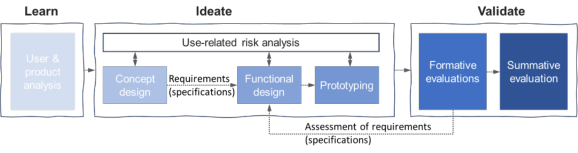
Following the methodology proposed by (Casas et al., 2023). The HFP is structured into three sequential and iterative phases: Learn, Ideate, and Validate (see Fig. 1).
Figure 1: Methodology of the HFP.
Phase 1: Learn The objective of this initial phase is to define the context of use and identify end-users’ needs and potential barriers (Casas et al., 2025). The primary output is the Early Human Factor Analysis (EHFA), which synthesises results from qualitative research, such as focus groups and in-depth interviews with experts, and quantitative data from an international survey involving over 850 participants. Haga clic o pulse aquí para escribir texto.This foundational analysis establishes the functional requirements and specific constraints for the three target sectors: healthcare, logistics, and sports.
Phase 2: Ideate At the beginning of the Ideation phase, user requirements are translated into technical specifications and conceptual designs. A critical component of this stage is the use-related risk analysis, which identifies foreseeable use errors and hazardous situations to ensure wearer safety. These considerations are formalised in the Human Factors Integration Plan (HFIP), a living document that ensures the plan’s traceability as the system evolves from initial mock- ups to functional prototypes.
Phase 3: Validate The Validation phase employs iterative formative evaluations to verify the integration of product requirements throughout the development process. Any usability problems or interaction limitations identified during these assessments are recorded in the Human Factors Issues Register (HFIR). This register ensures that issues are systematically tracked and resolved before final deployment. The process concludes with a summative evaluation demonstrating that the ARE platform can be used safely and effectively by representative users in relevant environments.
Ethical Governance and Data Privacy To uphold the highest standards of scientific integrity and respect for human dignity, the project is overseen by a Social Sciences and Humanities Advisory Board (SSHAB). This independent body monitors compliance with GDPR and ethical principles, ensuring that all research activities (approved by the Research Ethics Committee of the Universitat Politècnica de València) prioritise data protection, inclusion, and the prevention of social bias.
Pilot Design and Architecture The operational implementation of the HFP has been materialised through a prototype designed to validate the ARE platform across three representative professional sectors: healthcare, logistics, and outdoor sports. This pilot phase bridges the gap between initial technical requirements and actual field performance, ensuring the system reaches Technology Readiness Level (TRL) 5 by the project’s conclusion.
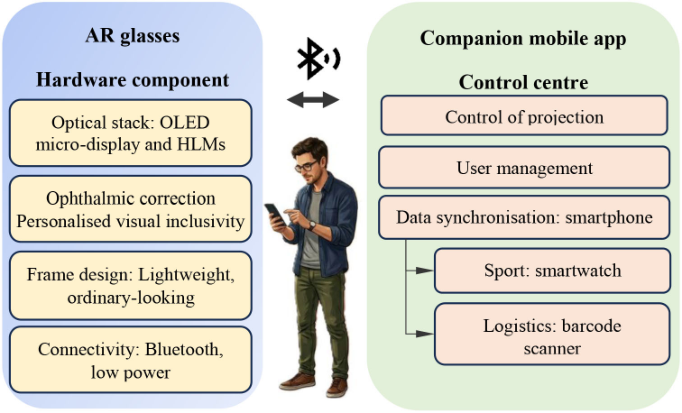
System Architecture The wearable system is structured around two primary components: the AR glasses and companion mobile applications (see Fig. 2).
Figure 2: System architecture.
The hardware, AR glasses, consists of lightweight, ordinary-looking frames that integrate ultra-low-power OLED micro displays and innovative holographic lens mirrors (HLMs). A critical architectural feature is the ability to incorporate personalised ophthalmic correction into the optical stack, ensuring inclusivity for users with visual impairments. Connectivity is managed via Bluetooth to ensure high-speed data transmission with minimal power consumption.
On the other hand, the companion mobile application serves as the system’s control centre, managing data synchronisation from external sources. At this stage, a smartphone is also linked to other devices, such as a Garmin watch for sports, or a barcode scanner in the logistics case. The app allows real-time configuration of AR content, enabling users to manage the content projected onto the lenses, its frequency, and location.
Implementing a Human Factors Plan for an Augmented Reality Eyewear 323 Methodology of Evaluation
The evaluation protocol is organised into three sequential layers designed to ensure a rigorous and comprehensive assessment of system performance. In total, 27 users participated in the ARE evaluation.
Layer 1 Pre-trial Characterisation. The 27 participants underwent a standardised baseline assessment comprising craniofacial anthropometric measurements, including interpupillary distance and bridge width, as well as a visual acuity screening. This characterisation step ensures that inter- individual variability is systematically accounted for when evaluating the ergonomic fit and optical performance of the AR prototype.
Layer 2 Close-interaction usability testing in laboratory conditions. During the testing in laboratory conditions, participants evaluated the interaction with the system across three critical dimensions: (I) physical interaction (fit, ergonomics and comfort); (II) mobile app and content projected (usability); and (III) virtual image quality (contrast, readability).
Layer 3 Assisted Field Trial Exposure. The third layer involves extended and continued use (1 hour) across three application use cases, and the assessed aspects are: mobile app usefulness and adaptation, visual comfort, mental load, and overall platform assessment (effectiveness, efficiency, and user satisfaction). In the healthcare domain, 6 participants took part in the study, which was conducted at the Simulation Centre of the Medical University of Lodz (February 2026) and focused on AR-assisted training for medical procedures. In the logistics domain, another 6 participants took part in the study, which was conducted at Orbel Grupo facilities (March 2026) to assess order-picking efficiency. In the sports domain, the trial was conducted during competitive rowing training sessions with 6 participants of the Fédération Française d’Aviron (March 2026), during which real-time performance metrics, including stroke rate and heart rate, were projected directly onto the AR glasses.
RESULTS
The Layer 1, pre-trial characterisation, confirmed the representativeness of the pilot sample: of the 27 end-users recruited across the three sectors (age: between 22-61; 12 women, 15 men), 56% reported some form of visual impairment (myopia, astigmatism or presbyopia) and 44% use glasses frequently or always, validating the centrality of ophthalmic correction as a design requirement identified in the Learn phase (Casas et al., 2025).
The Layer 2 laboratory assessment of prototype M17+ evaluated physical interaction, mobile app usability, projected content, and virtual image. Mobile application usability and usefulness received uniformly high ratings across sectors, with mean scores above 4.0 on a 5-point scale.
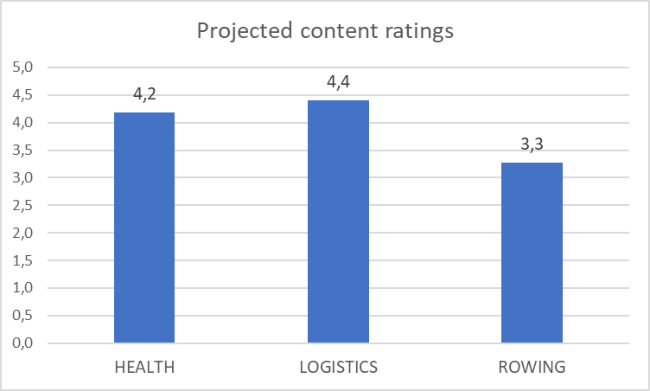
The projected content usability dimension showed a cross-sector divergence (Fig. 3). Logistics achieved the highest mean rating (4.4/5). At the same time, healthcare scored 4.2/5, with users identifying content format
(size and colour) as the main areas for improvement. The rowing sector received the lowest rating (3.3/5), highlighting issues with the content format and the need to better align user actions with the information required at that moment to optimise rowing technique. These results are consistent with the higher complexity of real-time performance data overlays compared to structured task guidance (Windhausen et al., 2024).
Figure 3: Score of the projected contents usability (n = 27).
Layer 3 field trials have yielded domain-specific qualitative insights that were not fully anticipated during the Learn phase. In the healthcare trial at the MUL Simulation Centre (February 2026, n = 6), the global assessment was positive. Participants expressed interest in future use, but identified demands for colour adaptability to differentiate alert levels and support colour-blind users, integration of blood pressure parameters in a single display unit, and the ability to adjust text size ad hoc. In the logistics trial at Orbel Grupo facilities (March 2026, n = 6), the principal finding was that relying on the smartphone app for barcode entry undermined the hands-free character of the system, slowing down the picking process, a known friction points in AR-assisted picking implementations (Rejeb et al., 2021). A subset of users also reported difficulty refocusing between the virtual overlay and the real environment. During the rowing trial at FFA facilities (March 2026, n = 6), the issues identified relate to the frame design. The overall design is not ideally suited to sports, which require a more wraparound frame with a better fit.
All findings have been logged in the HFIR and are informing the pre- deployment refinement cycle before the sports field trial and the final summative evaluation (Zhang et al., 2024).
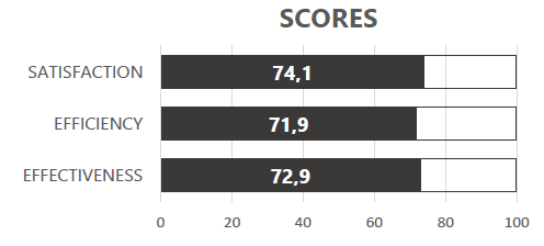
After the field trial, overall satisfaction (Fig. 4) reached 74.1, effectiveness 72.9, and efficiency 71.9, all rated Good (B), indicating residual friction in the task flow and interaction speed that warrant refinement prior to the summative evaluation (Escalada-Hernández et al., 2024).
Figure 4: Global SUS score (n = 27).
DISCUSSION
The results of the Learn phase provide a robust empirical foundation for the evaluation framework presented in this paper. The international survey (n = 869 participants across five European countries) revealed differentiated adoption intent across sectors, with healthcare achieving the highest Net Promoter Score (NPS = +35), followed by sports (NPS = +26) and logistics (NPS = +7). These findings are consistent with prior literature, which identifies professional motivation and perceived task relevance as primary drivers of wearable technology acceptance in occupational settings (Schall et al., 2018). The comparatively lower NPS in logistics aligns with its higher cost sensitivity: 39% of respondents identified cost as the primary adoption barrier, in line with established evidence on ROI-driven decision-making in workforce technologies.
A critical finding with direct design implications is that over 50% of the target population requires optical correction. In healthcare, 49.1% of users reported wearing prescription glasses full-time, and a further 41.2% reported wearing them part-time. This requirement is not adequately addressed by current commercial HMD platforms, which typically lack integrated ophthalmic correction (Rauschnabel et al., 2018).
The proposed three-layer evaluation architecture extends established human-centred design frameworks (ISO 9241-210:2019) by operationalising traceability at the instrument level. Anthropometric and visual baseline parameters (e.g. interpupillary distance, visual acuity) are explicitly linked to optical performance metrics collected in Layer 2, enabling attribution of perceptual issues to individual user profiles. This is particularly relevant in ARE systems, where optical alignment is inherently user-dependent. Layer 3 complements this approach by evaluating in user-relevant environments, including medical simulation (University of Lodz), logistics operations (Orbel) and high-performance sports contexts (Fédération Française d’Aviron).
Several limitations of the current methodology must be acknowledged. First, pilot sample sizes are constrained by the controlled nature of the validation environments, limiting generalisability. Second, although battery autonomy requirements (>12 h) were derived from user data, long-term exposure effects on visual fatigue and cognitive load remain to be assessed in a future longitudinal Layer 3 phase. Third, the logistics use case introduces
a dependency on peripheral hardware (barcode scanner), adding a system- level interaction variable not present in other domains. These limitations are documented in the Human Factors Issues Register (HFIR) and will inform subsequent design iterations.
CONCLUSION
This paper has presented the methodology developed to operationalise the Human Factors Plan (HFP) of the POPULAR project, bridging the gap between a structured conceptual framework and a deployable, evidence- based field evaluation protocol. Three findings from the completed phases warrant particular emphasis as they shape the scope and design of the ongoing validation work.
First, the Learn phase established that optical inclusivity is not a peripheral feature but a core usability requirement: more than 90% of the healthcare sample requires prescription correction either full-time or part-time, and visual discomfort ranks among the top adoption barriers across all three sectors (23–33%). These data justified the architectural decision to integrate holographic lens mirrors into a sub-40 g frame and defined the optical acceptance threshold against which Layer 2 results must be interpreted. The laboratory evaluation of prototype M17+ confirmed that the system achieves excellent effectiveness (86.1) and satisfaction (94.4), validating the core design decisions derived from the Learn phase. The lower efficiency score (77.8) identifies a specific, actionable refinement target, task flow and interaction speed that the HFIR traceability model has already directed for the next development iteration.
Second, the differentiated adoption intent identified in the survey, NPS of +35 in healthcare, +26 in sports, and +7 in logistics, has been corroborated by the field trial results: projected content satisfaction scores diverged substantially across domains (4.8 in logistics, 4.1 in healthcare, 3.6 in rowing), and each domain surfaced qualitatively distinct interaction issues. The healthcare trial revealed demands for colour adaptability and text resizing that were not captured in the original requirements; the logistics trial exposed a fundamental hands-free operation bottleneck introduced by the peripheral barcode scanner dependency. These domain-specific findings confirm that a single generic usability protocol cannot adequately capture the full interaction profile of a multi-domain ARE system, and that the scenario- driven Layer 3 architecture is a necessary, not optional, component of the evaluation framework.
In summary, the POPULAR platform represents a significant advancement in inclusive technology, ensuring that professionals requiring visual correction are not excluded from the digital transition. Future work will focus on the summative evaluation of the final prototypes and longitudinal field trials to assess long-term efficiency gains and cognitive impact in high-stakes professional environments.
Longitudinal exposure data will further address the open question of long- duration visual fatigue, the principal unknown that structured laboratory sessions cannot replicate. The methodology described here is offered as
Implementing a Human Factors Plan for an Augmented Reality Eyewear 327 a transferable reference for other multi-domain wearable development programmes in which individual physiological variability, and specifically optical correction, constitutes a first-order design constraint.
ACKNOWLEDGMENT
The POPULAR project has received funding from the European Union’s Horizon Europe research and innovation programme under grant agreement No 101135770. This publication reflects the views only of the author, and the Commission cannot be held responsible for any use which may be made of the information contained therein. The authors would like to thank all partners of the Popular Consortium.
REFERENCES
Casas, A. M., Camallonga, C. S., Rojas, J. M., Jimenez, V., Divo, F., & Andrzejczyk, A.
(2025). Smart Glasses and Augmented Reality to Support Healthcare. Healthcare and Medical Devices, 171(171). https://doi.org/10.54941/ahfe1006205 Casas, A. M., Vicente, A. L., Solano-García, L., & Laparra, J. (2023). 3 sprints from zero to innovative medical device in 16 months: Benefits of combining Human Factors and Agile. Production Management and Process Control, 104(104). https://doi.org/10.54941/AHFE1003047 Cheng, A., Fijacko, N., Lockey, A., Greif, R., Abelairas-Gomez, C., Gosak, L., & Lin, Y.
(2024). Use of augmented and virtual reality in resuscitation training: A systematic review. Resuscitation Plus, 18. https://doi.org/10.1016/j.resplu.2024.100643 Feuillade, M. (2026). POPULAR: Prescription optics providing a universal lens for augmented reality eyewear. Https://Doi.Org/10.1117/12.3113230, 13822, 138220A. https://doi.org/10.1117/12.3113230 Hernández, J. L., Casas, A. M., Feuilliade, M., Bonjour, X., Jimenez, A., Jimenez, V.,
Palop, L. S., Ortiz, J. F. S., Rojas, J. M., & Soler, A. (2024). Augmented Reality Eyewear with ophthalmic correction for mainstream applications, overcoming acceptance barriers through Human Factors Plan. Health Informatics and Biomedical Engineering Applications, 142(142). https://doi.org/10.54941/AHFE1005068 Kraus, S., Durst, S., Ferreira, J. J., Veiga, P., Kailer, N., & Weinmann, A. (2022).
Digital transformation in business and management research: An overview of the current status quo. International Journal of Information Management, 63(4), 102466. https://doi.org/10.1016/j.ijinfomgt.2021.102466 Rauschnabel, P. A., He, J., & Ro, Y. K. (2018). Antecedents to the adoption of augmented reality smart glasses: A closer look at privacy risks. Journal of Business Research, 92, 374–384. https://doi.org/10.1016/j.jbusres.2018.08.008 Schall, M. C., Sesek, R. F., & Cavuoto, L. A. (2018). Barriers to the Adoption of Wearable
Sensors in the Workplace: A Survey of Occupational Safety and Health Professionals. Human Factors, 60(3), 351–362. https://doi.org/10.1177/0018720817753907
LISTED IN THE AHFE DIGITAL BOOKSTORE CATALOGUE
Explore the complete digital volume
Usability and User Experience
Read this individual research paper free through the original publisher, or explore the full digital proceedings book.
ISBN 979-8-950676-08-6
Explore this ISBN in the AHFE Bookstore ↗Listed in the July 2026 bookstore catalogue; search by ISBN to confirm current availability · Digital book purchase optional