Toshihisa Doi (2024). Psychological Impacts of Different Organizational Cultures Toward Telecommuting on Workers. In: Social and Occupational Ergonomics. AHFE Open Access, vol. 152, pp. 115–121. https://doi.org/10.54941/ahfe1005326
This study focused on the culture and policies regarding telecommuting autonomy in companies and aimed to examine the impact of these policies on telecommuting. Specifically, the author investigated the effects of employees' perceptions of company policies and culture regarding telecommuting on their satisfaction, work engagement, stress reactions, and subjective productivity. A web-based survey was performed on 300 employees who regularly telecommute. Respondents were divided into three groups based on their ratings of questions about the company's policy toward telecommuting. Differences in satisfaction, work engagement, stress reaction, and subjective productivity were compared among the three groups. The results suggest that satisfaction declines in the group with the least autonomy. The results also suggest that engagement increases in the group perceived to be the most proactive in implementing telecommuting.
The number of teleworkers has increased rapidly since the coronavirus disas- ter (Eurofound and International Labour Office, 2017; Henke et al., 2016). Because telecommuting has advantages such as eliminating commuting and work-location restrictions and making it easier to balance work with child- care and nursing care (Gajendran and Harrison, 2007; Evans et al., 2004), it continues to be widely adopted even as the various restrictions imposed by the coronavirus disaster are being eased. For teleworkers to work comfortably under these circumstances, ergonomic knowledge is essential to construct an appropriate telecommuting environment.
In order to construct a better telecommuting environment, requirements that directly affect workers’ bodies, such as the physical environment, facil- ities, and ICT equipment, are essential. However, many studies have also pointed out the importance of workers’ cognitive and organizational aspects, such as autonomy in work. However, research findings focusing on workers’ perception of autonomy in telecommuting are scarce, and an accumulation
of research findings is needed. Takahashi et al. (2022) pointed out that orga- nizational support is essential for ease of work in telecommuting. Adisa et al. (2023) investigated the relationship between telecommuting and employee engagement and reported that organizational support is necessary for effec- tive work execution. Sakai et al. (2023) pointed out the importance of establishing measures to ensure work time control, discretion, and auton- omy to reduce telecommuting stress and examine how employees perceive these measures.
This study aimed to investigate the impact of these factors on telecom- muting by focusing on the culture and stance of companies regarding the autonomy of telecommuting. Specifically, the study examined the stance of companies toward telecommuting in terms of the degree to which workers can adjust the dates and times of telecommuting, whether they are managerial or non-managerial toward employees when telecommuting, and whether they are proactive or reactive in implementing telecommuting. Then, these factors’ effects on workers’ psychological aspects were analyzed. The following psy- chological aspects were selected: (1) satisfaction, (2) perceived productivity, (3) work engagement, (4) stress reactions. In addition, the author also ana- lyzed the differences in the effects of the number of telecommuting days and hours on the aforementioned psychological aspects of workers, depending on differences in corporate culture and stance.
METHODS
Participants A web-based questionnaire survey was conducted on 300 workers (mean 44.21 years, SD: 10.88, 162 males and 138 females) recruited via an Internet research company and working from home two or more days a week for at least six months. All of them lived in Japan and worked from home in Japan.
Questionnaire Items In this study, the author focused on the culture and stance on autonomy regarding telecommuting and examined the impact of this on the psychologi- cal aspects of workers. The organizational culture of telecommuting includes (1) whether employees are free to decide the date and time of telecommut- ing (5-point Likert scale from 1: disagree to 5: agree), (2) the organization’s management attitude toward telecommuting (4-point SD scale from 1: man- agerial to 4: non-managerial), (3) the organization’s attitude of implementing telecommuting (4-point SD scale from 1: positive to 4: negative).
The four psychological aspects selected were (1) satisfaction, (2) perceived productivity, (3) work engagement, and (4) stress reactions. Each of these was measured as follows. In addition, overall satisfaction with telecommuting was measured on a 7-point Likert scale.
Work Engagement Work engagement is a positive and fulfilling psychological state. The Utrecht Work Engagement Scale is proposed by Schaufeli and Bekker (2010) as a
Psychological Impacts of Different Organizational Cultures Toward Telecommuting 117
measure of work engagement. This study used the Japanese version of the Utrecht Work Engagement Scale (simplified version) (Shimazu et al., 2008; Schaufeli et al., 2019). This scale elicited responses to three questions about vitality, enthusiasm, and immersion using a seven-point rating scale. The total score across the three items was recorded to form an overall score.
Stress Reactions In Japan, a Brief Job Stress Questionnaire was used to assess stress at work (Shimomitsu et al., 2000; Shimomitsu, 1998; Shimomitsu, 2000). This questionnaire consisted of three parts: job stressors, stress reactions, and modifiers, and was used to identify high-stress individuals. In this study, 29 items related to stress were used. These 29 items consisted of a four-point rating scale based on liveness, irritability, fatigue, anxiety, depression, and somatic complaints. The total score (after reversing the negative items) was used as an overall stress score.
Perceived Productivity The following three questions were posed. Participants responded using a five-point scale based on their work situation over the previous month:
Do you think your work productivity is high?
Do you think you are achieving more than expected?
Do you think telecommuting has improved your work efficiency?
The total score of these three items was used as the perceived productivity score.
Data Analysis First, a cluster analysis was conducted on three items related to the company’s policy on telecommuting, and the respondents were divided into groups according to the differences in the culture of the organizations in which they worked. Then, a one-way ANOVA was conducted to compare the differences among the groups and to examine the effects of differences in organizational culture on the psychological aspects of telecommuting as perceived by the employees.
RESULTS
Correlations Among Questionnaire Items The correlation coefficients among the items are shown in Table 1 below. A positive correlation was found between the score of whether employees could freely decide the date and time and their overall satisfaction level. Neg- ative correlations were also found between the management attitude of the organization and the implementation attitude of telecommuting and work engagement.
118 Doi
Table 1. Correlation coefficients among the questionnaire items.
Table available in the original PDF paper.
C1 C2 C3 P1 P2 P3 P4
- 0.252 -0.196 0.248 0.122 0.033 -0.056
C1 Freely decide the date and time of telecommuting
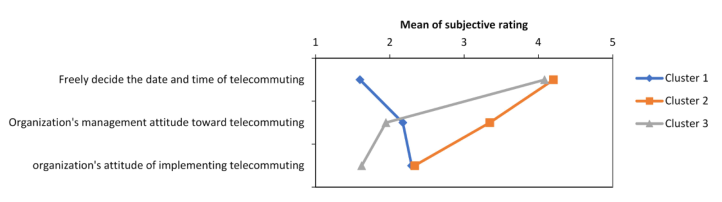
Clustering by Organizational Attitudes Regarding Telecommuting A cluster analysis using the k-means method was conducted using three items related to the company’s policy on telecommuting, and the survey respon- dents were divided into three groups (Cluster 1: 85, Cluster 2: 98, Cluster 3: 117). Figure 1 shows the mean scores of the items related to telecommuting policy for each group. A one-way ANOVA revealed significant differences between the groups for all items. Figure 1 indicates that cluster 1 is a group that cannot freely decide on telecommuting dates and times and has a rel- atively managerial attitude toward telecommuting. Cluster 2 is a group of workers who can freely decide their workdays at home and have a non- managerial attitude toward telecommuting. Cluster 3 was defined as orga- nizations that were proactive about telecommuting and allowed employees to decide their telecommuting days and times freely but adopted a relatively managerial attitude toward telecommuting.
Figure 1: Characteristics of each cluster.
Differences Among the Clusters
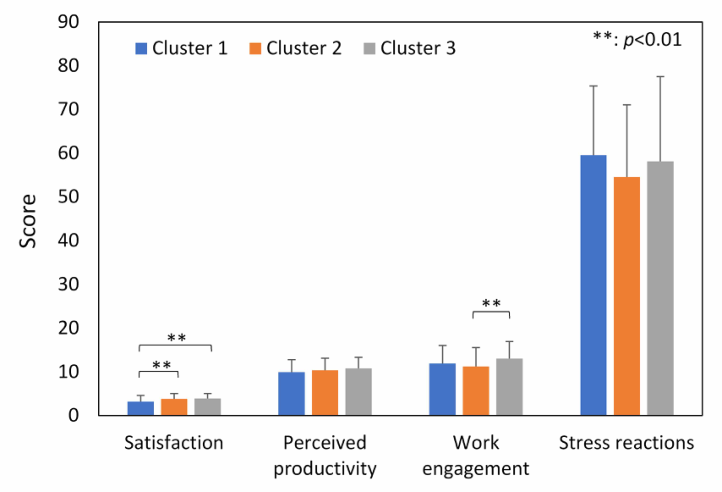
Figure 2 shows the results of each group’s responses for satisfaction, work engagement, stress reaction, and perceived productivity. A one-way ANOVA on satisfaction with telecommuting showed a significant differ- ence (F(2,297)=8.427, p<0.01), and a Tukey-Kramer multiple comparison showed a significant difference between cluster 1 and the other clusters (p<0.01).
Psychological Impacts of Different Organizational Cultures Toward Telecommuting 119
One-way ANOVA for work engagement revealed a significant differ- ence (F(2,297)=5.385, p<0.01), and Tukey-Kramer multiple comparisons revealed a significant difference between cluster 2 and cluster 3 (p<0.01).
One-way ANOVAs on stress response and perceived productivity showed no significant differences between the groups.
Figure 2: Comparison of employee’s psychological aspects among clusters.
DISCUSSION
In the correlation analysis, all three items used in the cluster analysis were cor- related with the workers’ subjective evaluation of telecommuting, suggesting that all of these organizational policies impact the workers’ psychologi- cal aspects. Therefore, using them as indices for the cluster analysis was appropriate.
The clusters were classified into three groups, as described above. Looking at the characteristics of each cluster, cluster 1 is considered to be the group in which the workers feel the least autonomy in both the decision of the telecom- muting date and time and the management system during telecommuting. On the other hand, cluster 2 was not different from cluster 1 in terms of proac- tiveness, but the other characteristics of cluster 2 were in conflict with those of cluster 1. This suggests that workers in Cluster 2 feel that they have a high degree of freedom. Cluster 3 is the group in which workers feel that they are the most proactive in implementing telecommuting and can freely decide the date and time. However, on the other hand, they feel that they are the most managerial during the workday.
120 Doi
When the differences in the scores of each indicator between these three clusters were analyzed, the score of cluster 1 was significantly lower for satisfaction. Cluster 1 is the group with the least autonomy, suggesting that the degree of discretion/autonomy of the workers’ telecommuting may impact their satisfaction. This is a reasonable conclusion, as many studies on telecommuting have pointed out the importance of autonomy. It could be necessary to support employees in achieving a high degree of autonomy in telecommuting to increase employee satisfaction. Furthermore, the score of cluster 3 was significantly higher when looking at work engagement. Clus- ter 3 differs from clusters 1 and 2 in that it is perceived as the most positive attitude toward telecommuting. In other words, the active implementation of telecommuting is important for increasing workers’ work engagement.
CONCLUSION
This study examined the effects of employees’ perceptions of corporate policies and culture toward telecommuting on their satisfaction, work engagement, stress reactions, and perceived productivity. Participants were asked about three items related to the company’s policy on telecommuting: (1) whether the company allows employees to decide their telecommuting schedule freely, (2) the organization’s management attitude toward telecom- muting, and (3) the organization’s attitude toward telecommuting implemen- tation. Differences in satisfaction, work engagement, stress reaction, and perceived productivity among the three groups were compared, and satisfac- tion was significantly lower in the group that perceived the least autonomy. This suggests that satisfaction declines when employees perceive telecommut- ing as a policy of low autonomy. Work engagement was significantly higher in the group where telecommuting was perceived to be the most proactive. This suggests that engagement increases when employees feel that telecommuting is a proactive policy.
ACKNOWLEDGMENT
This research was funded by JSPS KAKENHI, grant number 22K18140.
REFERENCES
Adisa, T. A, Ogbonnaya, C., Adekoya, O. D. (2023). Remote working and employee engagement: A qualitative study of British workers during the pandemic, Infor- mation Technology and People, Vol. 36, No. 5, pp. 1835–1850. Eurofound and International Labour Office. (2017). Working anytime, anywhere:
The effects on the world of work. Publications Office of the European Union, Luxembourg, and the International Labour Office, Geneva. Evans, J., Kunda, G., Barley, S. R. (2004). Beach time, bridge time, and billable hours: The temporal structure of technical contracting, Administrative Science Quarterly, vol. 49, pp. 1–38. Gajendran, R. S., Harrison, D. A. (2007). The good, the bad, and the unknown
about telecommuting: Meta-analysis of psychological mediators and individual consequences, Journal of Applied Psychology, vol. 92, no. 6, pp. 1524–1541.
Psychological Impacts of Different Organizational Cultures Toward Telecommuting 121
Henke, R. M., Benevent, R., Schulte, P., Rinehart, C., Crighton, K., Corcoran, M.
(2016). The effects of telecommuting intensity on employee health, American Journal of Health Promotion, vol. 30, no. 8, pp. 604–612. Sakai, K., Ebara, T. (2023). Perspective of Teleworking Research under the Post- COVID-19 Era – Research Issues to Be Addressed in Human Factors and Ergonomics-, The Japanese Journal of Ergonomics, Vol. 59, No. 6, pp. 244–250. Schaufeli, W. B., Bakker, A. B. (2010). Defining and measuring work engage-
ment: Bringing clarity to the concept, In A. B. Bakker, M. P. Leiter (Eds) Work engagement: Recent developments in theory and research, pp. 10–24, Psychology Press. Schaufeli, W. B., Shimazu, A., Hakanen, J., Salanova, M., de Witte, H. (2019). An ultra-short measure for work engagement: The UWES-3 validation across five countries, European Journal of Psychological Assessment, vol. 35, pp. 577–591. Shimazu, A., Schaufeli, W. B., Kosugi, S., Suzuki, A., Nashiwa, H., Kato, A.,
Sakamoto, M., Irimajiri, H., Amano, S., Hirohata, K., Goto, R., Kitaoka- Higashiguchi, K. (2008). Work engagement in Japan: Validation of the Japanese version of Utrecht Work Engagement Scale, Applied Psychology: An International Review, vol. 57, pp. 510–523. Shimomitsu, T. (1998). Development of a novel brief job stress questionnaire, Report of the research grant for the prevention of work-related diseases from the Ministry of Labor. Shimomitsu, T. (2000). The final development of the Brief Job Stress Questionnaire
mainly used for assessment of the individuals, Ministry of Labour sponsored grant for the prebention of work-related illness: The 1999 report, pp. 126–164. Shimomitsu, T., Yokoyama, K., Ohno, H., Maruta, T., Tanigawa, T. (2000). Manual of the Brief Job Stress Questionnaire, In: Reports on the study of job stress and its effects on health in the workplace: The research grant for the prevention of work-related diseases from the Japan Ministry of labour. Tokyo: The Ministry of Labor. Takahashi, K., Kato, T. (2022). Re-searching Remote Works vol. 1: Data Analysis.
HAKUTO-SHOBO publishing.
LISTED IN THE AHFE DIGITAL BOOKSTORE CATALOGUE
Explore the complete digital volume
Social and Occupational Ergonomics
Read this individual research paper free through the original publisher, or explore the full digital proceedings book.
ISBN 978-1-964867-28-1
Explore this ISBN in the AHFE Bookstore ↗Listed in the July 2026 bookstore catalogue; search by ISBN to confirm current availability · Digital book purchase optional