Ian Garcia, Jouke Verlinden (2024). Immersive assistive technologies for knowledge transfer of crafts: Exploration and technical challenges. In: Social and Occupational Ergonomics. AHFE Open Access, vol. 152, pp. 103–114. https://doi.org/10.54941/ahfe1005325
Immersive technologies have created a paradigm shift in the realm of traditional crafts, offering unprecedented avenues for digitization and knowledge transfer. This scoping review explores the integration of immersive technologies within the traditional crafts domain, focusing on their utilization for digitization and their impact on knowledge transfer processes. Through a systematic analysis of available literature, this review aims to map the existing landscape of immersive technology applications in traditional craftsmanship, dissecting the modalities and influence on knowledge transfer. Emphasizing the use of virtual reality (VR), augmented reality (AR), and mixed reality (MR), this study endeavours to identify trends, gaps, and prospects for leveraging immersive technologies in the preservation, transmission, and enhancement of traditional craft knowledge. As set of results will be presented, namely a positioning map of existing solutions within immersive technology and their activeness in assistance. An overview of topics occurrences, visualized in a Venn diagram. An identification of the perspectives throughout the literature articles, a used methods overview and lastly a set of fundamental elements providing a set of tendencies to include when dealing with knowledge transfer of immersive technologies in crafts. It becomes clear from literature that existing studies focus rather on very specific test setups due to the unique nature of each craft or craft process. This leaves opportunity for generalization and creation of a structured repository. There is a trend towards usage of virtual avatars in studies that make use of immersive virtual elements in their experiment setups. There is a clear motive across the literature to combine the flexibility of the virtual with the familiarity of physical work environments. Therefore, mixed reality could form a possible solution, combining virtual and real-world components.
Munck, 2019), cultural influences (Kreijns et al., 2011; Lee et al., 2016), cus- tomization, and personalization (Zoran et al., 2014) to psychological benefits (Gamble, 2001), technological tool advancements (Acke et al., 2021; Latilla et al., 2018; Weigert et al., 2019), assistive techniques (Peng et al., 2015; Van Goethem et al., 2020) and knowledge performance (Latilla et al., 2018). There is an importance of the integration of contemporary approaches within traditional craft knowledge that carries throughout in society. E.g., modern materials, technologies, and design principles ensure the relevance and via- bility of crafts in contemporary contexts. Traditional crafts should be seen as cultural heritage and treated as economic assets and knowledge. Thus, the preservation of craft diversity and cultural identity are key for sustainable local economies and, thereby, craft preservation (Zabulis et al., 2023). Craft has many definitions, here specifically we analyse traditional crafts, prac- ticed directly by hand and through operation on natural materials. The aim of this study is to find anchor points for revitalisation of craft practices. Not only in its traditional form, but also exploring assistive technology and their opportunities within this field. Analysing the current work field and common practices allows us to define the potential interventions for said technology.
Immersive technology has a multitude of subjects to consider. To narrow this scope, we defined the most relevant direction with two arguments. The first is the feasibility and availability, secondly is the added value to apprentice education. Therefore, we focus on visual guidance which will be of interest for the craft process in general, as well as for tools and virtual object references.
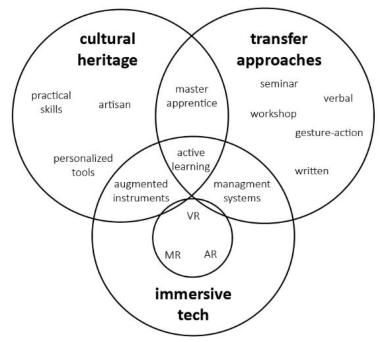
The integration of immersive technology with traditional crafts can pro- vide solutions to bridge generational gaps, enhance the preservation of cultural heritage, and empower both master craftsmen and apprentices. The potential of immersive technology with usage of visual guidance is depicted in Figure 1. Combined with cultural heritage it can elevate the crafts making experience through augmented instrument development.
Figure 1: Ingredients of knowledge in crafts.
Immersive Assistive Technologies for Knowledge Transfer of Crafts 105 Visual guidance is essentially the collection of virtual elements displayable in immersive technology which can be deployed as static 3D imagery or animation, usable as visualisation of a craft process step for example.
For knowledge transfer approaches it opens a way of additional visualisa- tion in 3D. The intersection of the three areas within (in) tangible knowledge encompasses active learning, provided through the user of immersive tech- nology when tailoring a management system to the crafts practice (Watanuki & Kojima, 2007).
This paper is part of the European project “Tracks4Crafts” which aims to revive and reframe crafts from historical, economic, and product develop- ment perspectives. By exploring the integration of immersive technology into traditional crafts, the project aims to bridge generational gaps, enhance the preservation of cultural heritage, and empower both master craftsmen and apprentices. For the overall purpose definition of this paper, and to stream- line with the goals of the European project, the following research questions are proposed: What is considered transferable knowledge within crafts, specifically in existing literature?
What is the landscape of immersive technology and transfer craft knowl- edge (TCK) assistance?
What are the existing fundamentals that align with immersive technology to enhance the effectiveness of knowledge transfer in crafts?
METHOD The scoping review method was employed as a strategic approach to com- prehensively explore and map the diverse applications of knowledge transfer and immersive technologies within the realm of traditional craftsmanship. This methodological choice involved a systematic examination of a wide range of literature, studies, and resources, allowing for a broad and inclusive overview of the field. The review facilitates identification and compilation of various uses, practices, and emerging trends regarding the integration of immersive technologies in knowledge transfer within traditional craftsman- ship. The scoping review process was structured to survey and synthesize existing knowledge, thus enabling a comprehensive understanding of the landscape, highlighting gaps, patterns, and opportunities, while laying the groundwork for further in-depth investigations. The study adopts a system- atic approach for analysing the literature using the SCM-TBFO framework devised for holistic literature review, which consists of: School of thought (S), Contexts (C), Methodologies (M), Triggers (T), Barriers (B), Facilitators (F) and Outcomes (O) (Singh and Dhir, 2023).
Suitable literature has been selected based on three main keyword com- binations. These are: immersive AND craft; craft AND knowledge AND transfer; immersive AND knowledge AND transfer.
Further on, the study employed the Preferred Reporting Items for System- atic Reviews and Meta-Analyses (PRISMA) approach to refine and extract pertinent information for an in-depth examination of relevant literature (Tricco et al., 2018). This method facilitated the selection of key papers
106 Garcia and Verlinden
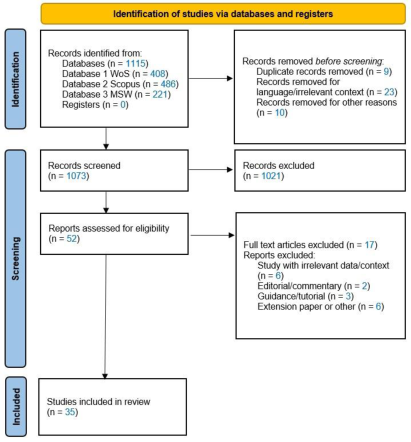
and studies essential for a deeper investigation within the domain of knowl- edge transfer and immersive technologies in traditional craftsmanship. The application of PRISMA in Figure 2 allows for the identification of scholarly contributions most aligned with the research objectives.
Figure 2: PRISMA flow diagram.
1115 publications were identified through the scoping search across three data bases, of which 52 were subjected to full-text review. 17 publications were excluded for reasons mentioned in Figure 2. A total of 35 publications were finally included in the scoping review.
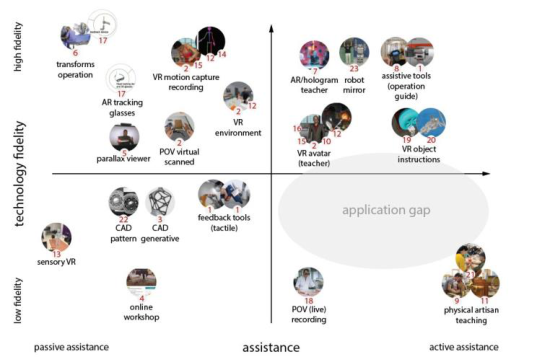
To elaborate findings, a couple of visualisation techniques are utilized. The first one is a quantitative positioning map of existing studies considering technology for assistance of the craft process. There exist two axes, defined respectively through technology complexity/fidelity and amount of activeness in assistance. For technology fidelity it is important to analyse the usage of the specific technology and the extent of usage in said study. High-complex tech- nology is seen as the most novel/most expensive (specialized labs, companies). Low-complex technology is approachable and accessible by the public. The positioning along the technology complexity axis is determined by a quantita- tive rating through the following indicators: cost, development, conventional or innovative elements and required expert for setup and/or usage. To deter- mine the activeness position in assistance, besides considering the use case, two extremes were defined. On the left we have completely passive assistance, meaning that the practitioner had to do everything themselves. And on the right, we have completely active, meaning that a physical instructor guides the practitioner during the process and can even intervene.
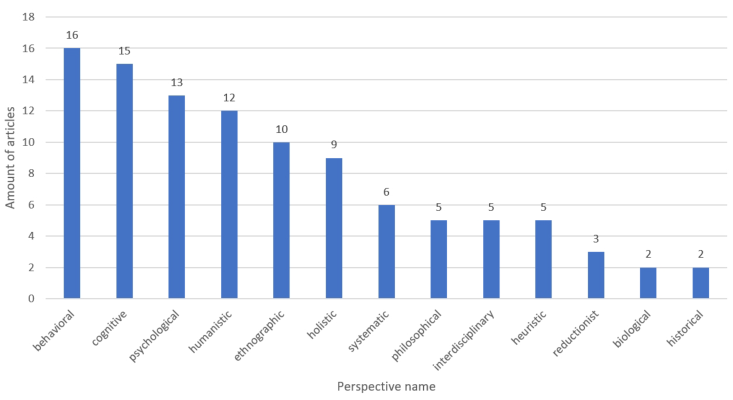
Categorizing perspectives in the literature is a challenging task due to the nuanced intentions of authors. A perspective can be described as the direction
Immersive Assistive Technologies for Knowledge Transfer of Crafts 107 to which research domain the author wants to contribute towards. To elab- orate this categorization, a set of three indicators are defined. Indicator 1: a trend analysis of keywords and context throughout the papers. Indicator 2: Subject of experiment and tools used for data analysis. Indicator 3: The type of results and what kind of data is presented. The set of predefined perspec- tives are based on grounds in psychology (Lloyd, 2017) and can be seen on the x-axis in Figure 4.
RESULTS Results will mainly be depicted in positioning maps and Venn diagrams. Showcasing the frequency and context of the different papers as subject of this study. The visual representations provide a combination of qualitative and quantitative information regarding the immersive knowledge transfer in traditional crafts and will support the answers to the research questions. Due to the qualitative intention of this paper and the nature of a scoping review, less emphasis has been placed on defining amount-specific results. Therefore, in multiple visualisations only the article title is mentioned.
Adoption of Technology in Traditional Craft-Making We found 23 significant articles that discuss the inclusion of various tech- nologies, which vary in fidelity and assistance intensity. To understand the positioning map in Figure 3 we need to clarify the meaning of ‘assis- tance’. When looking at passive assistance, the instrument or tool does not interfere/interact with the craft process itself. It is merely used as guidance or support. Where on the other hand in active assistance it is rather the interaction with the craft process, the material, the apprentice. For exam- ple, physically guiding the process or correcting steps while modifying the product.
The positioning visualisation of Figure 3 reveals most of the existing stud- ies working in the higher fidelity ranges with solutions such as motion capture, virtual reality (VR) environments and advanced operations such as assistive tools and transformative operation (Brondi et al., 2016; Carre et al., 2022; Carrozzino et al., 2016; Cunningham et al., 2021; Edwards et al., 2021; Esmaeili et al., 2018; Lawrence et al., 2021; Makarova et al., 2023; Okuda, 2007; Paredes & Vázquez, 2020; Pistola et al., 2021; van Dyck et al., 2023; Zoran et al., 2014). A major factor is also the high interest to create VR avatars. There are five explicit studies who use avatars to support the craft making and learning process in the digital world (Brondi et al., 2016; Carre et al., 2022; Carrozzino et al., 2016; Esmaeili et al., 2018; Zabulis et al., 2022). The application gap exists in the lower end of technological fidelity and the higher end of activeness in assistance, marked with a light-grey oval. In the high-fidelity technology range with active assistance, we find a set of physical expert workshops with minimal use of technology and maximum amount of human interaction (Goll et al., 2019; Hsu & Wu, 2020; Kojima et al., 2014; Lee et al., 2020). Whereas in the low-fidelity technology with passive assistance, there is more presentation of systems tools and software
108 Garcia and Verlinden
that do not allow master-student interaction (Aytekin & Rızvanog˘ lu, 2019; Saxena, 2023; Sun et al., 2023; Zoran et al., 2014; Zoran & Paradiso, 2013).
Figure 3: Positioning map–adoption to technology.
A variety of different levels of technology integration exist in the realm of crafts. The lowest tier consists of approaches without the use of any exter- nal tools, so crafts such as elementary origami, pottery (without wheel) and claying. Next as a middle tier we have the non-technology tool operated crafts, these include pottery, woodworking and knitting. The final tier has machinery tools in the practice of its craft, consisting of welding, tufting, woodworking (turning), glassblowing and metal sculpting.
The interaction of hand, body, tools and materials is the origin of skilful craftwork. Within this the following statement is true ‘to become skilful in the use of a tool is to learn and appreciate directly, without processes of interme- diate reasoning, the qualities of the materials that we apprehend through the tacit sensations of the tool in our hand’ (Jarvis, 2007). The material inspires the artisan, the artisan shapes the material, and the instrument facilitates this transformative process. It’s a dance of creativity, skill, and responsiveness. This relationship is not unidirectional; rather, it forms a holistic interconnec- tivity where each element influences and is influenced by the others (Groth, 2016). Embodied knowledge consists of tangible and intangible knowledge, these are the building stones of holistic understanding of crafts and their practice (Pistola et al., 2021). As an artisan, performing handwork, in com- bination with having human interaction with a material can be considered a craft. Plenty of different studies mention some sort of craft/handwork/art- s/heritage preservation. However, this paper solely focuses on transfer of tangible and intangible knowledge within this definition. The level of craft must be of hobbyist or professional level. For example, someone that is doing craftwork just for one experiment is not sufficient. A common occurrence is the use of crafts as demonstrator in shops, practices, expositions or museums.
Immersive Assistive Technologies for Knowledge Transfer of Crafts 109 These will not be included as suitable articles due to their purely informative or recreative nature.
Knowledge Transfer for Crafts The perspectives of articles in Figure 4 describe the type of view the author(s) have towards the subject. Throughout the studied articles the most common perspectives are ‘Behavioural’, ‘cognitive’, and ‘psychological’, these have interest in understanding the tacit knowledge and the underlying mechanics of craft making. Interestingly but not surprisingly is the high frequency of the ethnographic perspective, which is the study on cultural customs and habits. Traditional crafts have cultural significance woven into them naturally. Often specific crafts are location-related due to the nature of its sourced environ- ment. For example, silk and raw materials exist or are recreated locally and have historical significance.
Figure 4: Positioning map – author research perspectives.
Fundamental Elements A set of relevant tendencies towards safeguarding of crafts and technol- ogy implementation opportunities for knowledge transfer are noticeable throughout the literature study. The following list describes the coincidental perspectives and results from these articles.
Training program: case studies, experiments, literature study or field research results eventually end up in the development of a training of orga- nized tasks or creates an immersive timeline, providing progress overview.
Technology implementation: several studies imply specific integration. These take on different shapes, ranging from posture instructors to physical- digital tool development. Not only on an individual apprentice level but fostering collaboration by building a platform or having compatible solutions for digitisation practices.
110 Ian and Jouke
Status quo (resemblances with similar fields using current craft structure): Through VR and video there are new approaches possible for delivering tacit knowledge. A harmonious fit between data gathering techniques and knowl- edge holders is crucial. A large reoccurring influence is the ethnographic perspective.
Demo setup: throughout the studies several physical setups are being made as demonstrators, these are usually interactive to attract participants and range from training systems to more installation-style setups as experiment results.
Usage insights: it is important to embrace the realism factor of VR, thus creating a superior teaching exposure versus traditional video. Also, perfor- mance increase is noticeable in multiple papers, where operative times are reduced. Lastly when using immersive environments, the learning interest increases, and the overall apprentice or practitioner performance improves.
Support system: several systems are being tested and developed; these can have different goals. For example, the CAMIL system with its immersive affective model for learning supports tools for interactive collaboration. But there is also a setup for principles, to provide stability and recognizability for the preservation of craft. Lastly, repositories are effective safeguarding mechanisms, preserving specific tacit knowledge in a tailored system.
DISCUSSION Reflecting on the research questions on this study, some findings are dis- covered. Transferable knowledge within crafts is not described explicitly in many experiment or case studies, they are to be found in more theoretical works. They describe the differences between tangible and intangible knowl- edge transfer and consider intangible the toughest to quantify. There is not a specific universal language or way to describe this knowledge. Craftspeo- ple communicate their thoughts through methods of action, skill, and sense of all the properties (form, stiffness, colour, smell etc.). In the studied liter- ature, they are often considered as action models or training programmes such as seminars and workshops. A focus towards behavioural and cognitive experiments is visible throughout the perspectives. They try to underline and discover the intrinsic values of intangible knowledge. Additionally, getting to know how a craftsperson thinks and tries to communicate their mental process is part of the major study domain.
The application gap in Figure 3 reveals a potential focus field for follow- ing studies towards innovation within low-complex technology. However, if wanting to focus on similar existing solutions, it is better to examine more advanced technology implementations but with less activeness in assistance. Most literature uses advanced technology through proprietary equipment or industrial solutions. This makes the implementation for crafts in general less compatible. However, the techniques used within this higher fidelity range are deemed interesting through their potential benefits and simplified setup procedures. For example, the use of motion capture and the ability to create specific VR environments can allow interaction in multiple levels of fidelity, not only in the higher levels as the literature results initially reveal.
Immersive Assistive Technologies for Knowledge Transfer of Crafts 111 The fundamental elements create opportunity paths within the scope of immersive assistive technology for crafts. A set of fundamentals allow for development towards valuable solutions. The usage of training programs and demo setups show in-context demonstrations of specific knowledge. While support systems create an interactive environment for assistance and development of skill beyond the traditional linear training layouts.
CONCLUSION This study tries to unveil the current state of the art in assistive immersive technologies for craft knowledge transfer. Unique experimental setups are reoccurring within case studies, where specific prototypes are tested and/or reviewed. Knowledge surrounding more generalized implementations are only mentioned as conclusions or future work in the literature. This find- ing underlines the necessity for a methodology or structured framework to devise active assistance in a less technology-complex context, motivated by the application gap in Figure 3 and corresponds with the characteristics of the fundamental elements ‘training program’ and ‘support system’.
The emerging solutions are coupled to the available hardware and soft- ware. There is increased experimentation along virtual reality head mounted displays (HMD’s) using assistive immersed environments to guide a training programme or transfer real-world object knowledge through 3D visuali- sation. A clear trend towards the usage of virtual avatars and immersive environments is noticeable. However, approaches such as motion capture (of the artisan movement to recreate a one-on-one representation of the crafting process) for teaching novices suggests the lack of real-world reference, specif- ically the perception of realistic materials and interaction with the real-world environment. Mixed reality presents an opportunity for future work, com- bining both virtual and real-world components in guidance by fundamental elements ‘demo setups’ and ‘technology implementation’.
ACKNOWLEDGEMENTS This work was supported by the European Union, under the Horizon project Tracks4Crafts with project ID: 101094507.
REFERENCES
Acke, L., De Vis, K., Verwulgen, S., & Verlinden, J. (2021). Survey and literature study to provide insights on the application of 3D technologies in objects conser- vation and restoration. In Journal of Cultural Heritage (Vol. 49, pp. 272–288). Elsevier Masson s.r.l. https://doi.org/10.1016/j.culher.2020.12.003 Aytekin, B. A., & Rızvanog˘ lu, K. (2019). Creating learning bridges through participa- tory
design and technology to achieve sustainability in local crafts: a participatory model to enable the transfer of tacit knowledge and experience between the traditional craftsmanship and academic education. International Journal of Tech- nology and Design Education, 29(3), 603–632. https://doi.org/10.1007/s10798- 018-9454-3 Brondi, R., Carrozzino, M., Lorenzini, C., & Tecchia, F. (2016). Using Mixed Real- ity and Natural Interaction in Cultural Heritage Applications. In Informatica (Vol. 40). Carre, A. L., Dubois, A., Partarakis, N., Zabulis, X., Patsiouras, N., Mantinaki, E.,
Zidianakis, E., Cadi, N., Baka, E., Thalmann, N. M., Makrygiannis, D., Glushkova, A., & Manitsaris, S. (2022). Mixed-Reality Demonstration and Train- ing of Glassblowing. Heritage, 5(1), 103–128. https://doi.org/10.3390/heritage 5010006
112 Ian and Jouke
Carrozzino, M., Lorenzini, C., Duguleana, M., Evangelista, C., Brondi, R., Tecchia, F., & Bergamasco, M. (2016). An immersive VR experience to learn the craft of printmaking. Lecture Notes in Computer Science (Including Subseries Lecture Notes in Artificial Intelligence and Lecture Notes in Bioinformatics), 9769, 378– 389. https://doi.org/10.1007/978-3-319-40651-0_30 Christiansen, L., Hvidsten, T. E., Kristensen, J. H., Gebhardt, J., Mahmood, K., Otto, T.,
Lassen, A. H., Brunoe, T. D., Schou, C., & Laursen, E. S. (2022). A Frame- work for Developing Educational Industry 4.0 Activities and Study Materials. Education Sciences, 12(10), 659. https://doi.org/10.3390/educsci12100659 Cunningham, B. W., Brooks, D. M., & McAfee, P. C. (2021). Accuracy of roboticassisted spinal surgery—comparison to TJR robotics, da Vinci robotics, and optoelectronic laboratory robotics. International Journal of Spine Surgery, 15(S2), S38– S55. https://doi.org/10.14444/8139 De Munck, B. (2019). Artisans as knowledge workers: Craft and creativity in a long
term perspective. Geoforum, 99, 227–237. https://doi.org/10.1016/j.geofor um.2018.05.025 Edwards, T. C., Patel, A., Szyszka, B., Coombs, A. W., Liddle, A. D., Kucheria, R., Cobb, J. P., & Logishetty, K. (2021). Immersive virtual reality enables techni- cal skill acquisition for scrub nurses in complex revision total knee arthroplasty. Archives of Orthopaedic and Trauma Surgery, 141(12), 2313–2321. https://doi. org/10.1007/s00402-021-04050-4
Esmaeili, A. H., Thwaites, H., & Woods, P. C. (2018). Immersive virtual environ- ments for tacit knowledge transfer focusing on gestures: A workflow. Proceedings of the 2017 23rd International Conference on Virtual Systems and Multimedia, VSMM 2017, 2018-January, 1–6. https://doi.org/10.1109/VSMM.2017.8346255 Goll, I., Milo, R., Skovfoged, M., Jacek, J., Miroslav, C., Sokolov, K., Rodil, K., Rossau, I. G., Skovfoged, M. M., Czapla, J. J., & Sokolov, M. K. (2019). Dovetail- ing: safeguarding
traditional craftsmanship using virtual reality. In International Journal of Intangible Heritage (Vol. 14). Groth, C. (2016). Design- and Craft thinking analysed as Embodied Cognition. FormAkademisk - Forskningstidsskrift for Design Og Designdidaktikk, 9(1). https: //doi.org/10.7577/formakademisk.1481 Hsu, T. Y., & Wu, H. J. (2020). Developing knowledge management system for sup-
porting learning activity in the ceramics craft education. IEEE International Con- ference on Industrial Engineering and Engineering Management, 2020-December, 1339–1343. https://doi.org/10.1109/IEEM45057.2020.9309917 Jarvis, M. (2007). Articulating the tacit dimension in artmaking. Journal of Visual Art Practice, 6(3), 201–213. https://doi.org/10.1386/jvap.6.3.201_1 Kojima, T., Hiyama, A., Miura, T., & Hirose, M. (2014). Training Archived Physical Skill
through Immersive Virtual Environment. In LNCS (Vol. 8522). Kreijns, K., Kirschner, P. A., Jochems, W., & van Buuren, H. (2011). Measuring perceived social presence in distributed learning groups. Education and Information Technologies, 16(4), 365–381. https://doi.org/10.1007/s10639-010-9135-7 Lawrence, J., Goldman, D., Achar, S., Blascovich, G. M., Desloge, J. G., Fortes, T.,
Gomez, E. M., Häberling, S., Hoppe, H., Huibers, A., Knaus, C., Kuschak, B., Martin-Brualla, R., Nover, H., Russell, A. I., Seitz, S. M., & Tong, K. (2021). Project starline. ACM Transactions on Graphics, 40(6), 1–16. https://doi.org/10. 1145/3478513.3480490 Lee, G., Kang, H., Lee, J., & Han, J. (2020). A User Study on View-sharing Techniques for One-to-Many Mixed Reality Collaborations. 343–352. https://doi.org/ 10.1109/vr46266.2020.00054
Immersive Assistive Technologies for Knowledge Transfer of Crafts 113 LEE, H.-W., BARNES, C., & RENDA, G. (2016). Reviving Taiwan’s craft bamboo
industry: Evaluating recent strategies to transform a heritage craft sector into a contemporary cultural industry. 186–191. https://doi.org/10.5151/despro-icdhs 2016-03_002 Lloyd E, H. (2017). Perspectives in Psychology: XXIV Control of Coverants, the Operants of the Mind (4th ed., Vol. 15). Springer. https://doi.org/https://doi.org/ 10.1007/BF03393622 Makarova, I., Mustafina, J., Boyko, A., Fatikhova, L., Parsin, G., Buyvol, P., &
Shepelev, V. (2023). A Virtual Reality Lab for Automotive Service Specialists: A Knowledge Transfer System in the Digital Age. Information (Switzerland), 14(3). https://doi.org/10.3390/info14030163 Manfredi Latilla, V., Frattini, F., Messeni Petruzzelli, A., & Berner, M. (2018).
Knowledge management, knowledge transfer and organizational performance in the arts and crafts industry: a literature review. In Journal of Knowledge Management (Vol. 22, Issue 6, pp. 1310–1331). Emerald Group Holdings Ltd. https://doi.org/10.1108/JKM-08-2017-0367 Okuda, T. (2007). A new transforming method from tacit knowledge to explicit knowledge by using humanoid robot for verbalization. Paredes, S. G., & Vázquez, N. R. (2020). Is holographic teaching an educational inno-
vation? International Journal on Interactive Design and Manufacturing (IJIDeM), 14(4), 1321–1336. https://doi.org/10.1007/s12008-020-00700-w Peng, H., Zoran, A., & Guimbretiere, F. (2015). D-Coil A Hands-On Approach to Digital 3D Models Design. CHI. Pistola, T., Diplaris, S., Stentoumis, C., Stathopoulos, E. A., Loupas, G., Mandilaras, T.,
Kalantzis, G., Kalisperakis, I., Tellios, A., Zavraka, D., Koulali, P., Kriezi, V., Vraka, V., Venieri, F., Bacalis, S., Vrochidis, S., & Kompatsiaris, I. (2021). Creating immersive experiences based on intangible cultural heritage. Proceedings - 2021 IEEE International Conference on Intelligent Reality, ICIR 2021, 17–24. https://doi.org/10.1109/ICIR51845.2021.00012 Shilpi Saxena. (2023). An Empirical Analysis of Learners’ Perception of Online Learning Platform. 15(8). https://www.researchgate.net/ publication/371788414_An_Empirical_Analysis_of_Learners’_Perception_of_ Online_Learning_Platform Sun, T., Jin, T., Huang, Y., Li, M., Wang, Y., Jia, Z., & Fu, X. (2023). Restor- ing Dunhuang Murals: Crafting Cultural Heritage Preservation Knowledge into Immersive Virtual Reality Experience Design. International Journal of Human- Computer Interaction. https://doi.org/10.1080/10447318.2023.2232976 Tricco, A. C., Lillie, E., Zarin, W., O’Brien, K. K., Colquhoun, H., Levac, D.,
Moher, D., Peters, M. D. J., Horsley, T., Weeks, L., Hempel, S., Akl, E. A., Chang, C., McGowan, J., Stewart, L., Hartling, L., Aldcroft, A., Wilson, M. G., Garritty, C., … Straus, S. E. (2018). PRISMA extension for scoping reviews (PRISMA-ScR): Checklist and explanation. In Annals of Internal Medicine (Vol. 169, Issue 7, pp. 467–473). American College of Physicians. https://doi.or g/10.7326/M18-0850 van Dyck, L., Janssens, M., van der Putten, T., de Weerdt, J., Willekens, W., Garcia, I., & Verlinden, J. (2023). A pilot study with the Shaper Origin to determine the learning curve of augmented fabrication. In Connectivity and creativity in times of conflict. Academia Press. https://doi.org/10.26530/9789401496476-056 Van Goethem, S., Verlinden, J., Garcia, I., Degryse, R., Perdieus, S., Watts, R.,
& Verwulgen, S. (2020). The use of immersive technologies for design reviews. Advances in Intelligent Systems and Computing, 1217 AISC, 656–662. https: //doi.org/10.1007/978-3-030-51828-8_86
114 Ian and Jouke
Watanuki, K., & Kojima, K. (2007). Knowledge Acquisition and Job Training for Advanced Technical Skills Using Immersive Virtual Environment. Journal of Advanced Mechanical Design, Systems, and Manufacturing, 1(1), 48–57. https: //doi.org/10.1299/jamdsm.1.48 Weigert, A., Dhanda, A., Cano, J., Bayod, C., Fai, S., & Santana Quintero, M.
(2019). A Review of Recording Technologies for Digital Fabrication in Heritage Conservation. ISPRS Annals of the Photogrammetry, Remote Sensing and Spatial Information Sciences, 42(2/W9), 773–778. https://doi.org/10.5194/isprs-archives -XLII-2-W9-773-2019 Zabulis, X., Meghini, C., Dubois, A., Doulgeraki, P., Partarakis, N., Adami, I., Karuzaki, E., Carre, A. L., Patsiouras, N., Kaplanidi, D., Metilli, D., Bartalesi, V., Ringas, C., Tasiopoulou, E., & Stefanidi, Z. (2022). Digitisation of Traditional Craft Processes. Journal on Computing and Cultural Heritage, 15(3). https://doi. org/10.1145/3494675 Zabulis, X., Partarakis, N., Demeridou, I., Doulgeraki, P., Zidianakis, E., Argyros,
A., Theodoridou, M., Marketakis, Y., Meghini, C., Bartalesi, V., Pratelli, N., Holz, C., Streli, P., Meier, M., Seidler, M. K., Werup, L., Sichani, P. F., Manitsaris, S., Senteri, G., … Krivokapic, J. (2023). A Roadmap for Craft Under- standing, Education, Training, and Preservation. Heritage, 6(7), 5305–5328. https://doi.org/10.3390/heritage6070280 Zoran, A., & Paradiso, J. A. (2013). FreeD - A freehand digital sculpting tool.
Conference on Human Factors in Computing Systems - Proceedings, 2613–2616. https://doi.org/10.1145/2470654.2481361 Zoran, A., Shilkrot, R., Goyal, P., Maes, P., & Paradiso, J. A. (2014). The wise chisel: The rise of the smart handheld tool. IEEE Pervasive Computing, 13(3), 48–57. https://doi.org/10.1109/MPRV.2014.59
LISTED IN THE AHFE DIGITAL BOOKSTORE CATALOGUE
Explore the complete digital volume
Social and Occupational Ergonomics
Read this individual research paper free through the original publisher, or explore the full digital proceedings book.
ISBN 978-1-964867-28-1
Explore this ISBN in the AHFE Bookstore ↗Listed in the July 2026 bookstore catalogue; search by ISBN to confirm current availability · Digital book purchase optional