Jussi Okkonen, Reetta Oksa, Edward White, Mia Laine (2024). Information ergonomics and factors related to sociotechnical environments of work among Ghanaian HE faculty members. In: Social and Occupational Ergonomics. AHFE Open Access, vol. 152, pp. 9–17. https://doi.org/10.54941/ahfe1005316
Maintaining performance in ubiquitous work environment is increasingly dependent on the quality of physical, cognitive and organizational ergonomics of work. During and after the pandemic there has been significant change in higher education of working environments. More work is done in sociotechnical environments spatially dispersed and even asynchronously. Recent changes cause challenges assessed by sense of self-efficacy, sense of self-regulation and directly information ergonomics related factors. It is also about the daily flow of work and how it has effect also on personal level. The paper brings about the findings of a survey conducted in two Ghanaian universities during autumn and winter 2023. Relatively large sample (n=250) helps to shed light on the key factors of information ergonomics. The paper also presents framework to assess organizational and individual perspectives of information ergonomics when working in sociotechnical environments. There are implications to digital literacy and organizational norms too.
Information ergonomics refers to human-technology interaction and tech- nology assisted human interaction in digital environments. According to Okkonen et al. (2017) it consists of perspectives of technology, infrastruc- ture, social, individual. Technology is the perspective of user experience and how technology promotes or hindrances task performance. The perspective of infrastructure draws attention to digital landscape and different struc- tures for working. Social perspective is about explicit norms of working as well as socially constructed conventions of working. Individual perspective is about personal habits and personal fit to work in digital environments. Bordi et al. (2018) draws attention to communication in different forms as a key factor to affect wellbeing at work. Digital environment of knowl- edge work shapes the work environment of the individual, work practices, social conventions, and even the concept of work. The digitalization of work environment has brought about change in working schemes, i.e. how peo- ple organize, resource, and schedule their work. Knowledge work is about coping in information rich environment, using and refining knowledge.
Maintaining performance in ubiquitous work environment is increas- ingly dependent on the quality of physical, cognitive, and organizational ergonomics of work. During and after the pandemic there has been signifi- cant change in higher education of working environments. More work is done in sociotechnical environments spatially dispersed and even asynchronously. Recent changes cause challenges assessed by sense of self-efficacy, sense of self-regulation and directly information ergonomics related factors. It is also about the daily flow of work and how it has effect also on personal level. This paper addresses the topic from perspective of technostress and how it is related to self-efficacy, self-regulation, and sense of control (cf. Tarafdar et al., 2019). The aim is to find universal factors that affect all knowledge work- ers despite of their location or background. On the other hand, there are of course local features that affect for example this target group but might not be the issue in some other context. The key to address the changed work landscape of academics is to understand how ubiquitous computing with var- ious devices has changed the organization and scheduling of work. It should be also taken into account on how availability and easy to use information and communication technology has changed the organization and resourcing the work. Despite of positive impact of technology on productivity, freedom, equality, and accessibility there are still several issues that should be consid- ered especially when implementing new services or applications. Especially the normative work is important as individual habits and random ad hoc conventions may lead to unwanted development information ergonomics and effort and equity invested in developing the infrastructure may not lead to optimal result.
DATA, RESULTS AND FINDINGS The study focused on Ghanaian university lecturers’ perspective of their dig- ital infrastructure, usage of ICT devices, environment, services, and tools in their classrooms, using the. The survey provides a framework to measure lec- turers’ attitudes, ICT skills, pedagogical use, procedures, and technological readiness as well as issues related to their work – life balance. The survey consists of 150 survey items and to ensure its successful rollout in Ghana, translated items were rewritten into English by a native speaker. The sur- vey was then checked and edited by our Ghanaian authors and colleagues to ensure the nuance of the questioning was accurately conveyed to the participants. An invitation to participate in the online survey was emailed to all UCC and UEW lecturers, thus a purposeful sampling approach was employed. The survey ran from the September 2023 to the end of January 2024 which garnered a total on 359 participants, which was refined down to 201 participants after the data was cleaned for missing or incomplete data. The majority of missing responses were caused by early drop-off. Ethics permission was obtained from both the University of Cape Coast and the Uni- versity of Education, Winneba. The survey also received formal support from Vice Chancellors of both Universities. In this paper presents items related to information ergonomics and technostress.
Information Ergonomics Factors Related to Sociotechnical Environments 11
The sample consisted of 159 male responses and 52 female responses. It reflects current gender structure in Ghanaian universities. As the survey was targeted to faculty members the majority of respondents had doctoral degree and all had at least bachelor’s degree. In this respect the sample is skewed and results are mostly applicable in academic context. Also 96% of respondents work full time at the university. Half of the respondents teach using both face-to-face and digital environments and they also work remotely at least to some extent. Only 17% of respondents do not work remotely.
R, R Studio and the psych package were used for the analysis (Revelle, 2023, RStudio Team, 2023, The R foundation, 2023). Graphics were pro- duced with likert and ggplot2 packages (Bryer & Speerschneider, 2016; Wickham, 2016).
Table 1 presents the selected items for the analysis. The first four constructs are related to user experiences, attitudes, and sentiments towards the use of technology. The fifth construct, technostress, has five subscales on negative effects of technology as well as supporting utilization and implementation of technology. Construct structures and reliability of questionnaire subscales are evaluated with factor analysis and McDonald’s omega (ωt) (Revelle, 2023). Contrary to the widely used Cronbach’s α, it does not assume that each subscale variable has equal loadings onto a latent variable and uncorrelated errors (tau-equivalence) (Hayes & Coutts, 2020).
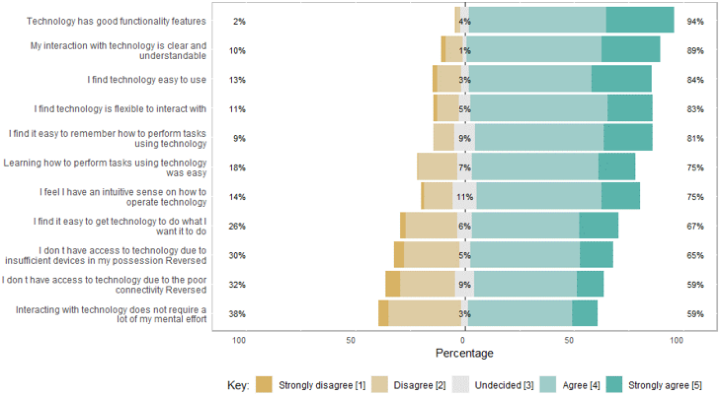
*Number of Factors determined by Parallel Analysis **RMSEA: relating to one factor solution: some suggested cutoff values <0.7 (Steiger, 2007), <0.6 (Hu & Bentler, 1999), 0.8> mediocre fit <0.10<poor fit (MacCallum, Brown & Sugawara, 1996) ***NNFI / TLI < 90 indicates that (one factor) model could be improved Bentler and Bonett (1980) Non-Normed Fit Index (NNFI), also known as the Tucker-Lewis index (TLI) The perceived ease of the use of technology at work in general was pos- itive. Typically, the respondents had well-functioning digital infrastructure, sufficient skills and it provided solid support for their work. However, the insufficient devices and poor connectivity were reported major issues. Espe- cially in off-campus the connectivity in Ghana is the major obstacle for accessing digital environments and faculty must bypass the issue with using simple services and applications. On the other hand, the responses reflected positive attitude towards using the technology in their work and motivation to utilize it.
Figure 1: Perceived ease of use and usability of technology.
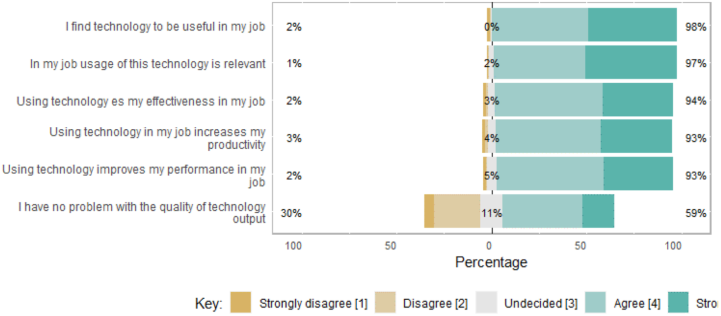
The perceived usefulness of technology is high as illustrated in Figure 2. Even the statements are on abstract level the respondents find technol- ogy useful for their jobs. The effect on productivity and performance were widely acknowledged. Overall, the results reflect satisfaction on technology. Only issue reported was quality of technology output. By this question it is impossible to isolate the reason for the issue, yet most probably there are conflict between the expectations and actual output. However, despite the issue the respondents reported high effectiveness and subjective experience of productivity.
Figure 2: Perceived usefulness of technology.
Self-efficacy is related to an individual’s beliefs or experiences on capac- ity to execute tasks by themselves without interruptions by seeking help to
Information Ergonomics Factors Related to Sociotechnical Environments 13
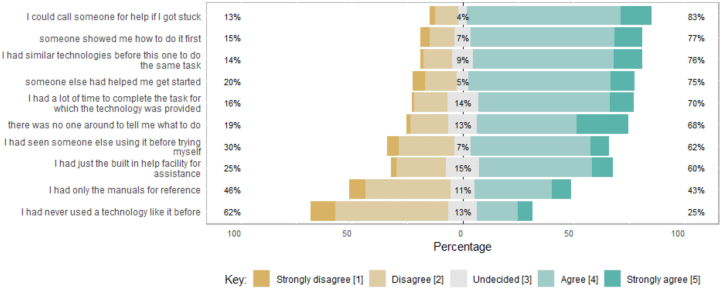
get forward or solving problems related to workflow. It also reflects confi- dence with technology and understanding on how interact with services and application. To some extend it reflects also the sense of control over the tech- nology. The respondents reported good self-efficacy with the technology they use. Figure 3 summarizes results related to technology self-efficacy. However, as the survey did not make difference between the types of technology, the findings are only framing the topic. This should be analysed more thoroughly by disciplines and domains of respondents too.
As table 1 suggested, the technology self-efficacy section had a three-factor structure. Statements “...there was no one around to tell me what to do.”, “...I had never used a technology like it before.”, “...I had only the manuals for reference.” had only weak loadings in the three-factor solution, whereas statements “...I had seen someone else using it before trying myself.”, “...I could call someone for help if I got stuck.”, “...someone else had helped me get started.”, “...someone showed me how to do it first.” loaded onto one factor. The remaining statements, “...I had a lot of time to complete the task for which the technology was provided.”, “...I had just the built-in help facil- ity for assistance.”, “...I had similar technologies before this one to do the same task.” loaded to another factor. There is significant association between responses to the different statements and thus sense of self-efficacy seems to at least coexists with good user experience. Yet of course the causality is complex to pinpoint.
Figure 3: Technology self-efficacy. The beginning of the statements were: “In general, I could complete any desired work task using technology, if…“.
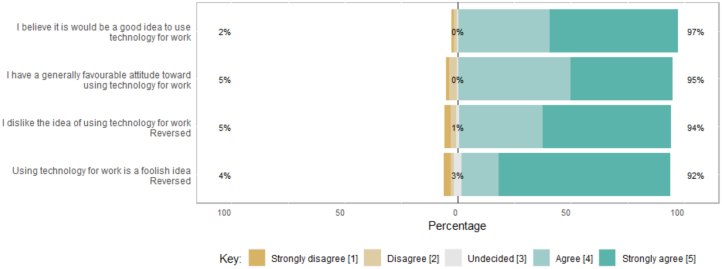
The last set of items related to technology relationship was about atti- tudes towards technology use as illustrated in Figure 5. There was large consensus on usefulness of technology in work. This most probably reflects the perceived usefulness of technology as well as high sense of self-efficacy with technology. Even there are issues with availability of technology and connectivity the reported attitudes are significantly enthusiastic towards tech- nology. It may also reflect the well-functioning infrastructure and robust services.
Figure 4: Attitudes towards technology use.
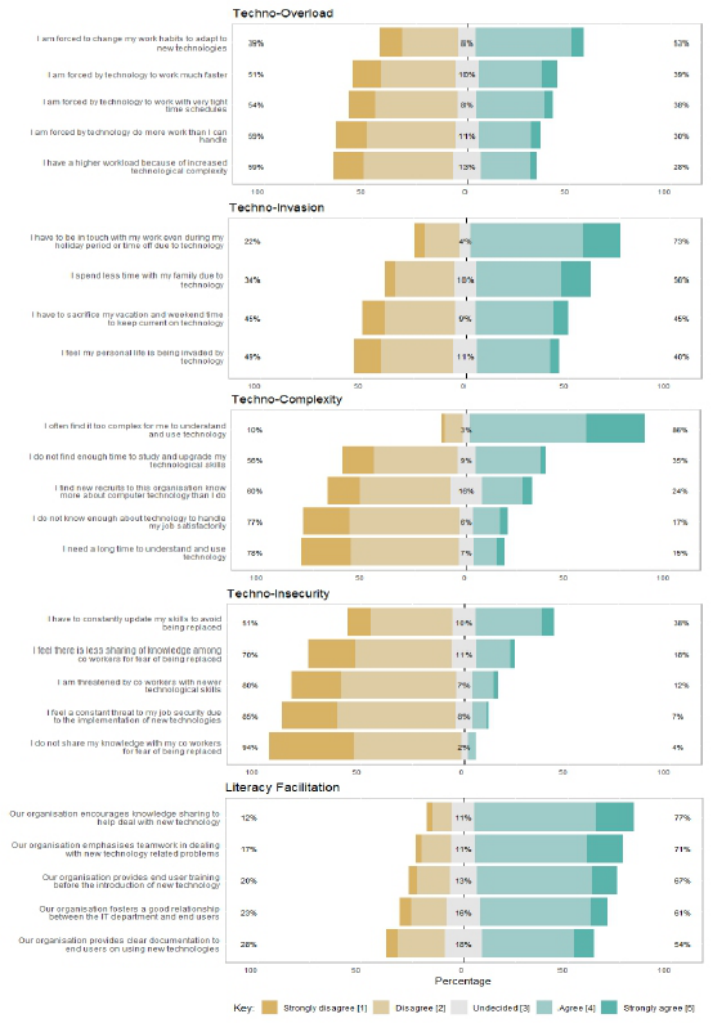
Technostress is operationalised techno-overload, techno-invasion, techno- complexity, techno-insecurity, and literacy facilation as illustrated in Figure 6. There is higher variability in responses related to stress than it was in relation to technology relationship. This draws attention to flip side of digital work environments as when different factors are taken into account it seems that roughly half of the people have major issues with information ergonomics.
The first subsection related to technostress examines overload caused by tehcnology. Especially forced change in working habits, workload, shorter time windows and external demands cause pressure and and stress. Tech- nology seems to dictate and increase the pace of work and thus it can be considred negative. Other signficant factor related to stress is techno- invasion. The distinction between work and leisure no longer exist as easy access to work domain makes transitions easy and quick. This can be seen also a positive effect of extensive utilisation of digital environments, yet it can make work-life balance difficult to maintain. Techno-complexity and techno- insecurity have less effect on stress, but they still exist. Literacy facilitation seems to be relief for stress, yet only for some respondents.
Contrary to five factors found in the technostress-questionnaire sample by Ragu-Nathan et al. (2008), this sample contained four factors. Similar factor structure emerged, but some connections between technostress items emerged. The literacy facilitation and techno-insecurity sections loaded onto the first factor, techno-complexity and techno-insecurity loaded onto the sec- ond factor, techno-overload and techno-insecurity onto the third factor and finally techno-invasion loaded onto factor four with weak loadings from techno-insecurity items. These loadings mean that techno-insecurity was not a separate dimension, which is likely due to a combination of sample effect, smaller sample size and association of techno-insecurity to the other sub- sections. For all subscales but literacy facilitation, a separately fitted one factor solution was sufficient, implying those subscales represent one con- struct. Overall, the association between overload and invasion reflect the same experiences of ill experiences. Complexity and insecurity have associ- ation. Literacy facilitation has opposite effect, yet by this analysis it is not possible to draw conclusion on total effect.
Information Ergonomics Factors Related to Sociotechnical Environments 15
Figure 5: Technostress by its components.
DISCUSSION
The results presented above link the factors related to information ergonomics to complex phenomena of humans in digital work environments. Based on the findings there seems to need for further examination for exter- nal and internal interruptions, i.e. self-interruptions not generated by external
impulses. There is already data on that too, yet it was beyond the scope of this paper. Findings suggest high fragmentation of work and concentration due to technology. This should be addressed by the self-regulation perspec- tive. Even the techno-invasion also proposes that people cannot escape digital work in leisure the hyperconnected and highly interdependent work in com- plex, multidimensional and distributed collaboration networks seems to be very demanding. Also, the ambiguity in communication media, platform and channel choices and response time expectations cause fluctuations on and off to work.
The results in this paper pointed out that regardless of functioning of infrastructure there are conventions and habits that cause load to people. Also, inability to distinguish relevant information from less relevant causes more demand on information acquisition and refining for individuals. The subjective wellbeing and productivity seem to be product of sense of control on work, achievement and self-fulfilment. More attention should be paid to work organising in personal and group level, paying attention to lead times of work and optimal processes. Also eliminating information related excess work and minimizing waste in work thus keeping the eye on the ball.
This paper presented first analysis of survey on factors related to use of technology and technostress. The result presented the associations between the factors of user experience and technostress. There is connection to exist- ing discussion on information ergonomics and more generally to wellbeing at work and work-life balance discussion. Further analysis will concentrate more on explaining the experiences of lost balance or control. Even with these initial findings the explaining factors fall to categories presented in the intro- duction. For some users the poor user experience may cause obstacles to be productive. It can be the infrastructure too. Most evidently the issues fall to categories of habits and conventions. From individual perspective the habits could cause poor balance and job performance. On the other hand conven- tions in certain organization may cause lot of redundant work, unwanted interruption and even waste of time.
ACKNOWLEDGMENT
The authors would like to acknowledge Dr. Benjamim Ghansah, Dr. Ephraim Kwaku Kwaa-Aidoo and Dr. Christopher Yarkwah for their contribution and support in planning and execution the survey.
REFERENCES
Bentler, P. M., & Bonett, D. G. (1980) Significance tests and goodness of fit in the analysis of covariance structures. Psychological Bulletin, 88. 588–606. Bryer J, Speerschneider K (2016). _likert: Analysis and Visualization Likert Items_.
R package version 1.3.5, <https://CRAN. R-project.org/package=likert>. Bordi, L., Okkonen, J., Mäkiniemi, J.-P., Heikkilä-Tammi, K. (2018) Communication in Digital Work Environment - Implications for Wellbeing at Work. Nordic Journal of Work Life Studies Vol. 8, No. (3) doi: https://doi.org/10.18291/njwls. v8iS3.105275.
Information Ergonomics Factors Related to Sociotechnical Environments 17
Hayes, A. & Coutts, J. (2020). Use Omega Rather than Cronbach’s Alpha for Estimating Reliability. But… Communication Methods and Measures, 14(1), 1–24. https://doi.org/10.1080/19312458.2020.1718629 Hu, L., & Bentler, P. M. (1999). Cutoff criteria for fit indexes in covariance struc-
ture analysis: Conventional criteria versus new alternatives. Structural Equation Modeling, 6, 1–55. https://dx.doi.org/10.1080/10705519909540118 MacCallum, R. C., Browne, M. W., & Sugawara, H. M. (1996). Power analysis and determination of sample size for covariance structure modeling. Psychological Methods, 1(2), 130–149. https://doi.org/10.1037/1082-989X.1.2.130 Okkonen, J., Heimonen, T., Savolainen, R., & Turunen, M. (2017). Assessing Infor-
mation Ergonomics in Work by Logging and Heart Rate Variability. in T. Ahram and C. Falcão (eds.), Advances in Usability and User Experience, Advances in Intelligent Systems and Computing 607, Springer doi 10.1007/978-3-319-60492- 3_41. R Core Team (2023). R: A language and environment for statistical computing. “R version 4.2.2 (2022-10-31 ucrt)”R Foundation for Statistical Computing, Vienna, Austria. URL https://www. R-project.org/. RStudio Team. (2023). RStudio: Integrated Development Environment for R. RStu-
dio, PBC. Retrieved from https://www.rstudio.com/. Steiger, J. H. (2007). Understanding the Limitations of Global Fit Assessment in Structural Equation Modeling. Personality and Individual Differences, 42, 893–898. https://doi.org/10.1016/j.paid.2006.09.017 Tarafdar, M., Cooper, C. L., & Stich, J. F. (2019). The technostress trifecta-techno
eustress, techno distress and design: Theoretical directions and an agenda for research. Information Systems Journal, 29(1), 6–42. Wickham, H. (2016). ggplot2: Elegant Graphics for Data Analysis. Springer-Verlag New York. Retrieved from https://ggplot2.tidyverse.org/. William Revelle (2023). _psych: Procedures for Psychological, Psychometric, and Per-
sonality Research. Northwestern University, Evanston, Illinois. R package version 2.3.12, <https://CRAN. R-project.org/package=psych>.
LISTED IN THE AHFE DIGITAL BOOKSTORE CATALOGUE
Explore the complete digital volume
Social and Occupational Ergonomics
Read this individual research paper free through the original publisher, or explore the full digital proceedings book.
ISBN 978-1-964867-28-1
Explore this ISBN in the AHFE Bookstore ↗Listed in the July 2026 bookstore catalogue; search by ISBN to confirm current availability · Digital book purchase optional