Jussi Okkonen, Jari Laarni, Antti Syvänen, Mikael Wahlström, Jarmo Viteli, Mia Laine, Joel Rauma (2024). Sense of technology self-efficacy and motivation coexisting with algorithmic thinking. In: Human Interaction and Emerging Technologies (IHIET-AI 2024): Artificial Intelligence and Future Applications. AHFE Open Access, vol. 120, pp. 161–171. https://doi.org/10.54941/ahfe1004566
Modern warfare presents the state of the art in technological advances. Even the most developed weapons and information systems are implemented the users and final decision makers are still human. There has been extensive discussion about contemporary skillset that is often drawn the components of digital literacy. In that context digital literacy is combination of technical skills to use technology, to interact with technology, and understand technology. It can be seen also as capability to understand different forms of information, algorithmic, computational, and epistemic thinking. Even the digital literacy framework applied is multi-faceted, it operationalises the perspectives of human performance with autonomous or semiautonomous systems. This paper discusses skillset needed to operate and operate with complex information driven systems. The aim is to construct a comprehensive way to assess capabilities among people in service to allocate the most suitable person to a post. The study is based on expert interviews and focus groups session on the topic. The presented competency framework and measures to assess different perspectives. Paper also discusses the practical application of the measurements and how items related to technology self-efficacy and motivation are related to algorithmic thinking.
The “AI generation” is no more mentally capable than previous generations (Flynn &; Shayer 2018), but as users of digital consumer products, they may be more skilled than previous generations, which does not automati- cally imply greater technical proficiency in digital technology (Bennett et al., 2008) – such as programming knowledge or a deeper understanding of how technology works, such as AI. According to an international computer and information literacy study, only a fraction of the 8th graders in the 14 OECD countries who are considered the “AI generation” are capable of indepen- dent information gathering and guiding their actions (Fraillon et al., 2019), although by international comparison, Finnish 8th graders had good skills, especially in the field of programming thinking (Leino et al., 2019). The devel- opment of these skills depends on the ability of school systems to include
computer and information literacy objectives in their curricula (Drossel et al., 2020), so the skills of future generations will continue to depend on the functioning of the school system – not on general Western digital develop- ments. The generation that feels that the use of digital technology is normal is used to communicating and acting through digital tools, as well as search- ing for information and finding out things independently. As a result, the culture of generations previously called “digital natives” (Prensky, 2001) or “millennials” is characterized by an emphasis on working in a group, indi- vidualistic thinking, questioning, and a truth/ethical-relativistic conception of knowledge (VanMeter et al., 2013). Representatives of the current gener- ation Z (born 1996–2015) strive for independent thinking and finding new perspectives, while detaching themselves from objective or authorized truth (Weber, 2019). In digital capabilities, more important than technical compe- tence is the orientation to digital technology created through good thinking skills. Em. In addition to programmatic thinking, identifying and avoiding cognitive biases typical of human thinking (Haselton et al., 2015) in infor- mation processing is such a capability. Avoiding thought errors caused by cognitive biases is relevant, for example, in data analytics. The role of AI in data analytics is growing, but it is the user’s responsibility to ensure their applicability and reliability in decision-making. In other words, the ability to assess whether the information processed from the data is accurate is required, because artificial intelligence, like humans, is capable of erroneous reasoning. Many of these AI fallacies are due to the algorithms used, whose biases are abstract and thus difficult to understand intuitively. The reasons for algorithm biases may not be easy to pinpoint (Serrà, 2019). Humans can correct detected analysis errors and take into account the risks of incorrect analysis, whereas artificial intelligence can only act on the basis of the data, algorithms and parameters at its disposal.
The task of the user of the analysis produced by AI is to be a moral actor in the AI-supported decision-making system, able to weigh the effects and weight of decisions made on the basis of the analysis. In addition to logical- analytical thinking capabilities, digital capacities are also associated with cognitive-moral thinking and action capabilities (Weber, 2019; VanMeter et al., 2019). For example, Myyry et al. (2009) found that cognitive-moral reasoning related to self-determination values predicts poorer compliance with security rules. The use of artificial intelligence will require both the ability to question and critically evaluate the information produced by the systems, as well as simultaneous ethical-moral thinking skills and com- mitment to ethical guidelines. There are two different areas in defining digital readiness. The first relates to the individual’s attitudes, experience background and beliefs related to perceptions of knowledge. By looking at technological attitudes, one can assess the level of general positive orientation towards technology; The use of both entertainment (e.g. computer gaming) and utilization (e.g. coding experience, content production) of technology is investigated from the background of experience. Secondly, beliefs related to knowledge perceptions are also important, as they describe the ability to critically evaluate both the information produced by AI systems and the limitations of one’s own thinking. A higher level of thinking promotes the
Sense of Technology Self-Efficacy and Motivation Coexisting 163
emergence of positive epistemological beliefs, and on the other hand, negative beliefs can slow down and even prevent the achievement of formal thinking (Dweck, 2008).
The ability of AI systems to quickly produce results in different application areas has created a situation where the performance of AI systems exceeds the ability of their users to understand their functioning (Serrà, 2019). Depend- ing on the area of application, too rapid utilisation of information produced by artificial intelligence has consequences of varying severity. For example, there have been many problems with the use of artificial intelligence in the profiling of personnel in organisations, similar problems that researchers are currently trying to reduce by developing mechanisms to control the use of AI systems (Tarafdar et al., 2020). After all, a lot depends on the capabili- ties of the actor responsible for the utilisation of artificial intelligence - the human being in question. In digital capabilities, alongside technical compe- tence, the orientation to digital technology created through critical thinking skills are implicit factors, i.e. an individual’s relationship with technology and motivation to use technology are implicit factors. They form the basis for the development of knowledge and skills in a task-specific manner. Em. In addition to programmatic thinking, identifying and avoiding cognitive biases typical of human thinking (Haselton et al., 2015) in information processing is such a capability. Avoiding thought errors caused by cognitive biases is important, for example, in data analytics. The role of AI in data analytics is growing, but it is the user’s responsibility to ensure their applicability and reliability in decision-making. In other words, the ability to draw conclusions about the accuracy of data is required, while artificial intelligence is just as capable of producing errors in data analysis as humans are. Many of these AI errors are caused by the algorithms used, whose biases are abstract and thus difficult to understand intuitively; Ts. The reasons for algorithm biases may not be easily identifiable (Serrà, 2019). But humans can correct detected ana- lytical errors and take into account the risks of relying too much on analyses that turn out to be incorrect. AI, on the other hand, can only operate based on the data, algorithms and parameters at its disposal.
Clausewitz’s quote from the classic “Fog of War” has been interpreted to mean that the uncertainties of warfare are due to a distorted and excessive amount of information, rather than to the scarcity of existing information or the actual situation (Beyerchen, 1992). Warfare always involves uncertainty, from which the use of artificial intelligence does not provide protection. On the contrary, AI itself can generate uncertainties. Despite this, the tools of war- fare are becoming increasingly autonomous, as artificial intelligence makes it possible to increase the operating freedom of systems. This is rapidly lead- ing to a battlefield singularity: a situation where the human actor is the only factor slowing down decision-making (Kania, 2017).
Modern warfare presents the state of the art in technological advances. Even the most developed weapons and information systems are implemented the users and final decision makers are still human. There has been extensive discussion about contemporary skillset that is often drawn the components of digital literacy. In that context digital literacy is combination of tech- nical skills to use technology, to interact with technology, and understand
technology. It can be seen also as capability to understand different forms of information, algorithmic, computational, and epistemic thinking. Even the digital literacy framework applied is multi-faceted, it operationalises the perspectives of human performance with autonomous or semiautonomous systems. This paper discusses skillset needed to operate and operate with complex information driven systems. The aim is to construct a comprehensive way to assess capabilities among people in service to allocate the most suitable person to a post. The study is based on expert interviews and focus groups session on the topic. The presented competency framework and measures to assess different perspectives. Paper also discusses the practical application of the measurements and how items related to technology self-efficacy and motivation are related to algorithmic thinking.
RESEARCH SETTING The study was conducted in three phases. The first phase was to inter- view experts in different organisational position in Finnish Defence Forces to map overall situation related changing requirements due the technological advances, capabilities of people, and how they affect the whole organisation. In the context most important issue is matching people to task, allocation of the talents, as well as maintaining required skills and knowledge. Also, the lifecycle of people in service was one of focal points. Interviews were con- ducted during May-June 2023. There were thirteen interviewees. The second phase was the validation of the interview findings by focus groups, and it was conducted during and after interviews. Development of survey items was based on items brought about in the interviews and focus groups. Survey was organised to map the factors related to the technology relationship by orien- tation and experiences on digital technology, motivation and affective factors in service, and experiences of general sentiments as users. Piloting the survey was conducted among Finnish conscripts in September 2023.
RESULTS
The expert interviews revealed the need to adapt to the digitalisation of various functions and related systems. As a starting point, the interviewees identified three main development directions. The first relates to autonomous data processing and/or operation integrated into systems. It is a technology that improves system performance, but at the same time requires the user to understand both the operation of the system at a basic level and possi- bly also fault or malfunction situations. The second is related to the huge increase in the amount of data collected by various sensors. This involves the need for automation/automation related to data processing, which empha- sizes the role of humans as critical decision-makers. Especially this is related to situations when a decision is made to influence by force in a time-critical situation. The third factor is related to active operational development, where the competence of conscripts and the reserve in particular is critical com- plementary competence for the competence of the personnel of the Finnish
Sense of Technology Self-Efficacy and Motivation Coexisting 165
Defence Forces. The interviews highlighted the identification and alloca- tion of competence-related capabilities as a significant factor. This is not a problem for people who voluntarily apply for special tasks and are tested sep- arately, but the comments were primarily about screening for hidden abilities from the mass. It also emerged that the operational capability requirements of combatants in the digital environment are not up to date in this respect.
A significant question related to technological capability is what kind of spearhead fighter the future will be. The Finnish Defence Forces, which is still built on conscripts, needs mass to carry out tasks in different branches of the armed forces, but in addition to surviving in a physical environment, the leading fighter of the future is required to be able to use various techni- cal equipment. Outside the traditional battlefield and due to its expansion, there is a need for a digital reserve, i.e. a digital reserve. A group of capable individuals to utilize socio-technical environments, be responsible for cyber capabilities and utilize huge masses of data in operational activities.
Knowledge and skills in the digital technology environment are fundamen- tally linked to digital literacy. From the attributes of digital literacy mentioned in the interviews, four different archetypes can be derived, which can be seen as significant or even critical functional capacity requirements for the task. The role of digital literacy in functional capacity is reflected in a cumulative hierarchy of knowledge and skills:
1. The person knows how to use and accepts digital technology. 2. A person is able to operate a [limited] digital environment. 3. The person understands the structure of the digital environment and can take a critical view of it. 4. The person is able to manage digital technology and solve problems related to it.
At a basic level, digital literacy is the result of primary and secondary edu- cation and, on the other hand, functional capacity produced by personal interest. On the second level, it is about familiarization with a specific appli- cation or environment, but still it is based more on the person’s orientation and natural ability. The third and fourth levels are the result of further train- ing, training related to the position and orientation to the position. When a large number of conscripts begin their service after primary or secondary education, they must be found among the masses through technology ratios and general capability attributes. The situation is different for reservists, as many acquire vocational training after military service. This also involves a significant mismatch problem, as there is no unambiguous procedure for identifying and finding reservists’ competence and deploying reservists. Many of the interviewees did not consider the shortcomings in conscripts’ digital literacy to be problematic, but how the skills could be better utilised in the “life cycle” of conscripts. In addition, it was seen as positive that there are enough trainees for various tasks requiring technological capability. It was pointed out that the increasing complexity of the technology environment will require a new way of screening suitable trainees to become operators and administrators of various systems as well as basic users.
In terms of digital literacy, more important than technical competence is the orientation to digital technology created through good thinking skills, i.e. the person knows how to use and accept digital technology. This was measured in parts and it is used to create an image of a person as a user of technology. In addition, the background information asked about the usage habits of digital technology. All respondents used smartphones in particu- lar, but only 80% used computers. Of the respondents, 89 reported that they did not code, i.e. the majority of the respondents use the usage pro- file as a basic user for daily use. With regard to usage profiles, it can be stated that the respondents are able to use the digital environment in every- day situations. Survey examined attitudes towards the use of information technology and conscript training. Its themes were related to the user expe- rience of information technology, self-efficacy as an IT user, and factors related to the respondent’s service motivation. The purpose of the section was to map a person’s technology orientation and relationship with digital technology. The results of the section were used as independent variables with the results of the epistemic thinking, cognitive reflection, and algorith- mic thinking tests. In particular, epistemic thinking refers to the ability to understand the digital environment as a whole and practice critical thinking about it. Algorithmic thinking refers to the potential to act as an opera- tor of the digital environment. The data was used to create a regression model to examine the relationship between background variables and test results. In the analysis, motivational factors and user factors were formed from the background data according to the content of the claim to explain how much of the variation in the test result can be explained by each factor and the aim was to find a relatively large set of variables. The median test success was 7 correct answers, but only two answered completely correct answers.
Background variables, i.e. In terms of user profiles, there were no visible differences in terms of success in the test sections, i.e. the above-mentioned basic daily use of digital technology is not as such related to the test result. The finding is similar to what was assumed, as digital technology aimed at consumers is more related to the individual’s ways of utilising digital technol- ogy in everyday situations. Only education was a significant differentiating factor.
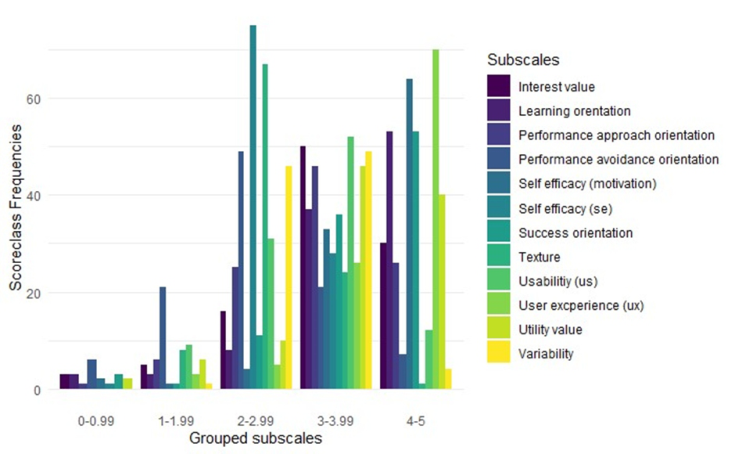
The background components are skewedly divided towards a generally more positive relationship with technology and a generally clear understand- ing of the structures of technology and knowledge as depicted in Figure 1. Examined by type value or median location, the most significant differences are in motivation, technology and knowledge perceptions and functional capacity in the technological environment. The observation is also related to the fact that the respondents have a clear understanding of themselves as users of technology and their own performance.
The correlation between algorithmic thinking and reflective thinking is positive. The correlation between algorithmic thinking and motiva- tional factors is positive. The correlation between algorithmic thinking and user experience and self-efficacy experience is significantly positive in terms of user experience, but not significantly positive in terms of
Sense of Technology Self-Efficacy and Motivation Coexisting 167
self-efficacy. The correlation between algorithmic thinking and the lower scales of the technology relationship is negative. The correlation between reflective thinking and the lower scales of motivational factors is mildly positive. The correlation between reflective thinking and user experi- ence and self-efficacy experience is positive. The correlation between reflective thinking and the lower scales of the technology relationship is negative.
Figure 1: Point distribution of background components.
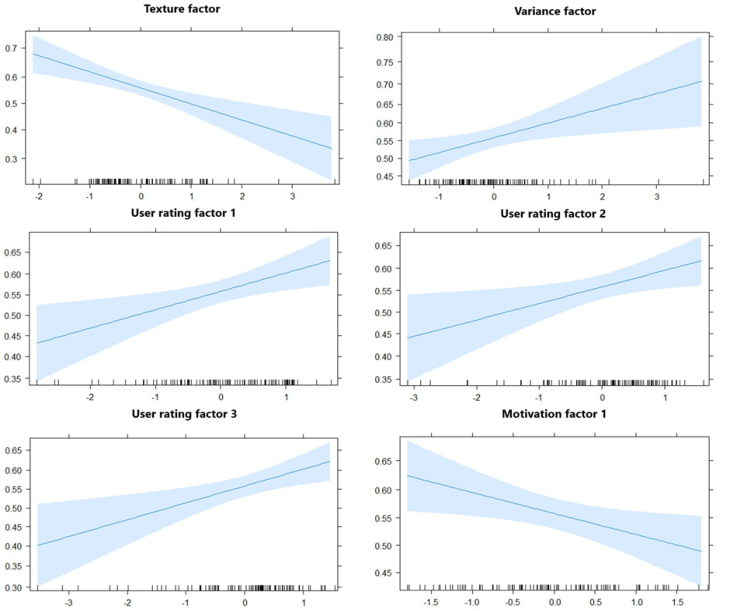
The regression model shows the links between different factors between test success (see below Figure 2). Examined as an aggregate, the model can be used to demonstrate the technology relationship and self-efficacy, i.e. self- efficacy. subjective assessment of competence, predictive good or excellent epistemic thinking, cognitive reflection and algorithmic ability. The finding is significant and can be used to demonstrate, at least in part, the links between different factors. Potential causality, on the one hand, is related to the ability to interact with digital technology, i.e. the ability to work with digital tech- nology. ability to promote a positive user experience and individuals have a realistic understanding of their own skills. In addition, those who succeed in the test are likely to be able to solve many digital-related puzzles, in which case negative experiences are not decisive for them or an obstacle to action. In terms of motivation and service orientation, on the other hand, the ratio of factors is the opposite for the respondents in the pilot phase. However, the connection is not necessarily an indication of a causal relationship, but there are other factors behind it.
Figure 2: Link between factors and test success.
DISCUSSION
The findings of the pilot study are significant when entering the experimen- tal phase. The operationalizations now made are relevant when considering the role of personal characteristics in functioning with autonomous capabil- ities. Based on the results, hypotheses can be derived about the influence of the characteristics of the individual when studying the interaction and functioning of a person with autonomy. The basic proposition is that those who succeed in the test, i.e. Those with a test score above the median are more able to interact with autonomy. At this stage, it is still difficult to say anything about cause-and-effect relationships between factors. Before the experimental phase, the connection between social prowess and other com- ponents should also be examined. They could be used to examine the links between general personality traits and factors related to the use of technol- ogy. In this way, factors other than user experience or competence can also be better examined. Especially when working in a team, non-technological abilities also matter.
The result point out coexistence of sense of self-efficacy, positive attitude towards technology, digital literacy and capability to algorithmic thinking. The implications of manifestations of digital literacy can be presented on several levels. Based on the study, the significance for the Defence Forces
Sense of Technology Self-Efficacy and Motivation Coexisting 169
in general, choices, training and reserve should be considered. According to the problems posed by the study, the digitalising world and thus also preparedness for cyber and hybrid threats require continuous maintenance and updating of capabilities. Digitalisation also offers significant opportuni- ties in that the doctrines and their implementation are flexible enough. The increase in technology and the related competence needs follow the changes in operating models.
The construction of the Defence Forces’ human resources begins with mili- tary service, branching off from it in different directions. Professional soldiers are a select group and are subject to the normal functions of allocating work- ing life resources or acquiring and developing competence. Professionals are also taken care of by a group of professionals or supervisors, which means that the matter is in order for them at least at a sufficient level. In Finland, the mass is in reserve and therefore attention should be paid to it. From a time perspective, the placement of individuals in positions corresponding to their capabilities is probably desirable for both the individual and the organ- isation. As stated in the results, abilities and tasks may not meet in the best possible way. There is hardly one root cause for this, but the key problem may be the lack of operationalisation of suitable selection criteria for the placement of persons. Transferring to the reserve is also a significant point of discontinuity, as an inactive reserve begins to live a life of its own, including in terms of its competence. A large part of the reserve becomes invisible as a competence potential, so it is not possible to make full use of the reservists’ competence. The competence that has grown through the training, hobbies and work experience of individuals is a significant resource and a significant reason for the existence of a reservist army.
ACKNOWLEDGMENT
The study for this paper was funded by the grant of PVTO program. Profes- sor Antti-Tuomas Pulkka contributed to developing survey items for piloting the conceptual construction related to motivation, self-efficacy, and user sentiments. Authors acknowledge the contribution of the people who partic- ipated as interviewees, focus group participants, as well as the other people in Finnish Defence Forces.
REFERENCES
Bennett, S., Maton, K., & Kervin, L. (2008). The ‘digital natives’ debate: A critical review of the evidence. British journal of educational technology, 39(5), s. 775–786. Benson, B. (2016). The Cognitive Bias Cheat Sheet. Medium. Saatavilla: https:
//medium.com/better-humans/cognitive-bias-cheat-sheet-55a472476b18 (luettu 2.10.2020). Beyerchen, A. (1992). Clausewitz, nonlinearity, and the unpredictability of war.
International security, 17(3), s. 59–90. Bryant, D. J. (2003). Critique, explore, compare, and adapt (CECA): a new model for command decision making. Technical Report: DRDC Toronto TR 2003-105,
Defence R&D Canada, Toronto, 2003. Saatavilla: https://apps.dtic.mil/dtic/tr/fu lltext/u2/a605875.pdf (luettu 2.10.2020). Bryant, D. J. (2006). Rethinking OODA: Toward a modern cognitive framework of command decision making. Military Psychology, 18(3), 183–206. Clausewitz, C. (1982). On war (Vol. 20). Penguin UK. Drossel, K., Eickelmann, B., & Vennemann, M. (2020). Schools overcoming the digi-
tal divide: in depth analyses towards organizational resilience in the computer and information literacy domain. Large-scale Assessments in Education, 8(1), s. 1–19. Dweck, C. S. (2008). Self-theories and lessons for giftedness: a reflective conversation. Teoksessa: T. Balchin, B. Hymer, ja D. J. Matthews. (toim.) The Routledge International Companion to Gifted education, (s. 308–316). London: Routledge. Flynn, J. R., & Shayer, M. (2018). IQ decline and Piaget: Does the rot start at the
top? Intelligence, 66, s. 112–121. Fraillon, J., Ainley, J., Schulz, W., Friedman, T. & Duckworth, D. (2019). Preparing for Life in a Digital World: The IEA International Computer and Informa- tion Literacy Study 2018 International Report. Amsterdam: International Association for the Evaluation of Educational Achievement (IEA). Saatavilla: https://research.acer.edu.au/cgi/viewcontent.cgi?article=1025&context=ict_literacy (luettu 2.10.2020). Geckoboard (2020). Data Fallacies to Avoid - Best practices. Geckoboard Company.
Saatavilla: https://www.geckoboard.com/best-practice/statistical-fallacies (luettu 2.10.2020) Haner, J., & Garcia, D. (2019). The Artificial Intelligence Arms Race: Trends and World Leaders in Autonomous Weapons Development. Global Policy, 10(3), 331–337. Haselton, M. G., Nettle, D., & Murray, D. R. (2015). The evolution of cognitive bias.
The handbook of evolutionary psychology, s. 1–20. Kania, E. B. (2017). Battlefield singularity: Artificial intelligence, military revolution, and China’s future military power. Washington: Centre for a New American Security. Labnotes (2019). A Serious Game for Intelligence, Surveillance, and Reconnaissance.
Serious Games for Collaborative Dark Network Discovery. Lincoln Laboratory Journal, 23(1). Saatavilla: https://www.ll.mit.edu/about/lincoln-laboratory- publications/lincoln-laboratory-journal/lincoln-laboratory-journal-45 (luettu 2.10.2020). Leino, K., Rikala, J., Puhakka, E., Niilo-Rämä, M., Sirén, M. & Fagerlund, J. (2019). Digiloikasta digitaitoihin: Kansainvälinen monilukutaidon ja ohjelmoinnillisen ajattelun tutkimus (2018). Koulutuksen tutkimuslaitos. Saatavilla: https://ktl.jyu.fi/fi/julkaisut/julkaisuluettelo-1/julkaisujensivut/2019/ic ils-2018-raportti.pdf (luettu 2.10.2020). Myyry, L., Siponen, M., Pahnila, S., Vartiainen, T., & Vance, A. (2009). What levels of moral reasoning and values explain adherence to information security rules? An empirical study. European Journal of Information Systems, 18, s. 126–139. Okkonen, J., Pulkka, A., Laine, M. (2023) Association between personal goal orien-
tations and experiences in online learning environment among Finnish conscripts. Computers in Human Behavior Reports (forthcominnig). Prensky, M. (2001). Digital natives, digital immigrants. On the Horizon, 9, 5, s. 1–6. Proud, R. W., Hart, J. J., & Mrozinski, R. B. (2003). Methods for determining the level of autonomy to design into a human spaceflight vehicle: A function spe- cific approach, [ in Proc. Performance Metrics for Intelligent Systems Workshop,
Sense of Technology Self-Efficacy and Motivation Coexisting 171
Saatavilla: https://fhs.brage.unit.no/fhsxmlui/bitstream/handle/11250/268 3228/Boyds%20OODA%20Loop%20Necesse%20vol%205%20nr%201.pdf (luettu 2.10.2020). Serrà, J. (2019). When the state of the art is ahead of the state of understanding: Unintuitive properties of deep neural networks. Mètode Science Studies Journal- Annual Review, (9). Tarafdar, M., Teodorescu, M., Tanriverdi, H., Robert, L., & Morse, L. (2020). Seek-
ing Ethical use of AI Algorithms: Challenges and Mitigations. Proceedings of the 41th International Conference on Information Systems, December 13–16, India. Weber, J. (2019). Understanding the millennials’ integrated ethical decision-making process: Assessing the relationship between personal values and cognitive moral reasoning. Business & Society, 58(8), s. 1671–1706. Winn, G. L., Slagley, J. M., Slagley, M. L., & Winn, L. (2019). Teaching Safety, Health,
and Environment in Engineering Programs for Millennials: Ethics Is the Basis. In Abdulwahed, M., Bouras, A., & Veillard, L. (Eds.). Industry Integrated Engineer- ing and Computing Education: Advances, Cases, Frameworks, and Toolkits for Implementation, s. 119–133. Springer, Cham. VanMeter, R. A., Grisaffe, D. B., Chonko, L. B., & Roberts, J. A. (2013). Generation Y’s ethical ideology and its potential workplace implications. Journal of business ethics, 117(1), s. 93–109.
LISTED IN THE AHFE DIGITAL BOOKSTORE CATALOGUE
Explore the complete digital volume
Human Interaction and Emerging Technologies (IHIET-AI 2024): Artificial Intelligence and Future Applications
Read this individual research paper free through the original publisher, or explore the full digital proceedings book.
ISBN 978-1-958651-96-4
Explore this ISBN in the AHFE Bookstore ↗Listed in the July 2026 bookstore catalogue; search by ISBN to confirm current availability · Digital book purchase optional