Jussi Okkonen, Mia Laine, Reetta Oksa, Edward White (2024). Self-efficacy and self-regulation variation in different modes of work. In: Human Factors in Design, Engineering, and Computing. AHFE Open Access, vol. 159, pp. 1751–1759. https://doi.org/10.54941/ahfe1005742
The paper brings about the findings of a survey conducted in two Ghanaian universities during autumn and winter 2023. Relatively large sample (n=201) helps to shed light on sense of self-efficacy and self-regulation as outcomes of different modes of work. The working hypothesis was that sociotechnical environments are challenging due to issues with information ergonomics especially from the perspectives of users. Moreover, as more work is done in sociotechnical environments spatially dispersed and even asynchronously sense of control and self-regulation are affected. There is also an underlying question about the balance between work and life. Mixed domains are the cause of conflicts in several ways. The paper presents also implications for enhancing work life balance among the people working extensively in soctiotechnical environments.
Working online in sociotechnical environments is challenging due to issues with information ergonomics especially from the perspectives of individual user. Information ergonomics refers to human-technology interaction and technology assisted human interaction in digital environments. According to Okkonen et al. (2017) it consists of perspectives of technology, infrastructure, social, individual. Technology is the perspective of user experience and how technology promotes or hindrances task performance. The perspective of infrastructure draws attention to digital landscape and different structures for working. Social perspective is about explicit norms of working as well as socially constructed conventions of working. Individual perspective is about personal habits and personal fit to work in digital environments. Bordi et al. (2018) draws attention to communication in different forms as a key factor to affect wellbeing at work. Digital environment of knowledge work shapes the work environment of the individual, work practices, social conventions, and even the concept of work. The digitalization of work environment has brought about change in working schemes, i.e., how people organize, resource, and schedule their work. Therefore, it is critical to approach working by the perspectives of self-efficacy and self-regulation.
Moreover, as more work is done in sociotechnical environments spatially dispersed and even asynchronously sense of self-efficacy, sense of control and self-regulation are affected. Self-efficacy refers to the personal understanding
on operational capacity or a belief of it (cf. Bandura, 1977). In educational context it refers to digital literacy, utilisation of different tools, services and environments, as well being able to solve problems (Mannila et al., 2018). Sense of control refers to individual ability to manage workflow and load as well as rich communication environment (cf. Bordi et al., 2018). As stated by Jeunet et al. (2018) control refers to agency in digital environment, i.e., understanding the behavioural patterns and being able to act accordingly. Moreover, it also requires ability to regulate the sociotechnical environment by conventions or norms. Self-regulation should be considered as key factor for presence in digital learning environments (Sharma et al., 2024). As discussed in Okkonen et al. (2024) self-regulation is connected to external and internal interruptions, i.e., self-interruptions not generated by external impulses, causing high fragmentation of work and concentration due to technology. As the techno-invasion also proposes that people cannot escape digital work in leisure, the hyperconnected and highly interdependent work in complex, multidimensional and distributed collaboration networks seem to be very demanding. Also, the ambiguity in communication media, platform and channel choices and response time expectations cause fluctuations on and off to work. Even with high sense of self-efficacy poor habits and conventions along with non-existing normative regulation of digital work environments can cause severe information ergonomics issues that can be also lead other problems, such as imbalance of work and life or mental or physical health problems.
DATA, RESULTS AND FINDINGS This paper spawns from the same dataset utilised in Okkonen et al. (2024) and Oksa et al. (2024). The study focused on Ghanaian university lecturers’ perspective of their digital infrastructure, usage of ICT devices, environment, services, and tools in their classrooms. The survey provides a framework to measure lecturers’ attitudes, ICT skills, pedagogical use, procedures, and technological readiness as well as issues related to their work – life balance. The survey consists of 150 survey items and to ensure its successful rollout in Ghana, translated items were rewritten into English by a native speaker. The survey was then checked and edited by our Ghanaian authors and colleagues to ensure the nuance of the questioning was accurately conveyed to the participants. An invitation to participate in the online survey was emailed to all UCC and UEW lecturers, thus a purposeful sampling approach was employed. The survey ran from the September 2023 to the end of January 2024 which garnered a total on 359 participants, which was refined down to 201 participants after the data was cleaned for missing or incomplete data. The majority of missing responses were caused by early drop-off. Ethics permission was obtained from both the University of Cape Coast and the University of Education, Winneba. The survey also received formal support from Vice Chancellors of both Universities. In this paper presents items related to information ergonomics and technostress.
The sample consisted of 159 male responses and 52 female responses. It reflects current gender structure in Ghanaian universities. As the survey was
Self-Efficacy and Self-Regulation Variation in Different Modes of Work 1753
targeted to faculty members the majority of respondents had doctoral degree and all had at least bachelor’s degree. In this respect the sample is skewed and results are mostly applicable in academic context. Also 96 % of respondents work full time at the university. Half of the respondents teach using both face-to-face and digital environments and they also work remotely at least to some extent. Only 17% of respondents do not work remotely.
R, R Studio (The R foundation, 2024; RStudio Team, 2024) were used for the analysis, along with the tidyLPA package for latent profile analysis (Rosenberg, 2018) and psych package for McDonalds Omega (Revelle, 2024). Graphics were produced with tidyLPA and ggplot2 packages (Rosenberg, 2018; Wickham, 2016).
Table 1 presents the selected items for the analysis. The first four constructs are related to experienced loneliness as well as attitudes and sentiments towards the use of technology. The fifth construct, technostress, has five subscales on negative effects of technology as well as supporting utilization and implementation of technology. Construct structures and reliability of questionnaire subscales are evaluated with factor analysis and McDonald’s omega (ωt) (Revelle, 2024). Contrary to the widely used Cronbach’s α, it does not assume that each subscale variable has equal loadings onto a latent variable and uncorrelated errors (tau-equivalence) (Hayes & Coutts, 2020).
*Number of Factors determined by Parallel Analysis **RMSEA: relating to one factor solution: some suggested cutoff values <0.7 (Steiger, 2007), <0.6 (Hu & Bentler, 1999), 0.8> mediocre fit <0.10<poor fit (MacCallum, Brown & Sugawara, 1996) ***NNFI / TLI < 90 indicates that (one factor) model could be improved Bentler and Bonett (1980) Non-Normed Fit Index (NNFI), also known as the Tucker-Lewis index (TLI)
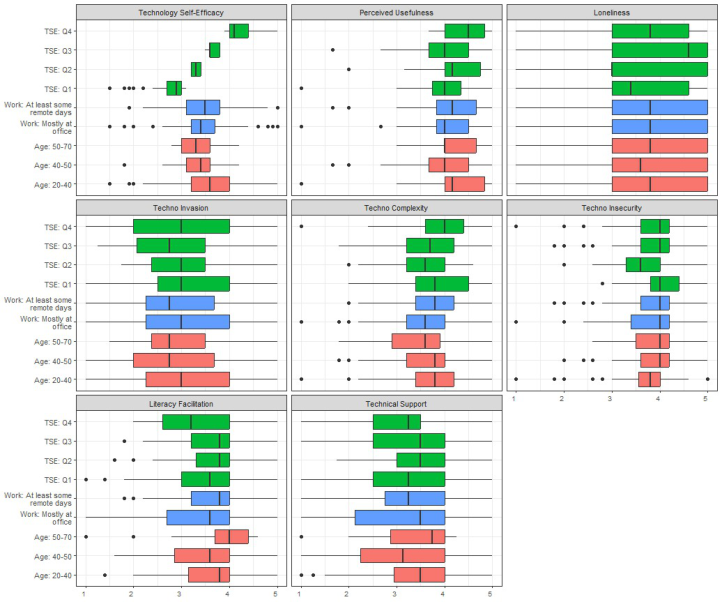
Small associations could be observed with age and dimensions of technostress, as well as Technology Self Efficacy. Similarly, small differences could exist between those working remotely at least some of the times and those who do not. However, no systematic or marked differences could be observed in quartiles of Technology Self Efficacy. These differences are smaller than expected, as described in Figure 1, suggesting a nuanced and complex relationships between the variables.
Figure 1: Associations between selected independent and dependent variables.
Comparison of group medians by Age Group using Kruskal-Wallis rank sum test results in p-value =0.041**, leading to rejection of the null hypothesis: “The medians of all groups are equal.” Pairwise comparison with Dunn’s test reveals that the the groups with statistically different medians are “31-40” and “41-50” (p-value = 0.038** with bonferroni adjustment). In other pairwise tests, there were no differences between the other groups. Comparison of group means by AgeGroup using Welch’s anova test results p-value = 0.141. Therefore, the null hypothesis that means of all groups are equal cannot be rejected. There is no evidence that the means of the age groups differ significantly. The results of the tests are contradictory but could be resolved by increasing the statistical power of the sample by gathering a larger sample.
Comparison of group medians by Primary Mode of Teaching: Kruskal- Wallis test results Kruskal-Wallis rank sum test results p-value = 0.51 and the null hypothesis: The medians of all groups are equal. There is no evidence that the medians of the groups differ significantly. As there is no significant difference between the groups by any defined independent variable, the next way to analyse is to find latent profiles as illustrated in Figure 2. For this purpose, Latent Profile Analysis was chosen. The dimensions of technostress, technostress inhibitors, peu, tse and loneliness were had mixed models fitted with Maximum Likelihood Estimation with robust standard errors (MLR).
Self-Efficacy and Self-Regulation Variation in Different Modes of Work 1755
The number of profiles was chosen based on information criterion (AIC & BIC), group separation (entropy), posterior probabilities, or the confidence of profile assignment (prob_min & prob_max), profile sizes (n_min, n_max), as well as bootstrap likelihood ratio test (BLRT) (Table 2). Each additional profile was a significant improvement based on BLRT, but an increase from 3 profiles to 4 would not have been advisable based on increase of interpretability, BIC and P min values.
Table 2. Criterion for selection of profiles.
Table available in the original PDF paper.
Profiles AIC BIC Entropy P min P max N min N max BLRT
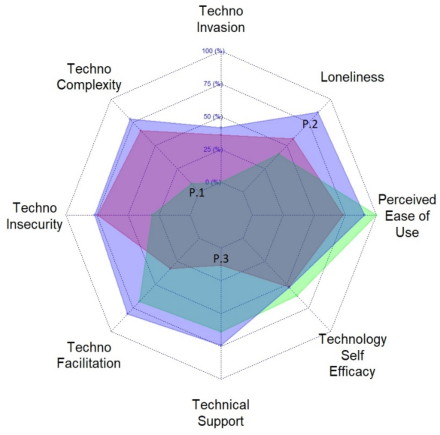
Figure 2: Illustration of three latent profiles by the dimensions (greater value refers to the more positive affect).
The first group, P.1, is characterized by the lowest experienced technostress scores, indicating highest levels of experienced technostress among the three groups. They also had the lowest scores on the Loneliness scale, indicating more experiences of loneliness. Conversely, they seem to have positive experience with technostress inhibitors, and slightly higher Perceived Usefulness and Technology Self-Efficacy scores than other groups. P.2 was characterized by higher levels scores of the Loneliness scale than other groups, indicating the least experienced loneliness. Overall, their responses to were rather positive. The technostress dimensions’ scores were high,
indicating low levels of experienced technostress. Their responses to the technostress inhibitor dimensions were also the highest among the three groups. Conversely, the responses to those dimensions in the remaining group, P.3, were the lowest. Their Perceived Usefulness score and Technology Self-Efficacy scores were also slightly lower than other groups’. Their technostress and loneliness score fall between the other two groups.
The frequencies of the chosen background did not show statistical significance. The chi-squared test resulted in an insignificant p= 0.24 for age groups (>41, 41–50, 50<), meaning that the observed differences in the allocation of age groups could be random. Similarly, frequencies of those working remotely at least one day a week and those working remotely less that once a week did not deviate significantly (p = 0.46) in the resulting LPA groups.
These findings might suggest that social connections might be a mitigating factor for experienced technostress. Individuals might be helped in coping better with the dimensions of technostress better, or by emotional peer- support or by being able to ask concrete help with technical issues. Moreover, it might be difficult to explicitly describe a problem, but it easy to discuss or show it to a colleague. Not being alone or having social contacts can be considered also a way to provide better sense of control over technology. Organizational Techno Facilitation and Technical Support provisions can be argued to provide similar aid as Technostress Inhibitors to the whole organization, regardless of social connections. In addition to peer support the mode of interaction makes a difference. The differences between groups should be considered significant.
DISCUSSION
The findings above lead to conclusion of somewhat universal time-spatial preferences that are not dependent on age, mode of work or sense of technology efficacy. As there was only minor difference on perceived ease of use the sample underlines the role of technology in everyday life. As the working hypothesis was that sociotechnical environments are challenging due to issues with information ergonomics especially from the perspectives of users’ experience, and it was mostly verified by the factors related to technology. Even there was relatively high reported capability to use technology, the factors related to invasiveness of technology as well as complexity of it, the issues seem to be organisational. Organisational perspective is emphasised if more work is transferred to sociotechnical environments for spatially dispersion and even asynchronous modes of working. This will affect the sense of control and self-regulation. There is also an underlying question about the balance between work and life if there is no possibility to have boundaries between work and home domains. Mixed domains are the cause of conflicts in several ways, but mostly it has impact on off-work domain.
When discussing the factors related to information ergonomics in complex phenomena of humans in digital work environments there seems to be universal patterns human behaviour. As presented above, there is no single
Self-Efficacy and Self-Regulation Variation in Different Modes of Work 1757
factor to explain why some like it online and others do not. Most probably it is more complex issue, and it even may vary over time and task. Regarding the sample in this study only 17 % of respondents do not have teaching activities online, yet they still execute other activities in sociotechnical environments. It might be impossible to isolate the effect on online teaching from other, such as communication, administration, activities. In future the interaction perspective should be examined more thoroughly.
Based on the findings, techno invasion is issue for all as it affects the sense of control and causes blurred boundaries. Especially teaching staff self-regulation is critical as they have more people to interact with. Communication can cause external and internal interruptions, i.e., self- interruptions not generated by external impulses. Findings suggest high fragmentation of work and concentration due to technology. This should be addressed by the self-regulation perspective. Even the techno-invasion also proposes that people cannot escape digital work in leisure the hyperconnected and highly interdependent work in complex, multidimensional and distributed collaboration networks seem to be very demanding. Moreover, this examination concentrated on personal factor leaving social and organisational perspectives out it should be also noted that no man is an island. Personal preferences and habits shape the organisational conventions and on the other hand organisational norms shape the working landscape. In relatively relaxed information environment people have high freedom to shape their infrastructure and the ways it is utilised. It is dependant of the organisational role, but most probably all execute job crafting to some extent.
Self-efficacy and self-regulation are connected in work. They spawn form different sources, yet both facilitate wellbeing and productivity in work. As discussed above there are several external factors that cannot be escaped but can be managed. Self-efficient person has resilience for maintain performance even in unexpected situations. On the other hand, self-regulation enhances work-life balance as it helps to stay within the boundaries. These factors are flip sides to some extent, yet those are individual attributes.
ACKNOWLEDGMENT
This study was conducted under European Comission Erasmus+ grant for Capacity Building in Higher Education project GOT, project number 101082794. The authors would like to acknowledge Dr. Benjamim Ghansah, Dr. Ephraim Kwaku Kwaa-Aidoo and Dr. Christopher Yarkwah for their contribution and support in planning and execution the survey.
REFERENCES
Bandura, A. (1977) Self-Efficacy: Toward a Unifying Theory of Behavioral Change. Psychological Review Vol. 84, 2 (March, 1977), 191–215. http://www.eric.ed.gov/ERICWebPortal/detail?accno=EJ161632 Bentler, P. M., & Bonett, D. G. (1980) Significance tests and goodness of fit in the analysis of covariance structures. Psychological Bulletin, 88. 588–606.
Bordi, L., Okkonen, J., Mäkiniemi, J.-P., Heikkilä-Tammi, K. (2018) Communication in Digital Work Environment - Implications for Wellbeing at Work. Nordic Journal of Work Life Studies Vol. 8, No. (3) DOI: https://doi.org/10.18291/nj wls.v8iS3.105275 Hayes, A. & Coutts, J. (2020). Use Omega Rather than Cronbach’s Alpha for
Estimating Reliability. But… Communication Methods and Measures, 14(1), 1-24. https://doi.org/10.1080/19312458.2020.1718629 Hu, L., & Bentler, P. M. (1999). Cutoff criteria for fit indexes in covariance structure analysis: Conventional criteria versus new alternatives. Structural Equation Modeling, 6, 1–55. https://dx.doi.org/10.1080/10705519909540118 Jeunet, C., Albert, L., Argelaguet, F., & Lécuyer, A. (2018). “Do you feel in control?”:
towards novel approaches to characterise, manipulate and measure the sense of agency in virtual environments. IEEE transactions on visualization and computer graphics, 24(4), 1486–1495. MacCallum, R. C., Browne, M. W., & Sugawara, H. M. (1996). Power analysis and determination of sample size for covariance structure modeling. Psychological Methods, 1(2), 130–149. https://doi.org/10.1037/1082-989X.1.2.130 Mannila, L, Nordén, L., and Pears, A. (2018) Digital Competence, Teacher Self-
Efficacy and Training Needs. In Proceedings of the 2018 ACM Conference on International Computing Education Research (ICER ‘18). Association for Computing Machinery, New York, NY, USA, 78–85. https://doi.org/10.1145/ 3230977.3230993 Okkonen, J., Oksa, R., White, E., Laine, M. (2024) Information ergonomics factors related to sociotechnical environments of work among Ghanaian HE faculty members. AHFE2024. https://doi.org/10.54941/ahfe1005316 Okkonen, J., Heimonen, T., Savolainen, R., & Turunen, M. (2017). Assessing
Information Ergonomics in Work by Logging and Heart Rate Variability. in T. Ahram and C. Falcão (eds.), Advances in Usability and User Experience, Advances in Intelligent Systems and Computing 607, Springer DOI 10.1007/978-3-319- 60492-3_41 Oksa, R., Laine, M, White, E., Okkonen, J. (2024) Basic psychological needs related to information ergonomics and loneliness. AHFE2024 (forthcoming). Sharma, K., Nguyen, A., & Hong, Y. (2024). Self-regulation and shared regulation
in collaborative learning in adaptive digital learning environments: A systematic review of empirical studies. British Journal of Educational Technology. R Core Team (2024). R: A Language and Environment for Statistical Computing. R version 4.4.0 (2024-04-24 ucrt). R Foundation for Statistical Computing, Vienna, Austria. Revelle, W. (2024). psych: Procedures for Psychological, Psychometric, and Personality Research. Northwestern University, Evanston, Illinois. R package version 2.4.6, <https://CRAN. R-project.org/package=psych> Rosenberg, J. M., Beymer, P. N., Anderson, D. J., Van Lissa, C. J., Schmidt, J. A.
(2018). tidyLPA: An R Package to Easily Carry Out Latent Profile Analysis (LPA) Using Open-Source or Commercial Software. Journal of Open Source Software, 3(30), 978, https://doi.org/10.21105/joss.00978 RStudio Team. (2024). RStudio: Integrated Development Environment for R.
RStudio, PBC. Retrieved from https://www.rstudio.com/. Steiger, J. H. (2007). Understanding the Limitations of Global Fit Assessment in Structural Equation Modeling. Personality and Individual Differences, 42, 893–898. https://doi.org/10.1016/j.paid.2006.09.017
Self-Efficacy and Self-Regulation Variation in Different Modes of Work 1759
Tarafdar, M., Cooper, C. L., & Stich, J. F. (2019). The technostress trifecta-techno eustress, techno distress and design: Theoretical directions and an agenda for research. Information Systems Journal, 29(1), 6–42. Wickham, H. (2016). ggplot2: Elegant Graphics for Data Analysis. Springer-Verlag
New York. Retrieved from https://ggplot2.tidyverse.org/
LISTED IN THE AHFE DIGITAL BOOKSTORE CATALOGUE
Explore the complete digital volume
Human Factors in Design, Engineering, and Computing
Read this individual research paper free through the original publisher, or explore the full digital proceedings book.
ISBN 978-1-964867-35-9
Explore this ISBN in the AHFE Bookstore ↗Listed in the July 2026 bookstore catalogue; search by ISBN to confirm current availability · Digital book purchase optional