Mia Laine, Jussi Okkonen, Svante Laine, Christian Andersson (2025). Casualty evacuation process comparison of single patient evacuation with unmanned ground vehicles to multiple carrier evacuation from conflict zones. In: Human Interaction and Emerging Technologies (IHIET-AI 2025): Artificial Intelligence and Future Applications. AHFE Open Access, vol. 161, pp. 215–224. https://doi.org/10.54941/ahfe1005912
Optimization of casualty evacuation from conflict zones aims at increasing the chance of a critically wounded soldier or civilian reaching life-saving care, minimizing secondary damages, and maximizing the utilization of available emergency medical resources. With the emergence of small, (autonomous) unmanned ground vehicles (UGVs), the initial evacuation away from the frontlines could be possible earlier and in a near-continuous fashion. This study evaluates the limits of increased efficiency of employing autonomous evacuation UGVs capable of transporting one patient at a time. Only the initial, combat evacuation to the battalion area of service, or combat nurse’s station is considered. The baseline information, such as ranges of distances, was obtained from a live simulation experiment, where participants consisted of 431 conscripts, 27 commissioned officers and 37 armored reserve officer students all from the armored brigade of Finland. The experiments were run during May and June 2024. The participants were divided into groups, and each group completed 4 conflict scenarios. In half of the scenarios, the evacuation UGV was remotely operated, and in half of the simulations it was implemented as a fully autonomous and mature system with a wizard of Oz method. The results of this paper give estimates of a sufficient number of continually operating evacuation UGVs necessary to evacuate 100 casualties within 60 minutes, and estimated differences in cost-effectiveness compared to an evacuation vehicle with a larger capacity.
Casualty evacuation (CASEVAC), or tactical evacuation (TACEVAC), is process of transportation of an injured person, or casualty, from the point of injury (POI) to advanced medical care (United States Marine Corps, n.d.). While these evacuation processes have similarities with civilian evacuation processes, military specific frameworks have been developed. Tactical Combat Casualty Care (TCCC) and NATO’s “10-1-2” principle are examples of structured evacuation processes. They have some common
principles, such as rapid buddy care at POI, prioritization of life-saving care for survivable injuries (i.e. haemorrhage, airway obstruction, and respiratory failure) and evacuation to further medical care in govern this process (Butler et al., 2017; NATO Standardization Office, 2019; Center for Army Lessons Learned, 2017; Ran et al., 2011).
The practicalities of evacuation are varying. The choice of how a casualty is extracted from POI can be influenced by terrain, distance and tactical situation. The distance of the conflict to an intermediary combat nurses’ station, battalion aid station, Role 1 facility, or Echelon 1 facility can also range anywhere between hundreds of meters to kilometers (Fisher et al., 2023; Johnson et al., 2022; Headquarters, Department of the Army, 2007/2009). If necessary, manual carries and drags are used for short distances away from POI (Headquarters, Department of the Army, 2021). As a reference, an upright drag for a 48-meter course has been reported to take 87 (+/−32) seconds on average (Mussalo ym). Litters should be favored if available, especially for longer distances as well as casualties needing physical stabilization. Multiple types of armored and non-armored vehicles can also be configured to extract casualties either from POI or to facilities with escalating levels of care, including but not limited to ground vehicles, helicopters, aircrafts, surface vehicles and trains (Walravens et al., 2023; Headquarters, Department of the Army, 2021).
The escalating levels of care have been formed into multiple structured frameworks. One such framework would have a battalion aid station belonging to Echelon I. There basic first aid and emergency care is provided, with a focus on stabilizing life-threatening injuries. A subsequent Echelon II has a capacity to administer resuscitative care and surgical aid. Further, Echelon III includes field hospitals with the ability to offer advanced resuscitative and surgical care. Finally, Echelons IV and V provide definitive treatment and long-term rehabilitative care in advanced medical facilities (Casualty Evacuation, 2021). Similarly, Tactical Combat Casualty Care (TCCC) guidelines prioritize rapid intervention, stabilization, and transport, but in three stages of care. “Care Under Fire” (CUF) emphasizes immediate lifesaving measures, such as haemorrhage control, while under active threats. “Tactical Field Care” (TFC) is provided further away from the conflict, in relatively safe environments. The care includes stabilization efforts in relatively secure environments, whereas the transportation of casualties to higher-echelon medical facilities belongs to “Tactical Evacuation Care” (TACEVAC) (Butler et al., 2017). The effectiveness of casualty flow through these echelons depends on several factors, including the phase of the conflict, the maturity of the theatre, availability of medevac resources (air or ground), air superiority, and environmental conditions such as geography and weather. The tactical environment, whether secure or hostile, also critically influences evacuation timelines and resource allocation (D’Angelo, Welde, & Chauhan, 2018). Challenges in casualty evacuation are frequently encountered. For example, exposure to enemy fire during evacuation increases the chance of a rescuer becoming a secondary casualty (Eastridge et al., 2012), whereas logistical bottlenecks, such as limited access to transport vehicles,
Casualty Evacuation Process Comparison of Single Patient Evacuation 217
complex terrain, contested airspace, or advanced medical facilities becoming overwhelmed, prolong the time between POI care and definitive treatment (D’Angelo, Welde, & Chauhan, 2018; Hooper et al., 2014). These delays can exacerbate morbidity and mortality (Scallan et al., 2020). A UK consensus study (Scallan et al., 2020) suggests of a tipping point at eight hours, where temporary stabilization measures (e.g., vascular shunts) often start to fail, and outcomes for conditions like blast lung injuries and traumatic brain injuries deteriorate. Furthermore, responders face cognitive and physical strain in mass casualty scenarios, leading to potential delays in triage and stabilization. As multiple casualties compete for limited resources, decision-making under pressure can further exacerbate these delays (Marlow et al., 2018). Behavioural observation studies have indicated of an increased likelihood of errors in such conditions (Marlow et al., 2018).
Another proposed solution is shift from centralized fixed medical facilities to small, mobile surgical and resuscitation teams near POI. To address challenges caused by prolonged evacuation timelines and constrained resources in remote environments, en route transfusions of fresh whole blood and freeze-dried plasma, and enhanced forward resuscitation techniques have significantly reduced preventable combat deaths (D’Angelo, Welde, Chauhan, 2018). However, these solutions put further pressure on medical logistics support (MEDLOG) deliver a growing quantity of medical supplies and equipment in a timely manner. According to Joint Publication 4–02 (2013), MEDLOG functions enable success of health care delivery, but it requires active management and collaboration across logisticians, planners, and clinicians. A failure to manage medical supply chains in contested environments can exacerbate delays in casualty evacuation and treatment.
The complexities of maintaining MEDLOG operations and challenges of casualty care could be alleviated by recent advancements in robotics and automation. These systems are argued to be able to enhance efficiency, safety, and scalability (Pilgrim & Fitzgerald, 2022; Martinic, 2014). Robotic systems can operate continuously without fatigue, addressing resource scarcity in mass casualty incidents (Williams et al., 2019). At POI, autonomous robots could enhance “Care Under Fire” by extracting casualties without exposing medics risk of active fire, allowing responders to focus on immediate threats and lifesaving interventions (Hooper et al., 2014). Autonomous extraction robots (Murphy et al., 2011), such as the Battlefield Extraction-Assist Robot (BEAR), is reported to be able to locate and retrieve casualties from hazardous environments (Williams et al., 2019). Moreover, any forms of UxVs could be able to provide rapid evacuation options, bypassing obstacles and ensuring timely transport to advanced care facilities (Martinic, 2014). Robotic platforms equipped with sensors could track vital signs during transport, relaying data to receiving medical facilities. This capability would enable early preparation and continuity of care (Pilgrim & Fitzgerald, 2022). While robotic systems could arguably alleviate physical strain, they may also introduce cognitive challenges requiring additional training (Pilgrim & Fitzgerald, 2022), before the integration
of real-time monitoring could enhance casualty care - especially if these systems are implemented haphazardly, or without considering how the information ergonomics in different stages of the evacuation process is affected.
METHODS
For this study, two evacuation methods were compared: autonomous unmanned ground vehicles and traditional AMPGVs.
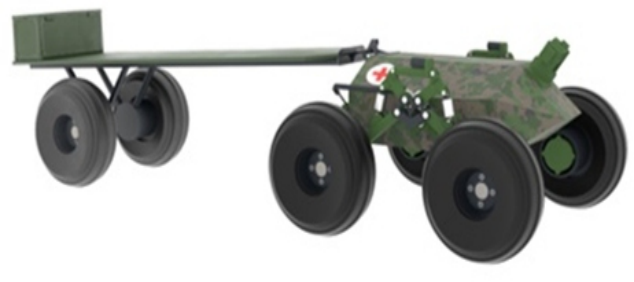
Evacuation Vehicles The UGV system chosen for this paper is called Laykka X.4. It is an experimental, modular UGV platform (Andersson et al., 2024), which in Figure 1 is equipped with a demonstrator of a medical evacuation module. The operational principles and the structure of the system’s AI-capabilities are discussed in a forthcoming article by Andersson et al., 2025. Laykka has a top speed of speed 30 km/h. The system does not have a publicly quoted price.
Figure 1: Laykka X.4 with a demonstrator of an evacuation module (Andersson, 2024).
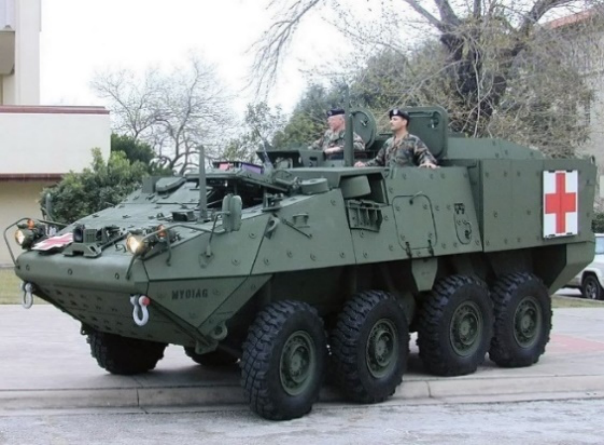
A comparative AMPGV system designed for medical evacuation and extraction from point of injury is M1284 medical evacuation vehicle, which is similar to M113 depicted in Figure 2. M1284 has a larger capacity of 6 ambulatory patients, 4 litter patients, or 3 ambulatory patients and 2 litter patients (Cronk, 2023). An average of 5 patients was used in this paper for simplicity. The M1284 has top speed of 54 to 61 km/h (Army Recognition, 2024). The system has been publicly quoted at $1.8 million per unit (Freedberg, 2013).
Casualty Evacuation Process Comparison of Single Patient Evacuation 219
Figure 2: The depicted M113 medical evacuation vehicle is the predecessor of M1284 (U.S. Army Medical Department, 2003).
Assumptions and Parameters The number of casualties was considered a constant 100, and the number of units needed to transport all casualties within 60 minutes was determined for a range of distances.
The UGVs have a speed of 5–30 km/h to account for varying terrain, and a setup time of 2 minutes per evacuation. Each UGV can handle one evacuation at a time. The travel logic for the UGV involves a one-way trip from the frontline to the BAS for the first evacuation, followed by round trips for subsequent evacuations. While Laykka system does not have a publicly quoted unit cost, the initial cost per UGV is arbitrarily chosen to be at $60 000 to allow for comparison, the arbitrary cost estimate is based on comparative publicly available price information. In contrast, AMPVs travel at a speed of 30−60 km/h and have a setup time of 10 minutes per evacuation. These vehicles can carry up to five casualties per trip and always perform round trips from BAS to the frontline for evacuations.
Evacuation Times The evacuation times (TUnit total) are calculated for varying setup times (S), speeds (V) and distances (D), taking the loading time into consideration.
For UGVs, the evacuation time is defined as a sum of the first evacuation time and of subsequent evacuation times. This can be defined as: TUGV total = TUGV1 + (nUGV −1) ∗TUGV
∗60)
= (SUGV + D VUGV
∗60+ (nUGV −1) ∗(SUGV + 2D VUGV
such that
.
Equation reproduced from the original PDF.
Similarly, the evacuation time of AMPVs is obtained from a sum of evacuation times: ∗60 TAMPV total = nAMPV ∗TAMPV = TAMPV = SAMPV + 2D VAMPV
Equation reproduced from the original PDF.
Number of Units Required The number of units required to evacuate N patients in T time is define d as:
[Equation or mathematical symbol available in the original paper PDF]
[Equation or mathematical symbol available in the original paper PDF] l m N Capacity
Total Trips =
ntrips per unit T S+2D 2D
V ·60
Equations and mathematical formulas are available in the original paper PDF.
where ntrips per unit is the the maximum number of evacuations possible per unit.
Total Costs Total cost for a vehicle type is calculated as a product units required and unit cost.
Total Cost = Units Required ∗Unit Cost The cost per evacuation is simply the total cost divided by the total number of evacuations (N = 100).
Equation reproduced from the original PDF.
CONCLUSION
Select outcomes from the cost-effectiveness evaluation are presented in Table 1. As expected, the number of UGVs needed increases with distance. In most cases, the UGV is more cost effective at transporting 100 casualties within 60 minutes even if a much larger number of units is required compared to AMPGVs. If a UGVs speed is 5 km/h and AMPGVs is 30 km/h, the cost of evacuation is equal at 4.8 km. For higher UGV speeds, the distance point would be > 20 km, or non-existent in case of equal speeds.
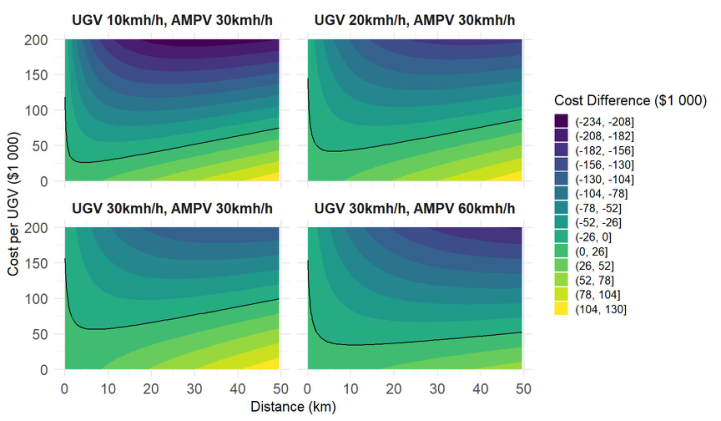
The effects of varying UGV unit costs can be seen in Figure 3, assuming that a hundred casualties are transported to a given distance within 60 minutes. First, the cost per UGV must drop for it to be more cost- effective on short distances, but the threshold increases again with distance. AMPVs are therefore at their most cost-effective at shorter distances of roughly 2-10 km. Relatively slow UGVs are associated with largest savings on longer distances, where also a larger number of AMPVs would be required. However, shorter distances are closer to the conflict and are associated with a higher risk of falling under fire, whereas longer distances are associated with higher levels of care, safety and benefits from having medical personnel present during transportation.
Casualty Evacuation Process Comparison of Single Patient Evacuation 221
Table 1. Total costs and cost per evacuation with UGVs and AMPGVs with varying speeds and distances. UGV unit cost is $60 000, a conservative estimate based on a range of similar systems, and $1 800 000 for AMPGV.
Speed (km/h) 5 30 15 30 30 30 30 30 30 30 Total Trips per Unit: 2 4 6 4 10 4 3 2 1 1 Number of Units Required
0.3 0.9 0.1 0.9 0.06 0.90 0.20 1.80 0.60 3.60
Total Cost ($ milj) 3 9 1.02 9 0.6 9 2.04 18 6 36 Cost per Evacuation ($ milj)
Figure 3: Cost differences for varying evacuation distances, vehicle speeds and UGV unit costs. AMPVs are favourable above the line and UGVs below it.
DISCUSSION
Holding other variables constant, (carrying capacity, terrain, distance and start time, rate of casualty), the AMPV will always be faster than a small evacuation UGV with a lower top speed. However, if Med-Laykka can start the evacuation before the conflict is over, i.e. earlier than an AMPV, the mean evacuation time is shortened. When the carrying capacity is the same, as in five single evacuation Med-Laykka versus a AMPV with a capacity of five, the faster AMPV will always be faster.
The slower and smaller vehicle is beneficial when it can start the evacuation process during the conflict. The larger, faster vehicle is a visible target, and as such it is more likely to be destroyed by enemy fire. Furthermore, if a vehicle is able to traverse unnoticed, it is able to extract a casualty from under fire faster than a medic – without risking further casualties. When small single evacuation UGVs are deployed from the beginning of the conflict, the mean time to have reached a field medic is significantly shortened.
While the AMPV is faster, it has a lower cost-effectiveness. The speed difference, distance of evacuation or the unit-cost of an evacuation must be large to favour AMPVs. Furthermore, the AMPG is limited to carrying 2 litters and 3 seated casualties, or 6 seated people at a time. This means that the number of severely injured is limited at a time. Conversely, a fleet of single evacuation UGVs with the equivalent capacity can prioritize the severely injured and likely to survive casualties first. The best approach would likely be to combine both types of transport.
When evacuation is begun earlier, the mean time to reach a medic should be significantly lowered. Another unexplored aspect is the flexibility to prioritize evacuation of those wounded soldiers, who seem to benefit from faster escalation of care. The limitation of this study is the inability to compare survival rates with Med-Laykkas and AMPVs. Furthermore, the probability of the evacuation vehicle to be destroyed should be explored under varying conditions.
Additionally, the complexity of managing medical supply chains in contested environments can exacerbate delays in casualty evacuation and treatment but is also likely to benefit from automation and/or decision support systems. The ability to predict the need for plasma and other medical supplies should be evaluated in an independent simulation.
Further simulation studies should consider the whole evacuation process from point of injury to higher echelons of care, along with MEDLOG aspects. Outcomes should include cost-effectiveness, time to reach care, need for care and survival rates in different levels of injuries. Variables to be simulated should include terrain conditions, as they can drastically influence the speed of vehicles, intensity of conflict, and the probability of the evacuation vehicle being destroyed. A comprehensive study should also consider the decision making and teamwork performance, such as discusses by Rosen et al. (2018), in the battalion area of service of forward medical facility, especially in different rates of casualties, varying lengths of hold and lack of medical supplies. These insights would aid in the development of a meaningful decision support system for these facilities.
UGVs can be a cost-effective alternative to AMPVs, with most benefits arising from employing both types of vehicles at appropriate stages of the evacuation process. However, further studies are necessary to understand how these systems should best be integrated into the evacuation process. The logistic process is somewhat straightforward, yet dynamic situation with casualties making the optimization problem exponentially more complex. The whole decision-making process at different levels of care should also be understood to avoid detrimental effects on the information ergonomics of medical personnel. Thus, UGV could serve as a partial solution as it is also a vehicle for providing information. In the simulation experiment informing this paper, even though there were no advanced patient monitoring systems within the evacuation UGV, at least it is visible for patient care and logistics operators. Information about patients in transport alone enhances the situational awareness needed to maintain smooth evacuation process. Additionally, the information on patient status delivered by UGV would help with planning the logistics as discussed above.
Casualty Evacuation Process Comparison of Single Patient Evacuation 223
ACKNOWLEDGMENT
The study for this paper was funded by the grant of PVTO program. Authors acknowledge the contribution of the participants, as well as the other people in Finnish Defence Forces.
REFERENCES
Andersson, C. A., Halme, K., Laine, M., Hulkko, V. and Virtanen, K. (2024).
Effectiveness of an Expendable Unmanned Ground Vehicle Stalling a Mechanized Infantry Company’s Primary Combat Units—A Virtual Simulation Experiment. Journal of Field Robotics. https://doi.org/10.1002/rob.22442 Andersson, C. A., Laine, M. and Okkonen, J. (2025). Defining autonomous functionalities of narrow artificial intelligences for a defensive unmanned ground vehicle to enhance human-UGV teaming performance for defending forces. In n.d & n.d (Eds.), Proceedings of the 13th International Conference on Human Interaction & Emerging Technologies: Artificial Intelligence & Future Applications, IHIET-AI 2025, April 22-24, 2025, Costa Del Sol, Universidad de Málaga, Spain (pp. 123–130). Springer. https://doi.org/10. 00000000 [SUBMITTED] Butler, F. K., Bennett, B., & Wedmore, C. I. (2017). Tactical Combat Casualty Care and Wilderness Medicine: Advancing Trauma Care in Austere Environments. Emergency medicine clinics of North America, 35(2), 391–407. https://doi.org/10.1016/j.emc.2016.12.005 Cronk, T. (2023). U. S. Army’s Armored Multi-Purpose Vehicle (AMPV). Congressional Research Service. https://sgp.fas.org/crs/weapons/IF11741.pdf Eastridge, B. J., Mabry, R. L., Seguin, P., Cantrell, J., Tops, T., Uribe, P., Mallett, O.,
Zubko, T., Oetjen-Gerdes, L., Rasmussen, T. E., Butler, F. K., Kotwal, R. S., Holcomb, J. B., Wade, C., Champion, H., Lawnick, M., Moores, L., & Blackbourne, L. H. (2012). Death on the battlefield (2001-2011): Implications for the future of combat casualty care. The journal of trauma and acute care surgery, 73(6 Suppl 5), S431–S437. https://doi.org/10.1097/TA.0b013e3182755d cc Fisher, A. D., April, M. D., Naylor, J. F., Kotwal, R. S., & Schauer, S. G. (2023).
The battalion aid station—the forgotten frontier of the Army health system during the global war on terrorism. Military Medicine, 188(5-6), e1240–e1245. https://doi.org/10.1093/milmed/usab401 Freedberg, S. J. Jr. (2013, March 22). Army Issues RFP For $6 Billion M113 Replacement: Armored Multi-Purpose Vehicle Program. Breaking Defense. https://breakingdefense.com/2013/03/army-issues-rfp-for-6-billion-m113-replac ement-armored-multi-purpose-vehicle-program/ Headquarters, Department of the Army. (2007). FM 4–02.2: Medical evacuation (Change No. 1, 2009). Department of the Army. Available at Army Knowledge Online: https://www.us.army.mil and General Dennis J. Reimer Training and Doctrine Digital Library: https://www.train.army.mil. Headquarters, Department of the Army. (2021). ATP 4–02.13: Casualty evacuation.
Department of the Army. Available at Army Publishing Directorate: https://www. armypubs.mil and Central Army Registry: https://atiam.train.army.mil/catalog/d ashboard. Hooper, T. J., Nadler, R., Badloe, J., Butler, F. K., & Glassberg, E. (2014).
Implementation and execution of military forward resuscitation programs. Shock, 41(Suppl 1), 90–97.
Johnson, S. A., Lauby, R. S., Fisher, A. D., Naylor, J. F., April, M. D., Long, B., & Schauer, S. G. (2022). An analysis of conflicts across Role 1 guidelines. Military Medicine, 187(3–4), e263–e274. https://doi.org/10.1093/milmed/usaa460 Rosen, M. A., DiazGranados, D., Dietz, A. S., Benishek, L. E., Thompson, D.,
Pronovost, P. J., & Weaver, S. J. (2018). Teamwork in healthcare: Key discoveries enabling safer, high-quality care. The American psychologist, 73(4), 433–450. https://doi.org/10.1037/amp0000298 Marlow, S. L., Bedwell, W. L., Zajac, S., Reyes, D. L., LaMar, M., Khan, S., Lopreiato, J., & Salas, E. (2018). Multiple Patient Casualty Scenarios: A Measurement Tool for Teamwork. Simulation in healthcare: Journal of the Society for Simulation in Healthcare, 13(6), 394–403. https://doi.org/10.1097/SIH.0000000000000342 Martinic, G. (2014). Glimpses of future battlefield medicine—the proliferation of
robotic surgeons and unmanned vehicles and technologies. Journal of Military and Veterans’ Health, 22(3), 49–52. Murphy, R. R., Tadokoro, S., Kleiner, A., & Goodrich, M. A. (2016). Disaster robotics. In Springer Handbook of Robotics (pp. 1577–1604). Springer. Mussalo, J., Kyröläinen, H., & Vaara, J. P. (2024). Physical fitness determinants of
a military casualty evacuation test. Military Medicine. https://doi.org/10.1093/mi lmed/usae414 NATO Standardization Office. (2019). Allied Joint Doctrine for Medical Support (AJP-4.10, Edition C, Version 1). North Atlantic Treaty Organization. Parker, P. J. (2007). Casualty evacuation timelines: An evidence-based review. BMJ Military Health, 153(4), 274–277. Pilgrim, C. H. C., & Fitzgerald, M. (2022). Novel approaches to point of injury
care utilizing robotic and autonomous systems. Journal of Military and Veterans’ Health, 30(4), 6–10. Ran, Y., Hadad, E., Daher, S., Ganor, O., Yegorov, Y., Katzenell, U., Ash, N., & Hirschhorn, G. (2011). Triage and air evacuation strategy for mass casualty events: A model based on combat experience. Military Medicine, 176(6), 647–651. https://doi.org/10.7205/MILMED-D-10-00390 Scallan, N. J., Keene, D. D., Breeze, J., et al. (2020). Extending existing recommended
military casualty evacuation timelines will likely increase morbidity and mortality: A UK consensus statement. BMJ Military Health, 166(4), 287–293. U. S. Army Medical Department. (2003). M1133 Medical Evacuation Vehicle [Photograph]. Wikimedia Commons. https://commons.wikimedia.org/w/index. php?curid=317800 van Dongen, T. T. C. F., de Graaf, J., Plat, M.-C. J., Huizinga, E. P., Janse, J.,
van der Krans, A. C., Leenen, L. P. H., & Hoencamp, R. (2017). Evaluating the military medical evacuation chain: Need for expeditious evacuation out of theater? Military Medicine, 182(9–10), e1864–e1870. https://doi.org/10.7205/MI LMED-D-17-00007 Walravens, S., Zharkova, A., De Weggheleire, A., Burton, M., Cabrol, J. C., & Lee, J. S. (2023). Characteristics of Medical Evacuation by Train in Ukraine. (2022). JAMA network open, 6(6), e2319726. https://doi.org/10.1001/jamanetworkope n.2023.19726 Williams, A., Sebastian, B., & Ben-Tzvi, P. (2019). Review and analysis of search,
extraction, evacuation, and medical field treatment robots. Journal of Intelligent & Robotic Systems, 96(3–4), 401–418.
LISTED IN THE AHFE DIGITAL BOOKSTORE CATALOGUE
Explore the complete digital volume
Human Interaction and Emerging Technologies (IHIET-AI 2025): Artificial Intelligence and Future Applications
Read this individual research paper free through the original publisher, or explore the full digital proceedings book.
ISBN 978-1-964867-37-3
Explore this ISBN in the AHFE Bookstore ↗Listed in the July 2026 bookstore catalogue; search by ISBN to confirm current availability · Digital book purchase optional