Jussi Okkonen, Mia Laine, Christian Andersson (2025). Interplay of capability and personality when cooperating with autonomy. In: Human Interaction and Emerging Technologies (IHIET-AI 2025): Artificial Intelligence and Future Applications. AHFE Open Access, vol. 161, pp. 206–214. https://doi.org/10.54941/ahfe1005911
Based on the prior exploratory results a positive relationship with technology has an association with algorithmic thinking skills. Furthermore, a compounding effect of this relationship and higher algorithmic thinking skills could have an effect task performance with unmanned autonomous ground vehicles. In this paper a further analysis is necessary to take into consideration the accuracy of this subjective measure compared to objective data from the experiment. There is also a connection between task performance and personal attributes. This paper studies the interplay between personality, algorithmic thinking and performance with autonomy. The rich data is also discussed, and methodological implications related to combining different types of data are brought about. The results are derived from simulated combat scenarios where squad and platoon leaders utilized the UGV’s as part of the defending force. Data consists of interaction data from the UGV user interface, UX surveys, and performance data and background data of the participants. The participants of the experiment consisted of 431 conscripts, 27 commissioned officers and 37 armored reserve officer students all from the armored brigade of Finland. The experiments were run during May and June 2024.
Based on study by Okkonen et al. (2024), the role of technology relationship and algorithmic thinking as personal characteristics in functioning with autonomous capabilities such as unmanned vehicles (UxV’s) are factors associated with better task performance. Also, certain personality traits forecast acceptance of new technology and better task performance with it. The basic proposition is that conscripts with algorithmic thinking above the median are more able to interact with autonomy. The findings point out coexistence of sense of self-efficacy, positive attitude towards technology, digital literacy and capability to algorithmic thinking. Moreover, operating the UxV’s, as well as being on mission with such capabilities require human-autonomy teams human trust (Wohleber et al., 2023). Such trust is built on experience on technology, general technology relationship and agency over technology (Freedy et al., 2007). O’Nell et al. (2022) discuss the human-autonomy teaming (HAT) from several perspectives. For this
Interplay of Capability and Personality When Cooperating With Autonomy 207
study most relevant are cases with partial agent autonomy or high agent autonomy (cf. Parasurman et al., 2000). In several military cases there is requirement for human-in-the-loop or human-on-the-loop, yet the teaming should be based on expected synergy. Moreover, it is not trust in technology but also understanding the combined capability as well as conception of human-autonomy team (cf. Wildman et al., 2024). Interaction, agency and empowerment in that context should be discussed by the perspective of human conception of artificial agent (Roth et al., 1987).
The interaction between human and autonomy is somewhat similar to any other human technology interaction situation. However, autonomy challenges human cognition as user personality, technology relationship and technology self-efficacy as autonomy brings about the factor of unexpected action of the system. Especially in time-critical situations there are a group of independent factors affecting how people utilize autonomous capabilities. Cognitive load in combat situations is high, yet some individuals excel with their skills as some just ignore interaction. In this paper the interaction with autonomy is based on personality, technology relationship, logical-mathematical capabilities, motivation and behavioural intentions. As discussed in Wildman et al. (2024) the topics should be addressed from several perspectives, since several factors shape somewhat straightforward factor as trust.
Interaction between human and autonomy has been widely researched on several domains such as industry, logistics, transportation, education, aviation, and military. As stated in O’Neill et al. (2022) human autonomy teaming is goal-oriented activity towards common goal. O’Neill et al. (2022) underlines the importance of human individual difference in teaming and cooperation with autonomy. Taking the degree of agency into account as in Parasuranman et al. (2000) interaction perspective has more importance if there is high agent autonomy or partial agent autonomy. In industrial settings autonomy is often high as the environment is restricted and well controlled. The transition to non-restricted environments often calls for operator control or a more defined set of options or tasks. Analogy to military context is clear when attention is drawn to expendable resources in risky or dangerous missions or operations.
Rödel et al. (2014) discuss the user acceptance and user experience of autonomy as a sum of experienced utility of autonomy and perceived user experience built on of ease of use, attitude towards using autonomy, behavioral intention of the system, and trust and fun. In drone (UxV) context Christ et al. (2016) emphasize similar factors, yet trust on technology, in this case the integrated system, gains importance as degree of autonomy increases. Trust can be seen as the flip side of interaction or controlling (cf. Goodrich and Schultz, 2007; Crandall, 2005). The relationship with autonomy builds up on technology relationship, personality and user experience. In this paper the hypothesis is set on those. In addition, logical-mathematical intelligence, such as algorithmic thinking, should also positively affect cooperation with autonomy. As stated in Okkonen et al. (2024) technology self- efficacy, algorithmic thinking and motivation are connected. Putting above mentioned factors together then interaction is defined by personal attributes
emphasizing prior experience on technology and capability to understand the nature of it. However, personality features are also important as stated in Svendsen et al. (2011). This should be taken into account when behavioural intention is addressed as a sum of motivational factors. Motivation is also taken into account when interaction is studied. Behavioural intention becomes visible through existing or non-existing interaction with autonomy.
According to Park and Woo (2022) five personality traits, i.e. extraversion, agreeableness, conscientiousness, neuroticism, openness, affect positive and negative emotions towards artificial intelligence. In this study an extension to two dimensions of affective components was made. As discussed in Park and Woo agreeableness was associated with positive and negative emotions. Conscientiousness was negatively related to negative emotions. Neuroticism was related to negative emotions. Openness did not predict other attitudes. Similar findings by Barnett et al. (2015) when conscientiousness and neuroticism were associated with using technology. Conscientiousness is connected to both perceived and actual use of technology. Neuroticism has a similar negative association as demonstrated also by Park and Woo. Extraversion was significantly associated with actual use. Both studies connect personality traits and intention to use and actual use of technology. Similarly, this association should also exist with cooperation or interaction which both should be considered active use of autonomy.
The aim of this paper is to study the relationship between human and autonomous unmanned ground vehicle (UGV) focusing on interaction during simulated military operation. Explaining factors for interaction are technology relationship, algorithmic capabilities, and personality.
METHOD
The results are derived from simulated combat scenarios where squad and platoon leaders utilized the UGV’s as part of the defending force. Data consist of interaction data from the UGV user interface, UX surveys, and performance data. There were four different types of individuals clustered. Several independent variables were significantly connected to differences and this paper presents the model for explaining un-successful interaction. The paper concentrates on the connection between algorithmic thinking and technology relationship and how those shape interaction with autonomy, user experience and task performance.
The participants of the experiment consisted of 431 conscripts, 27 commissioned officers and 37 armored reserve officer students all from the armored brigade of Finland. The experiments were run during May and June 2024. Participants were allocated to different roles in defending as infantry troops and in attacking as part of the mechanized infantry troops, while 5 staff officers controlled simulated infantry troops operating the UGVs on the defending side. Out of those participants, 20 groups were formed, where up to five conscripts used the UGVs. The defending and attacking troops were commanded by senior officers, yet their role is considered neutral or minimal. Each participant completed four scenarios in total, switching sides after two scenarios. In half of the scenarios UGV’s were operated by human operators
Interplay of Capability and Personality When Cooperating With Autonomy 209
with direct communication possibility by squad and platoon leaders. Half of the simulated scenarios UGVs were operated using the wizard of Oz method, where human operators represented the AI capabilities. In latter scenarios squad leaders could command UGV’s actions indirectly by setting it to execute a certain task or ordering it to move to a certain location with the help of a user interface. A total of 48 battle simulations were fought including 4 control scenarios. These control scenarios were fought without any UGVs, and as such events in them are not discussed in this paper.
The primary objective of the analysis is to identify meaningful predictors of successful human autonomy teaming. The measure of this success was defined as the team’s hit counts on infantry fighting vehicles and dismounted infantry. Dimensions of technology relationship, (i.e. technology self-efficacy, user experience, difficulty of use, ease of use), motivational aspects (i.e. learning orientation, performance avoidance orientation), epistemic beliefs (simplicity and certainty of knowledge), along with interrelated algorithmic and reflective thinking skills were examined as predictors of the successful teaming. As count data with overdispersion and zero-inflation, negative binomial and Poisson zero inflation models were considered. Operator experience was included in the models to take operator learning into account. Additionally, level of autonomy and the position in the command hierarchy along with position in the defence line was included. Therefore, levels of autonomy were excluded and the whole sample was used. The models and graphics were built in R (R Core Team, 2024) using rStudio (Posti team, 2024), with tidyverse (Wickham et al., 2019) for data manipulation, ggplot2 (Wickham, 2016) for visualization and pscl (Jackman, 2024; Zeileis et al., 2008) for count modeling with zero inflation models.
RESULTS
To investigate the factors influencing successful human autonomy teaming, zero-inflation models were chosen to account for the excessive zeros in the data. Both zero-inflated Poisson (ZIP) and zero-inflated negative binomial (ZINB) models were tested to determine the best fit, with model comparisons performed using likelihood ratio tests. The ZINB model showed no significant improvement over the ZIP model based on likelihood ratio tests (ξ2(1) = 0, p > 0.5). Additionally, while overall variance was larger than the mean, the final model showed no need to include the overdispersion parameter. Consequently, the ZIP model was selected for parsimony. Level of autonomy was an insignificant predictor and therefore the whole sample was used, along with the scenarios were the UGVs were teleoperated. Even though the command hierarchy position and position in the defence line similarly was not significant, it was included to control for similarities in these positions.
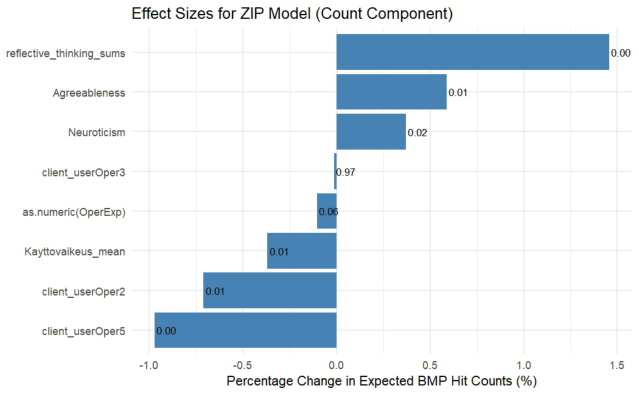
The number of times an Infantry Fighting Vehicle was hit was influenced most by user’s reflective thinking task score and insignificantly by operators’ experience. Predictors with positive effects include agreeableness and neuroticism, whereas difficulty of using technology has a negative effect on the expected hit count. The percentage changes in expected counts for predictors in the count component are illustrated in Figure 1.
Figure 1: Predictors of performance againts vehicles.
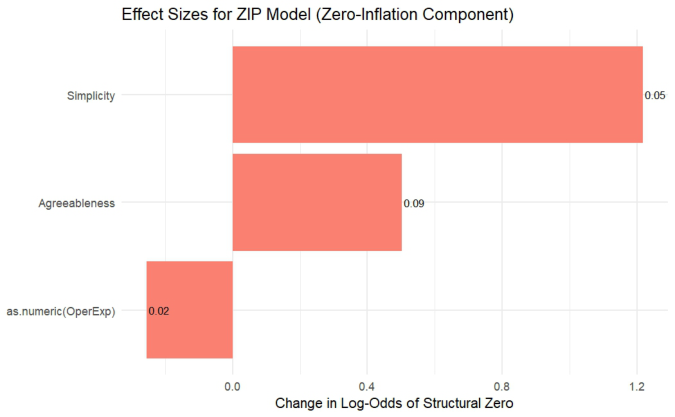
Positive values indicate an increase in the expected count, while negative values reflect a decrease. In the zero-inflation component, Simplicity and Agreeableness were significantly associated with increased log-odds of structural zeros, whereas operator experience was associated with decreased log-odds. The leg-odds for predictors in the zero-inflation component are presented in Figure 2.
Figure 2: Effect sizes.
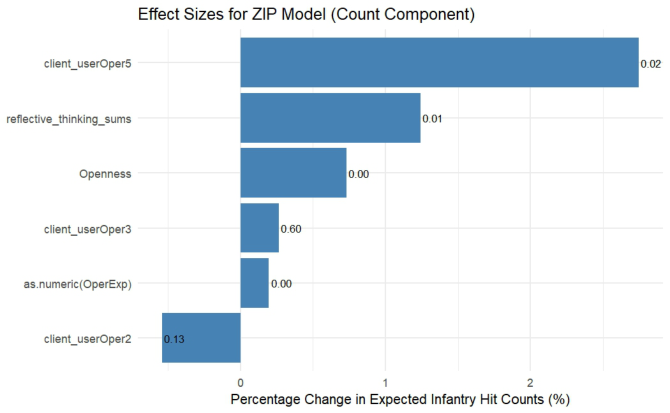
The number of times a dismounted Infantry member was hit was positively affected by reflective thinking scores, openness to new experiences operators’
Interplay of Capability and Personality When Cooperating With Autonomy 211
experience. The percentage changes in expected counts for predictors in the count component are illustrated in Figure 3.
Figure 3: Predictors of performance against infantry.
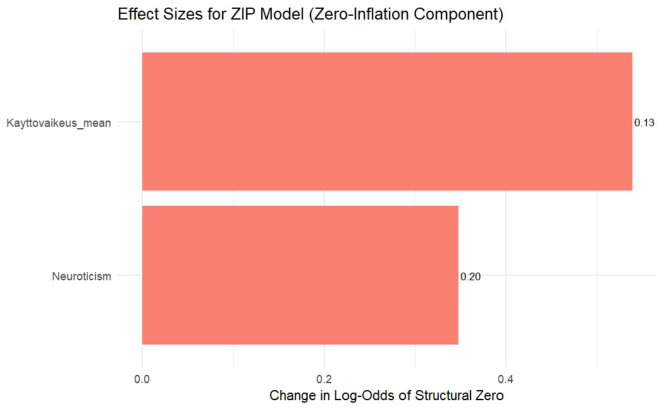
The log-odds of structural zeros were increased by difficulty in use of technology and neuroticism. While these effects were insignificant at 95% confidence level, their inclusion improved the fit of the model. Unlike with IFV hits, operator experience did not have a decreasing effect on the structural zeros. The leg-odds for predictors in the zero-inflation component are presented in Figure 4.
Figure 4: Effect sizes.
CONCLUSION AND DISCUSSION In addition to the models reported in the result section, each set of background variables were fit individually and as a group. While these models did not perform as well as the reported models nor produce significant predictors, they indicated that additional associations are likely to exist. Aspects such as performance avoidance orientation and conscientiousness were close to being significant, but their inclusion with other variables was not beneficiary. This is likely due to the interconnectedness of technology relationship, epistemic beliefs, reflective thinking skills, motivational aspects, algorithmic thinking skills and personality traits. Furthermore, these preliminary results encourage performing specifically designed experiments with larger samples. Interestingly, reflective thinking score was more clearly associated with successful human autonomy teaming than algorithmic thinking score.
The results implicate the connection between task performance and personal attributes also measured by operation task success. The scenarios utilised for data collection were somewhat simple, yet those reflect current outlook on the infantry battle. Most important factor drawn by results is the role of UGV use, i.e. person making tactical decision during the action. UGV operator evidently plays key role on UGV performance, yet UGV user e.g. squad leader has better overview of the squad formation and thus better ability to actively allocate resources. These findings should be utilised when allocating people to UGV users and operators. As discussed above the performance with UGV consist of capability and personality. As this partial task performance analysis revealed most relevant factors. Utilising the findings it is possible to define set of criteria for allocating persons to either user or operator role. Also, but not as evidently, exclusion criteria could be defined too especially for operators, as training an operator is investment on knowledge and thus it presents at least a large opportunity cost.
ACKNOWLEDGMENT
The study for this paper was funded by the grant of PVTO program. Authors acknowledge the contribution of the participants, as well as the other people in Finnish Defence Forces. Special gratitude is afforded to the Virtual Training Conscripts of Armored Brigade and the Chief of Virtual Training of Finnish Defense Forces.
REFERENCES
Barnett, T., Pearson, A. W., Pearson, R., & Kellermanns, F. W. (2015). Five-factor model personality traits as predictors of perceived and actual usage of technology. European Journal of Information Systems, 24(4), 374–390. https://doi.org/10. 1057/ejis.2014.10 Bruzzone, A. G., Massei, M., Di Matteo, R., & Kutej, L. (2019). Introducing
intelligence and autonomy into industrial robots to address operations into dangerous area. In Modelling and Simulation for Autonomous Systems: 5th International Conference, MESAS 2018, Prague, Czech Republic, October 17–19, 2018, Revised Selected papers 5 (pp. 433–444). Springer International Publishing.
Interplay of Capability and Personality When Cooperating With Autonomy 213
Christ, P. F., Lachner, F., Hösl, A., Menze, B., Diepold, K., & Butz, A. (2016). Humandrone-interaction: A case study to investigate the relation between autonomy and user experience. In Computer Vision–ECCV 2016 Workshops: Amsterdam, The Netherlands, October 8–10 and 15–16, 2016, Proceedings, Part II 14 (pp. 238– 253). Springer International Publishing. Crandall, J. W., Goodrich, M., Olsen Jr., D. R., Nielsen, C. W., et al.: Validating
human-robot interaction schemes in multitasking environments. IEEE Trans. Syst. Man Cybern. 35(4), 438–449 (2005). Goodrich, M. A., Schultz, A. C.: Human-robot interaction: a survey. Foundations Trends Hum. Comput. Interact. 1(3), 203–275 (2007) Jackman S (2024). pscl: Classes and Methods for R Developed in the Political Science
Computational Laboratory_. University of Sydney, Sydney, Australia. R package version 1.5.9, https://github.com/atahk/pscl/. Okkonen, J., Syvänen, A., Laarni, J., Viteli, J., Wahlström, J., Laine, M. (2024). Sense of technology self-efficacy and motivation coexisting with algorithmic thinking. IHIET-AI 2024. AHFE Open Access. doi: 10.54941/ahfe1004566. O’Neill, T., McNeese, N., Barron, A., & Schelble, B. (2022). Human–autonomy
teaming: A review and analysis of the empirical literature. Human factors, 64(5), 904–938. Parasuraman R., Sheridan T. B., Wickens C. D. (2000). A model for types and levels of human interaction with automation. IEEE Transactions on Systems, Man, and Cybernetics - Part A: Systems and Humans, 30, 286–297. https://doi.org/10.1109/3468.844354 Park, J., & Woo, S. E. (2022). Who Likes Artificial Intelligence? Personality
Predictors of Attitudes toward Artificial Intelligence. The Journal of Psychology, 156(1), 68–94. https://doi.org/10.1080/00223980.2021.2012109 Posit team (2024). RStudio: Integrated Development Environment for R. Posit Software, PBC, Boston, MA. URL http://www.posit.co/. Rödel, C., Stadler, S., Meschtscherjakov, A., & Tscheligi, M. (2014). Towards
autonomous cars: The effect of autonomy levels on acceptance and user experience. Proceedings of the 6th international conference on automotive user interfaces and interactive vehicular applications, (pp. 1–8). Rødseth, Ø. J., & Vagia, M. (2020, November). A taxonomy for autonomy in industrial autonomous mobile robots including autonomous merchant ships. In IOP conference series: materials science and engineering (Vol. 929, No. 1, p. 012003). IOP Publishing. Roth E. M., Bennett K. B., Woods D. D. (1987). Human interaction with an
“intelligent” machine. International Journal of Man-Machine Studies, 27, 479– 525. https://doi.org/10.1016/S0020-7373(87)80012-3 Svendsen, G. B., Johnsen, J. A. K., Almås-Sørensen, L., & Vittersø, J. (2011).
Personality and technology acceptance: the influence of personality factors on the core constructs of the Technology Acceptance Model. Behaviour & Information Technology, 32(4), 323–334. https://doi.org/10.1080/0144929X.2011.553740 Wickham H (2016). ggplot2: Elegant Graphics for Data Analysis_. Springer-Verlag New York. ISBN 978-3-319-24277-4. Wickham H, Averick M, Bryan J, Chang W, McGowan LD, François R, Grolemund
G, Hayes A, Henry L, Hester J, Kuhn M, Pedersen TL, Miller E, Bache SM, Müller K, Ooms J, Robinson D, Seidel DP, Spinu V, Takahashi K, Vaughan D, Wilke C, Woo K, Yutani H (2019). “Welcome to the tidyverse.” Journal of Open Source Software, 4(43), 1686. doi: 10.21105/joss.01686. https://doi.org/10.21105/joss.01686.
Wildman, J. L., Nguyen, D., Thayer, A. L., Robbins-Roth, V. T., Carroll, M., Carmody, K., Ficke, C., Akib, M., & Addis, A. (2024). Trust in Human-Agent Teams: A Multilevel Perspective and Future Research Agenda. Organizational Psychology Review, 14(3), 373–402. https://doi.org/10.1177/ 20413866241253278 Wohleber, R. W., Stowers, K., Barnes, M., & Chen, J. Y. (2023). Agent transparency
in mixed-initiative multi-UxV control: How should intelligent agent collaborators speak their minds? Computers in Human Behavior, (148). doi: 107866. Zeileis A, Kleiber C, Jackman S (2008). “Regression Models for Count Data in R.”
Journal of Statistical Software, 27(8).
LISTED IN THE AHFE DIGITAL BOOKSTORE CATALOGUE
Explore the complete digital volume
Human Interaction and Emerging Technologies (IHIET-AI 2025): Artificial Intelligence and Future Applications
Read this individual research paper free through the original publisher, or explore the full digital proceedings book.
ISBN 978-1-964867-37-3
Explore this ISBN in the AHFE Bookstore ↗Listed in the July 2026 bookstore catalogue; search by ISBN to confirm current availability · Digital book purchase optional