Christiano Bittencourt Machado (2024). Flight Simulation In Geography Teaching: Experience Reports In Two Scenarios. In: Human Interaction and Emerging Technologies (IHIET-AI 2024): Artificial Intelligence and Future Applications. AHFE Open Access, vol. 120, pp. 114–122. https://doi.org/10.54941/ahfe1004561
There is an increasingly innovative range of resources in education, seeking to create a motivating environment for learning. The aim of this work was to present experience reports on the use of a flight simulator in Brazilian and biblical geography classes in an elementary school and a reformed Christian theology church, respectively. Microsoft® Flight Simulator was used for this purpose. Two educational scenarios are presented here: (1) teaching of geographical aspects of Brazil for 10-years old students; and (2) teaching of biblical aspects for 8 to 10-years old children from a reformed Christian theology church. The classroom was prepared to simulate an internal airplane environment. First, in the elementary school scenario, students could learn about Rio de Janeiro, Niterói (school city), the Amazon rainforest, Brasília (Brazilian capital), Pantanal and the southern region of the country. On the other hand, in the church scenario, children were able to have a bigger picture about Egypt, Sinai desert, Dead Sea, Jordan river, the Sea of Galilee, and other important biblical sites in Palestine, providing a rich opportunity to learn the main stories of the Old and New Testaments. Children approved the use of technology to assimilate the content, and further projects are intended to present this application for adults.
It is known that the technological development that occurred in the 21st cen- tury stimulated a social revolution. Nowadays, the so-called “information society” presents challenges in several areas of life, including jobs, personal relationships and, of course, education. At the beginning of the 21st cen- tury, several technological advances have caused major economic, social, and cultural transformations, with the creation of new values. By influencing different areas of society, it could not be different in the field of Education (Gwo´zdziewicz and Cie´slikowska, 2020).
Information and Communication Technologies (ICT) have played an important role for Educational Sciences, in different areas of knowledge. According to Morejón and Mitjans (2021), ICT leads us to new situations and approaches that should lead us, through research and analysis of their
Flight Simulation in Geography Teaching: Experience Reports 115
effects, to take positions that mark the path and direction to continue serving to the society we want to build.
Information technology has become a current trend in mathematics educa- tion, leading to the use of computers and other technologies associated with them, giving a new scenario to the teaching, and learning process. The teacher must be a validator of these new technologies in the classroom, promoting student progress, combating inequities, and giving greater opportunities to current generations (Hwang et al., 2023).
Geography is one of the subjects that can benefit from ICTs. According to the National Common Curricular Base (BRASIL, 2017), there are spe- cific skills to be developed in children, using an integrative perspective of attitudes, skills, and knowledge. Among the various skills, we highlight the development of the ability to think geographically, curiosity to discover and get to know different territories and landscapes, understanding geographic concepts, analysis of concrete problems in the world, recognition of the interaction between man and the environment, among others.
In this context, the idea of using a flight simulator to develop these skills in elementary school students emerged. Considering another scenario, teaching biblical geography to children in churches offers several advantages in terms of understanding the Bible. The knowledge of the geographical context of the Bible provides a clearer picture of the events, stories, and teachings within it. The demonstration of the actual places where biblical events occurred may reinforce the historical validity of the Bible and provide the means for a visual and motivating learning.
After a review of the literature, no proposal was found related to the use of flight simulators for geography classes. Only two articles showed expe- riences with the use of flight simulators to teach aspects of aeronautical engineering (Bernoulli principle, flight physics, airplane instruments, cock- pit controls) (Aji and Khan, 2020; Ng and Chu, 2021). In this context, this work is justified, as it presents an innovative application of a technological resource (flight simulator for computers) in teaching geography. It is worthy to mention here that this experience report won two prizes in Brazil.
Therefore, the aim of this work was to present experience reports on the use of a flight simulator in Brazilian and biblical geography classes in an elementary school and a reformed Christian theology church, respectively. Microsoft® Flight Simulator was used for this purpose. Two educational sce- narios are presented here: (1) teaching of geographical aspects of Brazil for 10-years old students; and (2) teaching of biblical aspects for 8 to 10-years old children from a reformed Christian theology church.
MATERIALS AND METHODS
The flight simulator Microsoft® Flight Simulator 2020 (MSFS2020, Microsoft®, USA, 2020) was used. The premise of the game is to be able to travel anywhere in the world, simulating situations from a pilot’s daily life, such as adverse weather conditions. The commands are complex, however, there are different assistance options for beginners. This latest version of the game allows the faithful reproduction of geographical aspects of the terrain,
116 Machado
with trees, mountains, roads, rivers, etc., as well as traffic and animals in different scenarios.
MSFS2020 requires very powerful hardware. In this case, a DELL® Alien- ware notebook was used with the following specifications (model M15 R6 AW15-i1100-M30P, Intel Core i7 11800H processor, 16GB RAM, 1TB SSD memory, and Geforce RTX 3070 graphics card with 8GB). A keyboard, a mouse, and a Leadership® USB joystick were used as controls.
This study presents experience reports at two scenarios. The first one took place at Colégio Marly Cury, located in the city of Niterói, Rio de Janeiro, Brazil. The school was founded in 1969, serving students from kindergarten and elementary school (up to the fifth year). It currently has 450 students enrolled.
The school auditorium was prepared to simulate an internal airplane envi- ronment. To get closer to reality, the notebook’s sound card was connected to the ambient sound system, to simulate the real sound of the engines, and a projector was used to increase the size of the screen. Ambient lighting has also been reduced.
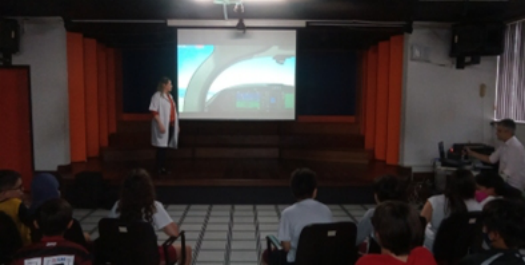
Four flyover events were organized across regions of Brazil, one for each fifth-year elementary school class, in October 2022. A total of 89 students participated in the activity. The main author was responsible for piloting the aircraft and controlling the direction of the camera during the simulation. A geography teacher used the dynamics of the simulation to explain various geographic aspects of the locations, such as relief, hydrography, urbanization, the effect of the human-environment interaction etc. (Figure 1).
Figure 1: School auditorium during the flight simulation, with the geography teacher in front.
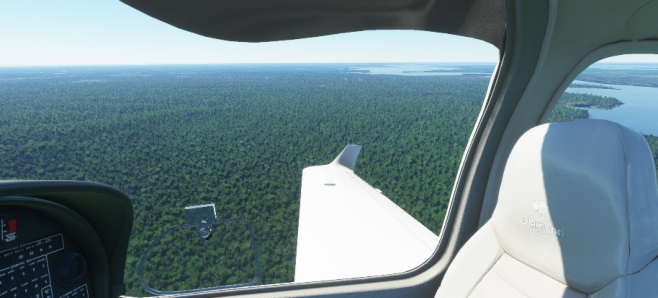
The flight simulation began with a take-off from Tom Jobim airport (Galeão), in Rio de Janeiro (RJ), with a Diamond DA62 aircraft, using open sky weather conditions. The students were able to fly over the city of Rio de Janeiro, Guanabara Bay, going to Niterói (the municipality where the school is located). Afterwards, the flight was terminated, and the plane was placed directly in the skies of Manaus, for a flight over the Amazon Rainforest. Other overflight locations were the “Maranhão bedsheets” and the Mato Grosso’s Pantanal. Finally, the plane was returned to the skies of
Flight Simulation in Geography Teaching: Experience Reports 117
Rio de Janeiro, for a landing at Santos Dumont airport. The entire class lasted about one hour. At the end of the activity, students were asked about their impression of the methodology used.
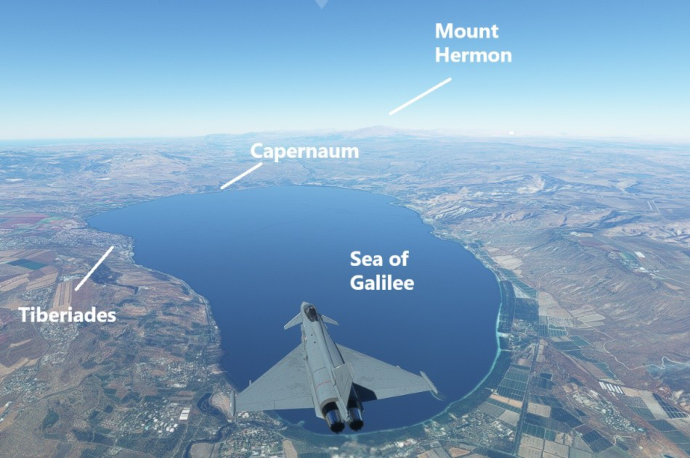
The second case report originates from Igreja Plena de Icaraí in Niterói, Brazil. This is a reformed Christian theology church that has been estab- lished for 25 years. Fifty-minute classes were conducted in the morning and evening for thirty children aged 8 to 10. These classes ran parallel to the adult worship services. The previously described setup was utilized. However, the simulation began with a take-off from Cairo International Airport in a jet (Eurofighter Typhoon). The flight path included flying over the Nile Delta, the Red Sea, the Sinai Desert, the Dead Sea, the Jordan River, and finally, the Sea of Galilee. At each of these locations, a historical description was pro- vided to the children, highlighting the primary biblical events associated with that area. On another screen connected to the data projector, a map displayed the jet’s exact position for the audience, using Remote Flight® Map app for iPad.
RESULTS
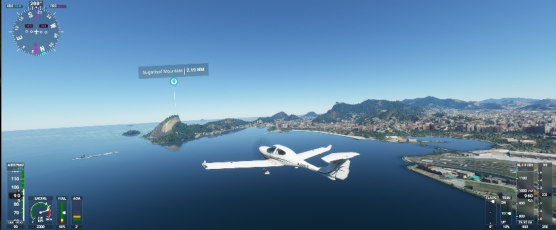
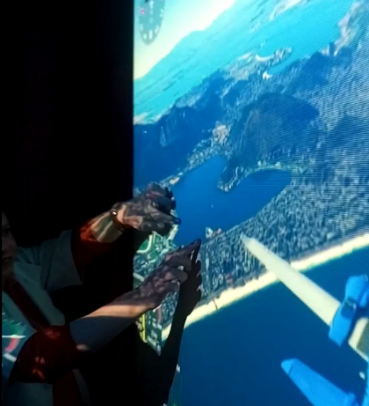
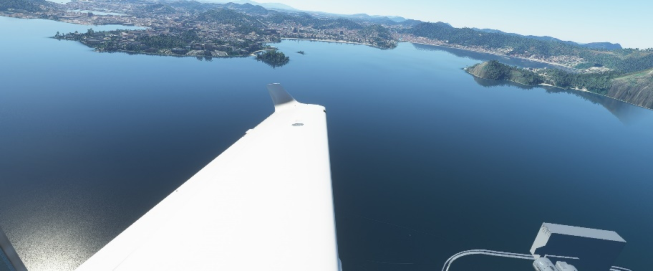
Brazilian Geography During the activity, it was possible to guide the students in a playful and dynamic way, achieving meaningful learning of various essential skills in geography. First, with the flyover of the cities of Rio de Janeiro and Niterói, and then in the mountainous region of the State, the geography teacher was able to address topics such as the municipality’s relief, intense urbanization (contrasting the forests with the urban centre, metropolitan area) – thus discussing the interaction of man with the environment, and hydrography (including Guanabara Bay and the Atlantic Ocean, with the beaches lining the municipalities) (Figures 2 to 4).
Figure 2: External camera from the plane, showing the Guanabara Bay, Sugarloaf Mountain, downtown Rio de Janeiro, and Santos Dumont airport (to the right).
During the flyover of the Amazon Rainforest (Figure 5), the students were able to discuss with the teacher about the importance of preserving fauna and flora, identify deforestation areas, and hydrographic aspects, such as the meeting of the Negro and Amazon rivers.
118 Machado
Figure 3: External camera from the plane. At this moment, the teacher points out the “heart” shape of Rodrigo de Freitas Lagoon in Rio de Janeiro.Figure 4: Side view showing the municipality of Niterói (RJ), where the school is located. One can see the Icaraí neighborhood (in the center of the image), São Francisco and Charitas (bay to the right of the image).Figure 5: Side view displaying the Amazon Rainforest in the state of Amazonas.
Flight Simulation in Geography Teaching: Experience Reports 119
Next, the students were able to fly over the “Maranhão bedsheets” and the Mato Grosso’s Pantanal, guided by the teacher’s information.
When asked about the activity, all the students emphasized that they were able to understand various geographical aspects of the places visited. They stated that the lesson was very motivating and interesting, and asked if there would be further opportunities to use the simulator at other times. Moreover, some parents expressed interest in attending the classes with their children.
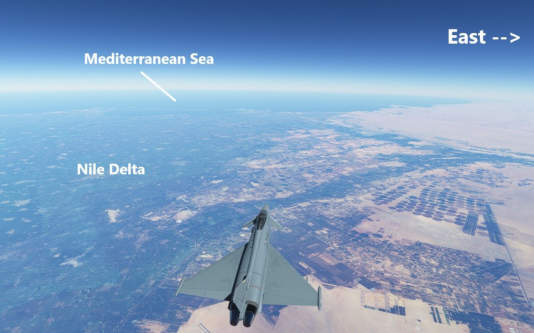
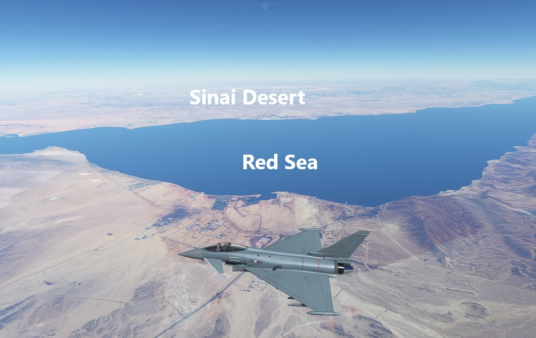
Biblical Geography Initially, while flying over the Nile Delta, one can pinpoint the Mediter- ranean Sea (to the North) and discern the stark contrast between verdant and arid regions (Figure 6). In Figure 7, we observe the Red Sea and the Sinai Desert, a location where significant biblical events from the Old Testament are described.
Figure 6: Flying over the Nile Delta (to the left).Figure 7: The Red Sea and the Sinai Desert.
120 Machado
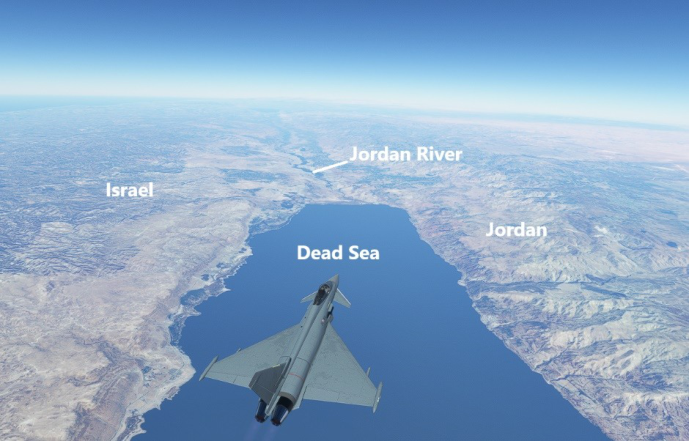
Upon arriving at the Palestinian peninsula, it was possible to fly over the Dead Sea and the Jordan River (Figure 8). Finally, the Sea of Galilee, with interesting biblical locations (Figure 9).
Figure 8: Flying over the Dead Sea. To the left, Israel. To the right, Jordan. It is possible to identify the Jordan river.Figure 9: The Sea of Galilee. It is possible to pinpoint Tiberiades and Capernaum.
Flight Simulation in Geography Teaching: Experience Reports 121
DISCUSSION AND CONCLUSION Numerous studies have already shown that the use of ICTs in the class- room increases students’ motivation for learning. The “level of motivation in the classroom with the use of ICT is much stronger, with greater concen- tration, increased learning, and a closer student-teacher relationship” (Kim et al., 2013). Research has indicated that “students who used resources/app- s/software to study were more motivated to learn content and more engaged in participating in school/academic activities”, and that academic improve- ments were observed. The strategic use of ICTs by students in a study context can influence perceptions of value and belonging, expectations of success, and autonomy (Cheung and Slavin, 2013).
Interactive learning with technologies such as smartboards, augmented reality (AR), and virtual reality (VR) tools can make lessons more engag- ing. They allow for interactive presentations and provide an immersive experience, especially for complex subjects.
The innovative integration of technology into education, as reflected in the utilization of Microsoft® Flight Simulator, underscores a pedagogical shift towards immersive learning. The presented experience from both the elementary school and the reformed Christian theology church illuminates the potential advantages of this approach.
In the elementary school scenario, students not only acquired knowledge about the geographical aspects of Brazil but also had an experiential under- standing of the regions, offering a more tangible connection than traditional textbook learning. The classroom’s transformation into an internal airplane environment further augmented the experiential learning process, placing students in a mindset more receptive to exploring the diverse terrains of Brazil.
In the church setting, the simulator provided children a spatial understand- ing of biblical locations. This geographical context can enhance comprehen- sion of biblical stories, anchoring abstract concepts to tangible locations. The application, therefore, bridges the gap between ancient biblical times and the modern age, making the narratives more relatable and vivid for young learners.
Across both scenarios, it’s evident that this mode of teaching encouraged active participation, curiosity, and engagement among students. The positive feedback from children underscores the potential of such tools in promoting better assimilation of content. However, it’s important to note that while technology can augment the learning experience, it should be used judiciously and complemented with traditional teaching methodologies for a balanced educational approach (Dede, 2009; Barab et al., 2010).
In conclusion, the use of flight simulators in teaching geographical and bib- lical aspects showcases the transformative power of technology in pedagogy. The immersive nature of such tools can foster deeper understanding, engage- ment, and retention of knowledge. While this study focused on children aged 8 to 10, the positive outcomes indicate the potential applicability for older age groups. Future projects exploring this application for adults would be a valuable addition to the evolving landscape of education, emphasizing that learning can be both informative and enjoyable.
122 Machado
ACKNOWLEDGMENT
The author would like to thank Marly Cury and Eliane Lewicki (Colégio Marly Cury) and Pastor Fabrini Viguier (Igreja Plena Icaraí) for the support in this project.
REFERENCES
Aji, C. A. and Khan, M. J. (2020) “Authentic Learning Environment with Flight Simulation Technology (Evaluation)”, Asee’s Virtual Conference, Paper ID 29256. Barab, S. A., Gresalfi, M. and Ingram-Goble, A. (2010). “Transformational play:
Using games to position person, content, and context”, Educational Researcher, volume 39, No. 7, pp. 525–536. Brasil. Ministério da Educação. (2017) “Base Nacional Comum Curricular (BNCC)”. Website: http://portal.mec.gov.br/conselho-nacional-de-educacao/base -nacional-comum-curricular-bncc. Cheung, A. C. and Slavin, R. E. (2013) “The effectiveness of educational technology applications for enhancing mathematics achievement in K-12 classrooms: A meta- analysis”, Educational Research Review, volume 9, pp. 88–113. Dede, C. (2009) “Immersive interfaces for engagement and learning”, Science,
volume 323, No. 5910, pp. 66–69. Gwo´zdziewicz, S. and Cie´slikowska, M. (2020) “Determinants of social development. About the power of expansion of (new) technologies”, International Journal of New Economics and Social Sciences (IJONESS), volume 11, No. 1, pp. 117–126. Hwang, S., Flavin, E. and Lee, J.-E. (2023) “Exploring research trends of tech-
nology use in mathematics education: A scoping review using topic modelling”. Education and Information Technologies, volume 28, No. 8, pp. 10753–10780. Kim, C., Kim, M. K., Lee, C., Spector, J. M. and DeMeester, K. (2013) “Teacher beliefs and technology integration”, Teaching and Teacher Education, volume 29, pp. 76–85. Microsoft. Flight Simulator. Website: https://www.flightsimulator.com/. Morejón, Y. L. and Mitjans, Y. N. (2021) “The TIC in the Sciences of the Edu-
cation”, International Journal of Sustainability Management and Information Technologies, volume 7, No. 2, pp. 48–51. Ng, D. T. K. and Chu, S. K. W. (2021) “Motivating Students to Learn STEM via Engaging Flight Simulation Activities”, Journal of Science Education and Technology, volume 30, pp. 608–629.
LISTED IN THE AHFE DIGITAL BOOKSTORE CATALOGUE
Explore the complete digital volume
Human Interaction and Emerging Technologies (IHIET-AI 2024): Artificial Intelligence and Future Applications
Read this individual research paper free through the original publisher, or explore the full digital proceedings book.
ISBN 978-1-958651-96-4
Explore this ISBN in the AHFE Bookstore ↗Listed in the July 2026 bookstore catalogue; search by ISBN to confirm current availability · Digital book purchase optional