Frank Rister, Nils Bartling (2023). Flight Training Research Paving the Path for Future eVTOL Pilots. In: Application of Emerging Technologies. AHFE Open Access, vol. 115, pp. 424–432. https://doi.org/10.54941/ahfe1004340
At the dawn of Urban Air Mobility (UAM), namely the introduction of eVTOL (electric Vertical Take-off & Landing) vehicles, we have been pioneering in designing a certifiable flight training programme for those pilots who will be the first in the world to operate such vehicles.This paper will discuss our training design path we pursued, the research and development work behind it and finally the resulting training design. Emphasis is laid on the analysis of the training needs, our design approach based on human-factors research and development, the requirements for the design of new flight simulators, and how a close cooperation with OEMs and aviation authorities made us validate this flight training programme course, which will prepare future eVTOL pilots for a safe and sustainable operation in Urban Air Mobility in just one year from now.
UAM will come to life in 2024. It will be a wholly new transportation domain of its own. This refers to the operational environment, the vehicle itself, and last but not least the human passengers and pilots: It will involve passenger flights in highly congested and confined urban areas, in an eVTOL-aircraft that by its nature is neither an airplane nor a helicopter, and which flies fully electric. Additionally, everything will have to fit in and comply with a new legal framework which is still to be fully implemented and designed. A fully developed eVTOL operation will be characterised by a huge number of sec- tors with very short legs and thus a high proportion of high-risk flight phases (CAE, 2021).
This novel way of air transport calls for new pilot applicant prerequisites that will differ from those of an airline or helicopter pilot, it calls for new human factors design considerations, new trainee-pilot requirements, and subsequently for new approaches to flight training, especially with regards to flight simulation. Furthermore, Urban Air Mobility will likely attract pas- sengers different to those flying on an airliner, thus requiring fostering of user-acceptance, also by highly trained pilots.
Especially training devices such as flight simulators but also the training programmes themselves, and the prerequisites for future flight instructors of such new vehicles are just some of the challenges we needed to tackle.
Flight Training Research Paving the Path for Future eVTOL Pilots 425
THE INTERPLAY OF HUMAN FACTORS RESEARCH AND TRAINING DEVELOPMENT EXPERTISE As already said, eVTOL vehicles are neither helicopters nor fixed-wing air- planes. Furthermore, the operational environment differs significantly from anything yet applied: short-distance flights in highly congested areas with the frequent requirement to take-off, approach and land in confined spaces. And with the projected number of vehicles likely to be deployed within the next decade, operations of such vehicles have to be highly standardized and proceduralized.
Thus, the primary challenge was to design a training program that would make use of the experience of pilots coming out of the fixed-wing as well as out of the rotary-wing world (Rister et al., 2014).
Human Factors Modelling and Learning Theory Taking advantage of the known and training for the unknown – this very common rationale was our first step to set a foundation of training require- ments at a time at which little to no experience with such a device existed in the world.
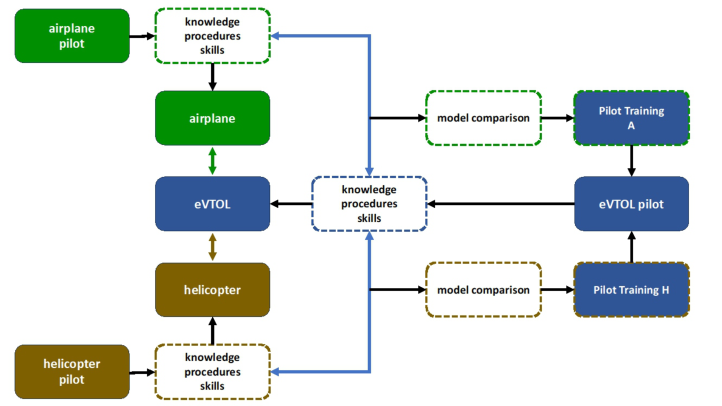
For this, we had to compare tasks and skills of the sources (aircraft and pilots) with the target vehicle and its tasks. Task models helped to identify differences in terms of new knowledge, new procedures, and skills and those that likely need to be made use of, changed and applied (see Figure 1).
Figure 1: Model comparison concept.
Before identifying the training needs, we made use of elements of learn- ing theory, namely transfer of learning, which refers to knowledge either being applied in a new way, in a new situation, or in familiar situations with different content. Thus, the transition training from a fixed-wing or rotary-wing aircraft to an eVTOL requires this transfer of learning, as the
426 Rister and Bartling
pilots inevitably try to transfer their existing flying knowledge, procedures and skills to this new type of aircraft. Learning theory also reveals how prior learning and acquired knowledge, procedures and skills affect subsequent learning (Schunk, 2004).
Previously acquired knowledge, procedures and skills can affect learn- ing in two ways: either does it facilitate learning and performance (positive transfer), or it obstructs this learning process, especially when pre- vious and well established knowledge, procedures or skills interfere with the newly to be acquired knowledge, procedures or skills, which is called negative transfer (Schunk, 2004).
Transfer of learning is further split into categories. One we made use of is to distinguish between low-road and high-road transfer (Salomon and Perkins, 1989). Low-road transfer means that well-established skills are transferred in a spontaneous and likely automatic fashion. A very common example is when we drive a car of another make and model than the one we normally drive for the first time. We will find similar to identical controls and indicators (shift, brake, speedometer, etc.) and may not face major difficulties in driving this new car, despite some minor differences may exist. This low-road transfer takes place as we as humans tend to abstract our knowledge into generic concepts during learning, which is called schema-abstraction (Posner and Keele, 1968). In other words, this abstraction is mastered as we are “cognitive economists”.
High-road transfer, on the other hand, requires an explicit and conscious formulation of abstraction of one situation to allow making a connection to another (Salomon and Perkins, 1989, p. 118). An initial categorization of differences, which can occur on the procedural layer or on the layer of concepts, is shown in Table 1.
Example for low-road transfer: operating procedures are the same, with only minor differences. The trainee applies previous knowledge, procedures or skills (trial & error). For example, ATC communication in an eVTOL aircraft would be the same as in any other aircraft, with a slightly differing location of the push-to-talk-button.
In high-road transfer, procedures may differ completely, or contain less or additional task steps, conceptual similarities or schemas (see above) can be used. And whenever the concepts are identical, the trainee could learn from a given metaphor (e.g., the previously flown aircraft). If such procedural concepts differ, as long as no interference with other learned concepts, new concepts should be taught prior to the flight training, or be demonstrated by the instructor so that the trainee has a model to learn from (Salomon and Perkins, 1989).
Obviously, conventional airplanes or helicopters differ significantly from an eVTOL aircraft and it is expected that only a few procedures show identi- cal concepts or that such concepts even conflict with each other. This category requires the highest training effort as it has to be very detailed, especially when previously acquired knowledge, procedures or skills obstruct learning (negative transfer, see above).
Flight Training Research Paving the Path for Future eVTOL Pilots 427
Table 1. Categories of differences and proposed learning method (Rister et al., 2016).
Table available in the original PDF paper.
Category Learning Methods Difference Score
Differences on Procedural Layer
Differences on Concept Layer Procedures are equal N/A Low Road Transfer
2 New Instruments
Trial & Error 1 Identical Procedures Procedures are equal, but instruments differ
High Road Transfer Positive
Procedures exist in both aircraft, but are not equal
Source procedure (S) and target procedure (T) share common concept
Metaphoric Learning Learning from Model
3 Changed Action Sequences based on reoccurring principles S & T without common concept, but T has concept not interfering with other concept
5 Changed action sequences and/or decision not based on reoccurring principles
Metaphoric Learning Learning from Model (initial training of principle as preparation of forward-reaching)
T does not follow a concept
Learning from Model
6 New procedures not based on reoccurring principles Conflict between T’s concept and another concept
High Road Transfer Negative
Learning from Model Learning from Errors Procedure completely new
T does follow a concept
High Road Transfer
Metaphoric Learning Learning from Model
4 New procedures based on reoccurring principles T does not follow a concept
High Road Transfer
Learning from Model
6 New procedures not based on reoccurring principles Conflict between T’s concept and another concept
High Road Transfer Negative
Learning from Model Learning from Errors
A very good example for learning by error in eVTOL flight training is the differing aircraft reaction on pilot control inputs.
In a fixed-wing aircraft, changing pitch control by, e.g., moving the side stick forward, would result in the aircraft lowering the nose and descend, whilst on an eVTOL rotorcraft, moving the side stick would also result in the aircraft lowering the nose but, instead of descending, the aircraft would simply accelerate forward, which can become a critical situation during an approach. When the trainee recognizes this, by trial and error, it is very likely that the trainee builds up on this experience and adapts motor action respec- tively. Based on model simulation (Osterloh et al., 2015) and comparison, our tools can automatically calculate the difference score as outlined in Table 1.
428 Rister and Bartling
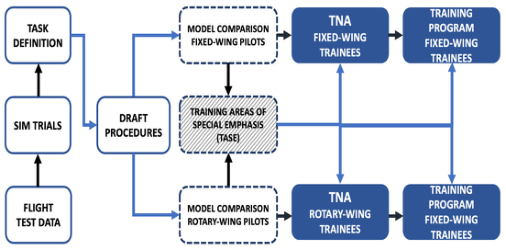
TRAINING DESIGN PATH Preceding the aforementioned simulation of the cognitive task model, the tasks themselves required definition, which was done by bringing flight test data into flight simulation trials. Next, preliminary normal procedures as well as non-normal/emergency procedures were drafted. The resulting dif- ference scores (out of the model simulation & procedure comparison) were the prerequisite for starting the training needs analysis, or TNA, according to ICAO rules for training design and the implementation of a competency based training (ICAO Doc. 9868, 2020).
This TNA forms the foundation for the training design (see Figure 2). From a high level basis (e.g., training phases, schedules) via the definition of train- ing modules, down to very granular levels of training tasks, topics, training and briefing contents, self-assessment quizzes, tests, check rides, instructor notes and pass-fail criteria (Royer, 1986).
Figure 2: High-level training design path.
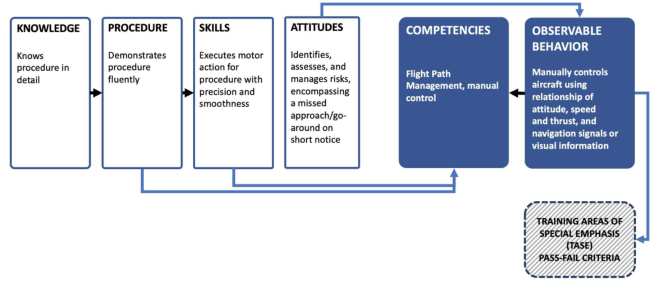
Also shown in figure, so-called training areas of special emphasis, or TASE are defined in the course of the training design. These TASE are an important element of certification criteria as well as for embedding a competency-based training assessment approach, or CBTA. As per definition by ICAO, CBTA fosters a quantitative assessment of qualitative training attributes, catego- rized into knowledge, skills and attitudes, which is why it is often referred to as KSA-competency criteria. These KSA are then referenced with observable behaviour, or OB.
Figure 3 depicts one instance of over 25 attributes out of an example of a missed approach. Please note that, apart from the ICAO-defined KSA, we have added the category “procedure”, as this was deemed beneficial from a cognitive science perspective as well as for the fulfilment of certain modelling requirements.
TRAINING DEVICES Alongside the training contents, a training needs analysis is also used to define the appropriate means of training for each task. This reaches from distant
Flight Training Research Paving the Path for Future eVTOL Pilots 429
learning with regularly instructor-led remote lessons embedded, via class- room lectures, to part-task training, simulator training and finally, training on the aircraft itself.
Figure 3: KPSA on the example of a missed-approach.
Whilst being rather obvious that theoretical topics can be covered by dis- tant learning courseware, practical training was not so easy to distribute between simulation devices and the real aircraft. On known vehicles, such as helicopters and airplanes, enough experience is given to easily define what to train in a simulation device, and what to train on the aircraft. With eVTOLs being so new to the world, and as legacy, full-flight simulators would cost a multitude of the price for an eVTOL, new approaches had to be sought.
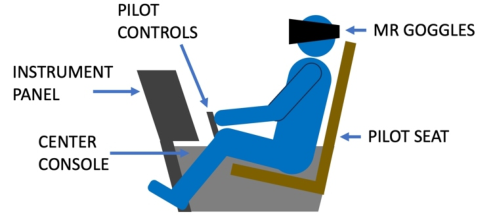
One such new approach came with mixed-reality (MR) becoming com- mercially available at a high precision and resolution. In contrast to VR, MR mixes real-reality with virtual portions of a simulation, making use of the best of both worlds. In our case, this means that a real eVTOL flight com- partment is used as hardware and is embedded into a virtual outside world: the trainee perceives, and interacts with a real hardware human-machine interface, whilst the outside world is fully virtual, allowing for much larger fields-of-view (FoV), than any projection-based legacy full flight simulation platform could ever offer. The trainee experience is so immersive (Schaffernak et al., 2022), that motion could be fully neglected, even for manoeuvre train- ing. However, implementing this new technology into flight training comes with some shortfalls and challenges:
Figure 4 shows a generic side view of the physical simulation setup: with mixed reality, the trainee sees all physical components as shown in “real reality”, either by optical see-through or cameras in the goggles. These com- ponents form the so-called cut-out area, which will not be overlaid by virtual simulation. This also includes objects that remain in this area, such as check- lists, maps, electronic flight bags (EFBs), as well as all visible parts of the own body, e.g., hands, arms and legs. Anything else, the fuselage parts, such as windscreen, structures, doors and especially everything which would be seen outside the aircraft, will be simulated by virtual reality.
430 Rister and Bartling
One major concern hereby is that the trainee will be very much immersed into the simulated environment and is likely to be less responsive to instruc- tions from the outside of this “world”.
Figure 4: Physical components of simulation device – side view.
That said, the interaction between the trainee and the instructor needs to be newly elaborated to ensure that the instructor can not only observe the trainee’s performance from remote, but by being closely next to him or her. With the vehicle being so different to a helicopter or a fixed-wing aircraft, the instructor needs to have the opportunity to demonstrate manoeu- vres, intervene and correct the trainee’s actions whenever required to mitigate any negative learning tendencies. In other words, the instructor needs to be embedded into this simulation set-up.
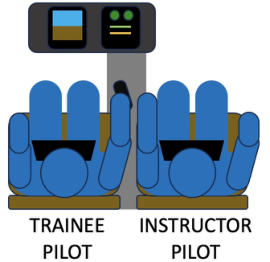
In Figure 5, a generic dual-seater solution is shown which includes the instructor pilot into the whole simulation setup. As such, the instructor, as well as the trainee need to be part of the aforementioned cut-out area, so that one can observe the other for a maximum training benefit. This, of course, adds complexity to the MR solution for a future flight simulator, which is still under development.
Figure 5: Physical components of simulation device in a dual-seater setup – top view.
In the configuration shown in Figure 5, the side view of the trainee is impacted by the instructor, which would reflect a real world scenario with a passenger on the side. Nevertheless, modelling a cut-out around a moving object, such as the pilot in the other seat, remains a challenge of its own.
Flight Training Research Paving the Path for Future eVTOL Pilots 431
CONCLUSION
The new world of eVTOL flight will develop quickly and will take paths previously unknown. Every single device being built in the future may have traits that have never been combined in an aircraft before.
Vertical takeoff and landing possibly combined with transitions to fixed wing-like cruise flight. Drone-like applications, paired with helicopter and fixed-wing aircraft in any perceivable combination, are being defined by use- case. It will be essential for any future training on such devices to establish a sound and safe gap analysis and derive the training needs and TASE. At the same time instructors and examiners must be highly adaptable as knowledge and skills between two helicopters or fixed wing aircraft may translate easily but will not necessarily between two kinds of eVTOL. Training for an eVTOL license might even focus more on fundamentals of “airmanship” and knowl- edge of the risks in several operating environments in order to have a solid aviatory foundation. Motor Skills and Interpretation of flight instruments could be trained on a general level.
Thereafter any of these competencies have to be translated into the specific requirements for the aircraft intended to be operated. All aviation knowledge from fixed wing to rotary wing to drone flying has to be melted into a new training approach for eVTOLs. New flexible and easily configurable training devices shall underscore these new training requirements.
ACKNOWLEDGMENT
The authors would like to acknowledge the support of the European Avia- tion Safety Agency – EASA and the contribution of Humatects GmbH who supported by making available our jointly developed modelling software and methodology.
REFERENCES
CAE (2021). Pilot Training for Advanced Air Mobility. CAE 2021 report, CAE website: https://www. CAE.com ICAO (2020). Doc 9868: Procedures for Air Navigation Services – Training, (3rd
Ed.). Montreal, Quebec: ICAO. Osterloh, J.-P., Bellet, T., Borchers, S., Botta, M., Donatelli, S., Eilers, M., Feuerstack, S., Larsen, M., Magnaudet, M., Martin, D., Presta, R., & Weber, L. (2015). D2.4 - Modelling Techniques and Tools V1.0. Technical Report by HoliDes Consortium, https://www.holides.eu Posner, M. I., & Keele, S. W. (1968). On the genesis of abstract ideas. Journal of
Experimental Psychology, 77(3), 353–363. Rister, F., Osterloh, J.-P., Luedtke, A. (2016). Predicting Pilots’ Training Progress, Workload and Cognition by the Implementation of Learning Algo- rithms into Experience-based Flight Training. Association of Aviation Psychology. Lisbon/Berlin: Hogrefe. Rister, F., Osterloh, J.-P., Luedtke, A. (2014). Adaptive Flight Simulation Programs – Three Years of Research and How the Results Fuel a New Generation of Training Design. In: Kolrep, H. (Ed.). Aviation Psychology - Facilitating change (s). European Association of Aviation Psychology. Berlin: Hogrefe.
432 Rister and Bartling
Royer, J. M. (1986). Designing instruction to produce under-standing: An approach based on cognitive theory. In G. D. Phye & T. Andre (Eds.), Cognitive classroom learning: Understanding, thinking, and problem solving (pp. 83–113). Orlando: Academic Press. Salomon, G., & Perkins, D. N. (1989). Rocky roads to transfer: Rethinking
mechanisms of a neglected phenomenon. Educational Psychologist, 24, 113–142. Schaffernak, H., Moesl, B., Vorraber, W., Holy, M., Herzog, E., Novak, R., & Koglbauer, I. (2004). Novel Mixed Reality Use Cases for Pilot Training. In: Education Sciences, Vol. 12(5). Basle, Switzerland: MDPI. Schunk, D. (2004). Learning theories: An educational perspective (6th ed.). Upper
Saddle River, NJ, USA: Pearson, p. 220, ISBN 0-13-707195-7.
LISTED IN THE AHFE DIGITAL BOOKSTORE CATALOGUE
Explore the complete digital volume
Application of Emerging Technologies
Read this individual research paper free through the original publisher, or explore the full digital proceedings book.
ISBN 978-1-958651-91-9
Explore this ISBN in the AHFE Bookstore ↗Listed in the July 2026 bookstore catalogue; search by ISBN to confirm current availability · Digital book purchase optional