Arvin Shadravan, Hamid Parsaei (2023). The Paradigm Shift from Industry 4.0 Implementation to Industry 5.0 Readiness. In: Application of Emerging Technologies. AHFE Open Access, vol. 115, pp. 1–10. https://doi.org/10.54941/ahfe1004296
"Industry 4.0," initially a German initiative focused on technological advancements within the industrial sector, has garnered global recognition. Other nations have also initiated similar strategic endeavours, leading to extensive research dedicated to the development and implementation of Industry 4.0 technologies. More recently, the European Commission introduced "Industry 5.0," a decade following the inception of Industry 4.0. While Industry 4.0 is commonly perceived as technology-driven, Industry 5.0 is heralded as value-driven. The coexistence of these two industrial revolutions has spurred significant debates and necessitates thorough explanations. The business sector plays a pivotal role in fostering economic growth. However, the integration of new technology and the growing complexity of products and production processes have direct repercussions on industrial companies and their workforce. Critics of the Industry 4.0 paradigm underscore its technocratic focus on digitalization and novel technologies. Consequently, when Industry 5.0 emerged, discussions regarding its function and rationale gained rapid prominence. Industry 5.0 complements Industry 4.0, emphasizing the pivotal role of workers in the industrial process. Industry 4.0 has facilitated remarkable technological advancements, including additive manufacturing, artificial intelligence, augmented reality, cyber-physical systems, blockchain, and cybersecurity. These technologies address issues like demand fluctuations and market instability by minimizing human involvement in decision-making through the integration of computers, materials, and AI. Nonetheless, Industry 4.0 must surmount challenges in data security, supply chain management, human resource administration, and technological integration. In contrast, Industry 5.0 tackles these challenges with innovations such as predictive maintenance, hyper-customization, cyber-physical cognitive systems, and collaborative robots, placing a strong emphasis on human-centricity. The introduction of Industry 5.0 heralds an anticipated paradigm shift, prioritizing holistic, sustainable, and human-centered value generation. However, the escalating complexity of digitalization poses considerable difficulties, particularly for small and medium-sized businesses (SMEs) with limited resources for effective digitalization initiatives. This study delves into the literature surrounding improvements for both Industry 4.0 and Industry 5.0, addressing issues such as data privacy and technical integration problems. In Industry 5.0, resilience emerges as a crucial factor in enabling hyper-individualization and customized product offerings. Additionally, this study provides a concise exploration of the primary drivers and facilitators of the adoption of these new paradigms. It subsequently conducts a literature-based analysis, examining how these two paradigms differ from three essential perspectives: people, technology, and organizations. Moreover, it offers a comprehensive framework to assist researchers and businesses in comprehending the technologies, challenges, and solutions associated with Industry 4.0.
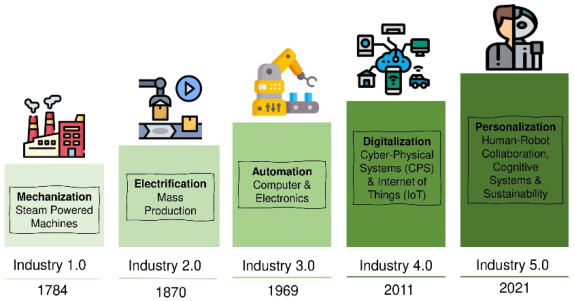
Production prior to the Industrial Revolution was based on traditional tech- niques, which were less effective for high-volume production. The First Industrial Revolution was characterized by the development of steam power and mechanical methods, greatly increasing productivity. Breakthroughs in electrical, mechanical, and electronic devices marked the Second Industrial Revolution, with Frederick Taylor’s publication on scientific management being a turning point during this period. The start of the Third Industrial Rev- olution, or Industry 3.0, was marked by the advent of computer numerical control (CNC), which increased production volume and introduced partial automation. Industry 4.0 emerged as a result of the resources and optimiza- tion needed for Industry 3.0’s development. It involves automating processes by integrating information and communication technology with production systems. Real-time data analysis enhances strategic decision-making, and technologies such as artificial intelligence, blockchain, cybersecurity, additive manufacturing, and augmented reality are all part of Industry 4.0 (Shadravan et al., 2022). This revolution addresses issues like unstable markets and fluc- tuating demand by minimizing human involvement in decision-making pro- cesses and linking computers, materials, and AI (Shadravan et al., 2023). The desire to transform traditional machinery into self-learning machines capable of improving maintenance, efficiency, and management through interactions with the environment served as the impetus for the Industrial Revolution. The idea of the Internet of Things (IoT) allowed for the cyber-physical link- ing of systems through the development of standardized protocols. During the COVID-19 epidemic, Industry 4.0 provided digital solutions to press- ing problems and bridged the gap between the digital and physical realms. Building upon Industry 4.0, Industry 5.0 integrates artificial intelligence (AI) with human intellect to enhance the accuracy and efficiency of machines in industrial production (Shadravan et al., 2023). By supporting human-centric strategies and addressing social requirements, Industry 5.0 aims to overcome the challenges posed by Industry 4.0. This next stage of the industrial revo- lution focuses on cutting-edge technologies, including collaborative robotics (Cobots), smart homes, and the data interoperability of network sensors, all contributing to increased productivity and accuracy (Lu et al., 2022). Indus- try 5.0 aspires to provide workers with more fulfilling occupations and bridge the gap between manufacturing and society’s demands by placing humans at the core of industrial production and manufacturing. See Figure 1 for the visual representation of the stages of the industrial revolution.
LITERATURE REVIEW
Industry 4.0, often referred to as the Fourth Industrial Revolution, origi- nated as a project under the German government’s high-tech policy in 2011. Key projects introduced during this period were the Smart Factory and the concept of Cyber-Physical Production Systems (CPPS). It was in 2011 that the term “Industry 4.0” was publicly introduced, drawing inspiration from the concepts of the initial three Industrial Revolutions. The First Indus- trial Revolution marked the transition from manually operated to water or
The Paradigm Shift From Industry 4.0 Implementation to Industry 5.0 Readiness 3
steam-powered machines. The Second Industrial Revolution introduced elec- tricity and modern assembly lines. The Third Industrial Revolution brought about developments in field-level communication and computer technology for automation.
Figure 1: Stages of Industrial Revolution – Industry 1.0 to 5.0.
Interactions between humans and machines have become increasingly important to advance research and innovation (Xu et al., 2021). Both in sci- entific circles and business discussions, there is a growing interest in how Industry 4.0 and Industry 5.0 relate to each other and how they are pro- gressing. This study aims to investigate the coexistence of Industry 4.0 and Industry 5.0 and provide insights into these interconnected issues. While the study does not delve into a comprehensive analysis of these industrial revolutions, its primary goal is to spark further conversation and under- standing. In the era of Industry 4.0, Cyber-Physical Production Systems (CPPS) play a pivotal role in facilitating the flexible manufacture of cus- tomized goods with high efficiency. By enabling intelligent decision-making through real-time communication and collaboration, CPPS enhances pro- duction processes. Professional associations have come together to create the collaborative Industry 4.0 Platform, which aims to coordinate activities and foster a cross-sectoral approach. The idea of the Fifth Industrial Revolu- tion, or Industry 5.0, emerged as Industry 4.0 gained momentum (Coronado et al., 2022). Industry 5.0 places a strong emphasis on social justice, sustain- ability, and the welfare of workers. While recognizing businesses’ ability to advance societal objectives, it seeks to foster the industry’s long-term con- tribution to humanity within planetary limitations. Harmonizing technology with human-centric values is a key aspiration of Industry 5.0, promoting a balanced and sustainable future for industrial development.
Industry 4.0 Concept By utilizing embedded networked systems for intelligent control, Cyber- Physical Systems (CPS), also known as Industry 4.0, intelligently connect industry-related machines and processes. One widely accepted framework
4 Shadravan and Parsaei
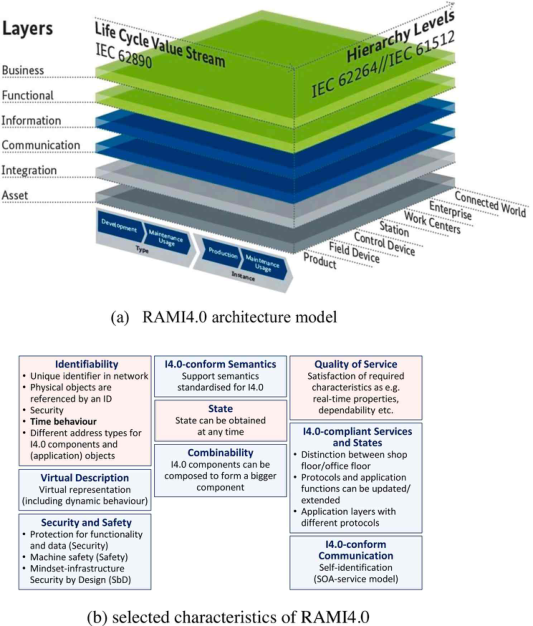
supporting Industry 4.0 activities is the Reference Architecture Model Indus- try 4.0 (RAMI4.0). Developed by the German Electrical and Electronic Manufacturers’ Association (ZVEI), RAMI4.0 is a three-dimensional coor- dinate system that illustrates the structure of Industry 4.0 systems. The “Life Cycle Value Stream” axis represents the life cycle of facilities and products, encompassing aspects such as business models and the benefits of implement- ing Industry 4.0. The “Hierarchy Levels” axis governs the functionalities within manufacturing facilities. Meanwhile, the “Layers” axis describes the breakdown of a machine into its properties (see Figure 2). Key design prin- ciples of Industry 4.0 include intelligent and self-organizing Cyber-Physical Production Systems (CPPS), service-oriented reference architecture interop- erability within CPPS and people, adaptability to changing requirements, optimization for Overall Equipment Effectiveness (OEE), data integration across disciplines and the entire life cycle, dependable and secure communi- cations between businesses, and data security. These guidelines are aimed at ensuring the reliable, secure, and effective execution of Industry 4.0 elements (Vogel et al., 2016).
Figure 2: Reference architecture model industry 4.0 (RAMI4.0) (Xu et al., 2021).
The Paradigm Shift From Industry 4.0 Implementation to Industry 5.0 Readiness 5
Industry 5.0 Concept Since 2017, there have been academic initiatives to introduce the idea of Industry 5.0, also known as the Fifth Industrial Revolution. Responding to conversations among research organizations, technological groups, and funding agencies across Europe, the European Commission formally called for Industry 5.0 in 2021. In January 2021, a report titled “Industry 5.0: Towards a Sustainable, Human-centric, and Resilient European Industry” was published, formalizing this appeal. Industry 5.0 aims to ensure that man- ufacturing respects the limits of the earth and prioritizes workers’ well-being, acknowledging that industry can achieve societal goals beyond employment and growth. It complements the current Industry 4.0 paradigm by focus- ing on research, innovation, sustainability, and human-centric approaches in European industry. The European Commission’s agreement that social and environmental concerns should be incorporated into technology innovation has accelerated the development of Industry 5.0. By adopting this strategy, innovation obstacles can be addressed, and technical progress can align with future societal values. As industry becomes more aware of the need for a systematic approach to innovation, it is reassessing its place in society and its role. Political goals in Europe, including the Green Deal and the knowl- edge gained from the Covid-19 crisis, further emphasize the importance of promoting sustainability, moving towards a circular economy, and creating industries that are resilient, future-proof, and human-centered (Xu et al., 2021).
Challenges of Industry 4.0 Organizations must address several major issues posed by Industry 4.0, including:
Technical integration: To prevent the creation of low-quality products, it is essential to incorporate technologies capable of effectively manag- ing digitalization. Implementing standard protocols for efficient machine communication and gaining additional input while adopting new IT technologies are crucial steps.
Security of data and information: The deployment of the Internet of Things (IoT) can expose businesses to industrial espionage and illegal access. Sectors such as healthcare and freight, which deal with patient data and sensitive information, are particularly concerned about data privacy.
Human resource concerns: Thriving in the Industry 4.0 setting requires employees to have the right training, making good management practices essential. Establishing sound policies can boost adaptability and foster innovation in the workforce.
Supply chain difficulties: Digitalization and automation have increased the accuracy of market forecasting and product traceability within sup- ply chains. However, data privacy and integration management remain significant obstacles in supply chain management.
Rising system complexity: As technology advances and systems become more intricate, ensuring product safety and quality becomes increasingly urgent (Kiel et al., 2017) (Ghadge et al., 2020).
6 Shadravan and Parsaei
Industry 5.0 as a Solution to Industry 4.0’s Drawbacks Industry 5.0 introduces novel tactics and technologies to address the chal- lenges raised by Industry 4.0. Here are the important issues and solutions found in Industry 5.0:
1. Supply chain: Supply Chain 4.0 emphasizes mass customization, trans- parency, adaptability, waste reduction, and responsiveness. In contrast, Supply Chain 5.0 not only retains these advantages but also seeks to achieve a balance between people and technology. Industry 5.0 pro- motes sustainability in supply chain management and incorporates cutting-edge technologies like AI and Cobots (Frederico 2021). 2. Data security: Industry 5.0 addresses data security concerns by utilizing decentralized Industrial Internet of Things (IIoT) and blockchain mid- dleware. Integrating data from diverse sources and services enhances failure mitigation and troubleshooting in smart manufacturing. The use of blockchain-based smart contracts promotes autonomy and sus- tainability in Industry 5.0 systems, reducing the need for third-party registrations and documentation (Leng et al., 2019). 3. Technical integration: Industry 5.0 emphasizes human-centricity and the fusion of human creativity with precise machine capabilities to boost performance and production. Collaborative robots, or Cobots, play a vital role in enhancing product quality by handling repetitive chores and freeing up human workers to focus on value-adding tasks (Maddikunta et al., 2022).
METHODOLOGY
Due to the significant impact of digital technologies on society and vari- ous industries, businesses worldwide are facing the need to adapt through transdisciplinary digital transformations to remain competitive. This trans- formation goes beyond mere digitalization and involves restructuring entire organizational structures, business models, and processes. The German gov- ernment’s launch of the Industry 4.0 project in 2011 emphasized the impor- tance of cyber-physical systems, particularly in the manufacturing industry. The COVID-19 pandemic highlighted the resilience of early adopters of technology, as businesses with high degrees of digitization and effective digi- talization strategies were better equipped to navigate the challenges posed by the crisis.
Assessing the organization’s current level of digital maturity is the initial step in developing a successful digitalization strategy. This evaluation helps identify the digital strengths of organizational processes and areas for poten- tial improvement. The findings from this assessment can be used to tailor the digitalization plan to suit the firm’s needs and uncover untapped potential throughout the transformation process.
Small and medium-sized businesses (SMEs), comprising 99.4% of all com- panies in Germany in 2019, play a crucial role in the economy. Digitization allows SMEs to compete with larger companies on price and product quality by providing increased knowledge access, effective communication, extensive
The Paradigm Shift From Industry 4.0 Implementation to Industry 5.0 Readiness 7
product development, the emergence of new business sectors, and reduced bureaucracy. However, the digital transformation process poses unique chal- lenges for SMEs, such as new dependencies and significant risks, particularly related to information security and data protection.
The increased focus on digitization is driven by developments like EU AI laws, issues such as broken supply chains and a shortage of skilled work- ers, as well as concerns about climate change and its implications. These developments pave the way for Industry 5.0, the next phase of Industry 4.0, which is described by the European Commission as being “more future-proof, resilient, sustainable, and people-centric.”
Industry 5.0 represents a paradigm shift that places a stronger emphasis on a human-centered approach to digital transformation. While Industry 4.0 emphasizes adaptability and positive impacts on the environment and econ- omy, it often overlooks the social aspect. In contrast, Industry 5.0 repositions the focus on human-centric strategies, considering factors such as com- petencies, motivation, and well-being as essential for a sustainable digital transformation. This approach also acknowledges the significance of workers in the production process.
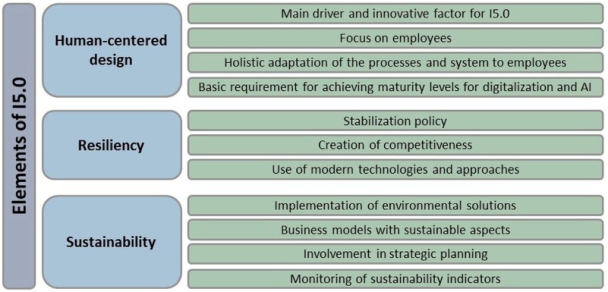
To successfully implement and sustain Industry 5.0 in SMEs, a human- centered strategy must address people’s needs and preferences, manage security threats, uphold ethical standards, ensure physical integrity, and pro- tect data privacy. The three pillars of Industry 5.0 - human-centered design, resiliency, and sustainability - must be considered when determining the readiness requirements for digitalization and AI adoption.
This paper addresses two research questions: 1) Are the Industry 4.0 matu- rity models appropriate for evaluating Industry 5.0’s digital transformation process, specifically for SMEs? 2) Can current Industry 4.0 maturity mod- els be modified to accommodate Industry 5.0’s more stringent requirements? To investigate these questions, a systematic literature review was conducted to examine the present state of research on determining the level of human- centered AI and digitalization adoption in SMEs. The review provides an overview of the essential criteria considered in evaluating Industry 4.0 readi- ness, guiding the discussion on implementing Industry 5.0 successfully and sustainably in SMEs.
Maturity models (MMs) are used to track and monitor an organization’s progression towards a desired state through a multi-stage, sequential process. These models outline the projected development path and demonstrate how capabilities change over time. MMs can be quantitatively or qualitatively assessed, and they serve as a reliable technique for assessing an organiza- tion’s digitization process, creating improvement plans, and benchmarking internal and external skills. There are three application-specific functions of MMs: comparative, prescriptive, and descriptive models. Comparative models allow for internal and external comparisons, descriptive models iden- tify the organization’s status, and prescriptive models offer suggestions and development directions. Suggestions, and development directions.
MMs can be applied through predefined steps, such as filling out ques- tionnaires (Angreani et al., 2020). By evaluating the current situation and identifying areas for improvement, organizations can bridge the gap between
8 Shadravan and Parsaei
their current state and the desired state. As MMs are tailored to specific use cases, industries, and businesses, they serve as valuable tools for firms undergoing digital transformation (Hein et al., 2023).
Figure 3: Elements of Industry 5.0 (Hein et al., 2023).
DISCUSSION
This study investigates the applicability of current maturity models (MMs) for digital transformation in small and medium-sized businesses (SMEs) within the framework of Industry 5.0. It reveals that existing MMs are not fully suited for Industry 5.0’s digital transformation process due to their lack of human-centered approaches. While some MMs discuss personnel and their benefits to some extent, there is a need to expand MMs in areas like flexibility, sustainability, people-centeredness, resilience, and resource efficiency.
The authors argue that Industry 5.0 represents a distinct kind of Indus- trial Revolution from its predecessors as it integrates technology with societal requirements. The study raises questions about Industry 4.0’s strong tech- nological orientation while overlooking human-centricity, sustainability, and resilience. In contrast, Industry 5.0 adopts a methodical approach to address these issues and places the welfare of industry workers at the center of the production process. It also examines the compatibility between Industry 4.0’s enabling technologies and the objectives of Industry 5.0, suggesting that while many technologies can align with Industry 5.0’s societal goals, some may require special consideration.
Industry 5.0 is viewed as a complementing extension of Industry 4.0’s ele- ments rather than a mere continuation. The study introduces the concept of a “techno-social revolution,” where technology serves as a tool to fulfil social needs, which become the ultimate goal. To embrace the key princi- ples of Industry 5.0, including resilience, human-centricity, and sustainability, adjustments may be needed in Industry 4.0’s trajectory.
In addressing the problems of Industry 4.0, such as technical integration, data security, human resource issues, and supply chain problems, Industry 5.0 employs cutting-edge technologies and a human-centric strategy. Collabora- tive robots, or Cobots, play a crucial role in combining human ingenuity with mechanical precision.
The Paradigm Shift From Industry 4.0 Implementation to Industry 5.0 Readiness 9
This study offers valuable insights into the difficulties, constraints, and potential solutions related to Industry 5.0’s implementation, making it a useful resource for businesses and scholars alike.
CONCLUSION
In the context of Industry 5.0, this paper has examined current maturity models and proposed recommendations for their expansion to incorporate a more comprehensive and human-centered approach to digital transfor- mation in small and medium-sized firms (SMEs). It highlights the lack of a human-centered orientation in existing MMs and emphasizes the impor- tance of considering organizational ethics, participation, and human needs throughout the transformation process.
The study suggests collaborating with business partners and conducting stakeholder interviews to enhance the models and identify their practical applications. It draws a distinction between Industry 4.0, driven by tech- nology, and Industry 5.0, driven by values, emphasizing that both are vital for achieving social goals and overcoming technical challenges. The paper cautions against the excessive use of buzzwords and stresses the need for thoughtful discussions and clear future visions for the industry.
Recognizing the scarcity of research on Industry 5.0, the study acknowl- edges the challenge of fully comprehending all technical advancements and their implications. However, it highlights the potential for more research in areas such as data security and integration for Industry 5.0 technologies.
Sustainability is given significant importance, along with the opportunity for increased production and efficiency through automation and data analy- sis. Companies are urged to have distinct visions, objectives, and attitudes to successfully transition and innovate. Notably, the significant automa- tion advancements brought about by Industry 5.0 allow human workers to produce uniquely tailored items.
The focus should be on developing skills, defining human-machine rules, and understanding how artificial intelligence impacts people. Future research can concentrate on establishing intelligent control systems, enhanc- ing automation, addressing data security challenges, and improving human- machine interaction.
REFERENCES
Accenture. The art of AI maturity: Advancing from practice to performance.
2022, URL: https://www.accenture.com/_acnmedia/Thought-Leadership-Assets/ PDF-5/Accenture-Art-of-AI-Maturity-Report.pdf. Coronado, E., Kiyokawa, T., Ricardez, G. A. G., Ramirez-Alpizar, I. G., Venture, G. and Yamanobe, N., 2022. Evaluating quality in human-robot interaction: A systematic search and classification of performance and human-centered fac- tors, measures and metrics towards an industry 5.0. Journal of Manufacturing Systems, 63, pp. 392–410. Frederico, G. F., 2021. From supply chain 4.0 to supply chain 5.0: Findings from a
systematic literature review and research directions. Logistics, 5(3), p. 49.
10 Shadravan and Parsaei
Ghadge, A., Er Kara, M., Moradlou, H. and Goswami, M., 2020. The impact of Industry 4.0 implementation on supply chains. Journal of Manufacturing Technology Management, 31(4), pp. 669–686. Hein-Pensel, F., Winkler, H., Brückner, A., Wölke, M., Jabs, I., Mayan, I. J., Kirschen-
baum, A., Friedrich, J. and Zinke-Wehlmann, C., 2023. Maturity assessment for Industry 5.0: A review of existing maturity models. Journal of Manufacturing Systems, 66, pp. 200–210. Kiel, D., Müller, J. M., Arnold, C. and Voigt, K. I., 2017. Sustainable industrial value creation: Benefits and challenges of industry 4.0. International journal of innovation management, 21(08), p.1740015. Leng, J., Jiang, P., Xu, K., Liu, Q., Zhao, J. L., Bian, Y. and Shi, R., 2019. Maker-
chain: A blockchain with chemical signature for self-organizing process in social manufacturing. Journal of Cleaner Production, 234, pp. 767–778. Lu, Y., Zheng, H., Chand, S., Xia, W., Liu, Z., Xu, X., Wang, L., Qin, Z. and Bao, J.,
2022. Outlook on human-centric manufacturing towards Industry 5.0. Journal of Manufacturing Systems, 62, pp. 612–627. Maddikunta, P. K. R., Pham, Q. V., Prabadevi, B., Deepa, N., Dev, K., Gadekallu, T. R., Ruby, R. and Liyanage, M., 2022. Industry 5.0: A survey on enabling technologies and potential applications. Journal of Industrial Information Inte- gration, 26, p. 100257. Nolan, R. L., 1973. Managing the computer resource: a stage hypothesis. Commu-
nications of the ACM, 16(7), pp. 399–405. Shadravan, A. and Parsaei, H. R. (2022). Enabling digital warehousing by an additive manufacturing ecosystem. In Proceedings of the 7th North American Interna- tional Conference on Industrial Engineering and Operations Management (IEOM Society). Shadravan, A. and Parsaei, H. R. (2023). Impacts of industry 4.0 on smart man-
ufacturing. In Proceedings of the 13th International Conference on Industrial Engineering and Operations Management (IEOM Society) (pp. 7–9). Shadravan, A. and Parsaei, H. R., Applications of Industry 4.0 in Supply Chain Management: A Systematic Literature Review. In Proceedings of the 8th North American International Conference on Industrial Engineering and Operations Management (IEOM Society). Staufen AG. Study: Digitalization 2020. 2020, URL: https://www.staufen.ag/wp-
content/uploads/Study-Digitalisation-2020.pdf. Vogel-Heuser, B. and Hess, D., 2016. Guest editorial Industry 4.0–prerequisites and visions. IEEE Transactions on automation Science and Engineering, 13(2), pp. 411–413. Xu, X., Lu, Y., Vogel-Heuser, B. and Wang, L., 2021. Industry 4.0 and Industry 5.0—
Inception, conception and perception. Journal of Manufacturing Systems, 61, pp. 530–535.
LISTED IN THE AHFE DIGITAL BOOKSTORE CATALOGUE
Explore the complete digital volume
Application of Emerging Technologies
Read this individual research paper free through the original publisher, or explore the full digital proceedings book.
ISBN 978-1-958651-91-9
Explore this ISBN in the AHFE Bookstore ↗Listed in the July 2026 bookstore catalogue; search by ISBN to confirm current availability · Digital book purchase optional