Arun Ulahannan, Charlotte Collins, Michael Lombardo, Christina Kang, Stewart Birrell (2025). Towards the Future of Air Travel: Public Perceptions on eVTOL Aircraft and Service Design. In: Human Systems Engineering and Design (IHSED2025): Future Trends and Applications. AHFE Open Access, vol. 198, pp. 149–158. https://doi.org/10.54941/ahfe1006771
Commercial interest in Electric Vertical Take-off and Landing (eVTOL) aircraft is accelerating, yet user perspectives on aircraft design and service models remain underexplored. Early integration of these insights is critical to ensuring successful implementation and public acceptance of this emerging transport mode. An interview study was conducted with 33 participants who attended the Farnborough International Airshow 2022, UK. Uniquely, participants had physical access to a production-size model of Supernal LLC’s SA-1 eVTOL aircraft during the interviews. Given the novelty of eVTOLs, this was of significant methodological benefit to the study. Thematic coding and analysis of the interviews using two independent researchers was conducted, resulting in two distinct thematic groupings of participants: 1) eVTOLs as a service, and 2) eVTOLs on demand. Importantly, across the two groups, there were significant differences in the perceptions towards the physical design of the eVTOL and its purpose, impacting scheduling, seat capacity, set layout, and pilot interactions. These significant findings around the design of the aircraft and service should be used in conjunction with the growing body of literature on eVTOL implementation to ensure the successful implementation of future eVTOLs and wider shared mobility services.
Rising vehicle ownership and urbanisation have intensified two major transport challenges: traffic congestion and environmental degradation. In the UK alone, congestion is estimated to cost over £300 billion between 2013 and 2030 (INRIX, 2014), while transport emissions remain a major barrier to achieving net-zero targets under the Paris Climate Agreement (Logan, Nelson, and Hastings, 2020). Shifting to greener transport modes is therefore essential. Public transport offers clear benefits, with significantly lower emissions per kilometre compared to private vehicles—buses produce 103g/km, rail 36g/km, and light rail 29g/km versus 168g/km from private cars (GOV.UK, 2020). Nonetheless, growing road traffic continues to overwhelm infrastructure, with up to 40% of congestion caused by recurrent patterns such as peak commuting times (Cambridge Systematics, 2005). The
environmental and economic impacts of congestion, including 3.1 billion gallons of excess fuel use in the US annually (Barth and Boriboonsomsin, 2009), underscore the urgency of identifying alternative, efficient modes of mobility.
One such alternative is Urban Air Mobility (UAM), enabled by electric Vertical Take-off and Landing (eVTOL) aircraft. These vehicles promise to alleviate surface congestion and reduce emissions through electric propulsion (Shihab et al., 2020). The growing investment from firms such as Lilium, Airbus, and Bell signals strong industry momentum (Hornyak, 2020). However, successful implementation requires more than technical feasibility or well-designed vertiport infrastructure (Birrell et al., 2022). It demands public acceptance, clear service models, and well-designed aircraft that meet user expectations (Vascik and Hansman, 2018).
To date, research on public perceptions of eVTOLs has largely centred on projected demand and demographic profiling, often suggesting that initial users may be high-income individuals using the service for commuting or airport transfers (Binder et al., 2018, Babetto et al., 2023). Factors such as travel time and fare cost have been identified as key determinants of mode choice (Boddupalli, 2019), yet studies have rarely examined the aircraft design or service configuration preferences that shape user acceptance. Moreover, insights from helicopter services like BLADE or Uber Copter offer limited guidance due to the significant design differences between helicopters and eVTOLs (Garrow, German, and Leonard, 2021).
This lack of research presents a critical gap. Without understanding how passengers perceive and prioritise design features—such as seating, cleanliness, noise, safety protocols, and comfort—there is a risk that eVTOL services will fail to align with public needs or expectations. Comfort and safety are well-established drivers of passenger satisfaction in aviation (Richards, Jacobson, and Kuhlthau, 1978; Anitsal, Anitsal, and Anitsal, 2017), and factors such as perceived cleanliness, the presence of a pilot, and even onboard safety instructions have a measurable impact on willingness to fly (Rice and Winter, 2015).
Therefore, this study aims to address this gap by investigating public perceptions of eVTOLs, focusing on two key areas: the design of the aircraft itself and the characteristics of the service model. By identifying user motivations and segmenting potential future passengers, this research will contribute to a more holistic understanding of how to design and implement eVTOL services that are not only technologically feasible but also socially and behaviourally acceptable.
METHOD
To explore public perceptions of eVTOL aircraft, an in-depth interview study was conducted at the 2022 Farnborough International Airshow (FIA), one of the world’s largest aviation trade events. Researchers were granted access to the Supernal LLC exhibit, where interviews were conducted independently using a collaboratively developed questionnaire (Coventry University and Supernal LLC).
Towards the Future of Air Travel: Public Perceptions on eVTOL Aircraft and Service Design 151
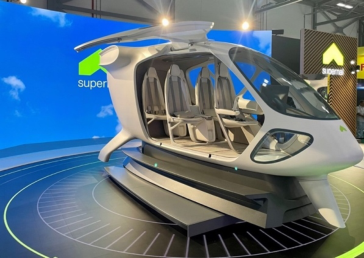
Participants engaged with a full-scale model of Supernal’s SA1 eVTOL, featuring a two-by-two passenger layout and a front pilot seat. This direct interaction with a 1:1 model was a significant methodological advantage, as few participants would have previously encountered a life-sized eVTOL—an important factor in eliciting informed preferences (Riza et al., 2024).
Participants were recruited through street-intercept sampling at the booth. Given the diverse FIA attendee base, this approach enabled the collection of a broad and balanced sample.
Figure 1: Supernal LLC’s SA-1 aircraft.
The interview schedule was adjusted to ensure questions concerning urban air mobility in general were conducted outside of the model, and questions regarding the physical design characteristics of eVTOLs and the consequent user requirements were asked inside, or within proximity to, the model aircraft. Thirty-three participants were interviewed as part of the study. Before the interview, written consent was obtained, and all interviews were audio recorded. Importantly, to prevent bias in participant response, participants were not briefed on the possible capabilities of the Supernal LLC aircraft or the likely journey types it would complete. The responses gained from interviews were solely based on their prior knowledge of eVTOL and UAM, as well as their visual perceptions of the eVTOL on display and those they had already seen during their visit to the air show. A breakdown of the participants can be seen below in Table 1.
Table 1: Continued Category Variable Frequency Percentage (%)
Table available in the original PDF paper.
Highest Qualification GCSE 4 12.1 A-Level 4 12.1 University Qualification 25 75.8* Sector Industry 9 27.3 Academia 10 30.3* Public Sector 4 12.1 Other 10 30.3* *Indicate the highest %/frequency variable for the category.
A semi-structured topic guide was developed to guide interviews while allowing flexibility to explore emergent themes. Initial questions focused on participants’ general perceptions of eVTOL aircraft, followed by prompts related to the physical layout and design after engaging with the scale model. The airshow setting offered participants broader exposure to other eVTOL models, enriching their responses.
The analysis was grounded in thematic analysis (Braun and Clarke, 2006), a well-established method widely applied in transport research (Alyavina, Nikitas, and Tchouamou Njoya, 2020; Ulahannan et al., 2020). The two researchers developed a collaborative coding strategy. All interviews were audio recorded, transcribed, and cross-checked for accuracy before being imported into NVivo. Both researchers familiarised themselves with the dataset and independently applied a consistent coding framework—including structural, descriptive, process, and in-vivo coding (Saldaña, 2013).
Table 2: Coding strategy for transcript analysis.
Table available in the original PDF paper.
Coding Type Description Structural Given the detailed guidance provided by the topic guide, this was used as the starting point to organise the interview responses (Namey et al., 2008) Descriptive This summarised responses according to words or phrases and was used to capture the high-level response to a question Process Process coding relied on the interviewers’ observation of the participant and capturing any gestures or movements that indicated their response, but where they did not verbalise (Corbin and Strauss, 2014) In-vivo This captured the exact phrase used by the participant
Following the first coding cycle, the two independent researchers compared results to minimise individual bias. Discrepancies were reconciled through discussion, with any missing codes added. A second cycle of independent coding was then conducted, after which the researchers collaboratively identified sub-themes and grouped them into broader thematic categories. Matrix analysis was used to explore thematic variation across participant demographics. A final collaborative review with the academic team and Supernal LLC was undertaken to identify participant
Towards the Future of Air Travel: Public Perceptions on eVTOL Aircraft and Service Design 153
groupings within the data, forming the basis for developing future eVTOL user personas.
RESULTS & DISCUSSION This study aimed to explore user perceptions of both the physical design and operational model of eVTOLs, as well as gain insight into prospective user types. Using NVivo’s matrix query tool and thematic analysis (Braun and Clarke, 2006), latent themes were independently identified by two qualitative researchers and then collaboratively analysed. Two distinct user perspectives emerged—those viewing eVTOLs as public transport and those seeing them as a private service. These underlying use-cases shaped preferences across several thematic areas, as summarised in Table 3.
Table 3: Emergent wider themes of interviewed participants.
Table available in the original PDF paper.
Group eVTOL as a Service eVTOL on-Demand Baggage expected, more importance suggested Baggage expectations Baggage is expected, though not as high importance
Flight Scheduling Scheduled/timetabled On-demand, called when needed Seating capacity More seating capacity (with more compact seats)
Current seating (4 seats) is adequate Seating layout Forward-facing seating Option to rotate chairs inward (fellow passengers are more likely to be known) Pilot interactions No pilot interaction, closed-off access
Pilot interaction and open access
These divergent views align with findings by Straubinger et al. (2020), who identified differences in expectations around deployment timelines, cost, flight schedules, and integration with existing systems. In this study, however, the identified mediating factors were more practically focused—baggage expectations, flight scheduling, passenger demographics, seating capacity and layout, and interactions with the pilot. These factors, directly linked to user perceptions, offer critical insights into how eVTOL aircraft should be designed to cater to segmented user groups. The thematic groupings developed from participant interviews relate to tactical and strategic design decisions as defined by Rajendran and Srinivas (2020) and are now discussed.
Baggage was the most frequently coded topic and emerged as a key concern for participants, with many expecting the ability to store bags akin to commercial aircraft: “I’m guessing that [the bag] would go under the seats” (P2). However, these expectations are not aligned with the technical limitations of current eVTOL aircraft, which face strict payload constraints (Goyal et al., 2021). The perception of baggage needs was strongly mediated by whether the participant imagined eVTOLs as public transport or a private service. Public transport-oriented participants considered baggage as
expected but less critical, while those expecting a private service stressed the importance of accommodating larger luggage: “obviously you want to be able to take suitcases… I don’t know how it fits in there” (P3), “it’s got storage space in the back” (P23). Existing aircraft, such as the Volocity (200 kg payload), Alaka’i (450 kg), and Joby (400 kg) (Ahluwalia et al., 2021), demonstrate the payload limitations that make such expectations challenging. These mismatches point to a source of user dissatisfaction, especially among premium service users.
The second area of divergence was how participants envisioned eVTOL flight operations. Those imagining a public transport use-case favoured scheduled, time-tabled services: “to optimise usage, you may have to schedule it” (P22), “scheduled like a bus, would be much cheaper” (P33). Scheduling was seen as essential for cost control and planning, particularly for commuting or family travel. In contrast, those envisioning a private eVTOL service emphasised flexibility and on-demand use, drawing parallels with ride-hailing apps: “you just hit the button and it comes to you” (P13), “it could be much more practical… you need that flexibility” (P20). The expectation of higher cost was acknowledged but deemed acceptable for a premium user base: “it’s for the ultra-rich, so it will be more of an ad-hoc service” (P11). These findings are echoed in Straubinger et al. (2020), who observed similar divisions in views about integration with existing infrastructure. Regardless of the model, cost reductions compared to helicopters are predicted (Garrow, German, and Leonard, 2021), suggesting that public and private eVTOL markets could evolve concurrently.
Seating capacity was another feature where public service users expected more than four seats, interpreting this as essential for cost-efficiency and usability: “you’d expect to have six seats, if it was going to be more like a public vehicle” (P4). Conversely, participants imagining private eVTOL use found four seats adequate and desirable for comfort: “Looks comfortable inside and a lot of space” (P5). Similarly, seating layout preferences differed: public transport users preferred all seats facing forward for privacy: “a little bit more privacy to each passenger” (P20), while private service users valued face-to-face seating for social interaction: “it will be better as people would like to talk to each other” (P26).
Another important theme was the interaction between passengers and the pilot. The current eVTOL design seen at the Farnborough International Airshow featured an open cockpit, prompting concern among those who saw the aircraft as a public service. Safety and distraction were common worries: “it would be cool but also would be unsafe” (P18), “you get somebody who tries to attack the pilot” (P24). In contrast, private-service participants welcomed pilot interaction as enhancing the experience: “it makes you feel more settled” (P10), “it would be nice to have that opportunity” (P29).
This study uniquely contributes to the literature by examining pilot- passenger interaction in air travel. While this is largely unexplored for aviation, analogous evidence from road transport suggests that such interactions could negatively affect safety. For instance, conversations with passengers have been associated with increased collision risk (Mahachandra et al., 2020, Theofilatos et al., 2018). However, this effect
Towards the Future of Air Travel: Public Perceptions on eVTOL Aircraft and Service Design 155
is dependent on the nature of the conversation—supportive dialogue can enhance performance, whereas social chat is detrimental (Charlton and Starkey, 2020; Papantoniou, 2018). In ride-sharing and taxi contexts, driver- passenger conversation is often seen as intrusive or distracting (Meurer et al., 2020; Liu and Wayne Xu, 2018), especially among younger users. In this study, half of those who preferred no interaction were aged 18–24, aligning with findings that millennials tend to value privacy and minimal communication in shared mobility contexts (Pakusch et al., 2020).
LIMITATIONS The FIA provided an interactive and relevant setting for the interviews, though the sample likely overrepresents individuals with a specific interest in aviation. Despite achieving diversity in age and educational background, future research should aim to include participants without a prior interest in aviation technologies. To mitigate potential bias, coded data were independently analysed by two qualitative researchers. Some interviews were truncated due to the nature of the consumer tradeshow environment; those with significant data loss were excluded from analysis. While the transient setting limited interview duration, the opportunity for participants to engage directly with a scale model of the eVTOL aircraft was deemed a valuable trade-off.
CONCLUSION
The backdrop of FIA provided a unique opportunity to interview participants whilst having access to a range of eVTOL aircraft models. To date, this is the first study of its kind where participants had direct access to sit inside Supernal LLC’s SA-1 1:1 scale mock-up. From the 33 participants interviewed, over 550 codes were generated by two qualitative researchers who worked independently.
Concerning the design of the aircraft, most participants were positive about the design. Notably, there was a strong expectation of being able to bring baggage on board the aircraft, despite participants recognising that space was limited. There were also design amenities requested, such as cupholders, chargers, which are common on commercial airliners now. Participants also intuitively understood the limitations of the aircraft in terms of the distance it could travel and the types of journeys it would therefore be limited to. Communications with the pilot also received a mixed response, with differing expectations as to whether that would be allowed.
Using a deeper thematic analysis, two wider themes were found in the responses concerning how future use-cases of eVTOLs as a transport mode. The use cases of eVTOL as a service and eVTOL on demand differed across key design and service characteristics:
Passenger baggage capacity was considered important across both wider themes.
The wider theme of eVTOL as a service was associated with a scheduled service model, whereas the on-demand theme was linked to a more flexible, responsive service design.
High seating capacity was expected in the scheduled service theme, while the on-demand theme was typically associated with taxi-style layouts accommodating up to four passengers.
Adaptability to different journey purposes was seen as key to eVTOL design. Participants preferred inward-facing seats for on-demand services and forward-facing seats for scheduled services, suggesting that aircraft interiors may need to be reconfigurable depending on the service model.
Communication with the pilot was expected in the on-demand theme. However, the implications for pilot distraction remain unclear due to limited existing research.
Overall, the development of eVTOLs remains in its infancy, and significant questions remain around the design and implementation of the aircraft and services. The thematic groupings identified in this study provide the first- of-its-kind guidance for both the physical and service design of these future aircraft.
REFERENCES
Ahluwalia, R. K., Peng, J. K., Wang, X., Papadias, D., and Kopasz, J. (2021) ‘Performance and Cost of Fuel Cells for Urban Air Mobility’. International Journal of Hydrogen Energy 46 (74), 36917–36929. Alyavina, E., Nikitas, A., and Tchouamou Njoya, E. (2020) ‘Mobility as a Service
and Sustainable Travel Behaviour: A Thematic Analysis Study’. Transportation Research Part F: Traffic Psychology and Behaviour 73, 362–381. Anitsal, M., Anitsal, I., and Anitsal, S. (2017) A Sentiment Analysis of Air Passengers of Top Ten US Based Airlines. Babetto, L., Kirste, A., Deng, J., Husemann, M., and Stumpf, E. (2023) ‘Adoption of
the Urban Air Mobility System: Analysis of Technical, Legal and Social Aspects from a European Perspective’. Journal of the Air Transport Research Society 1 (1), 152–174. Barth, M. and Boriboonsomsin, K. (2009) ‘Traffic Congestion and Greenhouse Gases’. Access Magazine 1 (35), 2–9. Binder, R. B., Garrow, L. A., German, B. J., Mokhtarian, P. L., Daskilewicz, M. J.,
and Douthat, T. H. (2018) ‘If You Fly It, Will Commuters Come? Predicting Demand for Evtol Urban Air Trips’. 2018 Aviation Technology, Integration, and Operations Conference [online] available from <https://arc.aiaa.org/doi/10.2514/ 6.2018–2882> [19 April 2023]. Birrell, S., Payre, W., Zdanowicz, K., and Herriotts, P. (2022) ‘Urban Air Mobility Infrastructure Design: Using Virtual Reality to Capture User Experience within the World’s First Urban Airport’. Applied Ergonomics 105. Boddupalli, S.-S. (2019) Estimating Demand for an Electric Vertical Landing and
Takeoff (EVTOL) Air Taxi Service Using Discrete Choice Modeling [online] Georgia: Georgia Tech. Available from <https://smartech.gatech.edu/handle/1853/ 61811> [19 April 2023]. Braun, V. and Clarke, V. (2006) ‘Using Thematic Analysis in Psychology’. Qualitative Research in Psychology [online] 3 (2), 77–101. Available from <https://www.tandfonline.com/action/ journalInformation?journalCode=uqrp20> [28 July 2023].
Towards the Future of Air Travel: Public Perceptions on eVTOL Aircraft and Service Design 157
Cambridge Systematics (2005) Traffic Congestion and Reliability: Trends and Advanced Strategies for Congestion Mitigation [online] United States. Federal Highway Administration. available from <https://rosap.ntl.bts.gov/view/dot/ 20656> [19 April 2023]. Charlton, S. G. and Starkey, N. J. (2020) ‘Co-Driving: Passenger Actions and Distractions’. Accident Analysis & Prevention [online] 144, 105624. Available from <https://linkinghub.elsevier.com/retrieve/pii/ S0001457520305844> [6 December 2022]. Corbin, J. and Strauss, A. (2014) Techniques and Procedures for Developing
Grounded Theory [online] SAGE Publications. Available from <http:// books.google.co.uk/books?id=hZ6kBQAAQBAJ&printsec=frontcover&dq= intitle:Basics+of+Qualitative+Research+Techniques+and+Procedures+for+ Developing+Grounded+Theory&hl=&cd=1&source=gbs_api>. Garrow, L. A., German, B. J., and Leonard, C. E. (2021) ‘Urban Air Mobility: A Comprehensive Review and Comparative Analysis with Autonomous and Electric Ground Transportation for Informing Future Research’. Transportation Research Part C: Emerging Technologies 132, 103377. GOV. UK (2020) Greenhouse Gas Reporting: Conversion Factors 2019 [online] available from <https://www.gov.uk/government/publications/ greenhouse-gas-reporting-conversion-factors-2020>. Goyal, R., Reiche, C., Fernando, C., and Cohen, A. (2021) ‘Advanced Air Mobility:
Demand Analysis and Market Potential of the Airport Shuttle and Air Taxi Markets’. Sustainability 13 (13), 7421. Hornyak, T. (2020) ‘The Flying Taxi Market May Be Ready for Takeoff, Changing the Travel Experience Forever’. CNBC, March 7. INRIX (2014) Traffic Congestion to Cost the UK Economy More Than
£300 Billion Over the Next 16 Years - INRIX [online] available from <https://inrix.com/press-releases/traffic-congestion-to-cost-the-uk- economy-more-than-300-billion-over-the-next-16-years/> [10 April 2024]. Liu, X. and Wayne Xu, W. (2018) ‘Adoption of Ride-Sharing Apps by Chinese Taxi Drivers and Its Implication for the Equality and Wellbeing in the Sharing Economy’. Https://Doi. Org/10.1080/17544750.2018.1524392 [online] 12 (1), 7–24. Available from <https://www.tandfonline.com/doi/abs/10.1080/ 17544750.2018.1524392> [1 August 2023]. Logan, K. G., Nelson, J. D., and Hastings, A. (2020) ‘Electric and Hydrogen Buses:
Shifting from Conventionally Fuelled Cars in the UK’. Transportation Research Part D: Transport and Environment [online] 85, 102350. Available from <https:// www.sciencedirect.com/science/article/pii/S136192092030537X>. Mahachandra, M., Prastawa, H., Mufid, A. H., and Suryoputro, M. R. (2020) ‘Does Driver-Passenger Conversation Affect Safety on The Road?’ in Proceedings of the 5th NA International Conference on Industrial Engineering and Operations Management. held 2020. Meurer, J., Pakusch, C., Stevens, G., Randall, D., and Wulf, V. (2020) ‘A Wizard
of Oz Study on Passengers’ Experiences of a Robo-Taxi Service in Real-Life Settings’. DIS 2020 - Proceedings of the 2020 ACM Designing Interactive Systems Conference [online] 1365–1377. Available from <https://dl.acm.org/doi/10.1145/ 3357236.3395465> [6 December 2022].
Namey, E., Guest, G., Thairu, L., and Johnson, L. (2008) ‘Data Reduction Techniques for Large Qualitative Data Sets’. Handbook for Team-Based Qualitative Research [online] 2 (1), 137–161. Available from <papers3://publication/uuid/34BA2E11- 0652-4DC0-B267-9F11333A64D0>. Pakusch, C., Meurer, J., Tolmie, P., and Stevens, G. (2020) ‘Traditional Taxis vs
Automated Taxis – Does the Driver Matter for Millennials?’ Travel Behaviour and Society 21, 214–225. Papantoniou, P. (2018) ‘Structural Equation Model Analysis for the Evaluation of Overall Driving Performance: A Driving Simulator Study Focusing on Driver Distraction’. Https://Doi. Org/10.1080/15389588.2017.1398825 [online] 19 (3), 317–325. Available from <https://www.tandfonline.com/doi/abs/10.1080/ 15389588.2017.1398825> [6 December 2022]. Rajendran, S. and Srinivas, S. (2020) ‘Air Taxi Service for Urban Mobility: A
Critical Review of Recent Developments, Future Challenges, and Opportunities’. Transportation Research Part E: Logistics and Transportation Review 143, 102090. Rice, S. and Winter, S. R. (2015) ‘Which Passenger Emotions Mediate the Relationship between Type of Pilot Configuration and Willingness to Fly in Commercial Aviation?’ Aviation Psychology and Applied Human Factors 5 (2), 83. Richards, L. G., Jacobson, I. D., and Kuhlthau, A. R. (1978) ‘What the Passenger Contributes to Passenger Comfort’. Applied Ergonomics 9 (3), 137–142. Riza, L., Bruehl, R., Fricke, H., and Planing, P. (2024) ‘Will Air Taxis Extend Public
Transportation? A Scenario-Based Approach on User Acceptance in Different Urban Settings’. Transportation Research Interdisciplinary Perspectives 23. Saldaña, J. (2013) The Coding Manual for Qualitative Researchers (2nd Ed.) [online] SAGE. Available from <https://www.cambridge.org/core/product/ identifier/CBO9781107415324A009/type/book_part>. Shihab, S. A. M., Wei, P., Shi, J., and Yu, N. (2020) ‘Optimal Evtol Fleet Dispatch for Urban Air Mobility and Power Grid Services’. AIAA AVIATION 2020 FORUM [online] 1 PartF. Available from <https://arc.aiaa.org/doi/10.2514/ 6.2020–2906> [19 April 2023]. Straubinger, A., Rothfeld, R., Shamiyeh, M., Büchter, K. D., Kaiser, J., and Plötner,
K. O. (2020) ‘An Overview of Current Research and Developments in Urban Air Mobility – Setting the Scene for UAM Introduction’. Journal of Air Transport Management 87, 101852. Theofilatos, A., Ziakopoulos, A., Papadimitriou, E., and Yannis, G. (2018) ‘How Many Crashes Are Caused by Driver Interaction with Passengers? A Meta- Analysis Approach’. Journal of Safety Research 65, 11–20. Ulahannan, A., Cain, R., Thompson, S., Skrypchuk, L., Mouzakitis, A., Jennings, P., and Birrell, S. (2020) ‘User Expectations of Partial Driving Automation Capabilities and Their Effect on Information Design Preferences in the Vehicle’. Applied Ergonomics [online] 82, 102969. Available from <http:// www.sciencedirect.com/science/article/pii/S0003687019300365>. Vascik, P. D. and Hansman, R. J. (2018) ‘Scaling Constraints for Urban Air Mobility
Operations: Air Traffic Control, Ground Infrastructure, and Noise’. 2018 Aviation Technology, Integration, and Operations Conference [online] available from <https://arc.aiaa.org/doi/10.2514/6.2018–3849> [22 February 2023].
LISTED IN THE AHFE DIGITAL BOOKSTORE CATALOGUE
Explore the complete digital volume
Human Systems Engineering and Design (IHSED2025): Future Trends and Applications
Read this individual research paper free through the original publisher, or explore the full digital proceedings book.
ISBN 978-1-964867-74-8
Explore this ISBN in the AHFE Bookstore ↗Listed in the July 2026 bookstore catalogue; search by ISBN to confirm current availability · Digital book purchase optional