Kay Atkin, Arun Ulahannan, Paul Herriotts, Stewart Birrell (2023). Accessibility of Air Travel for Passengers with Reduced Mobility: Results of Passenger Focus Group. In: Human Factors in Transportation. AHFE Open Access, vol. 95, pp. 569–577. https://doi.org/10.54941/ahfe1003842
Air travel is reported in the UK as the most difficult form of transport to navigate for disabled people [1]. Disabled people are half as likely to have travelled by air than non-disabled people, with lower satisfaction, and poor flight experiences putting them off flying in the future [2, 3]. This study aims to explore the experiences when travelling by air of passengers with reduced mobility due to neuromusculoskeletal (NMSK) disability. This was a qualitative study using focus groups to explore passenger experiences. Four focus groups (two in-person, two virtual) were undertaken, until data saturation was evident. A targeted recruitment strategy was used with a subsequent snowball effect. Eligibility criteria requirements were to have travelled by air and have reduced mobility due to a NMSK condition. The focus group worked through the stages of the air travel journey. Focus groups were audio recorded and transcribed before thematic analysis was undertaken using NVivo. 15 participants (male=7, female=8) took part in the focus groups (7 wheelchair users, 4 mobility aid users, 4 non-visible). Key findings related to the visibility of disability, getting on/off the plane, communication between stakeholders and staff awareness. The most popular codes related to boarding and exiting the plane. Within this part of the journey several themes emerged; forgotten at the gate or long delays, first on-board policy not followed leading to lack of dignity, poor confidence in handling and transfer into the plane seat techniques, and unsuitable seat location or type. Delays were also strongly linked to the inability to access toilet facilities on board. Getting off the plane was also linked to anxiety about the safe return of mobility aids and potential damage. Staff awareness of medical devices (stoma, catheter bags, prosthetics) emerged as a theme during security with many participants reporting embarrassment and humiliation. The visibility of disability was raised in all focus groups with those without visible aids finding it harder to access assistance. In contrast, those with a more visible restriction such as a wheelchair expressed frustration at how they shouldn’t be treated differently. The difficulties faced by disabled passengers are complex and varied. Reported problems span over multiple departments involved in the journey from communication between organisations, physical infrastructure or equipment availability, organizational policy and training, through to the individual’s attitude/perception. A key finding is that each disability is individual, their needs differ and assistance needs to be responsive to this. Following on from this study, a questionnaire will be developed and shared with a greater participant reach to evaluate if these findings remain consistent across the target group. This will then enable targeted research focused on practically addressing the issues raised. 1.Motability, The Transport Accessibility Gap. 2022.2.Department of Transport, The Inclusive Transport Strategy: Achieving Equal Access for Disabled People, Department of Transport, Editor. 2018: UK.3.Department of Transport, Access to air travel for disabled persons and persons with reduced mobility - a code of practice. 2008.
Air travel is reported in the United Kingdom (UK) as the most difficult form of transport to navigate for disabled people (Motability, 2022). Disabled people are half as likely to have travelled by air than non-disabled people, with lower satisfaction, and poor flight experiences putting them off flying in the future (Department of Transport, 2018, Department of Transport, 2008). Disabled people are classed as the largest minority group in the population, but also, most if not all will at some point during their lifetime suffer a disability albeit temporary or permanent (World Health Organisation, 2011, United Nations, 2021). Legislation regarding disabled passengers varies around the world. For example, in Europe the airport is legally required to provide the assistance services, which is in contrast to the US where the airlines organise and pro- vide the services themselves (Civil Aviation Authority, 2022, U.S. Department of Transportation, 2017). A global survey recently reviewed current legisla- tion and noted inconsistencies between countries which poses a challenge to disabled passengers (Budd and Ison, 2020). The level of assistance requests is rising significantly in the UK with over double the number of requests in 2019 compared with five years previous (Civil Aviation Authority, 2020). Given the rising demand for assistance services coupled with the difficulties faced by disabled passengers, this topic requires greater attention from the aviation industry. This study aims to explore the experiences when travel- ling by air of passengers with reduced mobility due to neuromusculoskeletal (NMSK) disability.
METHODOLOGY
A qualitative study using focus groups to explore passenger experiences was undertaken. Qualitative research aims to gain understanding as to why answ- ers are provided. In the case of this research this is important due to the complexity and multi-factorial nature of disability, so a detailed understan- ding of the answers given and the why was particularly important. Focus groups were chosen due to the interaction between participants which leads to discussion (Morgan., 2019). Given the mix of disability focus group discus- sion can assist with identifying if views are shared or differ within the group (Denscombe, 2017).
Both in person and virtual focus groups were undertaken. Allowing both options met accessibility needs of the participants which given the target group, was a key consideration within the study. Virtual focus groups are not a replacement for in person groups but viewed as an additional tool to expand the reach of the study (Bloor et al., 2011). The target was to recruit 6–8 participants for each focus group which had been identified as an optimal number of participants in both virtual and in-person focus groups (Stewart and Williams, 2005, Robinson, 2020).
Four focus groups (two in-person, two virtual) were undertaken, at this point data saturation was evident. The focus groups worked through the stages of the air travel journey with prompting from the moderator to ensure each stage was covered but allowing discussion of each stage to be led by participants.
Accessibility of Air Travel for Passengers With Reduced Mobility 571
Figure 1: Journey stage prompt.
Figure available in the original PDF paper.
The focus group study followed on from an earlier study run by the resea- rcher focused on 1:1 interview, if key topics raised in the interviews had not been discussed these were also prompted by the moderator to ensure further understanding could be gained. Focus groups were audio recorded and tran- scribed before thematic analysis was undertaken using NVivo to analyse the data collected. Initially codes were identified linked to journey stages. Themes were identified and further analysis to investigate if these were journey stage specific or affected multiple journey stages.
Recruitment was undertaken via a targeted approach with an arti- cle published in the Motability Lifestyle magazine, which is distributed to disabled people in the UK, alongside this a recruitment poster was shared on social media with varying disability groups which was fur- ther reposted resulting in a snowball strategy. Eligibility criteria require- ments were to have travelled by air and have reduced mobility due to a NMSK condition.
RESULTS & DISCUSSION A total of 15 participants (male = 7, female = 8) took part across the four focus groups. A full breakdown of the participants can be viewed in Table 1. All focus groups had a mix of participants with different levels of mobility. The majority of participants have lived with their disability for over 10 years.
Table 1. Focus group participants.
Table available in the original PDF paper.
Focus Group
Mobility Category Flights per year
Age Gender Time since onset of disability 1a Permanent Wheelchair User 0–1 65+ Male 10+ year 1b Mobility Aid 0–1 55–64 Female 3–5 years 1c N/A1 0–1 55–64 Male N/A 2a Permanent Wheelchair User 2–5 45–54 Female 10+ years 2b Non-Visible 0–1 35–44 Female 10+ years 2c Non-Visible 2–5 55–64 Male Since birth 2d Permanent Wheelchair User >5 55–64 Male 10+ years 3a Wheelchair 2–5 45–54 Female 10+ 3b Permanent Wheelchair User 0–1 55–64 Male 10+ 3c Non-Visible 0–1 35–44 Male 3–5 years 4a Mobility Aid User 2–5 65+ Female 10+ 4b Permanent Wheelchair User 0–1 65+ Male 10+ 4c Ambulant Wheelchair 2–5 65+ Female 10+ 4d Mobility Aid 2–6 55–64 Female 3–5 years 4e Permanent Wheelchair User 2–5 55–64 Female 10+
1 companion of disabled traveler, due to high drop out at that focus group they were included to allow group discussion.
Table 2. Top 10 themes.
Table available in the original PDF paper.
Number Theme 1 Aircraft Seat 2 Aisle Chair/ Lifting/transfer 3 Delays 4 Mobility aid return issues 5 Perceptions/visibility of disability/Lack of understanding 6 Aircraft Toilet 7 First on, last off 8 Link to/accessing assistance team 9 Communication 10 Scanners (security)
Table 2 shows the top 10 themes which were raised during the focus groups. Boarding and exiting the plane generated many themes in the top 10 (seat, aisle chair, transfer, first on last off, delays, mobility aid return). The visibility of disability was raised in all focus groups with those without visible aids finding it harder to access assistance. In contrast, those with a more visible restriction such as a wheelchair expressed frustration at how they shouldn’t be treated differently, “Awareness that we are human beings. We don’t have two heads.” (P4e).
The physical appearance of disability was discussed by Poria et al. (2010) due to the impact of this on interactions between staff and passengers. The visibility or non-visibility of disability can lead to subconscious bias resulting in different treatment as a result.
Alongside the visibility issue was discussion around staff awareness and understanding. This was raised by two of the focus groups specifically around security and awareness of medical devices. Participants voiced embarras- sment during the security process as staff appeared unaware of what common medical devices such as a catheter bag or stoma were, “The lady that pat- ted me down in the line, she lifted my top up in public and asked if it was full. I don’t think they understood. She said what is it. I said it’s a stoma bag and they just asked again is it full. So she sort of had some under- standing but not the dignity. It was so embarrassing with everyone stood around” (P2b).
Communication between stakeholders was raised at multiple journey stages. There was a feeling the process is fragmented and doesn’t move seam- lessly between providers, “I will get an impression that even though you’ve mentioned umpteen times on the flight, you know that’ll need assistance. When I get there, it never gets from the people who mention it to the staff to the ground staff because there’s never anybody waiting for you. I think they don’t know what’s going on” (P1a).
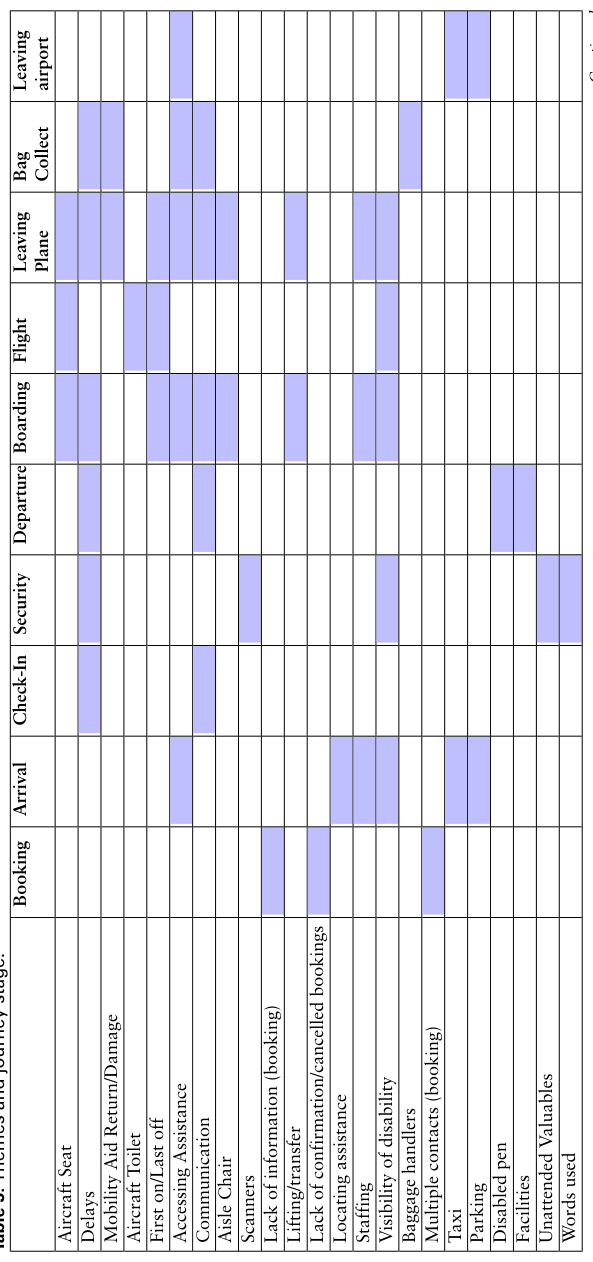
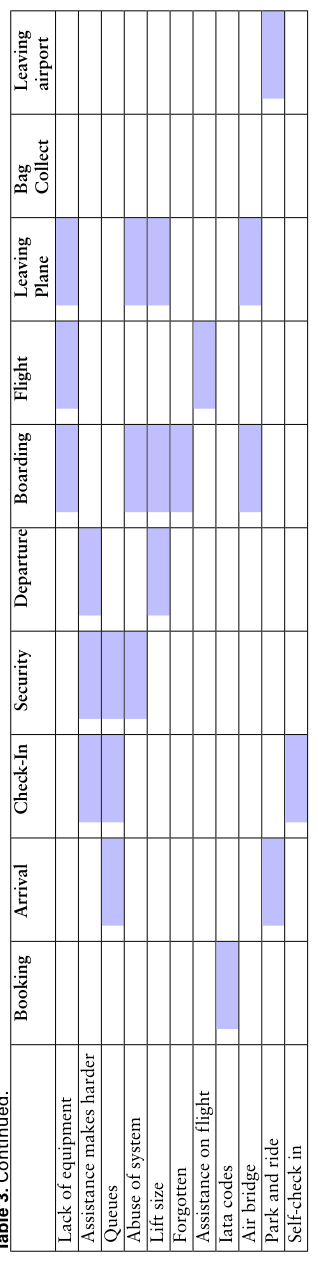
Boarding and leaving the plane generated the most discussion, codes and themes as shown in Table 3. Wildham (2021) noted there has not been any improvement in boarding since research undertaken in 2012. This part of the journey presented a particular challenge for those passengers who have no option but to rely on the support of the airport team to allow them to access their seat. A lack of confidence in the current methods was voiced alongside
Accessibility of Air Travel for Passengers With Reduced Mobility 573
a resigned acceptance that if they want to go on a plane, they must accept it. This is in agreement with previous literature noting “staff was not always familiar with the appropriate way to move them from the wheelchair to the seat” (Poria et al., 2010). “It’s not not great, but I mean you get used to it. You know there’s no other way of doing it” (P1a), “I find that so humiliating being lifted across, and they don’t always do a very good job of it.” (P4e), “they don’t know how to lift me properly. They’ve hurt me in doing it. They’ve nearly dropped me doing it.” (P4b).
In addition to the concerns around transfer to the seat there was also the- mes relating to being forgotten at the gate or long delays, “They took him downstairs and left him there in the room. He missed the flight” (P2c).
The first on-board policy not being followed led to a lack of dignity which echoes previous studies showing despite this policy being in place in practice it is not happening (Darcy, 2012, Wildman, 2021). Wildman (2021) also made comments on the emotive impact with passenger embarrassment a common occurrence, “going on when the plane is full is absolutely horrific” (P2a).
Unsuitable seat location or seat type was also raised during the focus groups with many passengers frustrated they are unable to explain why parti- cular seats are needed for reasons such as access or comfort, “unless you give me those bulkhead ones, I cannot transfer myself so again You’re putting more pressure on the handlers to lift you up. You’ve lost your independence, so I will say give me the Bulkhead ones” (P2c).
Getting off the plane was also linked to anxiety about the safe return of mobility aids and potential damage. This was a key concern of participants in an interview study of adults with disabled children to whether mobility aids would arrive safely, or if parts would be missing or damaged (Davies and Christie, 2018). “It’s like if they knew how important it is to that person, you wouldn’t be chucking like they do with the cases or whatever, and you’re like this is these are like so expensive and these are people’s legs. These are your independence and you’re just chucking them around You know like they were two pounds from a bargain shop.” (P2a).
Delays spanned across the most journey sections of all themes. A strong link was noted between the inability to access toilet facilities on board and delays. The result of delays can prolong the inability to access a toilet facility, leaving passengers uncomfortable or at risk of soiling which is not acceptable, “when I boarded the plane and I wasn’t physically able to stand up to get to go to the toilet. So that’s a five hour flight. And then we’ve got to wait till you get back into the airport to be able to go to the toilet. And I found it very frustrating that in this country, I appreciate the need for everybody there and ready, but they ask you to go to the boarding gate an hour before the flights. And so I’ve got to then go another hour. I ended up being six seven hours before I could go to the toilet and being very uncomfortable.” (P4d). This also highlights the issue around accessibility of the facilities on board the aircraft, which has been widely reported in the existing literature, with many participants noting they cannot use on board toilet facilities due to both the toilet size but also transferring from the seat to get to the toilet (Chang and Chen, 2012, Darcy and Ravinder, 2012, Davies and Christie, 2017, Davies and Christie, 2018, Zorro et al., 2018).
Continued
Table 3. Themes and journey stage.
Accessibility of Air Travel for Passengers With Reduced Mobility 575
Table 3. Continued.
CONCLUSION
The difficulties faced by disabled passengers are complex and varied. Reported problems span over multiple departments involved in the jour- ney from communication between organisations, physical infrastructure or equipment availability, organizational policy, and training, through to the individual’s attitude/perception. A key finding is that each disability is indi- vidual, their needs differ, and assistance needs to be responsive to this. Following on from this study, a questionnaire will be developed and shared with a greater participant reach to evaluate if these findings remain consistent across the target group. This will then enable targeted research focused on practically addressing the issues raised.
Key Findings
Visibility of disability impacts the journey creating challenges gaining assi- stance for those who’s disability is not visible and altered interactions for those who’s disability is visible.
Different levels of mobility impairment incur different challenges.
Boarding and exiting the plane is a particularly challenging journey segment.
Policies such as first on last off are not always occurring in practice.
Security staff require better knowledge of common medical devices they may incur during searches.
ACKNOWLEDGMENT
The authors would like to acknowledge Motability for funding this project and all the participants for giving up their time to attend the focus groups.
REFERENCES
Bloor, M., Frankland, J., Thomas, M. & Robson, K. 2011. Focus Groups in Social Research. SAGE Research Methods. Budd, L. & Ison, S. 2020. Supporting the needs of special assistance (including PRM)
passengers: An international survey of disabled air passenger rights legislation. Journal of Air Transport Management, 87. Chang, Y.-C. & Chen, C.-F. 2012. Meeting the needs of diabled air passengers: Factors that faciitate help from airlines and airports. Tourism Mangement, 33, 529–236. CIVIL AVIATION AUTHORITY. 2020. Accessibility Progress at UK Airports
[Online]. UK Civil Aviation Authority. Available: https://www.caa.co.uk/news/a ccessibility-progress-at-uk-airports/ [Accessed 4/4/2023 2023]. CIVIL AVIATION AUTHORITY. 2022. Passengers requiring special assistance [Online]. CCA Website. Available: www.caa.co.uk/passengers/prm [Accessed 30/5/2022 2022]. Darcy, S. & Ravinder, R. 2012. Air travel for people with disabilities. Best Practice
in Accessible Tourism: Inclusion, Disability, Ageing Population and Tourism. Darcy, S. 2012. (Dis) embodied air travel experiences: Disability, discrimination and the affect of a discontinuous air travel chain. Journal of Hospitality and Tourism Management, 19, 91–101.
Accessibility of Air Travel for Passengers With Reduced Mobility 577
Davies, A. & Christie, N. 2017. An exploratory study of the experiences of wheelchair users as aircraft passengers – implications for policy and practice. IATSS Research, 41, 89–93. Davies, A. & Christie, N. 2018. The experiences of parents with children with disabi-
lities travelling on planes: An exploratory study. Journal of Transport and Health, 11, 122–129. Denscombe, M. 2017. The good research guide, Open university press. Department of Transport 2008. Access to air travel for disabled persons and persons with reduced mobility - a code of practice. Department of Transport 2018. The Inclusive Transport Strategy: Achieving Equal
Access for Disabled People. In: Transport, D. O. (ed.). UK. Morgan., D. L. 2019. Introducing Focus Groups. SAGE Research Methods. SAGE Publications, Inc. Motability 2022. The Transport Accessibility Gap. Poria, Reichel, A. & Brandy, Y. 2010. The Flight Experiences of People with
Disabilities: An Exploratory Study. Journal of Travel Research, 49, 216–227. Robinson, J. 2020. Using Focus Groups. Handbook of Qualitative Research in Educaton. Elgar online. Stewart, K. & WILLIAMS, M. 2005. Researching online populations: the use of
online focus groups for social research. Qualitative Research, 5. U. S. DEPARTMENT OF TRANSPORTATION. 2017. Wheelchair and Guided Assistance [Online]. Available: www.transportation.gov/individuals/aviation- consumer-protection/wheelchair-and-guided-assistance#:\protect$\relax\sim$: text=When%20a%20passenger%20with%20a,individual%20with%20a%20b omility%20impairment [Accessed 30/5/2022 2022]. United Nations. 2021. Factsheet on Persons with Disability [Online]. United Nati-
ons. Available: https://www.un.org/development/desa/disabilities/resources/facts heet-on-persons-with-disabilities.html [Accessed 21/11/2021 2021]. Wildman, J. 2021. Supporting the Needs of Air Travel Passengers with Disabilities.
Bsc (Hons) Aviation Management, Coventry University. WORLD HEALTH ORGANISATION 2011. World Report - Chapter 1 - Understanding Disability. Zorro, S., Macario, R. & Silva, J. 2018. Air Transportation: Perception and Impact
of Passengers with Reduced Mobility. Journal of Air Transport Studies, 9.
LISTED IN THE AHFE DIGITAL BOOKSTORE CATALOGUE
Explore the complete digital volume
Human Factors in Transportation
Read this individual research paper free through the original publisher, or explore the full digital proceedings book.
ISBN 978-1-958651-71-1
Explore this ISBN in the AHFE Bookstore ↗Listed in the July 2026 bookstore catalogue; search by ISBN to confirm current availability · Digital book purchase optional