Arun Ulahannan, Katie Zdanowicz, Cameron Bowie, Stewart Birrell (2022). Making wireless charging a reality: A real-world mixed methods evaluation of vehicle alignment. In: Intelligent Human Systems Integration (IHSI 2022): Integrating People and Intelligent Systems. AHFE Open Access, vol. 22. https://doi.org/10.54941/ahfe1001070
Wireless charging could allow drivers to better manage their vehicle’s range through more frequent, if slower, charging. However, accurate alignment between the vehicle and the ground pad is crucial. 12 participants were asked to align either the front or rear of a wireless-enabled vehicle, with a ground pad; both with and without the support of an in-vehicle alignment HMI. We found that participants were most accurate when front aligning the vehicle. The alignment HMI significantly improved longitudinal alignment in all conditions. However, when front aligning, lateral alignment was not significantly improved by the HMI. Alignment was poorest when the vehicle pad was at the rear of the vehicle. We found that 100% of participants could align accurately enough to begin charging with the aid of the HMI, followed by only 17% for unassisted front aligning and 0% when rear aligning; highlighting the importance of pad location and HMI support.
Intelligent Human Systems Integration (IHSI 2022): Integrating People and Intelligent Systems https://openaccess.cms-conferences.org/#/publications/book/978-1-7923-8988-7
INTRODUCTION
One of the most significant contributors to Traffic Related Air Pollutants (TRAPS) are taxis. Euro 5 and earlier diesel emission standard taxi models are responsible for 60% of the nitrous oxide emissions from passenger vehicles in Greater London (Borken-Kleefeld & Dallmann, 2018). Studies have found that increases in taxi fuel efficiency are linked to a decrease in nitrous oxide and carbon dioxide emissions (Fry et al., 2019). A reduction in polluting gases provide benefits not only for the wider city environment, but for the vehicle occupants too. Recent findings have suggested that taxi drivers are exposed to high levels of TRAPs (Moreno et al., 2019), responsible for the increase in cardiovascular and respiratory diseases (Hachem et al., 2019). Evidently, there are benefits to exploring alternative fuel sources that can reduce the resulting emissions from vehicles- particularly taxis. Battery electric vehicles have become the most viable alternative to combustion fuel vehicles. However, there are challenges to their adoption, such as range, charging infrastructure and price (Oliveira et al., 2020; Ulahannan et al., 2021). To address specifically the issues around range, the Wireless Charging of Electric Taxis (WiCET) project will install five wireless charging transmitter pads (11 kW) at a high profile taxi rank in Nottingham, UK. Alongside the wireless charging pads, nine taxis will be fitted with wireless charging capabilities. The aim of the project is to understand if providing an opportunity to taxi drivers to charge their vehicle at their place of work in the taxi rank, will allow them to manage their electric taxi’s range, hence promoting the adoption of electric taxis. From the driver’s perspective, with no need to step outside of the vehicle to plug a charging cable in, this could enable a seamless transition between driving and charging the vehicle. Hence promoting a method of maintaining vehicle range through charging the battery by smaller amounts continuously throughout the day. There are two main types of wireless charging: “dynamic” and “static”. Dynamic charging places the inductive charging capability continuously along the road, allowing for charging during driving (He et al., 2020). One of the key factors in the efficiency and effectiveness of static wireless charging is the alignment of the vehicle over the ground pad (Birrell et al., 2015). Recent innovation in the field of inductive charging has led to improvements in charging rates and more resilience to misalignment and distance issues (Machura & Li, 2019), but typically tolerances of around ±10cm from their optimal positioning are expected for today’s wireless charging pads. However, aligning the vehicle with a ground pad can be challenging for drivers and therefore an investigation into how well drivers can align to a ground pad in different conditions is an important next step in developing our understanding. AIM This study aimed to understand how well drivers can align with a wireless charging ground pad in different conditions, such as differing charge pad locations (front or rear of vehicle) and if in-vehicle HMI support is offered.
Intelligent Human Systems Integration (IHSI 2022): Integrating People and Intelligent Systems https://openaccess.cms-conferences.org/#/publications/book/978-1-7923-8988-7
METHOD
A real-world investigation was designed to understand how well drivers can align with a wireless charging ground pad. The study took place at the Eastcroft Depot site in Nottingham, UK (Fig. 1). This site featured an installation of two WiCET wireless charging pads (Lumen Freedom Generation 2) built for pilot testing before installation at a hige-profile taxi rank. The site is privately owned by Nottingham City Council, meaning public vehicles were not permitted to drive the roads – allowing for a level of control over traffic conditions. The vehicle chosen was a WiCET LEVC TX electric taxi retrofitted with wireless charging capabilities (Fig. 1). In total, 12 participants took part in the trials. The study was approved by Coventry University’s ethics board (P128531). There were three conditions evaluated, which were conducted in a random order for each participant:
1) Front alignment with HMI support (Fig 2). The display provided lateral & longitudinal guidance on a display, requiring participants to align two rectangles that represented the vehicle and the ground pad. The display would activate with low-power excitation, meaning precision alignment guidance would only display when within 15 cm of the ground pad 2) Front alignment without assistance (aligning to the front wheels). 3) Rear alignment without assistance (aligning to the back wheels). First, participants were introduced to the vehicle and briefed. If required, they then drove a familiarisation route around the proposed route (Fig. 2). After this, participants then drove each of the three alignment conditions. Participants were free to reverse and realign until they were happy with their alignment. After each condition, researchers took measurements to the front and side of the vehicle: two measurements for each wheel towards a front facing reference line and one from the centre of the front or rear wheel to a side reference line (depending on the testing condition). In the analysis, the longitudinal measurements for the left and right wheel were averaged to a single longitudinal measure. Furthermore, these measurements were compared to baseline measurements previously recorded for perfect vehicle alignment. Finally, after the completion of all three conditions, a semi-structured interview was conducted.
Intelligent Human Systems Integration (IHSI 2022): Integrating People and Intelligent Systems https://openaccess.cms-conferences.org/#/publications/book/978-1-7923-8988-7
Fig. 1. (left to right) WiCET wireless charging ground pad at Eastcroft Depot, participant driving route and LUMEN in-vehicle support HMI
RESULTS AND ANALYSIS ALIGNMENT ACCURACY As described in the methodology, two longitudinal measurements were taken for the left and right wheel and one lateral measurement. The left and right longitudinal measurements were averaged and are presented below in Table 1, which describes the average difference from perfect alignment. Results were positively normalised as misalignment was considered the same for positions that were over and under the perfect alignment. Further, a count of how many of the participants achieved an alignment where charging was possible is also detailed in Table 1. For this count, if either the left or right longitudinal alignment was within the alignment tolerance of ±10cm, this was considered to be a good alignment where charging was possible.
Table 1. Alignment results (difference in cm from perfect alignment) and the number of participants who aligned accurately enough for charging to be possible Longitudinal / cm Lateral / cm
Condition
Charging possible? Mean SD Min Max Mean SD Min Max Front w/HMI 3.9 3.0 0.5 10.3 6.7 3.3 1.0 11.5 12
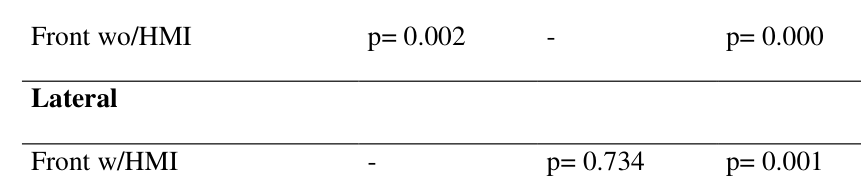
Table 2. Results from the Repeated Measures ANOVA Longitudinal Front w/HMI Front Rear wo/HMI
Table available in the original PDF paper.
Equation reproduced from the original PDF.
Intelligent Human Systems Integration (IHSI 2022): Integrating People and Intelligent Systems https://openaccess.cms-conferences.org/#/publications/book/978-1-7923-8988-7
Equation reproduced from the original PDF.
Intelligent Human Systems Integration (IHSI 2022): Integrating People and Intelligent Systems https://openaccess.cms-conferences.org/#/publications/book/978-1-7923-8988-7
Furthermore, from our observations, we noted that participants were understandably more focused on the assistance display during the alignment, waiting for guidance to appear, and may have been distracted with regards to their lateral alignment; in comparison to the front wo/HMI condition, where participants were focused on viewing the roadway to guide their alignment. This suggests that a HMI supporting the alignment needs to begin providing alignment cues before changes to lateral alignment become more difficult (for example, at around 60cm to the pad). In both conditions, with and without the assistance, lateral alignment was always more accurate when drivers were aligning to the ground pad at the front of the vehicle. Rear alignment was evidently the most difficult condition for drivers to achieve accurately. In this WiCET project, the charging pads will be installed towards the rear of the vehicle for technical reasons. This could be the case for other retrofitted wireless charging solutions, hence highlights the importance of providing an interface that supports with rear alignment. INTERVIEW RESULTS A short semi-structured interview was conducted with participants after all three alignment conditions were completed. Overall, participants were unanimous in their support for wireless charging of electric vehicles, with many focussing on the convenience of not requiring cable plugging, “It’s easier to charge without a cable” (P11), “It’s convenient and practical” (P6). Regarding the alignment process, in line with the quantitative results, all participants agreed that the rear alignment condition was the most difficult, “The back one was hard because you don’t know where you are and you don’t have any reference points” (P1); “I had no idea how to park, it was really difficult and challenging” (P3). Furthermore, as alluded to in the quantitative results, participants felt that the assistance display did not provide enough notice before displaying the precision alignment information, indicating that relying on low-power excitation at 15cm is not enough to help guide the participant, “the interface isn’t too responsive” (P4), “the screen is too late with the response” (P3). While the longitudinal results were significantly better using the HMI assistance, the lateral results were not significantly better compared to front aligning without assistance. As we previously hypothesised, with precision alignment guidance only being displayed at 15cm from the ground pad, this does not give enough forewarning to be able to adjust lateral alignment. From an interface design perspective, some participants felt confused as to which icon on the display corresponded to their vehicle, “It took me a second to realise that I need to look at the red square” (P3), “the screen was a bit confusing” (P1). Future research may wish to consider that from the perspective of the driver, they are stationary, and the ground pad is being brought towards them- hence, the interface could reflect this to depict a ground pad icon that moves towards a fixed icon of the driver’s vehicle. Some participants offered suggestions for improvements to the alignment process, such as a physical marker to which a point on the vehicle could be lined up to (e.g. a wing mirror or bumper), “additional markings would be helpful” (P4), “If you drive forward it would be easier to have a line or a marker ahead of you” (P7). However, a physical marker would not
Intelligent Human Systems Integration (IHSI 2022): Integrating People and Intelligent Systems https://openaccess.cms-conferences.org/#/publications/book/978-1-7923-8988-7 work for different vehicles where differing dimensions and charge pad placements will affect where the reference point needs to be. LIMITATIONS The sample size of 12 limits the generalisability of the results, however even with this number the results are significant and compelling. Furthermore, participants were exclusively from Nottingham City Council, though this was solely for vehicle insurance purposes to legally drive the vehicles around the private test site. It would also have been beneficial to test the rear alignment condition with an alignment assistance. However, to move the placement of the pad on the vehicle would not have been practically or technically feasible.
CONCLUSION
This real-world alignment trial takes advantage of the cutting-edge work being done as part of the WiCET project to understand how accurately drivers can align with a ground charging pad in three different conditions. This study found:
Aligning the front of the vehicle to the ground pad was most accurately achieved by drivers. With the addition of the support HMI, 100% of drivers could park accurately enough to initiate wireless charging. Without the HMI this dropped to only 17% for front alignment and 0% for rear.
The HMI support significantly improved longitudinal alignment accuracy but offered no significant improvement over an unassisted lateral alignment to the front of the vehicle. This was because guidance was offered too late (i.e., 15 cm before the pad) to affect lateral alignment.
In all cases, rear alignment was the least accurate alignment condition, and highlights that interface support with parking is essential.
With the vehicle pad towards the rear, on average participants stopped 61.8cm short of the ground pad. Interface support is only offered 15cm prior to the pad, hence a solution is needed to bridge this gap and guide drivers to continue driving forwards to reach the minimum distance for low-power excitation guidance.
For cases where the vehicle used with wireless charging remains consistent (e.g., a standardised taxi), physical markers were requested by participants. This study has provided an important step in understanding the challenges facing the adoption of wireless charging for electric vehicles. Despite the challenges of alignment, all drivers were able to align within the required tolerances for wireless charging when supported by the in-vehicle HMI. Evidently, while it provides an improvement for front alignment, an assistance HMI appears to be essential for rear alignment, where alignment was significantly worse than the other two conditions. As with many aspects of human factors, experience will play an important role in alignment accuracy. It could be the case that as participants continue to align and become familiarised with the vehicle, that alignment
Intelligent Human Systems Integration (IHSI 2022): Integrating People and Intelligent Systems https://openaccess.cms-conferences.org/#/publications/book/978-1-7923-8988-7 accuracy will improve. Future studies should look to explore this alignment process longitudinally to understand how quickly participants can become familiarised with the process. However, supporting novice users is essential to ensure they persist with the technology and realise the full benefits that electric vehicles offer. The authors would like to acknowledge WiCET Project partners: Cenex, Nottingham City Council, Shell Recharge, Hangar19, Sprint Power and Transport for London. The work is funded by the Office for Zero Emission Vehicles and supported by Innovate UK (106610).
REFERENCES
Birrell, S. A., Wilson, D., Yang, C. P., Dhadyalla, G., & Jennings, P. (2015). How driver behaviour and parking alignment affects inductive charging systems for electric vehicles. Transportation Research Part C: Emerging Technologies, 58, 721–731. Borken-Kleefeld, J., & Dallmann, T. (2018). Remote sensing of motor vehicle exhaust emissions. In
True Initiative Report (Issue Ddecember). https://www.trueinitiative.org/media/597524/true- london-rs-report-fv-20181214.pdf Fry, D., Kioumourtzoglou, M. A., Treat, C. A., Burke, K. R., Evans, D., Tabb, L. P., Carrion, D., Perera, F. P., & Lovasi, G. S. (2019). Development and validation of a method to quantify benefits of clean-air taxi legislation. Journal of Exposure Science and Environmental Epidemiology, 1–12. https://doi.org/10.1038/s41370-019-0141-6 Hachem, M., Saleh, N., Paunescu, A. C., Momas, I., & Bensefa-Colas, L. (2019). Exposure to traffic
air pollutants in taxicabs and acute adverse respiratory effects: A systematic review. Science of the Total Environment, 693, 133439. https://doi.org/10.1016/j.scitotenv.2019.07.245 He, J., Yang, H., Tang, T. Q., & Huang, H. J. (2020). Optimal deployment of wireless charging lanes considering their adverse effect on road capacity. Transportation Research Part C: Emerging Technologies, 111, 171–184. https://doi.org/10.1016/j.trc.2019.12.012 Machura, P., & Li, Q. (2019). A critical review on wireless charging for electric vehicles. Renewable
and Sustainable Energy Reviews, 104, 209–234. https://doi.org/10.1016/j.rser.2019.01.027 Moreno, T., Pacitto, A., Fernández, A., Amato, F., Marco, E., Grimalt, J., Buonanno, G., & Querol, X. (2019). Vehicle interior air quality conditions when travelling by taxi. Environmental Research, 172, 529–542. https://doi.org/10.1016/j.envres.2019.02.042 Oliveira, L., Ulahannan, A., Knight, M., & Birrell, S. (2020). Wireless charging of electric taxis:
Understanding the facilitators and barriers to its introduction. Sustainability (Switzerland), 12(21), 1–21. https://doi.org/10.3390/su12218798 Ulahannan, A., Knight, M., Doel, R., & Birrell, S. (2021). Look, No Cables! An Interview Study into Guiding the Practical Implementation of Wireless Chargers for Electric Taxis. International Conference on Applied Human Factors and Ergonomics, 269–276.
Intelligent Human Systems Integration (IHSI 2022): Integrating People and Intelligent Systems https://openaccess.cms-conferences.org/#/publications/book/978-1-7923-8988-7
LISTED IN THE AHFE DIGITAL BOOKSTORE CATALOGUE
Explore the complete digital volume
Intelligent Human Systems Integration (IHSI 2022): Integrating People and Intelligent Systems
Read this individual research paper free through the original publisher, or explore the full digital proceedings book.
ISBN 978-1-7923-8988-7
Explore this ISBN in the AHFE Bookstore ↗Listed in the July 2026 bookstore catalogue; search by ISBN to confirm current availability · Digital book purchase optional