Gabriella Duca, Giovanni Gugg, Vittorio Sangermano, Antonio Di Palma (2024). Measuring safety culture in the Disaster Resilient Society context: an actionable toolkit. In: Social and Occupational Ergonomics. AHFE Open Access, vol. 152, pp. 132–140. https://doi.org/10.54941/ahfe1005328
Given the multifaceted and multiscale nature of the concept of safety culture, its shifting to the Disaster Resilient Society (DRS) context requires a comprehensive exploration of its multiple aspects and dimensions, making it meaningful from the public safety perspective. Starting from factors and aspects of safety culture described in scientific and technical literature, we have defined specific indicators for measuring safety culture in three target groups: citizens, practitioners and public servants indirectly involved in prevention, preparedness and response. CORE EU project has shaped an original Safety Culture model, addressing multiple levels of safety culture and grasping the many facets that characterise the large cultural diversity encountered when the analysis targets different societal groups, from citizens to practitioners. Following this reference model, a toolkit for the execution of Safety Culture measurement campaign has been developed, supporting the investigation in a geographic community. It consists of three techniques specifically tailored for each intended target group: first step is an initial collection of quantitative data, with a large-scale survey; the second step implements a qualitative data collection with semi-structured interviews and, finally, the third, qualitative, step consists of focus groups. The paper describes the overall proposed methodology to run a Safety Culture campaign in the DRS context, provide examples of designed tools and discusses the early results of the toolkit validation in seven European regions.
As widely known, the concept of Safety Culture was spread by the Interna- tional Atomic Energy Agency (IAEA) after the Chernobyl accident (IAEA, 1986). Since then, almost all safety critical contexts - from oil and gas to healthcare- have reflected on Safety Culture specificities in their respective domains (van Nunen et al., 2022), developing their own indicators and tools and making the iterative measurement of the safety culture a common practice.
The definition and facets of this crucial yet, somehow, cloudy concept (Reason, 1997) are many, but all refer to a way of thinking, feeling, and
Measuring Safety Culture in the Disaster Resilient Society Context: An Actionable Toolkit 133
acting about individual and collective safety from within a group (INEA- INSAG, 1991). Safety Culture refers to the formal aspects of safety derived from existing risks and influences how individuals within a group or organi- zation make decisions and behave in their complex environment (Wiegmann et al., 2004). It is not a tangible object but rather a subtle and profound concept that cannot be taught, learned, or organized at a specific time; it is a combination of characteristics and attributes in organizations and indi- viduals that ensure that safety issues receive adequate attention given their importance (IAEA-INSAG, 1991).
Since safety culture is a proactive attitude based on the capability to antic- ipate, monitor, respond and learn (Hollnagel, 2016), it represents a crucial aspect of community resilience in face to disasters. In fact, the term “culture” is central to the concept of safety, as it is a continuous process of social, polit- ical, and dialectical construction, history, and development (CORE 2023). In the context of Disaster Resilient Society (DRS), Safety Culture is a way of thinking, an interpretative key to reality in relation to the integrity of people, places, things, and environments. As such, it is not a fixed fact or a standard procedure but a perspective that must be observed to understand its state in each place, time, and group within its fluid mutability. Worth considering is the fact that in our societies a variety of cultural groups coexist, with beliefs or interests that conflict with those of the broader culture, leading to the idea of “safety subcultures” (Sherry, 2018) that might influence the overall capacity of a community to be prepared, respond, react and recovery from a disaster.
Within this context, the aim of designing actionable instruments to investi- gate Safety Culture at local community level to improve resiliency to disasters should necessarily refer to an elicitation of the concept duly adapted from the industrial/occupational context to wider societal groups or communi- ties. To this purpose, the CORE (Science and Human Factors for Resilient Society) acknowledges that “a positive Safety Culture includes all of the pre- vailing values, attitudes, and tangible and intangible capabilities that, within a community, ensure the maximum protection of all its members before (pre- vention), during (preparedness and response) and after (recovery and building back) a disaster” (Duca and Gugg, 2023; CORE, 2023). In the DRS context, Safety Culture is an integral part of a community’s overall culture, influenc- ing the perception and management of risks and disasters. It cross-cuts a wide range of entities, including national and local organizations, public and pri- vate sectors, profit and non-profit organizations, as well as various social groups and private citizens. Therefore, a “positive safety culture enables a coherent and harmonised understanding of the risks and severity of disas- ter consequences and fosters the implementation of deliberated actions and behaviours at individual and community levels with the overall purpose of guaranteeing adequate protection for all society members through preven- tion, preparedness, response, recovery and building back better” (Duca and Gugg, 2023; CORE, 2023).
MEASURING SAFETY CULTURE TO IMPROVE SOCIETAL RESILIENCY TO DISASTERS Methodological Approach
Safety culture can be difficult to measure, especially if the target community may encompass multiple levels of safety culture or showing widely nuanced facets that characterise it, as it is the case of the large diversity implicitly brought by the many social segments, roles and responsibility dealing with disaster resilience. The measurement campaign designed for CORE project is intended to be addressed to a geographic community, consisting of individ- uals united by common ties and shared access to resources, services, culture, beliefs, and attitudes. In the purpose of this study, a community may relate to various spatial scales, from villages to regions and beyond.
Technical and scientific literatures proposes a rich variety of safety culture indicators and corresponding measurement methods (Churruca et al., 2021; Marshall, 2020) In the purpose of this study, the most interesting models are the ones offering the opportunity to depict the multifaceted and multi- layered constituent aspects that can characterize safety culture in large and highly mixed social groups. On this basis, CORE project has built a Safety Culture measurement toolkit basing indicators on eight elements (CORE, 2023; CANSO, 2008). Information, Reporting, Justness, Learning, Flex- ibility, Attitudes to Safety, Risk Perception, Safety-related behaviour, and three dimensions: behavioural, situational and psychological (CORE, 2023; van Nunen et al., 2022; Sherry, 2018; Aven et al., 2021).
Once set the overall framework of indicators, the study has addressed the problem of identifying the method for data collection and analysis suitable for the DRS domain. Several methods are proposed, ranging from obser- vation of daily operations, document review, survey, interview, and focus groups; these include quantitative and qualitative techniques, which should be selected and combined to provide the best information for the objectives and scope of the safety culture measurement campaign (Marshall, 2020). The combination of different methods is crucial for the significance of the results; as an example, surveys alone do not provide comprehensive information on the dimensions of culture. They capture the first two levels of artifacts and beliefs shared by the organization, while cultural dimensions are also context dependent and require interpretive methods to discover. Qualitative, appre- ciative, and open methods are considered more appropriate for addressing deeper issues and contextual aspects of culture (Schein, 2000; Flin, 2007). To analyze safety culture as holistically and correctly as possible, CORE project’s Safety Culture measurement methodology combines various tech- niques, considering the strengths and weaknesses of each method and the strengths and weaknesses of each method. This approach ensures that safety culture is understood and supported by the target audience, ensuring that research is effective and relevant.
Within the target geographical community, three target groups are the focus of the safety culture measurement campaign: citizens, servants of pub- lic authorities, and civil protection practitioners. Citizens include individuals
Measuring Safety Culture in the Disaster Resilient Society Context: An Actionable Toolkit 135
and civil society organizations; public servants belong to authorities responsi- ble of direct and indirect provision of services that might affect the probability or the extent of the consequences of a disastrous event (i.e. social services, ter- ritorial planning, infrastructure management); practitioners are members of public authorities or professionals in volunteering association responsible of preparedness, early warning, first response and reaction. Then, the CORE toolkit for Safety Culture measurement in DRS context implements a prede- termined three steps approach, consisting of three tools (techniques) based on a common framework of indicators that have been specifically tailored for each of the three intended target group, consisting of a large scale survey, semi structured interviews and focus groups.
The Survey CORE safety culture survey has been designed to support the quick and not expensive data gathering from a large panel/population, unveiling the high- level traits of the safety culture in the investigated community. The survey consists of three different questionnaires, whose answers are presented on an even options Likert scale, to allow grasping a trend more easily. The answers are meant to be anonymous; if a sufficient number of respondent is involved, data gathered can be processed statistically to identify differences between groups, keeping in mind that bare data say little about culture. Questionnaire for citizens includes 29 questions, questionnaire for public servants consists of 35 questions and the one for practitioners presents 39 items. Each question is formulated in order to transversally provide insights on one of the elements and one of the dimensions identified. Table 1 provides an example of the how the items have been designed for each target group.
Table 1. Example of items of CORE safety culture surveys (CORE, 2023).
Citizens I receive information and updates from official sources regarding risks in my territory
Informed Culture Psychological Aspects
Citizens I think sometimes official communication regarding risk alert are disproportionate
Just Culture Behavioural Aspects
Citizens People do not usually consider if a behaviour in a potentially critical situation could be risky for themselves or others Public servants
Informed Culture Situational Aspect
It is clear who are the persons and roles responsible for decisions that affect prevention, preparedness, response, and recovery in relation to risks within my organization’s jurisdiction.
(Continued)
Table 1. Continued Target Question Safety Culture Element
Table available in the original PDF paper.
Safety Culture Dimension
Public servants
Reporting Culture Psychological Aspects
Sometimes I do not share suggestions or information because they will be disregarded by my management
Just Culture Behavioural Aspects
Public servants
Outcomes/effects/consequences of decisions or interventions are fairly and openly discussed in official contexts set by my organization
Informed Culture Situational Aspect
Practitioners I can rely on complete and updated information to perform my everyday duties.
Just Culture Behavioural Aspects
Practitioners Safety issues arisen during operations are duly analysed to find the deepest roots of the event.
Learning Culture Psychological Aspects
Practitioners I have the feeling that the same events or disasters recur without learning from experience.
The Semi-Structured Interviews The execution of the interviews follows the early analysis of survey results. They are aimed at supporting the deeper understanding of the rationale behind the results from the large-scale survey, highlighting mechanisms, causes, effects and interrelations among the issues emerged from the survey. They combine some structured questions with some unstructured exploration and allow to learn how people make meaning of situations/events. They pro- vide an insight of the elements constituting the positive and negative aspects of safety culture in the investigated community. Table 2 shows the first level of interviews structures for the three targets (practitioners and public servant are grouped, in this case), addressing the Safety Culture elements, whilst the dimensions are explored through the items of the second level.
Table 2. Example of questions of CORE safety culture semi-structured interviews (CORE, 2023).
Table available in the original PDF paper.
Citizens Public Servants and Practitioners Safety Culture element Informed Culture Have you ever thought about possible disasters that you might be involved in?
Do you think that in your everyday job you can rely on accurate and comprehensive information relating to (natural, industrial, or manmade/ma- licious) risks in your field of action? Does your institution run campaigns and/or provide regular warnings on existing risks to citizens? Reporting Culture
Have you ever contacted a public office to report a risky situation or a contingency?
How often you or your colleagues speak up about overlooked risks or situations? Does your organization collect, manage and/or encourage reports or suggestions by citizens?
(Continued)
Measuring Safety Culture in the Disaster Resilient Society Context: An Actionable Toolkit 137
Table 2. Continued Citizens Public Servants and Practitioners Safety Culture element
Table available in the original PDF paper.
How are people raising concerns on risks, procedures or improvements considered?
Just Culture Do you think that communication on risks within your community is transparent?
How often are risks reviewed or procedures updated?
Learning Culture
Have you done any action to be better prepared to a future risk following a disastrous event? (either personally involving you, other people you know or learnt from media) Flexible Culture Can citizens do something in first person to reduce the probability of a dangerous event or its consequences?
In your opinion, does your organization deploy its skills and capabilities at the best, according to the specific event or crisis situation? Attitudes to Safety
Do you think that it would be possible preventing disasters or reducing their consequences?
Do you think that your organization devotes the proper attention to preven- tion and preparedness for risks under your field of intervention? (for public authorities only) Do you think that, in relation to specific roles and responsibilities of each institution, every public or private organization devotes the proper attention to prevention and preparedness for risks in this territory? (for practitioners only) Risk Perception
Have you put in place any personal measures to be prepared for a possible disaster or event?
Within the limits of anyone’s role, do you think that in your organization there is a clear and consistent understanding of the risks for public safety your organization has to deal with? (for public authorities only) Do you think that in your organizations is clear the relevance and impact of each risk you deal or might deal with? (for practitioners only) Safety-related behaviour
Are regulations effective/important to prevent disasters or reduce their consequences?
In your everyday duties, in what extent compliance with rules and procedures is necessary to mitigate events/disasters consequences?
The Focus Groups The third stage of the CORE Safety Culture measurement methodology fore- sees the use of a further research instrument: the focus group. The provide insights into a diversity of perspectives, collective sense-making, and the opportunity to observe culture in action and help the unveiling of unclear or misunderstood dynamics among the actors/groups. Focus groups allows the listening to others’ views, revealing attitudes, feelings, beliefs, experi- ences and reactions in a way that is not feasible using other method and finally contribute to create a shared space that is a foundation stone for
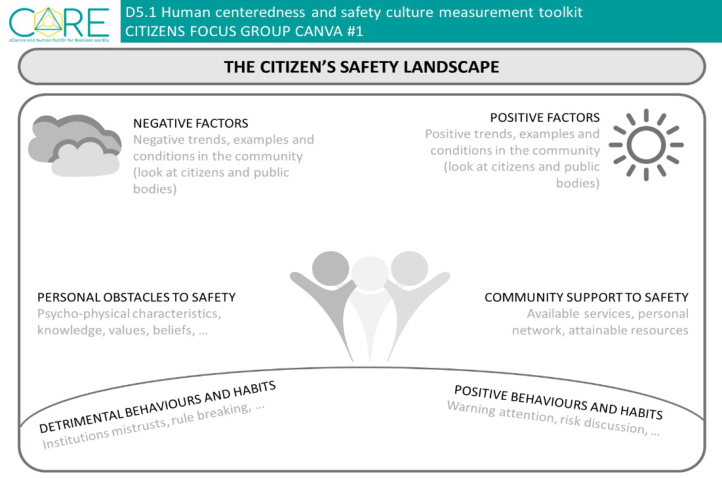
future improvements paths. CORE focus groups use the graphic aid of can- vas for short aide-memoire to foster the focus on the topics of interest. CORE project has designed three focus group discussion canvas: (i) first one for the citizens, aimed at the comprehensive discussion of the socio-cultural factors and mechanisms affecting the safety landscape for citizens, (ii) second one for the representatives of public authorities and practitioners aimed at build- ing an insight of safety culture features in their organizations, (iii) the third one aimed at understanding safety culture characterising aspect through the analysis of an event. Figure 1 shows the graphic canva for the execution of citizens’ focus group.
Figure 1: The citizens’ safety landscape (CORE, 2023).
Validation of the Toolkit and Overall Methodology The CORE Safety Culture measurement toolkit is being used to conduct a comparative analysis of Safety Culture in six European regions: Campania and Veneto in Italy, Alsace in France, Bavaria in Germany, Great Manchester in United Kingdom and Sweden (whole Country, given the population den- sity). First phase took place in the summer of 2023, involving 1175 Citizens, 266 Practitioners and 80 public servants responding to their respective sur- veys. Second phase took place between September and October 2023, and consisted in executing least 3 citizens, 3 practitioners and 3 authorities for each of the involved regions; each interview lasted 45–60 minutes and paved the way for the last phase held between November and December 2023. The latter consisted in the arrangement, in each region, of two types of focus groups: with citizens and with practitioners grouped with other public ser- vants. Citizens involved in the various phases of the research are equally distributed between males and females and in the various age groups, with
Measuring Safety Culture in the Disaster Resilient Society Context: An Actionable Toolkit 139
a slight preponderance for the age groups of Adults (30–44) and middle- aged adults (45–62). Among the practitioners, there is a strong male majority, with about 75% of male participants versus the 25% of females, with most professionals with many years of experience.
Despite the final comparative analysis is still ongoing, some preliminary conclusions on the applicability and validity of the toolkit can be drawn. A first observation concerns the shift of field of application to whole society from a work organization: if in a given institution the management can give example, encourage and foster large participation to the measurement cam- paign, the same cannot happen when the target is a geographical community. In this case, recruiting participants and building good quality panel is much more challenging and request great effort and professionalism. On the other hand, the issues proposed to participants have been perceived as relevant and data collected covered all the Safety Culture facets identified for the DRS context. Safety Culture resulted a topic capable to engage participants and stimulate the sharing of experiences, clarifying difficulties, unexpressed needs and generating ideas for improving disaster risk reduction and management in investigated groups, at individual and collective level.
CONCLUSION
Culture, including safety culture, influences the way general principles, rules, and knowledge manifest in a specific context. The European Union recog- nizes the significance of employing comprehensive and integrated approaches to disaster risk management to enhance resilience at various levels (European Union, Commission, 2023). Also The Sendai Framework for Disaster Risk Reduction, adopted in 2015, emphasizes the importance of safety culture in the context of disaster resilience. It calls for the integration of safety cul- ture into various sectors, including economic, structural, legal, social, health, and cultural aspects, to prevent and reduce disaster risk and strengthen resilience (UN, 2015). The presented toolkit has been designed to be and open source tool to support safety culture measurement campaign beyond the CORE project, with the aim to create an evidence-based source of knowledge, supporting policymaking and improved preparedness to disasters. Using structured methodologies and standardized tools for understanding positive and negative characteristics of Safety Culture in the many and varied Euro- pean communities could represent a step forward the goal of leaving none behind, strengthening societal resiliency.
ACKNOWLEDGMENT
This paper reports research results developed as part of the CORE — Science and Human Factors for Resilient Society project, which has received funding from the European Union’s Horizon 2020 Research and Innovation Program under grant agreement No. 101021746.
REFERENCES
Aven, T., & Ylönen, M. (2021). How the risk science can help us establish a good safety culture. Journal of Risk Research, 24(11), 1349–1367.
Churruca, K., Ellis, L. A., Pomare, C., Hogden, A., Bierbaum, M., Long, J. C.,... & Braithwaite, J. (2021). Dimensions of safety culture: A systematic review of quan- titative, qualitative and mixed methods for assessing safety culture in hospitals. BMJ open, 11(7). Civil Air Navigation Services Organisation. (2008). Safety Cul- ture Definition and Enhancement Process. Retrieved from https://www.icao.int/NACC/Documents/Meetings/2018/ASBU18/OD-10- Safety%20Culture%20Definition%20and%20Enhancement%20Process.pdf. CORE (2023). D5.1 “Human centeredness and safety culture measurement toolkit”.
CORE project. Duca, G., & Gugg, G. (2023). Safety Culture in the Disaster-Resilient Society Context: A Conceptual Exploration. Sustainability 2023, 15, 12236. European Union. (2023). Commission Recommendation of 8 February 2023 on
Union Disaster Resilience Goals. Official Journal of the European Union, C 56, 1. Flin R. (2007). “Measuring safety culture in healthcare: A case for accurate diagnosis”, in: Safety Science, 45; pp. 653–667. Hollnagel, E. (2016). The four cornerstones of resilience engineering. In Resilience
Engineering Perspectives, Volume 2 (pp. 139–156). CRC Press. IAEA INSAG (International Nuclear Safety Advisory Group). (1986). Summary Report on the Post-Accident Review Meeting on the Chernobyl Accident, “Safety Series”, No. 75-INSAG-l; IAEA: Vienna, Austria. IAEA INSAG (International Nuclear Safety Advisory Group). (1991). Safety Cul-
ture. A Report by the International Nuclear Safety Advisory Group, International Atomic Energy Agency, INSAG-4. Vienna, Austria. Marshall, T. M. (2020). Risk perception and safety culture: Tools for improving the implementation of disaster risk reduction strategies. International journal of disaster risk reduction, 47, 101557. Reason, J. (2016). Managing the risks of organizational accidents. Routledge. Schein E. H. (2000). Sense and nonsense about culture and climate, in Ashkanasy
N. M., Wilderom C. P. M., Peterson M. F. (eds), Handbook of Organizational Culture & Climate, Sage, Thousand Oaks (USA); pp. 131–146 Sherry, P. (2018, June 9). Key Components in the Measurement of Safety Culture.
National Center for Intermodal Transportation. Denver Transportation Institute, University of Denver, Denver, CO. https://www.du.edu/sites/default/files/2022-06/ sherry-denver-june-9-2018.pdf United Nations. (2015). Sendai Framework for Disaster Risk Reduction 2015–2030.
In Proceedings of the Third UN World Conference, Sendai, Japan, 18 March 2015; UN: Geneva, Switzerland; Volume 1. van Nunen, K., Reniers, G., & Ponnet, K. (2022). Measuring safety culture using an integrative approach: The development of a comprehensive conceptual frame- work and an applied safety culture assessment instrument. International journal of environmental research and public health, 19(20), 13602. Wiegmann, D. A., Zhang, H., Von Thaden, T. L., Sharma, G., & Gibbons, A.
M. (2004). Safety culture: An integrative review. The International Journal of Aviation Psychology, 14(2), 117–134.
LISTED IN THE AHFE DIGITAL BOOKSTORE CATALOGUE
Explore the complete digital volume
Social and Occupational Ergonomics
Read this individual research paper free through the original publisher, or explore the full digital proceedings book.
ISBN 978-1-964867-28-1
Explore this ISBN in the AHFE Bookstore ↗Listed in the July 2026 bookstore catalogue; search by ISBN to confirm current availability · Digital book purchase optional