There are several recent examples of major accidents involving naval ships. The starting point for this article is the collision between the frigate ‘Helge Ingstad’ and the oil tanker ‘Sola TS’. An investigation highlighted systemic weaknesses in the Norwegian navy related to safety competence safety management, and handling of goal conflicts. By means of a cross-sectional survey involving crews on Norwegian vessels (N = 9,344), we explored if naval ships differed from other ships on such aspects. The results indicated that crew members on naval ships had less experience and less confidence in their colleagues’ competence to work safety. There were few differences related to considerations of safety management and safety practices. There are approaches available that could supplement accident investigations in systemic analyses of complex sociotechnical systems.
Maritime transport has a long history of major accidents, and the industry continues to be associated with high risk related to ship accidents. In com- mercial shipping, 49 ships over 200 GT were lost in 2020 (Allianz, 2021). In Norwegian waters alone, there were 3795 ship accidents during the 10-year period from 2012 to 2021 (Norwegian Maritime Authority 2022). Modern naval ships are complex sociotechnical systems, equipped with highly adva- nced technology. Such vessels have not been exempted from major accidents. There are two recent examples from the US Navy, both happening in 2017. USS Fitzgerald collided with a container ship, loosing seven of its crew mem- bers and causing extensive damages to the ship. The same year, the destroyer USS John S. McCain collided with a tanker, causing ten casualties and severe material damages. The accident investigations after these events pointed to several common human and organizational causes for the accidents, inclu- ding training, fatigue, navigation errors, leadership and culture (Department of the Navy, 2017). The starting point for this paper is the collision between the military frigate ‘Helge Ingstad’ and the oil tanker ‘Sola TS’ that happe- ned on November 8th 2018 at 04:01 in the morning in the Hjeltefjord in the south west of Norway. The frigate, estimated to a value of $1,3 billion, was eventually lost, and there were minor injuries among seven of its crew
members. The accident was investigated by the Accident Investigation Board Norway (AIBN, 2019), and also internally by the Norwegian Armed Forces (NAF, 2020). The aim of this paper is to explore if some of the organiza- tional safety vulnerabilities revealed by the accident investigations could be of relevance for Norwegian naval ships in general. The empirical foundation is a quantitative survey, involving crew members from different vessel types, including naval vessels.
The ‘Helge Ingstad’ Accident As described by the Accident Investigation Board Norway (AIBN, 2019), ‘Helge Ingstad’ was sailing south after participating in the NATO exercise Trident Juncture at a speed of 17-18 knots and had turned the automatic identification system (AIS) in a ‘receive only’ mode, as often was the case for naval ships in training situations. Helge Ingstad had notified the Vessel Traffic Service (VTS) that they were entering the area. Sola TS had finished loading crude oil at the Sture terminal, and at 03.40 they started heading north with a pilot on board, using navigation lights and deck lights as the crew was still working on deck securing equipment. The Helge Ingstad navigation officers observed the lights, and even if Sola TS transmitted AIS signals, they assumed that it was a stationary object, as no speed vector was transmitted. Sola TS was therefore not tracked on the radar. At 03.57, Sola TS was increasing its speed to 6.1 knots. At 03.59, VTS became aware that the two vessels were on collision course after communicating with the pilot on Sola TS. After having verified that it was Helge Ingstad that was approaching, the pilot on Sola TS called Helge Ingstad and asked them to ‘…turn to starboard immediately’. The distance between the vessels was then approximately 875 meters. Helge Ingstad refused, as they thought they then would be too close to what they perceived as a stationary object. At 04.00, the master of Sola TS ordered ‘stop engines’. VTS also called Helge Ingstad at 04.00.44 and asked them to do something ‘You are getting very close’, at that point 250 m. Now Helge Ingstad realized that the ‘stationary object’ was moving and was on collision course. The pilot on Sola TS ordered full speed astern and Helge Ingstad tried to change course, but it was too late, and the collision was a fact at 04.01.15.
The Causes The causal factors for the accident presented in the investigation reports (AIBN,2019; NAF,2020) illustrate that the accident involved a range of orga- nizational, technical and human issues. The internal accident investigation report by the Norwegian Armed Forces (NAF, 2020), highlighted ‘cultural risk factors’ as contributing factors. According to this report, there might be systemic weaknesses in the Norwegian navy related to the acknowled- gement of safety competence and systematic safety management, including handling of goal conflicts between safety and operational deliveries. Com- petence, Safety Management and Safety practices will thus be particularly addressed in this paper.
Competence: The Officer of the Watch (OOW) on ‘Helge Ingstad’ had limited experience, possibly because of a lack of qualified personnel in the
Exploring Organizational Safety Vulnerabilities on Naval Ships 725
navy, resulting in early clearance. The OOW also served as an instructor of a OOW trainee during the event, a task that the OOW was not sufficien- tly trained for by the Navy. The navy had no competence requirements for instructors (AIBN, 2019). The NAF report points to a possible overconfi- dence in each other’s competence, to the extent that it contributed to ‘the perception of them being in full control of the situation’. This is an issue that is also actualized in the AIBN (2019) report, where it is suggested that “A more experienced OOW would probably have had a greater capacity to pick up weak signals of danger and be better equipped to suspect that his/her own situational awareness suffered from misconceptions.” Complacency was also mentioned as a weakness, possibly produced by a combination of well-educated and self-confident personnel, a strong hierarchy and perceived previous successes (ibid: 66). Complacency might reduce vigilance and nega- tively affect safe working practices. Safety management: The NAF (2020) report points to a fragmented safety management system in the navy, which might have led to information not reaching the intended personnel. The allo- cation of roles, responsibilities and authority was found to be complex and possibly confusing. The reporting culture might vary in the navy, and the analysis of reports were found to be delayed, and there might be under- reporting of near misses. Further, there might be a limited recognition of safety-related competence, and identification of safety-related goal conflicts. There might also have been a lack of management support and follow- up related to safety management and cultural issues from the Navy. Safety practices: The internal report (NAF, 2020) also points to other challenges that could be related to the navy in general. The combination of extensive training, self-confidence, respect for rank and achieved successes could con- tribute to complacency, and in turn to a lower awareness of weak signals of something being wrong. The basic assumption of ‘having full control’ that seems to be prevalent according to the report, could also make it difficult for some to notify others about operational concerns. Thus, complacency and overconfidence could have some negative implications for safe working practices.
Hypotheses Based on the investigation reports, the following four hypotheses will be explored:
H1. Crew members from naval ships have less experience than crew mem- bers from other ships. H2. Crew members from naval ships have greater confidence in their collegues’ competence than crew members from other ships. H3. Crew members from naval ships have a more negative perception of the safety management system (reporting, procedures) than crew members from other ships. H4. Crew members from naval ships have a more positive perception of safety practices onboard than crew members from other ships. The empirical foundation is a quantitative analysis of results from a large questionnaire survey distributed to respondents on Norwegian ships in early 2019. In the analyses, we will compare the results from crews on Norwegian naval ships with responses from crews from other ships.
Data Collection and Sample The Norwegian Maritime Authority (NMA) has since 2016 performed a cross-sectional survey involving crews on Norwegian vessels (Aalberg et al., 2020). In our study, we use data distributed in January 2019 by e-mail (N = 9,344). The questionnaire was based on existing questionnaires within the maritime industry, petroleum industry and experts in the industry were involved to validate and create new items. We excluded respondents from fishing vessels because many small fishing vessels have a crew of 1-2 persons. Further, respondents from movable offshore installations were removed, con- sidering that their operation is more like a fixed offshore installation than a sailing ship. The final sample consisted of 337 crew members from naval vessels and 7,435 crew members from other vessels (N = 7772). The cate- gory of ‘other vessels’ consists of a heterogenous pool of respondents from various ship categories ranging from smaller coastal cargo ships to larger passenger ships and offshore supply vessels. The respondents from naval ships are distributed across the Coast Guard (149), frigates (51), minesw- eepers (18), Submarine (14), Corvette (13), research vessels (12), Commando logistics (12), whereas the remaining 68 reported to work on diving vessels, high-speed crafts, royal yachts, search and rescue, reconnaissance vessels, or “other” naval ships.
There are some differences in the demographics (Table 1). The respondents from naval ships are younger and involve a larger proportion of captains and other officers, and a smaller proportion of crew members compared with other vessels. The sample generally consists of predominantly male respondents.
Measures and Statistical Analysis The survey consisted of more than 70 items on organizational and safety topics. Items from the survey were selected for analyses based on the hypoth- eses and on face value. Experience and competence were measured with two items addressing the years of experience as a sailor, and years of experience
Exploring Organizational Safety Vulnerabilities on Naval Ships 727
Table 2. ‘How many years of experience do you have as a sailor?’ Distribution of answers from naval ships (n = 307) and other vessels (n = 7149) – percent.
Table available in the original PDF paper.
< 1 year 1–3 years 4–10 years > 10 years Naval ships 6.2 14.3 25.7 53.7 Other ships 1.6 7.3 19.5 71.6
Table 3. ‘How many years of have you worked on the type of vessel where you are currently working?’ Naval ships (n = 307) and other vessels (n = 7149) – percent.
Table available in the original PDF paper.
< 1 year 1–3 years 4–10 years > 10 years Naval ships 11.1 26.4 37.1 25.3 Other ships 6.3 17.6 34.1 41.9
on their current vessel type. Safety management was measured through three categories of items: i) shipboard safety management, ii) onshore safety mana- gement, and iii) procedures. Safety practices was measured using five items relating to mindful safety practices and reporting. Based on factor analyses (PCA), structural equation modelling (SEM), a promising level of convergent and discriminant validity of the scales in the survey has been demonstrated in previous research (Aalberg et al., 2020). Descriptive statistics was applied in the analyses of the present study. For the hypotheses, statistical analyses were conducted using chi square tests (X2) and analysis of variance (ANOVA).
RESULTS
Experience and Competence The first two hypotheses were related to experience and competence. It was explored if crew members from naval ships had less experience than crew members from other ships, and also if crew members from naval ships had greater confidence in their collegues’ competence than crew members from other types of vessels.
The crew members from naval ships reported less experience as a sailor than crew members from other ships. Approximately 20 % of the sailors from naval ships reported less than or equal to three years of experience, whereas crew members from other vessels reported approximately 9 %. A chi square analysis showed that differences in experiences were statistically significant (X2(3) = 73.196, p < .001), thus supporting the first hypothesis.
The crew members from naval ships reported shorter experience from their current vessel type than crew members from other vessel types. Differences in reported years experiences was statistically significant X2(3) = 42.883, p < .001), also supporting the first hypothesis.
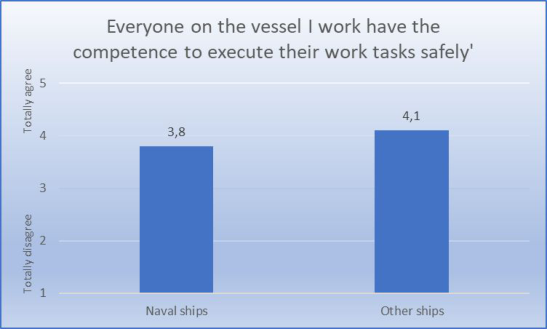
Results from an ANOVA showed that crew members on naval ships agreed to a lesser extent to the statement regarding adequate competence than crew members on other vessel types (F(1, 7407) = 6.533, p < .001). The second hypothesis was not supported.
728 Kongsvik and Aalberg
Figure 1: Level of agreement from 1 (‘Totally disagree’) to 5 (‘Totally agree’) on the statement ‘Everyone on the vessel I work have the competence to execute their work tasks safely’ – means.
Safety Management The survey included four categories of items related to safety management: shipboard safety management, onshore safety management and procedures. It was explored if crew members from naval ships had a more negative perce- ption of the safety management system and prrocedures than crew members from other vessel types (Table 4).
No statistically significant differences were found related to shipboard safety management items. The groups differed on one of the six items related to onshore safety management. Crews on naval ships had a more negative view on the shipowner’s response to reported incidents than other respon- dents, F(1, 6948) = 9,214, p < .001. However, the effect size was small (η2 < .01) indicating little practical implication. Thus, hypothesis 3 received limited support.
Safety Practices Five survey items were related to safety practices, considering reporting, the stopping of dangerous work and notification of colleagues (Table 5), analyzed with ANOVA.
There were small and no significant differences on the mean scores on items related to safety practices for naval and other ships. Crew members from naval ships did to a lesser degree agree with a statement regarding stopping work (F(1, 6950) = 14.391, p < .001 and regarding whether colleagues report incidents (F(1, 6872) = 5.467, p < .05. Effect sizes were small as measured by eta squared, η2 < .01 and thus implicates low practical implication of the differences. The results yield limited support hypothesis 4.
DISCUSSION
Naval ship crew members reported less general and specific experience as a sailor compared with crew members from other vessels. Naval ship crew
Exploring Organizational Safety Vulnerabilities on Naval Ships 729
Table 4. Level of agreement from 1 (‘Totally disagree’) to 5 (‘Totally agree’) on statements related to safety management – means.
Table available in the original PDF paper.
Statements Mean (St.dev) p-value
Naval Other ships ships
NS
4.50 (0.86)
4.44 (0.94)
Shipboard safety management
I am confident that I get support from ship management if I prioritize safety in all situations
NS
4.21 (1.00)
4.27 (0.99)
The ship management leads by example when it comes to ensuring one’s own and others’ safety
NS
Safety has first priority on the vessel I work on
4.34 (0.91)
4.39 (0.95) <.01 The shipowner responds to incidents we report 3.56 (1.2) 3.76 (1.19)
Onshore safety management
NS
3.71 (1.05)
3.76 (1.13)
I think that the shipowner’s responses to breaches of rules and procedures are fair
NS
3.95 (1.06)
4.08 (1.06)
We receive feedback on changes that are initiated based on reported adverse events
NS
Following the safety routines is not valued by the shipowner I work for*
4.22 (1.11)
4.12 (1.2) NS 4.11 (1.11) 3.97 (1.23) As long as the work is done, the shipowner does not care how we do the work*
NS
Procedures The safety procedures are adequate for my tasks
4.34 (0.93)
4.43 (0.87) NS I have easy access to procedures and instructions that apply to my work 4.54 (0.9) 4.62 (0.8)
*the items has been reversed.
members had less confidence in the colleagues’ safety competence compared with crew members on other ships. There was little or no evidence of naval crew members having a more negative perception of the safety management system. Crew members on naval ships were less positive to stop working in dangerous situations and had less confidence in the reporting behavior of their colleagues.
The mandate for the internal navy investigation after the accident was to uncover systemic risk factors (NAF, 2020). In general, systemic analysis builds on open systems theory and an input-process-output model (Harri- son, 1994). In a safety perspective, systemic analysis involves investigating complex interactions between components in a sociotechnical system, and approaches such as FRAM, Accimap and STAMP have been developed and applied for such analyses (Patriarca et al., 2020). The internal report high- lighted safety competence and safety management as systemic factors, and describes some cultural risk factors, including complacency, as a general ove- rarching casual category, considered to be of relevance to the Navy in general.
730 Kongsvik and Aalberg
Table 5. Level of agreement from 1 (‘Totally disagree’) to 5 (‘Totally agree’) on statements related to safety practices – means.
Table available in the original PDF paper.
Statements Mean (St.dev) p-value
Naval Other ships ships
NS
I report if I see hazardous situations
4,60 (0,62)
4,65 (0,66) <.001 4,43 (0,81) 4,61 (0,77)
I stop working if I think it can be dangerous for me or others to continue
NS
My colleagues stop me if I work in a hazardous way
4,19 (0,83)
4,24 (0,94) NS 4,52 (0,68) 4,45 (0,84)
I notify my colleagues if he/she does not use the required protective equipment
<.05
My colleagues report any adverse events or near misses
3,60 (1,13)
3,77 (1,18)
Even if the level of experience seems to be lower on Naval ships, which could be explained by the enrollment of conscripts in the Norwegian navy, there are no clear signs of complacency, as the trust in collegues’ safety compete- nce is medium and lower compared to crew members from other ships. Also, the perception of key elements of the safety management system is positive, including the support from ship management, prioritization of safety and procedures for their work. The safety practices addressed in the survey are also perceived to be adequate among the naval crew members, although less positive on reporting behavior compared to other crew members.
In total, there are no clear indications of systemic risk factors based on the survey results. In classical contributions from safety science, naval ships have in fact been put forward as examples of ‘High-Reliability Organizations’ (LaPorte & Consolini, 1991). Even if naval ships can be described as complex and tightly coupled sociotechnical systems and characterized by a high tur- nover of young and inexperienced personnel, aircraft carriers were found to operate quite safely. To consider a single accident and start looking for syste- mic causes made applicable for a whole category of cases (the navy in general) could lead to inaccurate generalizations. It is clearly commendable that the navy has searched for organizational root causes and weaknesses. Still, some of the issues identified could be independent of the navy and represent general challenges in maritime organizations. The two accident investigations have applied established methods and build on a general accident model, con- sidering root and immediate causes (ILCI), and a MTO (man, technology, organization) perspective. As mentioned, there are also other perspectives available, suitable for systemic analyses (Patriarca et al., 2020).
There are also some methodological weaknesses that could have influe- nced the results, including a relatively low number of navy respondents and some demographic differences between the two subsamples. The group of crew members selected for comparison is also quite heterogenous when it
Exploring Organizational Safety Vulnerabilities on Naval Ships 731
comes to missions, tasks and work processes. It might be that characteri- stics are ‘leveled out’ and become unsuitable for comparison. There are also raised some general concerns related to applying questionnaire surveys and self-reporting for considering organizational safety (e.g. Dahl & Kongsvik, 2018). In general, the results could be subject to Type II error; there might be differences between the subsamples even if the analyses have not been able to reveal them.
CONCLUSION
The crew members on naval ships had less experience and less confidence in their colleagues’ competence to work safety, compared with crew members from other ships. There were few and relatively small differences on other measures included in the analysis. There are several approaches available that could supplement traditional accident investigations when investigating systemic analyses of complex sociotechnical systems.
REFERENCES
Aalberg, A. L., Bye, R. J., Tkalich, A., Sørskår, L. I. K., & Berntsen, V. (2020). A Preliminary Psychometric Validation of the Safety Perception Index on Norwegian Vessels (SPIN-V). In 30th European Safety and Reliability Conference and the 15th Probabilistic Safety Assessment and Management Conference. https://www. rpsonline. com. sg/proceedings/esrel2020/pdf/3716. pdf. AIBN (2019). Part one report on the collision on 8 November 2018 between the
frigate HNOMS Helge Ingstad and the oil tanker Sola TS outside the Sture termi- nal in the Hjeltefjord in Hordaland County. Report: Acident Investigation Board Norway. Allianz (2021). Safety and shipping review 2021. An annual review of trends and developments in shipping losses and safety. Report. Dahl, Ø., Kongsvik, T. (2018). Safety climate and mindful safety practices in the oil
and gas industry. Journal of Safety Research, 64, 29-36. Department of the Navy (2017). CNO USS Fitzgerald and USS John S McCain.
Memorandum for distribution. Harrison, M. I. (1994): Diagnosing organizations: methods, models, and processes.
Thousand Oaks, California.: Sage. LaPorte, T.R., Consolini, P.M. (1991). Working in practice, but not in theory: Theoretical challenges of high-reliability organizations. Journal of Public Administration Research and Theory, 1, 19–47. Maritime Authority (2022). Accident statistics Obtained 10-02-22 from https://ww
w.sdir.no/ NAF (2020). Report after internal investigation of the serious incident with KNM Helge Ingstad in the Hjeltefjord 8 November 2018. [Rapport etter forsvarsin- tern undersøkelse av alvorlig hendelse med KNM Helge Ingstad i Hjeltefjorden 8. november 2018 – in Norwegian only] Report: Norwegian Armed Forces. Patriarca, R., i Gravio, G., Woltjer, R., Costantino, F., Praetorius, G., Ferreira, P.,
Hollnagel„ E. (2020). Framing the FRAM: A literature review on the functional resonance analysis method. Safety Science, 129.
LISTED IN THE AHFE DIGITAL BOOKSTORE CATALOGUE
Explore the complete digital volume
Human Factors in Transportation
Read this individual research paper free through the original publisher, or explore the full digital proceedings book.
ISBN 978-1-958651-36-0
Explore this ISBN in the AHFE Bookstore ↗Listed in the July 2026 bookstore catalogue; search by ISBN to confirm current availability · Digital book purchase optional