Herminia Machry, Lorena Muzel Gomes, Marzia Chowdhury (2026). Design and Workflow in Single-Family NICU Rooms: Examining Flow Disruptions in Infant Care. In: Healthcare and Medical Devices. AHFE Open Access, vol. 211, pp. 165–178. https://doi.org/10.54941/ahfe1007479
Neonatal intensive care units (NICUs) are uniquely complex settings, where families and clinicians navigate workflows shaped by sophisticated medical technology and safety risks surrounding fragile infants. To enhance developmental care, many NICUs have transitioned toward the Single-Family Room (SFR) design model, treating patients in private rooms. Compared to open bay layouts, SFRs have shown increased infection control and family participation in care. Despite these benefits, relatively little is known about how SFR design characteristics introduce safety risks to infant care, especially considering the increased family involvement in care tasks such as Kangaroo care and infant feeding. These tasks can be cognitively and physically demanding, especially for families, and carry substantial risk of infection, traumatic injury and medical errors. While design may potentially minimize flow disruptions and risks in healthcare tasks, evidence is scarce from the built environment perspective, especially in the NICU. We conducted a study to identify how specific SFR features such as room size, layout, and equipment/furniture design can influence disruptions in the flow of infant care tasks jointly performed by families and staff. Using an exploratory approach, we conducted two online focus groups and a case study involving field observations and interviews, thematically analysing the data. Findings revealed 11 types of design-related flow disruptions in the SFR, categorized as high and low risk. Flow disruptions were linked to SFR layout, storage and surface organization, infant bed clearances, cord management, and furniture/equipment design. Findings also revealed physical mechanisms involved in these flow disruptions, laying foundation for future research.
Infants treated in neonatal intensive care units (NICUs) are frequently subject to complex and lengthy treatments, facing risks of long-term developmental problems after NICU discharge (Van Poucke et al., 2022). The NICU environment is also the background of multiple and often overlapping infant care workflows involving high-risk tasks, different types of people (infant, family, multidisciplinary staff), and sophisticated medical technology; ultimately unveiling flow disruptions and patient safety hazards.
The built environment around NICU workflows has changed over time, mainly to improve infant’s developmental care, safety, and family participation in care (Shepley, 2014). NICUs went from shared open bays to the Single-Family Room (SFR) design model, where infants receive care in private rooms equipped with family accommodations and, in some cases, private bathrooms (Stevens et al., 2011). While research shows the benefits of adopting SFRs in comparison to open bays in NICUs, especially in terms of infection control and family involvement in infant care (Jones et al., 2022), these spaces introduced new dynamics in the work system of the NICU, which needs to be understood in more depth from the perspective of the built environment and human factors. Recent studies have laid foundational knowledge on SFR design features impacting family engagement behaviours in the NICU, mentioning how elements such as family storage and information displays may influence family-staff communication in the room (Machry et al., 2023; Machry et al., 2021). However, there is limited evidence on how SFR interior design features such as SFR size, layout, and equipment/furniture design can support safe infant care behaviours involving family and staff. It is important to understand how built environment features can help minimize flow disruptions in this collaborative work during tasks such as Kangaroo (or skin-to-skin) care, infant feeding, and biomedical waste management, looking for ways to reduce cognitive and physical burdens for staff and families, and lowering the risk of infection, traumatic injury, medical errors, wrong feedings, and parental disengagement in infant care.
THE SFR WORK SYSTEM The SFR is a unique, high-risk and high-complexity healthcare environment that involves a work system prioritizing patient safety. According to the Systems Engineering Initiative for Patient Safety 2.0 (SEIPS) model from Carayon and colleagues (2020), such healthcare settings are affected by inter- related factors: tasks, technology, people, organizational culture, and the physical environment. In this model, such factors jointly impact healthcare processes and ultimately affect patient and staff outcomes.
When examining the SFR work system, Clustered Care (or bundled developmental Care) stands out as the enactment of staff-family collaboration during infant care. It comprises tasks routinely performed at bedside several times a day, at defined times (e.g., every 3 or 4 hours), such as changing diapers, feeding, measuring vital signs and head circumference, administering medication, measuring the infant’s abdominal girth, taking axillary temperature, weighing the infant, changing their position, and doing Kangaroo care (Avazeh and Babaei, 2023). These tasks are typically performed in a bundle to minimize the time infants spend moving or making any effort, which could cause undesired weight loss. Additionally, evidence suggests that clustered care supports infant development due to uninterrupted infant sleep (Hendy et al., 2022; Wang et al., 2021), and reduced infant pain and stress (Chuang et al., 2019).
Design and Workflow in Single-Family NICU Rooms 167 Clustered Care is inherently multidisciplinary, involving tasks performed simultaneously by multiple people (e.g., nurses, respiratory therapists, parents) operating in different yet overlapping work zones in the SFR. The technology involved in these tasks is also diverse and multifaceted, varying according to the severity of infant’s conditions and pertaining to various types of infant bed (or incubator) sizes and complexities (e.g., incubators for the most critical, and cribs for the healthier infants), intravenous (IV) stands and monitors, and more advanced equipment (e.g., Ecmo machine and ventilators) for the most critical infants. The built environment of the NICU, in turn, has also been recognized as a factor to clustered care by showing how light, noise and smell in the NICU can influence infant sleep quality and oxygen saturation, as well as their breathing and heart-rate variability (Hendy et al., 2022; Givrad et al., 2021).
These studies, however, do not provide any specific insight into the context of SFRs or discrete infant tasks. Moreover, while there are studies investigating design features in the SFR that impact family engagement and identifying the relevant role of privacy partitions and information displays in the room when supporting family wellbeing and family-staff communication (Machry et al., 2023), no studies looked at how the built environment impacts tasks involving staff and non-clinical family members in infant care in the SFR, and how these features can support infection control and the efficiency of these tasks.
INFANT CARE RISKS & DIFFICULTIES Although not SFR-specific, there is evidence showing safety risks and workflow challenges in the NICU, such as risks of infection and injury, as well as feeding difficulties. Infection risks in the NICU stem largely from inadequate hand hygiene among healthcare providers and parents, often influenced by limited education, insufficient access to soap, running water, or alcoholbased hand rubs, and high stress or workload (Deshommes et al., 2021). Additional risks arise from improper handling of expressed breast milk, including unsafe cleaning of pumping supplies, contaminated containers, and incorrect milk transport (Mondkar et al., 2018), as well as infantrelated factors such as immune immaturity, very low birth weight (< 1500 g) (Gastmeier et al., 2007), high patient density (Casolari et al., 2005), and exposure to invasive procedures like catheter placement and mechanical ventilation (Buttinelli et al., 2017). Breast milk itself can be a source of infection when contaminated (Berardi et al., 2018), and infants remain vulnerable to respiratory, umbilical, and intestinal infections (Wang et al., 2021). Injury risks also have been reported in the NICU, including concerns that Kangaroo care may lead to intravenous line dislodgement or accidental extubation (Chan et al., 2015), as well as the potential for longterm musculoskeletal or neurodevelopmental issues when infants are improperly positioned (Goodstein et al., 2021). Moreover, feeding difficulties also pose risks to infant safety, including aspiration, poor weight gain, and malnutrition (Kritzinger et al., 2019).
The design of the NICU built environment can help prevent these risks and difficulties by minimizing flow disruptions in infant care. Environmental design can reduce surfacecleaning burdens, reinforce hand hygiene and surveillance, and co-locate infected infants in the same area to facilitate workflows (Cristina et al., 2019). Considering sinks can be reservoirs for pathogens (Squier et al., 2000), maintaining safe distances (at least 3 feet) between infant bed and sinks is also recommended to prevent splash contamination (Denham et al., 2018). Limited space, inadequate furniture, or lack of private areas for parents can also potentially hinder safe Kangaroo care (Yue et al., 2020). Furthermore, previous studies investigating other complex and risk-prone healthcare environments have specifically recognized flow disruptions as latent threats to patient safety in spaces such as operating rooms, revealing clutter issues and spatial features such as room layout and size contributing to the likelihood of disruptions in the surgical workflow leading to medical errors and contamination risks (Joseph et al., 2018).
RESEARCH AIM & QUESTIONS Based on this foundational knowledge, we aimed to investigate how interior design factors impact flow disruptions in the SFR, such as sterility threats and environmental hazards, that may lead to errors, contamination risks, and environmental hazards in the context of clustered infant care. We specifically looked at these disruptions during clustered care tasks jointly performed by family and staff in the SFR, such as infant feedings, medication administration, Kangaroo care, and waste management. We posed the following research questions: 1) “How are flow disruptions related to the built environment occurring in the SFR during family-staff clustered care tasks?”, and 2) “How are interior design features in the SFR influencing these flow disruptions?”
METHODS
Using a qualitative approach, this study was conducted in two phases, between May 2023 and August 2024. During Phase I we conducted two online focus groups with a total of eight staff members, with staff members from two NICUs following the SFR model and located in the United States. Phase II comprised of a case study in a SFR NICU located in the Midwest U.S., involving field observations combined with interviews with staff and families staying at the NICU. IRB approval for the study was received from the University of Kansas Medical Center (STUDY00150165).
In Phase I, we conducted two online focus groups with healthcare providers of two NICUs using the SFR design model. Focus groups were video recorded and transcribed verbatim using Zoom software. One focus group was from a large level IV NICU located in a Children’s hospital in the South of the United States, and included 4 participants
Design and Workflow in Single-Family NICU Rooms 169 (1 Neonatologist, 1 Registered Nurse, 1 Respiratory therapist, and 1 Speech Pathologist). The other focus group was from a level III NICU in a Children’s hospital in the Midwestern region of the country, and also included 4 participants (1 Neonatologist, 2 Registered Nurses, and 1 Social Worker). Two researchers asked open-ended questions aimed at identifying care tasks with family involvement that were potentially risky or inefficient, and related to the interior design of the SFR. Examples were “What types of infant care tasks do you usually see family members doing when taking care of their infant in the Single-Family room? How do these tasks happen in the room?”; and “Please describe what would be examples of inadequate behaviours during these infant care tasks performed by family members, such as errors, missteps, disruptions.” Such questions were used to narrow down the focus and precision of observation and interview tools used in Phase II.
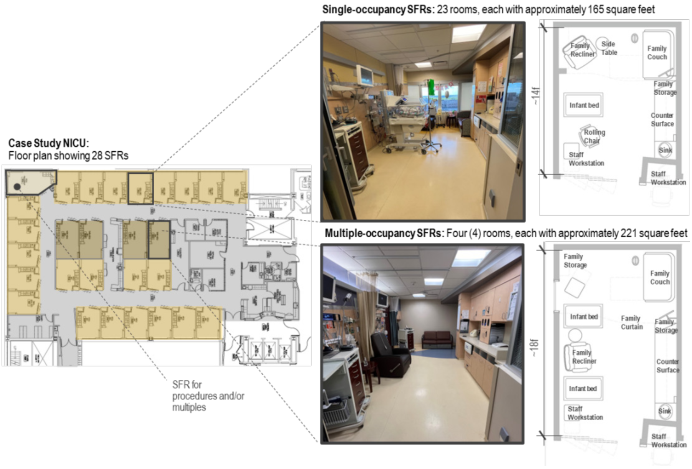
Phase II consisted of field observations of 13 infant clustered care events at a level III SFR NICU (Figure 1) located in a large teaching hospital in Kansas, involving staff and family, and in-person semi- structured interviews with 21 participants (14 staff and 7 families) in the same unit. Between July and October of 2023, two researchers conducted observations, interviews, and a physical assessment of the unit that included initial floor plan verification and ongoing photo assessments. Semi-structured case study interviews were audio-recorded and conducted for about 30 minutes in empty SFRs. Participants were recruited in person, during daily huddles and one-on-one interactions, with the help of a nurse acting as the study gatekeeper in the unit. An observation tool was developed based on the literature on environmental factors related to flow disruptions, errors, contamination risks, and environmental hazards in the context of infant care behaviours, adapting an existing framework for direct observations of performance and safety in healthcare (Catchpole et al., 2017).
During observations and interviews, we focused on the environmental context of clustered care tasks as defined by Machry and colleagues (2023): Direct Infant Care (Family and Staff collaborating in tasks involving direct physical contact with infants, such as skin-to-skin care, breast or bottle feeding, and diapering), Feeding Care (family and staff collaborating in tasks preparing infant feedings, such as pumping breastmilk and cleaning milk bottles), and Observational care (family and staff observing infant for supervision and learning purposes).
Data were analysed between March and July of 2024, using pattern matching and thematic analysis. One researcher transcribed interviews verbatim and selected quotes for analysis based on specific criteria. Quotes were selected if words or sentences from the participant describe actions, activities, opinions and perceptions related to infant care (e.g., feeding, cleaning, or holding infant, as opposed to activities family members do in the room that do not directly relate to caring for the infant); and if words or sentences from the participant also related to design /physical elements and characteristics of the Single-Family room
(not areas outside of the room). Quotes were transferred to a spreadsheet and coded by three researchers, who individually created code categories and themes based on relationships between built environment or design factors to infant care outcomes (e.g., infection risk, hazard, workflow inefficiency, etc.). Agreement meetings reconciled coding discrepancies, and data from observations and physical assessments were used to corroborate patterns found in interviews relating flow disruptions to SFR characteristics.
Figure 1: Floor plan of case study NICU showing the location of SFRs investigated: 23 SFRs designed for single-patient occupancy, and four (4) multiple-occupancy SFRs.
RESULTS
We identified 11 types of flow disruptions related to the interior design of the SFR. These were categorized as high risk (n = 4), potentially leading to infection or injury risks, and as low risk (n = 7), potentially leading to disruptions in direct care (infant holding and feeding), feeding care (preparing infant feedings), observational care (observing infant or care), and care demonstration (showing and teaching feeding strategies). Disruptions were linked to four themes: Inadequate Layout and Cord Management; Inadequate, Insufficient, and Disorganized Storage and Work Surfaces; Insufficient and Cluttered Infant Bed Clearances; and Inadequate Furniture/ Equipment Design. Table 1 shows the identified flow disruptions in relation to SFR design factors included in these themes, and Figures 2 and 3 illustrate environmental issues observed and mentioned by study participants.
Design and Workflow in Single-Family NICU Rooms 171 Inadequate Layout & Cord Management
Quotes from case study and focus group participants revealed that the layout (physical arrangement) of furniture and equipment in the SFR can contribute to risks of infection and injury in infant care tasks, as well as to the disruption of care and care demonstration (e.g., staff showing family how to properly feed infant). The position of the chair used by family members to hold their infants during Kangaroo care and feeding (the Kangaroo Chair) was often mentioned as inadequately positioned or not flexible enough, especially in SFRs occupied by multiple infants (e.g., twins). The chair was described as located where “cords don’t reach” or encroached with cords and equipment attached to the infant. This, in turn, was mentioned as a concern due to configuring tripping hazards and risks of connector dislodgement of life support equipment during tasks such as infant transfer from bed to parent holding. Additionally, staff noted that because the information board is used during feeding demonstrations, the Kangaroo chair must be positioned so parents can see it.
Sample quotes: “In the twin room, let’s say parents want to hold both twins and they’re on CPAP. (...) I need to get a chair. I have this baby in the tubing. (...) Can I get a chair in there? And then a nurse comes to see the other baby and you have isolette, ventilator, chair. (...) Then you’re going to try to do move maybe the ventilator or the isolette, and it’s just tight. It’s tight when they’re trying to do two things. I’m like ‘can you just sit on the couch’, and I’ll have them move, hold the baby over there. It’s just, I feel like it’s crowded.” (Case Study Nurse) “You’re limited on space. (...) My mom and I would try to be here, but then when RT and nurse would come in we would be ‘playing the shuffle game’. (...) If I’m standing there, I either have to back up or I have to scoot in, and then they have to go around me or they have to go in front of me. (...) And he’s got the nasal cannula and the wires, so we don’t want to go too far that something would pull out.” (Case Study Family)
The inadequate layout of resources for hand hygiene (e.g., sink, hand sanitizers) and waste management (trash cans and diaper scale) around the infant was also mentioned by staff as a usability or ergonomic issue. On the other hand, staff members also highlighted the lack of clean-dirty separation in the room as a threat to sterility around the infant, with conflicts between dirty/contaminated areas (e.g., dirty diaper scale) and sterile areas (e.g. surface used to prepare fluid catheters).
Sample quote: “There’s not a real separation between ‘kitchen’, ‘bathroom’ and ‘living room’ in this room, and I think that could be something to think about… think of how you separate things at your house, and how you keep the hygiene separated.” (Focus Group 2 Staff)
Table 1: Design factors identified in each impact level and type of flow disruptions.
Table available in the original PDF paper.
Impact Outcome Flow Disruption Design Factors N High Infection Risks Sterility Threats Inadequate clean-dirty layout separation 13S 3S (FG) 1F
Lack of family-dedicated storage 3S (FG) Lack of clean supply storage or surfaces 1S 1F
Injury Risks Risk of Connector Dislodgement due to Tripping Hazards
Cords or equipment in the way 7S 3S (FG) 6F 2S Insufficient and cluttered circulation around infant bed with supporting equipment
1F
Excessive Reach Inadequate Kangaroo chair position in relation to call button 1S (FG) Risk of Infant Malposition Inadequate Kangaroo chair position in relation to respiratory equipment
Low Active Care Disruption
Accessibility Barriers
Insufficient and cluttered circulation around infant bed with supporting equipment
8S 4S (FG) 5F Insufficient and disorganized work surfaces 3S 3F
Insufficient and disorganized storage and/or staging for tubes, catheters, and cords
2S 1S (FG) 2F Inadequate infant bed design 1F
Inadequate Kangaroo chair position in relation to infant bed, equipment, and sink
Visibility Barriers Inadequate layout of monitors, clock and curtain
4S 4F (Continued)
Table 1: Continued.
Table available in the original PDF paper.
Impact Outcome Flow Disruption Design Factors N 4F
Usability or Ergonomic Issues
Insufficient and disorganized storage and work surfaces 6S Inadequate layout of hand hygiene, trash cans, and diaper scale
1S 5F
Inadequate design of sink faucet, infant bed storage, and Kangaroo chair arms Inadequate layout of hand hygiene, trash can, side table, and diaper scale 1S 1S (FG) 3F
1S (FG)
Inadequate Kangaroo chair design
Care Demonstration Disruption
Care or Feeding Demonstration Barriers
2S (FG)
Feeding Demonstration Barriers
Inadequate Kangaroo chair position in relation to information board Clutter around infant bed 1S (FG) 1F Infant Observation Barriers (due to crowding/clutter)
Direct and Observational Care Disruption
2S (FG)
Family zone far away from infant bed
Family-infant Proximity or Touch Barriers N = number of participants | S = staff | F = family | FG = focus group
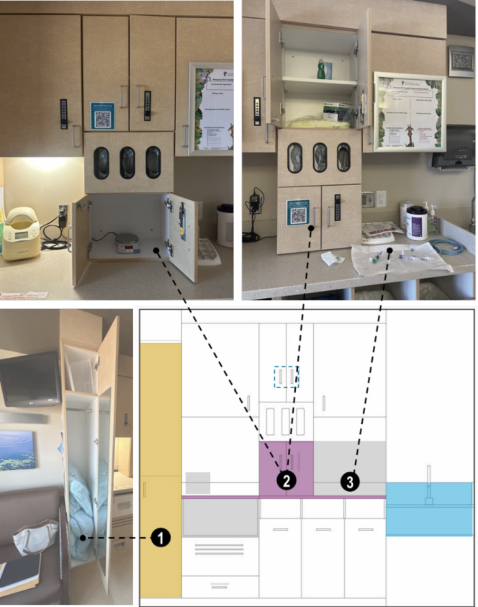
Inadequate, Insufficient, and Disorganized Storage & Work Surfaces Many staff participants from both the case study and focus groups, and one family member, associated sterility threats with the lack of clean-dirty separation in work surfaces such as the ones observed and illustrated in Figure 2. Also, the lack of family-dedicated storage in the SFR was identified as an issue because it created opportunities for family members to place their personal belongings in work surfaces of the room that should be clear/sterile. Staff and families described insufficient, disorganized work surfaces as an ergonomic challenge that created crowding and access barriers during infant feeding.
Sample quotes:
“Where we weigh diapers is where we clean things. So, that could be kind of gross. There could be an actual separation of ‘what’s dirty can go on this side’, and what’s needing to be very clean, have it be separate.” (Case Study Staff) “When the nurse comes in, sometimes we’re kind of working around each other right there [at the countertop]. (...) We’ve got the warmer, and it can get a little crowded when we’ve got multiple people here trying to do stuff, all right there, at that counter.” (Case Study Family)
Figure 3: Elevation of countertop area in the SFR (bottom right) and photos that show (1) small family storage availability; (2) diaper scale cabinet; and (3) clean-dirty conflicts on countertop, with clean fluid catheters and syringes in front of dirty diaper scale.
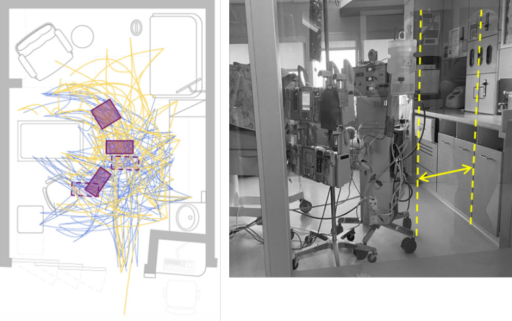
Insufficient and Cluttered Infant Bed Clearances Study participants, mainly staff, emphasized the presence of clutter in SFRs containing additional equipment, in clearances around infants with more critical care needs. This issue, which was also observed and is illustrated in Figure 3, was a concern due to being an accessibility barrier and tripping hazard in any direct infant care task. Furthermore, this was revealed as a barrier to family members who need to observe infant care in the infant bed area.
Sample quotes:
“(…) It can be mostly just lack of space, especially when there’s a ventilator involved, usually with going from the bed to the to the chair, whether it be the parent moving the baby or the RT, and the nurse moving the baby. We have to go under the respiratory tubing. (…) we do have to go under that tubing to be able to get to the chair. (...) Someone accidentally pulled the breathing tube out just in the process of trying to get the baby to the parent.” (Case Study Nurse) “A lot of times, when you want to touch [the baby], there’s nurses around. So, getting out of doors is a little bit of a challenge because there’s people coming in and out or in the doorway. (...) I don’t think it would be as much of a deal for babies that don’t have as much equipment. But with so much more equipment, which is necessary, it does make it a little more difficult to get around.(...) the switching process is a little difficult when you try to cross the equipment (incubator), so maybe if it had more space here for the switching moment.” (Case Study Family)
Figure 3: Example of single-occupancy SFR involving critical care equipment that shows hindered clearances and workflow around the infant bed. On the left, the movement of people and equipment tracked during field observations depicts the utilization of the area shown on the image on the right.
Inadequate Furniture/Equipment Design Both family and staff participants commented on the role of the design of Kangaroo chairs and the infant bed (incubator or Isolette) in their infant care tasks. They emphasized the need of armrests and more mobility in Kangaroo chairs, to facilitate comfort and communication during infant holding and feeding demonstrations. Risks of contamination and difficulty during infant cleaning (changing diapers) were associated with the opening mechanisms of the incubator’s doors/sides and storage drawers. Moreover, issues with infant cleaning (bath) were mentioned, mostly by family, in the context of inadequate sink and faucet design, revealing how the sink should be larger and the sink faucet should offer better water flow regulation systems to facilitate washing infants.
Sample quotes:
“Picking the appropriate chair to sit in… that makes a big difference. Because I don’t want to sit in a chair without an armrest… these guys get heavy. (…) I don’t ever use the folding chair because it doesn’t have arms.” (Case Study Family) “I can’t keep the [incubator] drawer open because it’s a little bit more easy access to reach instead of trying to reach over the isolette side. (…) it goes all the way down and it blocks over, locks it. So that way you’re able to stand up against the [BABY], but you can’t access any of the drawers because you can’t leave him with this [side] open..” (Case Study Family
“Anytime you’re changing a diaper in an isolette, closing the [isolette] doors is always hard. (…) you kind of have to use a dirty hand in a clean area. Going over here to weigh the diaper, you don’t want to leave the (isolette) door just flapping open and the baby to get possibly colder, or could possibly fall.” (Case Study Staff)
CONCLUSION
In this study, we examined how interior design features of the SFR shape influence disruptions during clustered infant care tasks jointly performed by family members and staff in the NICU. The 11 types of flow disruption identified ranged from sterility threats and tripping hazards to accessibility and visibility barriers, revealing physical mechanisms through which the built environment can influence tasks pertaining to direct infant care, feeding care, observational care, and care demonstrations. Notably, many of these disruptions emerged at the intersection of advanced medical technology and family participation in care, underscoring the complexity of SFR work systems. Our findings demonstrate that room layout, infant bed clearances, cord management, storage and surface organization, as well as furniture/ equipment design can contribute to safety risks and workflow inefficiencies. These data suggest that improving clean-dirty separation in work surfaces and cabinetry, increasing circulation space when advanced equipment is used in infant care, and improving storage allocation and furniture ergonomics may reduce cognitive and physical burdens on both staff and families, thereby supporting safer and more efficient infant care.
By linking specific spatial and design characteristics to high- and low-risk disruptions in clustered care, this study extends prior evidence on NICU design safety by highlighting important details in the SFR environment that should be considered and more deeply and critically evaluated. While limited in terms of generalizability due to its qualitative approach and small sample, our results provide a foundation for future quantitative and simulation- based research to inform evidence-based NICU design guidelines that more fully integrate patient safety, human factors, and family-centered care.
ACKNOWLEDGMENT
The authors would like to thank all study participants for their invaluable insights. We would also like to express our gratitude to Laurie Hay, for supporting the study during data collection.
REFERENCES
Avazeh, M. and Babaei, N., 2023. The necessity of implementing clustered care in preterm infants. International Journal of Community Based Nursing and Midwifery, 11(2), p. 149. Berardi, A., Guidotti, I., Creti, R., Alfarone, G., Grottola, A., Venturelli, C., Serpini, G.F.,
Della Casa, E., Vecchi, E., Boncompagni, A. and Toffoli, C., 2018. Two overlapping clusters of group B streptococcus late-onset disease in a neonatal intensive care unit. The Pediatric infectious disease journal, 37(11), pp. 1160–1164. Buttinelli, E., Ardoino, I., Lanzoni, M., Domeniconi, G., Pugni, L., Ronchi, A., Mosca, F., Biganzoli, E. and Castaldi, S., 2017. Epidemiology of Serratia marcescens infections in NICU of a Teaching and Research Hospital in Northern Italy. Minerva Pediatrics, 75(2), pp. 180–187. Carayon, P., Wooldridge, A., Hoonakker, P., Hundt, A.S. and Kelly, M.M., 2020. SEIPS
3.0: Human-centered design of the patient journey for patient safety. Applied ergonomics, 84, p. 103033.
Design and Workflow in Single-Family NICU Rooms 177 Casolari, C., Pecorari, M., Fabio, G., Cattani, S., Venturelli, C., Piccinini, L., Tamassia,
M.G., Gennari, W., Sabbatini, A.M.T., Leporati, G. and Marchegiano, P., 2005. A simultaneous outbreak of Serratia marcescens and Klebsiella pneumoniae in a neonatal intensive care unit. Journal of Hospital Infection, 61(4), pp. 312–320. Catchpole, K., Neyens, D.M., Abernathy, J., Allison, D., Joseph, A. and Reeves, S.T.,
2017. Framework for direct observation of performance and safety in healthcare. BMJ Quality & Safety; 26, pp. 1015–1021. Chan, G.J., Labar, A.S., Wall, S. and Atun, R., 2015. Kangaroo mother care: a systematic review of barriers and enablers. Bulletin of the World Health Organization, 94(2), p. 130. Chuang, L.J., Wang, S.H., Ma, M.C., Lin, C.N., Chen, C.L. and Huang, M.C., 2019.
A modified developmental care bundle reduces pain and stress in preterm infants undergoing examinations for retinopathy of prematurity: a randomised controlled trial. Journal of Clinical Nursing, 28(3–4), pp. 545–559. Cristina, M.L., Sartini, M. and Spagnolo, A.M., 2019. Serratia marcescens infections in neonatal intensive care units (NICUs). International journal of environmental research and public health, 16(4), p. 610. Denham, M.E., Bushehri, Y. and Lim, L., 2018. Through the eyes of the user:
evaluating neonatal intensive care unit design. HERD: Health Environments Research & Design Journal, 11(3), pp. 49–65. Deshommes, T., Nagel, C., Tucker, R., Dorcélus, L., Gautier, J., Koster, M.P. and Lechner, B.E., 2021. A quality improvement initiative to increase hand hygiene awareness and compliance in a neonatal intensive care unit in Haiti. Journal of tropical pediatrics, 67(3), p. fmaa029. Gastmeier, P., Loui, A., Stamm-Balderjahn, S., Hansen, S., Zuschneid, I., Sohr,
D., Behnke, M., Obladen, M., Vonberg, R.P. and Rüden, H., 2007. Outbreaks in neonatal intensive care units—they are not like others. American journal of infection control, 35(3), pp. 172–176. Givrad, S., Dowtin, L.L., Scala, M. and Hall, S.L., 2021. Recognizing and mitigating infant distress in neonatal intensive care unit (NICU). Journal of Neonatal Nursing, 27(1), pp. 14–20. Goodstein, M.H., Stewart, D.L., Keels, E.L., Moon, R.Y., Cummings, J., Hand, I., Adams-
Chapman, I., Aucott, S.W., Puopolo, K.M., Goldsmith, J.P. and Kaufman, D., 2021. Transition to a safe home sleep environment for the NICU patient. Pediatrics, 148(1). Hendy, A., Alsharkawy, S.S. and El-Nagger, N.S., 2022. The outcomes of a healing environment and clustering nursing care on premature infants’ vital signs, pain, and sleeping. Journal of Medicine and Life, 15(11), p. 1347. Jones, C.W., Moya, F. and Lynch, N., 2023. Unintended consequences of the neonatal
intensive care unit environment: integrative review of single-family room unit design. Advances in Neonatal Care, 23(2), pp. 151–159. Joseph, A., Khoshkenar, A., Taaffe, K.M., Catchpole, K., Machry, H. and Bayramzadeh, S., 2019. Minor flow disruptions, traffic-related factors and their effect on major flow disruptions in the operating room. BMJ quality & safety, 28(4), pp. 276–283. Kritzinger, A., Da Costa, M.A., Graham, M.A. and Krüger, E., 2019. Prevalence and
associated prenatal and perinatal risk factors for oropharyngeal dysphagia in high- risk neonates in a South African hospital. South African Journal of Communication Disorders, 66(1), pp. 1–8. Machry, H., Joseph, A., White, R. and Allison, D., 2023. Designing for family engagement in neonatal ICUS: How is the interior design of single-family rooms supporting family behaviors, from passive to active?. HERD: Health Environments Research & Design Journal, 16(3), pp. 238–260.
Machry, H., White R., and Barton S., 2021. The Case of a NICU with Single-family Rooms: Design Recommendations to Support Family Engagement Behaviors. Neonatology Today. 16(9), pp. 34–39. Mondkar, J., Chugh Sachdeva, R., Shanbhag, S., Khan, A., Manuhar Sinha, M.,
Dasgupta, R., Israel-Ballard, K. and Sabharwal, V., 2018. Understanding barriers and facilitators for human milk banking among service providers, mothers, and influencers of preterm and sick neonates admitted at two health facilities in a metropolitan city in India. Breastfeeding Medicine, 13(10), pp. 694–701. Shepley, M.M., 2014. Design for pediatric and neonatal critical care. Routledge. Stevens, D.C., Helseth, C.C., Khan, M.A., Munson, D.P. and Reid, E.J., 2011. A comparison of parent satisfaction in an open-bay and single-family room neonatal intensive care unit. HERD: Health Environments Research & Design Journal, 4(3), pp. 110–123. Van Poucke, J., Mailleux, L., De Beukelaer, N., Laroche, S., Ortibus, E., Strebelle, E.
and François, A., 2022. Care of the extremely low gestational age newborns after NICU discharge. Belgian Journal of Paediatrics, 24(1), pp. 55–61. Wang, H., Zhang, Y., Liu, X., Wang, Y., Shi, J., Yin, T., Zhao, F. and Yang, T., 2021.
The effect of continuous clustered care on the physical growth of preterm infants and the satisfaction with the nursing care. American Journal of Translational Research, 13(6), p. 7376. Yue, J., Liu, J., Williams, S., Zhang, B., Zhao, Y., Zhang, Q., Zhang, L., Liu, X., Wall, S., Wetzel, G. and Zhao, G., 2020. Barriers and facilitators of kangaroo mother care adoption in five Chinese hospitals: a qualitative study. BMC public health, 20(1), p. 1234.
LISTED IN THE AHFE DIGITAL BOOKSTORE CATALOGUE
Explore the complete digital volume
Healthcare and Medical Devices
Read this individual research paper free through the original publisher, or explore the full digital proceedings book.
ISBN 978-1-964867-87-8
Explore this ISBN in the AHFE Bookstore ↗Listed in the July 2026 bookstore catalogue; search by ISBN to confirm current availability · Digital book purchase optional