Joshua Kubelun, Kofi Owusu Adjei, Murendeni Liphadzi (2026). Strategic Approaches for Sustainable 4IR Skills Development in South Africa’s Built Environment. In: Sustainable Built Environment. AHFE Open Access, vol. 225, pp. 40–49. https://doi.org/10.54941/ahfe1007897
Sustainable Human Settlement and Construction Research Centre, Department of Construction Management and Quantity Surveying, University of Johannesburg, South Africa ↗
The Fourth Industrial Revolution (4IR) continues to redefine industries through technologies such as artificial intelligence (AI), automation, and the Internet of Things (IoT). In South Africa's built environment, advancements provide opportunities to improve productivity and sustainability. However, these efforts are impeded by poor policy alignment, inadequate educational reform, and a lack of digital infrastructure. This study explores strategic approaches that can enhance the sustainable development of 4IR skills in South Africa’s built environment. Standardised questionnaires were administered to 73 professionals working in the built environment, including architects, engineers, project managers, contractors, construction managers, and planners, through the purposive sampling technique. The data were analysed using descriptive statistics, such as means, standard deviations, and exploratory factor analysis (EFA). The topmost strategic approaches were ‘Curriculum reform to include 4IR and sustainability’, ‘Investment in digital infrastructure for training’, ‘Digital literacy programmes for underserved communities’, ‘Training in sustainable practices’, ‘Public-private partnerships for skills development’, and ‘Continuous professional development programmes’. The EFA results identified three key areas for skills development. Component 1: Institutional and Educational Programs, Component 2: Social and Awareness Interventions, and Component 3: Policy and Partnership Strategies. These results highlight the significance of collaborative governance, ongoing professional development, and curriculum modernisation in enhancing national 4IR competencies in the South African built environment.
The Fourth Industrial Revolution (4IR) has brought about a paradigm shift in industry functions due to the convergence of digital technologies such as artificial intelligence (AI), automation, robotics, and the Internet of Things (IoT) (Pittri et al., 2025; Gyamfi et al., 2025; Yankah et al., 2024). Technologies such as these enable data-driven project delivery, automate construction processes,
Strategic Approaches for Sustainable 4IR Skills Development in South Africa’s 41 and enhance infrastructure management and sustainability decision-making in the built environment (Ehtsham et al., 2025). Despite the significant role it plays in national development (Adebowale and Agumba, 2023), the built environment is hindered by productivity inefficiencies and skills shortages stemming from technological advancements and socioeconomic challenges.
The incorporation of 4IR technologies in construction presents opportunities for enhanced sustainability, reduced costs, and improved efficiency (Kissi et al., 2023; DHET, 2022). South Africa’s progress is still hindered by limited digital infrastructure, variable regulations, and an untrained workforce (Khoza, 2025). The sector’s ongoing reliance on labour-intensive and conventional methods, in contrast to the automation and digitalisation prevalent in more affluent countries, highlights the pressing need for change. This gap underscores the pressing necessity to provide workers with sustainable 4IR skills that combine technical knowledge and ecological awareness. Developing these skills is crucial not only for enhanced construction performance but also for attaining national development objectives associated with the United Nations’ SDGs and the National Development Plan (DHET, 2022).
Studies in South Africa have found that the implementation of 4IR technologies has been significantly hindered by the disparity between legislative guidelines, industry requirements, and educational systems (Hadzic, 2024; Kissi et al., 2023; Van Wyk et al., 2021). Universities and technical schools have been criticised for outdated curricula and failing to equip graduates with the skills needed for careers that rely heavily on technology (Ababio et al., 2024; DHET, 2022; Cunningham, 2018). National efforts to digitalise the built environment have been less effective due to insufficient unified policies and financial channels (Zhang et al., 2023). Consequently, many built environment professionals are deficient in transdisciplinary skills, such as digital literacy, systems thinking, and knowledge of sustainable design, which are required to operate effectively in a constantly evolving technological environment (Nkosi, 2021).
The development of 4IR skills is further hindered by sociocultural and economic factors, as well as institutional and educational shortcomings. Studies show that the Science, Technology, Engineering, and Mathematics (STEM) fields are still struggling with issues of inclusivity, such as gender disparities, concerns about job loss, and resistance to technological advancement (Van Wyk et al., 2021). Social barriers restrict the scope of ideas necessary for innovation and prevent groups on the margins from actively participating. A comprehensive strategy that incorporates social inclusion, policy alignment, and educational reform into a coherent framework is required for skill development (Kilic, 2025). Ensuring that technological advancements lead to sustainable and equitable growth across all societal sectors requires a workforce that is digitally competent and inclusive (Nkosi, 2021).
A disjointed and uncoordinated strategy for developing sustainable 4IR capabilities in South Africa’s built environment necessitates further examination. This study aims to establish a clear strategic direction for speeding up the 4IR transformation. This study aims to bridge the gap by examining strategic methods that can foster the long-term advancement of 4IR capabilities in the built environment. This study seeks to assess strategic
approaches for 4IR skills development, guiding practitioners, educational establishments, and decision-makers towards a more resilient and technologically advanced built environment by focusing on the interconnected elements of institutional change, inclusivity, and policy synchronisation.
LITERATURE REVIEW
Overview of Sustainable 4IR Skills An integrated collection of competences referred to as “sustainable 4IR skills” allows professionals to adopt new technologies while fostering environmental stewardship and social inclusion (Ehtsham et al., 2025). These abilities also encompass the capacity to use digital tools to ethically enhance resilience and sustainability in the built environment (Cunningham, 2018). Adebowale and Agumba (2022) stressed that cross-sector collaboration between industry, academia, and government is necessary to ensure that the workforce has the capabilities required for upcoming technological needs.
The built environment in South Africa remains constrained by a shortage of institutional support and technical skills training. Transformation in the digital arena is considered a national imperative under the National Development Plan (NDP) 2030; however, advancements are being hindered by outdated curricula and limited access to information and communication technology in many educational establishments (Ehtsham et al., 2012). The nation’s ability to fully take advantage of 4IR technologies is hindered by the gap between industrial needs and educational outcomes (Nkosi, 2021).
Strategic Approaches for Sustainable 4IR Skills Development Developing robust 4IR capabilities requires education and institutional change, social inclusion, and alignment of policies (Kissi et al., 2023). Parusheva (2019) maintains that investments in digital infrastructure and revamped curricula are vital for advancing technological proficiency. Converting theoretical 4IR principles into practical applications is hindered in professionals without a digitally enabled learning environment, thereby limiting innovation and productivity growth (Perusheva, 2019). Moreover, 4IR skills development initiatives have not been adequately aligned with the Broad-Based Black Economic Empowerment (BBBEE) agenda, which seeks to overcome historical disparities. BBBEE prioritises employment equity but fails to address the need to upskill black professionals in cutting-edge technologies, thus preventing their participation in the built environment shaped by 4IR (Mayer and Oosthuizen, 2022).
Adebowale and Agumba (2023) stated that awareness and inclusion initiatives are essential for addressing the human element in technology development. Campaigns to raise awareness can aid in dispelling misconceptions about automation, and training tailored to one’s gender ensures equitable access to new digital roles. Moreover, it highlights the importance of inclusive digital transformation in promoting economic stability and social cohesion, both of which are essential for the growth of sustainable industries (Adebowale and Agumba, 2023).
Strategic Approaches for Sustainable 4IR Skills Development in South Africa’s 43 Alignment between policy and partnership enables systemic change. Public-private partnerships (PPPs) should be connected to 4IR and BBBEE objectives through unified governance structures. Partnerships like these can generate the necessary expertise and financial resources to accelerate the adoption of innovative technology in the built environment (Kilic, 2025; Hadzic, 2024).
RESEARCH METHODOLOGY To evaluate the strategic approaches for sustainable 4IR skills development in South Africa’s built environment, this study employed a quantitative research design. This approach facilitated the collection of measurable data and the analysis of variable relationships to draw conclusions that are based on evidence. Professionals, namely, Architects, Construction Managers, Contractors, Engineers, Planners, Project managers, and Quantity Surveyors, in Gauteng Province were chosen for the study. The Gauteng province has diverse professionals working in the industry, as supported by Mabunda et al. (2026). Respondents were chosen through purposive sampling due to their experience and direct involvement in the built environment, which led to a sample size of 73. The questionnaire used was structured in two sections, with the first part being the background characteristics and the final part being the strategic approaches for sustainable 4IR skills development. The Likert scale was for the strategic approaches, with 1-strongly disagree to 5-strongly agree. The questionnaires were distributed using Google Forms. Descriptive analyses, such as mean (x̅), standard deviation, and exploratory factor analysis (EFA), were performed using the Statistical Package for the Social Sciences (SPSS) version 25. The suitability of the data for factor extraction was confirmed by Bartlett’s Test of Sphericity and the Kaiser- Meyer-Olkin (KMO). To comprehend the hidden correlations among the improvement variables, this method guarantees validity and reliability (Creswell and Creswell, 2017).
This study was conducted in compliance with established ethical research standards, ensuring transparency, integrity, and respect for participants. Participants, if applicable, were first informed about the study’s objectives and provided their consent beforehand. The study adhered to the university’s ethical guidelines and the broader standards for ethical academic research within the field of the built environment.
RESULTS
Background Characteristics Out of 73 respondents, the roles included Engineers (Civil, Structural, Mechanical, and Electrical) and Construction Managers, who made up the largest groups at 26% and 19.2%, respectively. Other participants included Architects at 15.1%, Project Managers at 13.7%, Contractors at 12.3%, and Quantity Surveyors at 11.0%. Planners had the least representation at 2.7%. This distribution indicates a diverse range of perspectives from various
professionals to support strategic approaches for Sustainable 4IR Skills Development in the built environment. In terms of work experience, 50.7% of respondents had between 1 and 5 years, whereas 27.4% had between 6 and 10 years. Those with 11-15 years and 16-20 years each constituted 11.0%. Notably, there were no respondents with over 21 years of experience. Most participants had between 5 and 10 years of work experience, suggesting a sample composed of individuals with significant exposure to 4IR Skills Development in the built environment. In terms of qualifications, 24.7% of respondents held a bachelor’s degree, while 72.6% held a master’s degree, making it the most common education level, and 2.7% had a doctoral degree.
Descriptive Statistics of Strategic Approaches for Sustainable 4IR Skills Development With a mean score of 4.34 to 4.04 in Table 1, the topmost strategic approaches for Sustainable 4IR Skills Development by the respondents were ‘Curriculum reform to include 4IR and sustainability’, ‘Investment in digital infrastructure for training’, ‘Digital literacy programmes for underserved communities’, ‘Training in sustainable practices’, ‘Public-private partnerships for skills development’, and ‘Continuous professional development programmes’. The other approaches also had a mean of 3.96-3.48 for ‘Policy incentives for 4IR adoption’, ‘Awareness campaigns to counter resistance to technology’, ‘Integration of 4IR skills with BBBEE frameworks’, and ‘Gender-focused training initiatives’.
Table 1: Strategic approaches for sustainable 4IR skills development (Fieldwork, 2025).
Table available in the original PDF paper.
Strategic Approaches x̅ SD Rank Curriculum reform to include 4IR and sustainability 4.34 0.749 1 Investment in digital infrastructure for training 4.08 0.722 2
Digital literacy programmes for underserved communities 4.07 0.788 3 Training in sustainable practices (e.g., lifecycle assessment) 4.07 0.887 3 Public-private partnerships for skills development 4.05 0.724 4
Continuous professional development programmes 4.04 0.824 5 Policy incentives for 4IR adoption (e.g., tax breaks) 3.96 0.716 6
Awareness campaigns to counter the resistance to technology 3.78 0.712 7 Integration of 4IR skills with BBBEE frameworks 3.75 0.703 8
Gender-focused training initiatives 3.48 0.868 9
EFA Results of Strategic Approaches for Sustainable 4IR Skills Development The data are appropriate for factor analysis because the Kaiser-Meyer- Olkin (KMO) measure of sampling adequacy yielded a value of 0.824 in Table 2, which is significantly higher than the suggested threshold of 0.70.
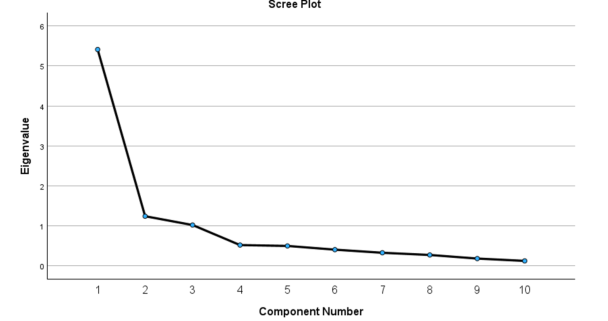
Strategic Approaches for Sustainable 4IR Skills Development in South Africa’s 45 Bartlett’s Test of Sphericity confirmed that the correlations between items were strong enough to support the extraction of underlying components, reaching statistical significance. In terms of factor extraction, the analysis found three different components with eigenvalues greater than 1.0. When taken as a whole, these three variables explain a significant 76.74% of the variance in the data.
The ultimate number of components extracted via EFA is depicted in Figure 1. The nature of the curve plotted demonstrates the corresponding component numbers. With 54.12% of the variance explained by the first component, it is the most dominant. The second and third components add 12.41% and 10.21% of the variance, respectively. A distinct multidimensional structure for the strategic approaches is revealed by the Rotated Component Matrix (using Varimax rotation) in Table 2. “Institutional and Curricular Transformation,” named for Component 1, is heavily influenced by curriculum reform to include 4IR and sustainability (0.871), Continuous professional development programmes (0.767), Investment in digital infrastructure for training (0.736), Training in sustainable practices (0.668), and Digital literacy programs for underserved communities (0.647). Component 2 seems to stand for “Social Inclusion and Advocacy,” as evidenced by the high loadings for awareness campaigns (0.658) and gender-focused training (0.898). Finally, Component 3 represents “Strategic Policy and Partnership Frameworks,” which is based on the integration of public-private partnerships (0.613) and BBBEE frameworks (0.898). All these strategic approaches have communalities greater than 0.70.
Table 2: Rotated component matrix for strategic approaches of sustainable 4IR skills development (Fieldwork, 2025).
Table available in the original PDF paper.
Component
Rotated Component Matrix
Extraction 1 2 3
.871 .762
Curriculum reform to include 4IR and sustainability
.767 .836
Continuous professional development programmes
.736 .857
Investment in digital infrastructure for training
.668 .717
Training in sustainable practices (e.g., lifecycle assessment)
.647 .688
Digital literacy programmes for underserved communities Gender-focused training initiatives .898 .832
.658 .656
Awareness campaigns to counter the resistance to technology
.898 .827
Integration of 4IR skills with BBBEE frameworks
.613 .721
Public-private partnerships for skills development
(Continued)
Table 2: Continued.
Table available in the original PDF paper.
Component
Rotated Component Matrix
Extraction 1 2 3
.601 .778
Policy incentives for 4IR adoption (e.g., tax breaks)”
1.2411 2.162 21.618 55.639
1.021 2.110 21.101 76.741
5.412 3.402 34.021 34.021 .824
Total Variance Explained Eigenvalue Eigenvalue AR % of Variance Cumulative % KMO Bartlett’s Test of Sphericity Approx. Chi-Square df p-value
444.266 45 <.001
Figure 1: Scree plot for strategic approaches for sustainable 4IR skills development. (Fieldwork, 2025).
DISCUSSION OF FINDINGS Discussion on Descriptive Results for Strategic Approaches for Sustainable 4IR Skills Development
The topmost strategic approaches for Sustainable 4IR Skills Development by the respondents were ‘Curriculum reform to include 4IR and sustainability’, ‘Investment in digital infrastructure for training’, ‘Digital literacy programmes for underserved communities’, ‘Training in sustainable practices’, ‘Public- private partnerships for skills development’, and ‘Continuous professional development programmes’. Curriculum reform to include 4IR and sustainability is required by educational institutions (Hadzic, 2024; Kissi et al. 2023; Van Wyk et al., 2021). Universities and technical schools should always update their curricula to adequately prepare graduates for the changing industry (Ababio et al., 2024; Cunningham, 2018). The nation’s ability to fully benefit from 4IR technologies is hampered by the divergence between industrial demands
Strategic Approaches for Sustainable 4IR Skills Development in South Africa’s 47 and educational output (Nkosi, 2021). The ‘Digital literacy programmes for underserved communities’, ‘Training in sustainable practices’, and ‘Investment in digital infrastructure for 4IR training’ are also supported by Nkosi et al. (2020), who advocate that those investments will not be a waste in human development. ‘Public-private partnerships for 4IR skills development’ are essential for the growth of nations and for the transfer of digital skills among parties (Dzingirai, 2025). Continuous professional development programmes for industry players are supported by Ebekozien et al. (2024).
Discussion on EFA Results for Strategic Approaches for Sustainable 4IR Skills Development Component 1: Institutional and curricular transformation: The cluster of factors under this category includes Curriculum reform to include 4IR and sustainability, Continuous professional development programmes, Investment in digital infrastructure for training, Training in sustainable practices, and Digital literacy programs for underserved communities. This component call for all training institutions, including universities and technical institutions, as well as professional bodies whose work involves 4IR skills to develop updated circulars and CPDs to help the built environment industry transformation (Hadzic, 2024; Kissi et al., 2023; DHET, 2022; Van Wyk et al., 2021; Nkosi, 2021; Nkosi et al., 2020; Cunningham, 2018). Component 2: Social inclusion and advocacy: The component factors include awareness campaigns and gender-focused training. The importance of social consciousness and inclusivity, which promotes social cohesion, is critical for the growth of the built environment (Kilic, 2025; Adebowale and Agumba, 2023). Labour productivity is greatly impacted by gender parity and technological advancement. These social factors guarantee that the adoption of 4IR fosters equitable economic growth rather than worsening inequality (Khoza, 2025).
Component 3: Strategic policy and partnership frameworks: The integration of public-private partnerships and support for BBBEE frameworks form this cluster. By strengthening institutional coherence through the integration of public-private partnerships and policy frameworks, funding mechanisms and incentives that promote innovation can be established. Such partnerships offer the governance framework required to support extensive digital transformation initiatives, claim Van Wyk et al. (2021). Public-private partnerships for 4IR skills development parties can benefit from digital skills transfer (Dzingirai, 2025). Therefore, a comprehensive framework for long- term 4IR skills development in South Africa is created by the interaction of policy, education, and social inclusion.
CONCLUSION
This study examines strategies for enhancing sustainable 4IR skills development in South Africa’s built environment sector. Key areas for improvement include transforming educational institutions to integrate digital literacy and sustainability, promoting inclusion and gender diversity in training, and aligning
policies to foster collaboration among government, academia, and industry. This study advances knowledge of how inclusion, education, and policy integration work together to improve a country’s preparedness for 4IR transformation. It offers empirical evidence in favour of changing professional training and higher education to incorporate sustainability and 4IR competencies.
University curricula should include courses on digital literacy, sustainability, and emerging technologies to equip students with essential skills for the industry. Expanding professional development programmes for practitioners through continuing professional development (CPD) is vital to bridge the gap between traditional methods and 4IR transformation. Promoting diversity via awareness campaigns and gender-balanced training programmes would ensure equal access for women and underrepresented groups, fostering a more innovative workplace culture. Public-private partnerships and policy alignment are necessary to develop sustainable 4IR skills, facilitated by collaboration among government, academia, and the private sector.
This study makes a significant contribution to the comprehension of how South Africa’s built environment can adjust to the skills required by the 4IR. This provides concrete evidence for the need for a holistic transformation in higher education and professional training that incorporates 4IR and sustainability skills.
This study focuses on Gauteng Province; the findings may not accurately reflect the diverse institutional and socioeconomic contexts across South Africa. Institutional processes and the qualitative subtleties of 4IR readiness were not thoroughly examined due to reliance on a quantitative research design using purposive sampling.
Future research should expand its geographic focus to encompass comparative studies across multiple provinces, thereby enhancing these findings and yielding a more comprehensive national outlook. Future research is recommended to employ qualitative or mixed methods approaches to better comprehend the various institutional mechanisms and cultural obstacles affecting 4IR readiness.
REFERENCES
Ababio, K.A., Adarkwa, S.A., Owusu, F.K., Dankwa, R., Serwah, A., Adjei, K.O., ..., Laryea, S.S. (2024). TVET graduates’ tracer study and employability in Ghana. African Journal of Applied Research, 10(2), 456–473. Adebowale, O., Agumba, J. (2023). Labour productivity in construction SMEs:
perspectives from South Africa. Acta Structilia, 30(1), 62–89. Creswell, J.W., Creswell, J.D. (2017). Research design: Qualitative, quantitative, and mixed methods approaches. Sage publications. Cunningham, S. (2018). World Economic Forum and the fourth industrial revolution
in South Africa. Pretoria: Trade and industrial policies South Africa. Department of Higher Education and Training (DHET), 2022. Skills Strategy: Support for the South African Economic Reconstruction and Recovery Plan. Website: https://www.dhet.gov.za/Planning%20Monitoring%20and%20Evaluation%20 Coordination/Skills%20Strategy%20-%20Support%20for%20the%20South% 20African%20Economic%20Reconstruction%20and%20Recovery%20 Plan%20-%202022.pdf
Strategic Approaches for Sustainable 4IR Skills Development in South Africa’s 49 Dzingirai, M. (2025). Harnessing New Technologies Public-Private Partnerships for
Sustainable Development. In Public Private Partnership Dynamics for Economic Development (pp. 199–212). IGI Global Scientific Publishing. Ebekozien, A., Aigbavboa, C.O., Adekunle, S.A., Aliu, J., Thwala, W.D. (2024). Training needs of built environment professionals: the role of fourth industrial revolution. Engineering, Construction and Architectural Management, 31(11), 4353–4371. Ehtsham, M., Parisi, G., Pedone, F., Rossi, F., Zincani, M., Congiu, E., Marchionni, C.
(2025). AI-Powered Advanced Technologies for a Sustainable Built Environment: A Systematic Review on Emerging Challenges. Sustainability, 17(17), 8005. Gyamfi, T.A., Bonney, S.O., Adjei, K.O., Thwala, W.D. (2025). Determinant of Challenges Associated with Sustainable Utilisation of Drones in the Building Construction Sector. African Journal of Applied Research, 11(5), 386–399. Hadzic, S. (2024). South Africa’s Digital Transformation: Understanding the Limits
of Traditional Policies and the Potential of Alternative Approaches. Computer Law & Security Review, 55, 106011. Khoza, N.G. (2025). The Fourth Industrial Revolution (4IR) readiness in South Africa’s public sector: Pathways to achieving SDGs. International Journal of Development and Sustainability, 14(1), 117–136. Kilic, B. (2025). AI, innovation and the public good: a new policy playbook (No.
318). CIGI Papers. Kissi, E., Aigbavboa, C., Smith, E.D., Thwala, D.W., Kwofie, T.E. (2023). Skills Development in the 4th Industrial Revolution: The Construction Industry. Emerging Debates in the Construction Industry, 149–173. Mabunda, R.G., Liphadzi, M., Adjei, K.O. (2026). The Factors Influencing Business
Forums on Stakeholder Engagement in the South African Built Environment. In Global Forum for Sustainable Built Environment Conference (pp. 1217–1229). Cham: Springer Nature Switzerland. Mayer, C.H., Oosthuizen, R.M. (2022). Sustainability in Industry 4.0 business practice: insights from a multinational technology company. Frontiers in Sustainability, 3, 886986. Nkosi, T., Aboginije, A., Mashwama, N., Thwala, W. (2020, March). Harnessing
fourth industrial revolution (4IR) for improving poor universities infrastructure in developing countries-A review. In Proceedings of the International Conference on Industrial Engineering and Operations Management (pp. 10–22). Nkosi, T.L. (2021). Harnessing the Fourth Industrial Revolution for improved educational infrastructure in South African higher education institutions. MSc Thesis, University of Johannesburg (South Africa). Parusheva, S. (2019). Digitalization and digital transformation in construction-
benefits and challenges. Information and communication technologies in business and education, 126–134. Pittri, H., Agyekum, K., Salgin, B., Dompey, A.M.A., Gasue, R., Anderson, S.A.
(2025). The Fourth Industrial Revolution Technologies and the Construction Industry in Ghana. Construction Economics and Building, 25(3/4). Van Wyk, L., Kajimo-Shakantu, K., Opawole, A. (2024). Adoption of innovative technologies in the South African construction industry. International Journal of Building Pathology and Adaptation, 42(3), 410–429. Yankah, J.E., Adjei, K.O., Tieru, C.K. (2024). Apps as partial replacement for robotics
and automation systems in construction health and safety management. Frontiers in Engineering and Built Environment, 4(2), 90–100. Zhang, J., Chen, M., Ballesteros-Pérez, P., Ke, Y., Gong, Z., Ni, Q. (2023). A new framework to evaluate and optimize digital transformation policies in the construction industry: A China case study. Journal of Building Engineering, 70, 106388.
LISTED IN THE AHFE DIGITAL BOOKSTORE CATALOGUE
Explore the complete digital volume
Sustainable Built Environment
Read this individual research paper free through the original publisher, or explore the full digital proceedings book.
ISBN 979-8-950676-01-7
Explore this ISBN in the AHFE Bookstore ↗Listed in the July 2026 bookstore catalogue; search by ISBN to confirm current availability · Digital book purchase optional