Mahdi Marzi, Ayşe Karacalı Tunç, Şebnem MARZİ (2026). Human Factors in AI-Driven Antimicrobial Stewardship: Clinician Decision-Making, Automation Bias, and Patient Safety Risks. In: Healthcare and Medical Devices. AHFE Open Access, vol. 211, pp. 9–19. https://doi.org/10.54941/ahfe1007464
This research explores how human behavior and psychology impact the effectiveness of artificial intelligence within hospital programs designed to manage antibiotic use. While these digital tools aim to combat antimicrobial resistance, their success often depends on how doctors interpret and trust the technology's suggestions. The study identifies significant obstacles such as alert fatigue and automation bias, which occur when clinicians either ignore warnings or follow computer guidance too blindly. Findings suggest that making AI logic more transparent and improving the way alerts are delivered can foster better professional engagement. Ultimately, the authors argue that human-centered design is essential to ensure these technological advancements actually lead to safer prescribing habits and better patient recovery. To achieve long-term success, medical systems must prioritize the interaction between clinicians and software during both the development and implementation phases.
Antimicrobial resistance (AMR) is widely recognized as a major global public health threat, driven primarily by inappropriate antimicrobial use across healthcare settings worldwide (WHO, 2025). Despite decades of antimicrobial stewardship (AMS) initiatives aimed at optimizing antibiotic prescribing, inappropriate and unnecessary antimicrobial use remains common in both inpatient and outpatient care (UKHSA, 2025; Holmes et al., 2016). This persistent gap between stewardship goals and real-world practice underscores the central role of human behavior, clinical judgment, and decision-making processes in antimicrobial prescribing (Raban et al., 2022).
In response to these challenges, artificial intelligence (AI)–driven antimicrobial stewardship systems have increasingly been developed to support key prescribing decisions, including antibiotic selection, de-escalation, and optimization of treatment duration. By integrating microbiological data, electronic health records, and clinical guidelines, Received January 5, 2026; Revised April 9, 2026; Accepted April 27, 2026; Available online July 20, 2026
these systems aim to improve guideline-concordant therapy and enhance stewardship performance (Pennisi et al., 2025; Bosetti et al., 2015; Van et al., 2022). However, accumulating evidence suggests that the effectiveness of AI-supported stewardship tools in clinical practice depends not only on algorithmic performance, but also on how clinicians perceive, interpret, and incorporate AI-generated recommendations into routine decision-making (Giacobbe et al., 2024; Ghassemi et al., 2019).
Human factors engineering offers a critical framework for examining clinician interaction with AI-enabled clinical decision support systems. Elements such as automation bias, cognitive workload, alert fatigue, and trust calibration have been increasingly associated with prescribing behavior and patient safety outcomes in AI-supported healthcare environments (Shortliffe et al., 2018; Bates et al., 2021; Sendak et al., 2023). Against this background, the present narrative review synthesizes evidence published between 2022 and 2025 to examine human factors–related challenges in AI-driven antimicrobial stewardship, with a specific focus on physician decision-making and implications for patient safety. Although much of the available literature focuses on physician prescribing behavior, the human factors identified are equally relevant to other clinical stakeholders engaged in antimicrobial stewardship activities.
To address these gaps, this study contributes to the existing literature by explicitly integrating human factors principles with AI-driven antimicrobial stewardship workflows, with particular emphasis on how automation bias, trust calibration, and cognitive workload shape antibiotic prescribing decisions and patient safety outcomes. Unlike prior reviews, this paper moves beyond descriptive synthesis by offering concrete, human-centered design and implementation strategies to support the safe and effective adoption of AI-assisted clinical decision systems.
METHODS
A narrative review was conducted to synthesize recent evidence on human factors influencing the design, adoption, and safe use of artificial intelligence (AI)–driven clinical decision support systems within antimicrobial stewardship programs. The literature search focused on peer-reviewed studies published between January 2022 and March 2025 that examined human–AI interaction, usability, trust, alerting strategies, and clinician behavior in AI-supported antimicrobial prescribing. Major biomedical, engineering, and interdisciplinary databases were searched, and eligible studies were selected based on predefined inclusion criteria emphasizing clinical relevance and end-user interaction. Retrieved articles were screened by title and abstract, followed by full-text review. Findings were thematically synthesized to identify recurrent human factor challenges and mitigation strategies relevant to AI-driven antimicrobial stewardship.
Literature Search and Selection Criteria
Databases searched: PubMed/Medline, Scopus, Web of Science, and IEEE Xplore
Search terms (example): (“antimicrobial stewardship” OR “antibiotic stewardship”) AND (“clinical decision support” OR “CDSS”) AND
Human Factors in AI-Driven Antimicrobial Stewardship 11 (“artificial intelligence” OR “machine learning”) AND (“human factors” OR usability OR “alert fatigue” OR “automation bias” OR trust)
Inclusion criteria:
∘ Publications between 2022–2025 ∘ Peer-reviewed articles, reviews, or implementation studies ∘ Focus on AI-supported antimicrobial prescribing or stewardship ∘ Explicit consideration of human factors, clinician interaction, or workflow integration
Exclusion criteria: ∘ Purely technical model development studies without clinical or user interaction ∘ Non-healthcare or non-antimicrobial decision support applications ∘ Non-English publications
Synthesis approach:
Narrative thematic synthesis, grouping findings into recurrent domains including automation bias, cognitive workload, alert fatigue, trust calibration, and human-centered design strategies.
Artificial Intelligence in Antimicrobial Stewardship Artificial intelligence (AI) applications in antimicrobial stewardship can be broadly grouped into three overlapping domains: prediction of antimicrobial resistance and prescribing appropriateness, clinical decision support for empiric and targeted therapy, and implementation-oriented studies evaluating prescribing behavior and stewardship outcomes (Pennisi et al. ,2025; Bosetti et al., 2025; Smith et al., 2024). Across these domains, recent evidence suggests that AI-supported stewardship interventions may improve guideline adherence and reduce the time to appropriate antimicrobial therapy, particularly when systems are integrated into routine clinical workflows and electronic health record infrastructures (Van et al., 2022; Sutton et al.,2020).
Despite these encouraging results, substantial heterogeneity remains in model development strategies, validation methods, and approaches to clinical integration, which limits the generalizability and reproducibility of reported findings (Ghassemi et al., 2019; Rajkomar et al., 2019). Many AI-driven stewardship tools continue to operate as so-called “black box” systems, providing recommendations without sufficient transparency regarding underlying rationale or contextual factors. Limited interpretability may impede clinician understanding, weaken appropriate adoption, and increase the risk of both misuse and disuse in real-world clinical settings (Amann et al., 2020).
To address these concerns, explainable artificial intelligence (XAI) has increasingly been proposed as a strategy to enhance interpretability and support safer clinical adoption of AI-based decision support. Emerging studies indicate that explanation mechanisms—such as feature importance displays, confidence estimates, or concise rationale summaries—can positively influence clinician trust and promote more appropriate antimicrobial decision-making (Cavallaro et al., 2023; Rosenbacke et al., 2024; Liu et al., 2022). However, explainability alone is unlikely to be sufficient if explanation outputs are poorly designed, misaligned with clinical workflows, or inconsistent with human cognitive processes.
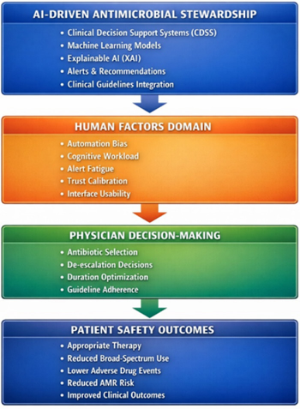
The main application areas of artificial intelligence in antimicrobial stewardship, along with commonly used AI approaches and reported clinical benefits, are summarized in Table 1. Beyond technical performance, the real-world clinical impact of these systems is strongly shaped by clinician interaction with AI-supported recommendations across antimicrobial stewardship workflows. As illustrated in Figure 1, key human factors— including automation bias, cognitive workload, alert fatigue, trust calibration, and interface usability—mediate the relationship between AI-driven stewardship tools and prescribing decisions, with important implications for patient safety and stewardship effectiveness.
Table 1: Applications of artificial intelligence in antimicrobial stewardship.
Table available in the original PDF paper.
AI Approach Clinical Target Reported Benefit
AI Application Area Resistance prediction Machine learning models
Figure 1: Conceptual framework illustrating the role of human factors in AI-driven antimicrobial stewardship. Human–AI interaction factors, including automation bias, cognitive workload, alert fatigue, trust calibration, and interface usability, mediate the relationship between AI-driven decision support and clinical decision-making among antimicrobial stewardship stakeholders, with downstream implications for patient safety and stewardship outcomes.
Human Factors in AI-Driven Antimicrobial Stewardship 13 Human Factors in Clinician–AI Interaction
Automation Bias Automation bias refers to the tendency of clinicians to place disproportionate reliance on automated recommendations, accepting AI-generated outputs with limited independent clinical verification (Shortliffe et al., 2018; Wright et al., 2016). In the context of AI-driven antimicrobial stewardship systems, this bias may present as inappropriate continuation of broad-spectrum antimicrobial therapy or delayed reassessment of treatment plans, particularly when a patient’s clinical condition changes or new diagnostic information becomes available (Giacobbe et al., 2024; Reddy et al., 2020).
The likelihood of automation bias increases under conditions of high cognitive workload, time pressure, and strong perceptions of authority or objectivity attributed to AI-based systems (Bates et al., 2021; Sendak et al., 2023). In such circumstances, clinicians may partially defer clinical judgment to algorithmic recommendations, creating new pathways for error rather than reducing existing ones. As a result, patient safety–focused frameworks increasingly emphasize the need for ongoing system evaluation, performance monitoring, and explicit human oversight to detect and mitigate automation- related risks in AI-enabled clinical decision support.
Cognitive Workload Antimicrobial prescribing requires clinicians to integrate microbiological data, antimicrobial pharmacology, organ function, and the patient’s evolving clinical trajectory, resulting in a substantial cognitive workload (Asgari et al., 2024). Although AI-driven decision support systems have the potential to alleviate this burden by aggregating and synthesizing complex clinical information, inadequately designed systems may paradoxically increase cognitive load and raise the risk of decision-making errors (Waldock et al., 2025; Blecker et al., 2019).
Usability studies of digital prescribing platforms indicate that fragmented information displays, excessive navigation steps, and poor alignment with clinical workflows can negatively affect clinician efficiency, situational awareness, and decision quality (Blecker et al., 2019; Ku et al., 2023). Under these conditions, AI-based tools may contribute to cognitive overload rather than provide meaningful cognitive support, thereby undermining their intended antimicrobial stewardship and patient safety benefits.
Alert Fatigue Alert fatigue is a well-recognized challenge in clinical decision support systems and represents a major barrier to the effective implementation of antimicrobial stewardship interventions (Zhang et al., 2018; Naiseh et al., 2023). Frequent exposure to alerts—particularly those with low specificity or limited clinical relevance—may gradually desensitize clinicians, increasing the likelihood that clinically important stewardship recommendations are ignored or overlooked (Zhang et al., 2018).
Empirical studies indicate that interruptive alert designs are especially prone to fatigue-related effects, as they disrupt clinical workflow and compete with other cognitive demands. By contrast, context-aware, prioritized, or non-interruptive alert strategies have been associated with greater clinician engagement and improved patient safety outcomes (Naiseh et al., 2023; Sakamoto et al., 2024). These findings highlight the critical role of alert design in determining whether AI-supported stewardship tools function as effective decision aids or contribute to additional cognitive burden.
Trust Calibration and Explainable AI Appropriate trust calibration—defined as avoiding both over-reliance on and undue skepticism toward AI-supported recommendations—is essential for safe and effective human–AI collaboration in clinical practice (Tun et al., 2025). Excessive trust in AI outputs may intensify automation bias and encourage uncritical acceptance of recommendations, whereas insufficient trust may lead clinicians to reject valid, evidence-based guidance produced by AI-driven decision support systems (Giacobbe et al., 2025).
Evidence from systematic reviews and experimental studies indicates that clinician trust in AI-based clinical decision support is influenced by multiple interrelated factors, including system transparency, explainability, usability, and prior experience or familiarity with AI tools (Liu et al., 2022; Tun et al., 2025; NIST 2023). Within antimicrobial stewardship settings, explainable artificial intelligence (XAI) has been proposed as a means of supporting more appropriate trust calibration by increasing the visibility of the rationale, uncertainty, and contributing factors underlying AI-generated recommendations.
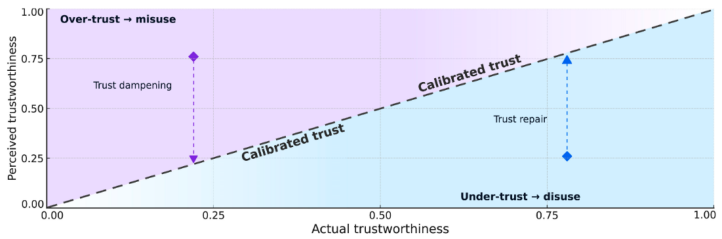
However, trust calibration is not governed by explainability alone. Poorly designed explanations, misaligned interfaces, or inadequate integration with clinical workflows may erode trust even in technically robust systems. As illustrated in Figure 2, departures from optimal trust calibration may result in either misuse—through over-reliance on AI recommendations—or disuse, in which potentially beneficial AI-supported guidance is disregarded, with important consequences for antimicrobial prescribing and patient safety.
Figure 2. Trust calibration curve illustrating the relationship between actual system trustworthiness and clinicians’ perceived trust in AI-assisted antimicrobial decision support. Over-trust may lead to misuse of AI recommendations and increased automation bias, whereas under-trust may result in disuse and rejection of valid AI-supported guidance, with downstream consequences for prescribing quality and patient safety.
Human Factors in AI-Driven Antimicrobial Stewardship 15 Patient Safety Implications
Human factor–related failures in AI-driven antimicrobial stewardship may introduce new patient safety risks, including delayed initiation of appropriate therapy, unnecessary or prolonged exposure to broad-spectrum antimicrobials, adverse drug events, and missed opportunities for timely de-escalation (Reddy et al., 2020; McCoy et al., 2014). These risks often arise not solely from algorithmic shortcomings, but from suboptimal human–AI interaction, such as inappropriate reliance on automated recommendations or insufficient engagement with AI-supported guidance.
The broader patient safety literature highlights that AI-enabled systems can both reduce and amplify harm, depending on the quality of system design, clinical evaluation, and real-world implementation (Labkoff et al., 2024; WHO, 2024). Insufficient attention to workflow integration, usability, and clinician oversight may unintentionally introduce new error pathways, even when technical performance appears strong under controlled conditions.
Accordingly, contemporary governance frameworks emphasize the need for continuous performance monitoring, post-deployment evaluation, and systematic reporting of AI-related safety events as integral components of responsible implementation (Labkoff et al., 2024; European Commission, 2019). Embedding these governance mechanisms within antimicrobial stewardship programs is critical to identifying emerging risks, facilitating learning from AI-related failures, and safeguarding patient safety as AI-supported decision-making becomes increasingly embedded in routine clinical practice.
Design and Implementation Considerations Human-centered design principles are fundamental to the safe and effective implementation of AI-driven antimicrobial stewardship systems. Key considerations include usability, compatibility with existing clinical workflows, and clear, actionable presentation of AI-generated recommendations (Amann et al., 2020; Ku et al., 2023). Systems that align with routine prescribing practices are more likely to support clinician decision-making without adding unnecessary cognitive burden.
Alert design represents a particularly influential implementation factor. Effective alert strategies should limit unnecessary interruptions while prioritizing high-risk clinical scenarios in which timely intervention is most likely to affect patient outcomes (Zhang et al., 2025; Naiseh et al., 2023; Sakamoto et al., 2024). Context-aware and prioritized alert mechanisms can help balance the need for clinical vigilance against the risk of alert fatigue, thereby enhancing both clinician engagement and patient safety.
Beyond technical system design, targeted clinician training and organizational support are critical for promoting appropriate reliance on AI-supported stewardship tools. Structured training initiatives can improve trust calibration, reduce misinterpretation of AI outputs, and support sustained adoption by increasing familiarity with system capabilities and limitations (Sendak et al., 2023; NIST, 2023).
Organizational commitment to effective human–AI collaboration is therefore essential to ensure that technical innovation translates into meaningful improvements in antimicrobial stewardship and patient safety. These findings highlight that the effectiveness of AI-driven antimicrobial stewardship systems depends not only on algorithmic performance but critically on the quality of human–AI interaction in real-world clinical environments. Key human factors–informed design principles and corresponding mitigation strategies for AI-driven antimicrobial stewardship systems are summarized in Table 2.
Table 2: Human factors–informed design principles for AI-driven antimicrobial stewardship systems.
Table available in the original PDF paper.
Identified Risk Design Recommendation
Human Factors Domain Automation bias Blind acceptance of AI output
Require clinical confirmation and rationale display Cognitive workload Information overload Simplified, task-oriented interfaces
Alert fatigue Ignoring critical alerts Context-aware and prioritized alerts Trust calibration Over- or under-trust Explainable AI with uncertainty indicators
Usability Workflow disruption Integration with existing clinical workflows Training Misinterpretation of AI output Structured human–AI interaction training
Future Directions Emerging directions in AI-driven antimicrobial stewardship include the development of trust-adaptive AI systems that adjust recommendations in response to clinician behavior and clinical context, simulation-based methods for evaluating human–AI interaction under realistic conditions, and the integration of large language models into antimicrobial prescribing workflows (Giacobbe et al., 2025; Naiseh et al., 2026). Together, these developments reflect a shift toward more interactive, adaptive, and context- aware AI applications within clinical decision support.
These advances further underscore the importance of embedding human factors engineering early in the design, evaluation, and governance of AI-supported stewardship systems. Proactive attention to human–AI interaction, usability, and trust calibration across the full lifecycle of these tools will be essential to ensure that technological innovation results in durable improvements in prescribing practices and patient safety.
CONCLUSION
AI-driven antimicrobial stewardship offers considerable potential to improve antimicrobial use and reduce the global burden of antimicrobial resistance; however, its effectiveness in clinical practice ultimately depends on the
Human Factors in AI-Driven Antimicrobial Stewardship 17 quality of human–AI collaboration across multidisciplinary antimicrobial stewardship teams. Addressing key human factors—including automation bias, cognitive workload, alert fatigue, and trust calibration—through human-centered design and appropriate governance is essential to maximize the benefits of AI-supported stewardship while protecting patient safety.
As AI-enabled decision support becomes increasingly integrated into antimicrobial prescribing workflows, sustained attention to clinician interaction, system usability, and organizational oversight will be critical to ensuring that technological innovation translates into meaningful and durable improvements in antibiotic decision-making.
ACKNOWLEDGMENT
The authors would like to acknowledge the contributions of previous researchers whose studies informed and shaped the scope of this review. We also thank healthcare professionals and antimicrobial stewardship teams whose clinical practices and scholarly work provided valuable insights into decision-making processes and patient safety considerations. This study did not receive any financial support.
REFERENCES Amann, J., Blasimme, A., Vayena, E., Frey, D., & Madai, V. I.; Precise4Q Consortium. (2020). Explainability for artificial intelligence in healthcare: A multidisciplinary perspective. BMC Medical Informatics and Decision Making, 20(1), 310. https://doi.org/10.1186/s12911-020-01332-6 Asgari, E., Kaur, J., Nuredini, G., Balloch, J., Taylor, A. M., Sebire, N., Robinson,
R., Peters, C., Sridharan, S., & Pimenta, D. (2024). Impact of electronic health record use on cognitive load and burnout among clinicians: Narrative review. JMIR Medical Informatics, 12, e55499. https://doi.org/10.2196/55499 Bates, D. W., Levine, D., Syrowatka, A., Kuznetsova, M., Craig, K. J. T., Rui, A., Jackson, G. P., & Rhee, K. (2021). The potential of artificial intelligence to improve patient safety: A scoping review. NPJ Digital Medicine, 4(1), 54. https:// doi.org/10.1038/s41746-021-00423-6 Blecker, S., Pandya, R., Stork, S., Mann, D., Kuperman, G., Shelley, D., & Austrian,
J. (2019). Interruptive versus noninterruptive clinical decision support: Usability study. JMIR Human Factors, 6(2), e12469. https://doi.org/10.2196/12469 Bosetti, D., Grant, R., & Catho, G. (2025). Computerized decision support for antimicrobial prescribing: What every antibiotic steward should know. Antimicrobial Stewardship & Healthcare Epidemiology, 5(1), e210. https://doi. org/10.1017/ash.2025.10091 Cavallaro, M., Moran, E., Collyer, B., McCarthy, N. D., Green, C., & Keeling, M. J.
(2023). Informing antimicrobial stewardship with explainable AI. PLOS Digital Health, 2(1), e0000162. https://doi.org/10.1371/journal.pdig.0000162 European Commission, High-Level Expert Group on Artificial Intelligence. (2019).
Ethics guidelines for trustworthy AI. Brussels: European Commission. Ghassemi, M., Naumann, T., Schulam, P., Beam, A. L., Chen, I. Y., & Ranganath, R. (2019). Practical guidance on artificial intelligence for health-care data. The Lancet Digital Health, 1(4), e157–e159. https://doi.org/10.1016/S2589- 7500(19)30084-6
Giacobbe, D. R., Marelli, C., Guastavino, S., et al. (2024). Artificial intelligence and prescription of antibiotic therapy: Present and future. Expert Review of Anti- infective Therapy, 22(10), 819–833. https://doi.org/10.1080/14787210.2024.23 86669 Giacobbe, D. R., Marelli, C., La Manna, B., Padua, D., Malva, A., Guastavino, S.,
et al. (2025). Advantages and limitations of large language models for antibiotic prescribing and antimicrobial stewardship. NPJ Antimicrobial Resistance, 3(1), 14. https://doi.org/10.1038/s44259-025-00084-5 Holmes, A. H., Moore, L. S., Sundsfjord, A., Steinbakk, M., Regmi, S., Karkey, A., Guerin, P. J., & Piddock, L. J. (2016). Understanding the mechanisms and drivers of antimicrobial resistance. The Lancet, 387(10014), 176–187. https://doi. org/10.1016/S0140-6736(15)00473-0 Ku, T. S. N., Al Mohajer, M., Newton, J. A., Wilson, M. H., Monsees, E., Hayden,
M. K., et al. (2023). Improving antimicrobial use through better diagnosis: The relationship between diagnostic stewardship and antimicrobial stewardship. Infection Control & Hospital Epidemiology, 44(12), 1901–1908. https://doi. org/10.1017/ice.2023.156 Labkoff, S., Oladimeji, B., Kannry, J., Solomonides, A., Leftwich, R., Koski, E., et al.
(2024). Toward a responsible future: Recommendations for AI-enabled clinical decision support. Journal of the American Medical Informatics Association, 31(11), 2730–2739. https://doi.org/10.1093/jamia/ocae209 Liu, X., Glocker, B., McCradden, M. M., Ghassemi, M., Denniston, A. K., & Oakden- Rayner, L. (2022). The medical algorithmic audit. The Lancet Digital Health, 4(5), e384–e397. https://doi.org/10.1016/S2589-7500(22)00003-6 McCoy, A. B., Thomas, E. J., Krousel-Wood, M., & Sittig, D. F. (2014). Clinical
decision support alert appropriateness: A review and proposal for improvement. Ochsner Journal, 14(2), 195–202. Naiseh, M., Al-Thani, D., Jiang, N., & Ali, R. (2021). Explainable recommendation: When design meets trust calibration. World Wide Web, 24(5), 1857–1884. https:// doi.org/10.1007/s11280-021-00916-0 Naiseh, M., Al-Thani, D., Jiang, N., & Ali, R. (2023). How the different explanation
classes impact trust calibration: The case of clinical decision support systems. International Journal of Human–Computer Studies, 169, 102941. https://doi. org/10.1016/j.ijhcs.2022.102941 National Institute of Standards and Technology (NIST). (2023). AI Risk Management Framework (AI RMF 1.0). Gaithersburg, MD: NIST. Pennisi, F., Pinto, A., Ricciardi, G. E., et al. (2025). Artificial intelligence in
antimicrobial stewardship: A systematic review and meta-analysis of predictive performance and diagnostic accuracy. European Journal of Clinical Microbiology & Infectious Diseases, 44(3), 463–513. https://doi.org/10.1007/s10096-024- 05027-y Raban, M. Z., Gonzalez, G., Nguyen, A. D., Newell, B. R., Li, L., Seaman, K. L., & Westbrook, J. I. (2023). Nudge interventions to reduce unnecessary antibiotic prescribing in primary care: A systematic review. BMJ Open, 13(1), e062688. https://doi.org/10.1136/bmjopen-2022-062688 Reddy, S., Allan, S., Coghlan, S., & Cooper, P. (2020). A governance model for
the application of artificial intelligence in health care. Journal of the American Medical Informatics Association, 27(3), 491–497. https://doi.org/10.1093/jamia/ ocz192
Human Factors in AI-Driven Antimicrobial Stewardship 19 Rosenbacke, R., Melhus, Å., McKee, M., & Stuckler, D. (2024). How explainable
artificial intelligence can increase or decrease clinicians’ trust in AI applications in health care: Systematic review. JMIR AI, 3, e53207. https://doi.org/10.2196/53207 Sakamoto, T., Harada, Y., & Shimizu, T. (2024). Facilitating trust calibration in artificial intelligence–driven diagnostic decision support systems for determining physicians’ diagnostic accuracy: Quasi-experimental study. JMIR Formative Research, 8, e58666. https://doi.org/10.2196/58666 Sendak, M. P., Gao, M., Nichols, M., Lin, A., & Balu, S. (2023). Human-centered
artificial intelligence in healthcare. NEJM AI, 1, e220009. Shortliffe, E. H., & Sepúlveda, M. J. (2018). Clinical decision support in the era of artificial intelligence. JAMA, 320(21), 2199–2200. https://doi.org/10.1001/ jama.2018.17163 Smith, M. R., Lee, J. J., Holubar, M., Salinas, J. L., Sampson, M. M., Medford, R. J.,
et al. (2024). Clinical decision support in the electronic health record: A primer for antimicrobial stewards and infection preventionists: Work smarter so end users don’t work harder. Antimicrobial Stewardship & Healthcare Epidemiology, 4(1), e204. https://doi.org/10.1017/ash.2024.448 Sutton, R. T., Pincock, D., Baumgart, D. C., Sadowski, D. C., Fedorak, R. N., & Kroeker, K. I. (2020). An overview of clinical decision support systems: Benefits, risks, and strategies for success. NPJ Digital Medicine, 3, 17. https://doi. org/10.1038/s41746-020-0221-y Tun, H. M., Rahman, H. A., Naing, L., & Malik, O. A. (2025). Trust in artificial
intelligence–based clinical decision support systems among health care workers: Systematic review. Journal of Medical Internet Research, 27, e69678. https://doi. org/10.2196/69678 Van Dort, B. A., Penm, J., Ritchie, A., & Baysari, M. T. (2022). The impact of digital interventions on antimicrobial stewardship in hospitals: A qualitative synthesis of systematic reviews. Journal of Antimicrobial Chemotherapy, 77(7), 1828–1837. https://doi.org/10.1093/jac/dkac112 Waldock, W. J., Gilchrist, M., Ashrafian, H., Darzi, A., & Franklin, B. D. (2025). A
mixed methods evaluation of an antimicrobial prescribing clinical decision support system app. NPJ Antimicrobial Resistance, 3(1), 71. https://doi.org/10.1038/ s44259-025-00146-8 World Health Organization. (2024). Ethics and governance of artificial intelligence for health: Guidance on large multi-modal models. Geneva: World Health Organization. World Health Organization. (2025). Global antibiotic resistance surveillance report
2025. Geneva: World Health Organization. UK Health Security Agency (UKHSA). (2025). English surveillance programme for antimicrobial utilisation and resistance (ESPAUR) report 2024–2025. London: UKHSA. Zhang, K., Meng, X., Yan, X., Ji, J., Liu, J., Xu, H., et al. (2025). Revolutionizing
health care: The transformative impact of large language models in medicine. Journal of Medical Internet Research, 27, e59069. https://doi.org/10.2196/59069
LISTED IN THE AHFE DIGITAL BOOKSTORE CATALOGUE
Explore the complete digital volume
Healthcare and Medical Devices
Read this individual research paper free through the original publisher, or explore the full digital proceedings book.
ISBN 978-1-964867-87-8
Explore this ISBN in the AHFE Bookstore ↗Listed in the July 2026 bookstore catalogue; search by ISBN to confirm current availability · Digital book purchase optional