Simon Cookson (2024). Making Sense of Culture in the Cockpit: The Crash of Japan Airlines Flight 1045. In: Advances in Human Factors of Transportation. AHFE Open Access, vol. 148, pp. 32–42. https://doi.org/10.54941/ahfe1005192
A novel methodology is used to analyze flight crew communication during the crash of Japan Airlines Flight 1045 in Anchorage, Alaska. Conversation analysis (CA) techniques are used to identify significant recurring phenomena and critical interactions that provide insight into the process of communication breakdown in the cockpit. Several communication barriers between the American captain and Japanese first officer (FO) and flight engineer (FE) contributed to the accident. One factor was the Japanese FO talking around flight safety concerns without stating them directly, which is explained in terms of high- and low-context interactions. Intra-cockpit communication may also have been influenced by topic avoidance and a desire to minimize face loss. The lessons from this accident are relevant to current airline operations as “culture accidents” still periodically occur.
There have been numerous airline accidents in which “culture”has been cited as a contributory factor. These accidents include: JAL Flight 1045 in Anchor- age, 1977; Avianca Flight 052 in New York, 1990; KAL Flight 801 in Guam, 1997; KAL Flight 8509 in London, 1999; Gol Transportes Aéreos Flight 1907 in central Brazil, 2006; and Asiana Flight 214 in San Francisco, 2014 (CENIPA, 2008; Chow, Yortsos & Meshkati, 2014; Helmreich, 1994; Ragan, 2007; Strauch, 2010). It has, however, been extremely difficult to establish causal links between specific cultural factors and the events that unfolded during the accidents. The difficulty is exacerbated by the fact that these were complex system accidents, each of which involved the coincidence of multiple causal factors (eg: operator fatigue, impairment due to alcohol, weather factors, equipment problems).
This paper examines the influence of cultural factors in the first accident above: the crash of Japan Airlines (JAL) Flight 1045 in Anchorage, Alaska, USA. A novel methodology is used to analyze flight crew communication during the accident. Significant recurring phenomena are observed in the intra-cockpit dialog and radio transmissions between pilots and air traffic controllers. Four critical interactions are also identified that mark key stages on the accident timeline. The recurring phenomena and critical interactions provide a deeper understanding of how cultural factors facilitated the process of communication breakdown.
Making Sense of Culture in the Cockpit: The Crash of Japan Airlines Flight 1045 33
This paper is the first stage of a project to analyze a series of so-called “culture accidents”in order that the role of cultural factors in communication breakdown may be better understood and similar accidents avoided in future.
THE ACCIDENT Japan Airlines Flight 1045 was scheduled to transport cargo from Anchorage International Airport in Alaska, USA, to Tokyo International Airport in Japan on January 13th, 1977. The aircraft was a McDonnell-Douglas DC-8-62F with the registration JA8054. It had three flight crew, two cargo handlers, and a load of 56 live cattle. The flight crew initially lined up for takeoff on the incorrect runway (24R) before being directed by the tower controller to the correct runway (24L). Shortly after takeoff from Anchorage, the aircraft stalled and crashed at 0635:39 local time. All five members of the crew died in the crash and the aircraft was destroyed (JAL, n.d.; NTSB, 1979).
The accident investigation was carried out by the National Transportation Safety Board (NTSB) and a 75-page report was published in January, 1979. The NTSB (1979, p. 19) found that “the probable cause of the accident was a stall that resulted from the pilot’s control inputs aggravated by airframe icing while the pilot was under the influence of alcohol.” The intoxicated pilot was the captain. His performance was judged to have been impaired by alcohol based on statements by witnesses of his pre-flight behavior, cockpit voice recorder (CVR) evidence of his slurred speech and mental confusion, and toxicological samples taken from his body after the crash.1 According to the NTSB, a contributory factor was “the failure of the other flightcrew members to prevent the captain from attempting the flight.” The report noted the problem of “command authority” inhibiting crew members from challenging a captain. It did not, though, give any details about the failure of the other crew members, other than saying “there is little or no evidence that the second-in-command or the flight engineer expressed any concern about the safety of the flight” and “there is no evidence that they took any action to prevent the flight from proceeding as planned” (NTSB, 1979, pp. 17–19). The captain was American; the first officer (FO) and flight engineer (FE) were Japanese. As Table 1 shows, the captain was significantly older, and had considerably more flight experience, than the other two flight crew members.
Table 1. The flight crew of JAL 1045 (NTSB, 1979).
Table available in the original PDF paper.
Captain First Officer (FO) Flight Engineer (FE) Nationality American Japanese Japanese Age 53 31 35 Flight hours (total) 23,252 1,603 4,920 Flight hours (DC-8) 4,040 1,207 2,757
1Alcohol is readily absorbed into the brain and affects many aspects of pilot performance including decision-making, radio communication and flight path control. It also increases the susceptibility to disorientation and hypoxia (Ewing, 2008; Harris, 2011).
34 Cookson
In a paper examining the influence of cultural factors on team perfor- mance in sociotechnical systems, Strauch (2010, p. 255) posited that the Japanese FO and FE were reluctant to challenge the American captain because they wished to avoid humiliating him. He surmised that “an affront to the captain’s “face” would have resulted by their suggesting to the cap- tain, their superior, that he delegate the takeoff to the first officer, a junior crewmember”.
In summary, the NTSB investigation found that the failure of the Japanese crew members to prevent the intoxicated American captain taking off con- tributed to the accident, and Strauch attributed this failure to cultural differences.
METHOD
The methodology draws on the conversation analysis (CA) tool developed by Nevile (2006) for the Australian Transport Safety Bureau (ATSB). The tool can be used in investigations of aviation or other transport accidents. It includes protocols for transcribing and analyzing recorded voice data, which enable an analyst to identify both recurring communication phenomena of special interest and also key periods of interaction that warrant close analysis.
Audio recordings were not available for this analysis.2 Instead the method- ology was applied to the CVR transcript in the NTSB report. The CVR data were first examined using the CA technique of unmotivated looking, in which there is no specific focus or intention. Then they were examined using motivated looking, which is informed by knowledge about the context, such as the findings of the accident report. Using new terminology based on the tool developed by Nevile (2006, pp. 19–20), the following features were identified: (1) Recurring phenomena – “communication phenomena of special interest that recur over the whole recording”; (2) Critical interactions – “key periods of interaction for close analysis”, which are considered to have directly or indirectly contributed to the accident.
Using a transcript instead of original audio is a limitation of this approach. The transcribing process in an accident investigation involves significant loss of detail because the transcription conventions are much simpler than those used for CA transcription. For instance, accident report transcripts usually do not indicate the precise timing of pauses and overlaps, and do not include information about speech delivery characteristics such as rising or falling intonation.
On the other hand, a key feature of the methodology is that CA techniques allow interactions to be examined as they unfolded, utterance by utterance. This is a defence against hindsight bias. It enables us to make sense of the accident while bearing in mind the participants did not know the plane would
2The NTSB can publish excerpts of CVR transcripts that are relevant to an investigation, but is prohibited from releasing audio recordings under US law (49 U.S. Code § 1114).
Making Sense of Culture in the Cockpit: The Crash of Japan Airlines Flight 1045 35
crash. As Dekker (2006, p. 27) noted: “You must guard yourself against mixing your reality with the reality of the people you are investigating. Those people did not know there was going to be a negative outcome, or they would have done something else.”
The CVR transcript covers a period of approximately 30 minutes lead- ing up to the crash. The analysis identified a number of shortcomings in the transcript:
Start time/end times – start times are not shown for many utterances and there are no end times, which makes it difficult to detect overlaps (but the transcript has some editorial notes about simultaneous speech);
Time errors – some of the times shown for intra-cockpit dialog are incorrect (eg: the first time is “1606:34”, followed by “1603:39” and “1606:06”);3
Languages: the dialog is in English, with translation from Japanese for some sections of intra-cockpit speech but no record of the original Japanese;
Typographical errors: all the controller transmissions shown on the taxiing route map in the report are marked as “TWR” (for tower controller) but the first eight transmissions were actually made by the ground controller.
RESULTS
Recurring Phenomena The analysis identified four communication phenomena that recur through- out the CVR transcript. Two phenomena occur in the intra-cockpit dialog, and the other two are in the pilot-controller radio transmissions.
Most, but not all, of the CVR recording was in English, and the first recur- ring phenomenon is code switching by the FO and FE to talk in Japanese. There are ten instances of this code switching. In several short exchanges the FO and FE deal with routine cockpit tasks (eg: checking the smoke detector status), but in the final five instances they talk about problems: limited vis- ibility and runway confusion. One instance is brief because it occurs in the middle of a checklist, and two others are cut short by radio messages. There is one instance involving a long exchange initiated by the FO (after 1627:06 in the transcript) in which he tells the FE in Japanese that they have entered a runway despite being instructed to hold short. At turn 10, the captain inter- jects, saying “just a moment” in Japanese. After a brief radio exchange, the FO and FE continue talking in Japanese about the “problem” of being on the runway, until the captain ends their talk at turn 15 by switching to English and saying “It’s okay”. This long exchange is part of the third critical interac- tion addressed below. The remaining instance (at 1630:36) is simply shown in the transcript as an utterance by the FE about runway confusion followed by an editorial note: “Sound of goso goso undeterminable in background”.4
3Times in the CVR transcript are shown as Greenwich Mean Time (GMT), but the main body of the report uses Alaska-Hawaii Standard Time (ie: local time), which is 10 hours behind GMT. 4“Goso goso” is an onomatopoeic Japanese word for the sound of rustling or murmuring.
36 Cookson
In the second pattern, the FO tries unsuccessfully to talk about a flight- related problem with the captain. There are four instances of this phe- nomenon. In one instance (at 1617:33), as the aircraft is about to start taxiing, the FO asks the captain twice whether ground equipment has been cleared away. In the other three instances, the FO tries to discuss runway visibility with the captain. Two of these instances are discussed in the critical interactions below.
Table 2. Exchange between tower controller and JAL crew (NTSB, 1979, p. 66).
Table available in the original PDF paper.
Turn Time Speaker Content 1 1627:55 Tower (radio) Okay you’re on two four right 2 1627:58 Captain (radio) Ah- we are two four left 3 1628:10 FO (radio) Ah- tower, Japan Air eight zero
The third communication phenomenon is switching of the pilot who radioes the controllers between the captain and FO. This role changing occurs eight times while the aircraft is taxiing. Table 2 shows an example, with a transmission from the captain followed shortly by one from the FO. In turn 1, the tower controller correctly states the position of the aircraft (ie: runway 24R). In turn 2, the captain expresses disagreement and states an incorrect position. The FO’s transmission in turn 3 is cut short by a message from an aircraft that has just landed.
The final communication phenomenon is that the captain uses plain lan- guage in radio messages while the FO adheres to standard phraseology. For example, out of 7 messages, the captain omits the call sign three times, and just says “Japan Air” on two occasions. By contrast, the FO says the call sign (“Japan Air eight zero five four” or “eight zero five four”) in 17 out of his 18 transmissions. This is illustrated in Table 2 (although the FO’s message is truncated due to a transmission by another aircraft). Related to this, there are two occasions in the intra-cockpit dialog where the captain asks what the call sign of his aircraft is (at about 1623 and 1630).
Critical Interactions Four key periods of interaction have been identified where there were oppor- tunities to prevent the flight from proceeding as planned. Various factors meant that these opportunities were not taken.
The first critical interaction concerned runway visibility and was between the captain and FO, as shown in Table 3. It took place during the initial part of the taxi. In turn 1, the FO makes a polite request to check the RVR (runway visual range).5 There is a disfluency marked by the hesitation token “ah”, which mitigates the request and likely also indicates the FO’s unease about raising this issue. In turn 2, the captain declines the request and there is laughter (by whom is unspecified). The captain uses the first person singular pronoun (“I think”) to invoke his individual authority as the commander, 5RVR is a measure of how far a pilot can see along a particular runway.
Making Sense of Culture in the Cockpit: The Crash of Japan Airlines Flight 1045 37
in contrast to the first person plural pronoun in the FO’s request (“Shall we”). The FO persists in turn 3, with more hesitation markers, by invoking the authority of an ATIS (Automatic Terminal Information Service) message transmitted five minutes previously. He states the visibility (“quarter mile”) with the unspoken implication that it is at or below the takeoff minimum. The captain again declines in turn 4, this time using the first person plural. He sets up a contrast between the flight crew (“we”) and the controllers (“ ‘em”) that may appeal to the team loyalty of the Japanese crew members. The FO responds in turn 5 with a minimal acknowledgment (“Okay”) and there is more laughter (by whom is again unspecified). The captain states the departure runway (24L) and the FO shows understanding that the sequence has ended by repeating the same words.
Table 3. Critical interaction 1 (NTSB, 1979, pp. 52–53).
Table available in the original PDF paper.
Turn Time Speaker Content 1 FO Shall we ask ah - RVR? 2 1618:47 Captain I think ah - no ((sound of laughter)) 3 FO Ah - ATIS said ah - quarter mile 4 Captain Better we don’t ask ‘em 5 1619:00 FO Okay ((Sound of laughter)) 6 Captain Two - four left 7 FO Two - four left
The second critical interaction, shown in Table 4, concerned flight crew communication and also involved the captain and FO. It occurred as the aircraft was taxiing past the terminal building. In turn 1, the captain gives two instructions. The first is for the FO to check that the captain responds to radio messages. The second, which includes an idiomatic phrasal verb (“speak up”), is for the FO to speak if he has any questions. The FO gives a dispreferred response (“Pardon”) indicating he has probably been distracted by overlapping between the captain’s utterance and (ironically) a radio mes- sage sent by the ground controller at 1622:57. In turn 3, the captain repeats the second instruction. The FO gives a preferred response in turn 4, deferen- tially accepting the instruction (“Yes, sir”). His quick response (overlapping the captain’s talk in turn 3) supports the suggestion that the FO had been distracted by an overlapping radio message in turn 1.
Table 4. Critical interaction 2 (NTSB, 1979, pp. 59–60).
Table available in the original PDF paper.
Turn Time Speaker Content 1 about 1623 Captain Make sure I acknowledge all transmissions, any questions speak up okay? 2 FO Pardon 3 Captain Any question, any problems, please speak, okay 4 FO Yes, sir ((simultaneous with above statement))
38 Cookson
The third critical interaction was a lengthy exchange about the aircraft’s position and runway visibility that involved all three members of the flight crew. It took place when the aircraft was lined up for takeoff on the incorrect runway (24R). This 27-turn exchange may be divided into three sections: (1) confusion between the FO and captain about their aircraft’s position and a Cessna light aircraft taking off in turns 1-5; (2) the FO’s explanation to the FE about entering a runway without clear- ance, as mentioned above with a pause for radio messages, in turns 6-20; (3) an exchange between the FO and captain about the minimum visibility for takeoff in turns 21-27.
For reasons of brevity, only section (3) of this exchange is shown in Table 5. In turn 21, the FO, after an initial hesitation marker, deferentially tries to talk about takeoff minimums but his statement is incomplete. The captain repeats the FO’s words (“Takeoff minimums”) and completes the statement with the word “okay” to indicate there is no problem. The FO does not accept this as the end of the sequence, and in turn 23 he tries to complete his utterance from turn 21. There seems to be overlapping talk as the captain responds with an ambiguous one-word question (“What?”). In turn 25, the FO finally manages to state his concern, with hesitation markers and self-repair of key information (“one six - sixteen” and “visi-visibility”). The FO’s assessment is that the minimum visibility for takeoff is 1,600 feet and current visibility is one quarter mile with fog. Using mitigated speech the FO avoids saying directly that they may not be able to take off because conditions are at or below minimum and changeable. In turn 26, the captain gives a dispreferred and ambiguous response (“So we have it”) and thanks the FO. Further discus- sion was prevented by a radio message from the tower controller at 1629:45. In turn 27, the FO says “Go ahead” which was possibly a response to an unspoken question as the captain gestured at the radio. This was followed by a radio transmission from the captain at 1629:50.
Table 5. Excerpt of critical interaction 3 (NTSB, 1979, pp. 52–53).
Table available in the original PDF paper.
Turn Time Speaker Content 21 FO Ah-, captain, takeoff minimums 22 Captain Takeoff minimums okay 23 FO Ah-, takeoff minimum two four left is ah 24 Captain What? 25 FO Ah, two four left minimum is one six - sixteen hundred feet RVR, so its ah quarter visi-visibility fog 26 1629:45 Captain So we have it, thank you 27 FO Go ahead
The final critical interaction was a short exchange between the FO and FE about the runway confusion. It took place as the aircraft taxied from runway 24R to 24L, and consisted of three turns in Japanese. Table 6 shows the NTSB
Making Sense of Culture in the Cockpit: The Crash of Japan Airlines Flight 1045 39
translation. In turn 1, the FO gives a correct assessment that the aircraft had been in the middle of runway 24R. In turn 2, the FE expresses agreement. In turn 3, the FO adds extra information about the turn they took to exit runway 24R. Further discussion was prevented by a radio message from the tower controller at 1633:17.
Table 6. Critical interaction 4 (NTSB, 1979, p. 71).
Table available in the original PDF paper.
Turn Time Speaker Content (NTSB translation from Japanese) 1 1633:12 FO we were just at the middle of two four right 2 1633:15 FE yah, we were there 3 FO made a turn from there
DISCUSSION
The NTSB Report The NTSB (1979, p. 17) report stated that there was little or no evidence of the FO or FE expressing “any concern about the safety of the flight”. In fact, this analysis shows that they repeatedly expressed such concerns. The FO talked to the captain about visibility three times, but each time the cap- tain dismissed the issue or they were interrupted by a radio message. Two instances are shown in Tables 3 and 5. In addition, the FO and FE talked about visibility or runway confusion on five occasions. During the third criti- cal interaction, the FO was worried about the risk of collision with a Cessna. After telling the FE they had entered a runway without clearance, he said “even if it’s small airplane, it’s problem” (ibid., p. 67).
Why was the communication of the Japanese crew members ineffective? As the NTSB noted, the “inviolate nature” of the concept of command authority at the time of the accident made it difficult for other crew members to chal- lenge a captain. In this case, the difficulty was exacerbated by the following factors: (1) Flight experience – Table 1 shows that the captain was 22 years older than the FO and had more than 14 times as many flight hours, which meant there was a steep “experience gradient” in the cockpit; (2) Language – the primary language in the cockpit was English, the cap- tain’s native language, but a second language for the FO, making it difficult for him to express concerns about the safety of the flight effectively; (3) Unfamiliar situation – given the FO’s limited flight hours, it is possible he had never faced this type of situation before and therefore had not rehearsed the language or skills necessary to resolve the problem.
Cultural & Linguistic Factors As noted previously, Strauch suggested that the Japanese crew members wanted to avoid threatening the captain’s face and therefore did not ask him to delegate the takeoff to the FO. This analysis shows the FO using polite
40 Cookson
and deferential language towards the captain, as well as mitigated speech, which could have been driven by a desire to minimize the threat to the cap- tain’s face. There is no evidence, though, that the Japanese crew members wanted the takeoff delegated to the FO. On the contrary, repeated references to low visibility and takeoff minimums imply that the FO probably wanted the captain to abandon the takeoff altogether.
Japan has been characterized as a high-context culture, while the United States is an example of a low-context culture. Anthropologist Edward Hall (1976, p. 113) warned that problems may arise when people from high- and low-context cultures interact due to differences in expectations for acceptable ambiguity: “When talking about something that they have on their minds, a high-context individual will expect his interlocutor to know what’s bothering him, so that he doesn’t have to be specific. The result is that he will talk around and around the point, in effect putting all the pieces in place except the crucial one.” As noted previously, the FO raised the issue of low visibility on three occasions, and in the final instance mentioned takeoff minimums three times (Table 5). The FO was talking in English, but thinking in Japanese and waiting for the captain to put the final piece in place. He wanted the captain to say that they should check the visibility with the controller because it was at or below minimum.
The accident report included extensive evidence that the captain was under the influence of alcohol, and the CVR transcript has multiple examples of the captain’s confused state (eg: about his aircraft’s position, call sign and clearances). However, the analysis found no references by the FO or FE to the intoxicated condition of the captain. Maybe they were trying to avoid threatening the captain’s face. It is also possible that the FO, deciding the captain’s intoxication was too difficult a topic to raise, instead chose to focus on other problems, namely the low visibility prior to takeoff. In other words, this might be an example of topic avoidance, a communication strategy used by second language speakers who lack the cultural or linguistic knowledge to discuss a particular topic in another language (Macaro, Vanderplank & Murphy, 2013).
Communication Breakdown
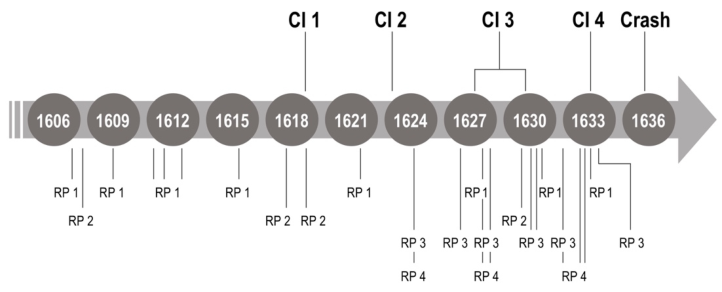
Figure 1 is a timeline of the critical interactions (CI) and recurring phenonema (RP) with times shown in GMT. The critical interactions were opportunities to prevent the flight from proceeding as planned. At CI 1, the captain turned down a request from the FO to check the visibility. At CI 2, the captain told the FO to speak up if he had any questions. This was another opportunity for the FO to voice concerns about the safety of the flight, but it seems to have been disrupted by a transmission from the ground controller. CI 3 spanned almost three minutes when the aircraft was lined up for takeoff on the wrong runway. The FO was aware they had entered a runway without clearance. He voiced his concern to the captain about the visibility, but the exchange was disrupted by a message from the tower controller. Finally, in CI 4 the FO and FE were making sense of the runway confusion, but their talk was disrupted by another message from the tower controller.
Making Sense of Culture in the Cockpit: The Crash of Japan Airlines Flight 1045 41
The communication interplay became increasingly complicated as the air- craft taxied, reaching a confused climax in CI 3 with code switching between English and Japanese in the cockpit (RP 1), the FO trying to raise a safety concern (RP 2), the captain and FO switching radio duties (RP 3) and the captain’s transmissions lacking clarity (RP 4). The flight crew were not functioning as an effective team, and their communication difficulties were compounded by the unfortunate timing of a series of radio messages that interrupted important cockpit talk. No action was taken to prevent the take- off, which proceeded with an intoxicated captain and airframe icing, resulting in the crash shortly after rotation.
CONCLUSION
This paper presents a novel methodology for analyzing the communication of pilots and air traffic controllers in airline accidents. CA techniques are used to examine interactions as they unfolded, which is a defence against hindsight bias. An additional benefit is that the methodology highlights shortcomings in the format of accident report transcripts. For example, valuable informa- tion about rate of talk, overlapping talk and distraction is not available if transcripts do not include accurate start and end times for all utterances.
The JAL Flight 1045 accident involved an intoxicated American captain taking off in an aircraft that had airframe icing. This analysis attempts to make sense of the failure of the Japanese flight crew members to prevent the takeoff. Several communication barriers have been identified that contributed to the accident: important talk about the aircraft’s situation was in Japanese; the FO talked around safety concerns and did not state them directly; the captain dismissed the safety concerns raised by FO; and important cockpit exchanges were interrupted by radio transmissions. In addition to a steep authority gradient in the cockpit, the FO’s reluctance to state his concerns directly can be understood in terms of high- and low-context interactions. It is also possible that the communications of the FO and FE were influenced by topic avoidance and a desire to minimize face loss.
42 Cookson
There have been major changes to airline training and procedures since the JAL Flight 1045 accident happened. One major development was the introduction of crew resource management (CRM6) training from the 1980s onwards. CRM teaches techniques that enable flight crews to work as effective teams and avoid problematic behavior patterns by, for instance, empowering junior crew members to challenge captains if a flight is at risk (Cookson, 2016). Despite these changes, “culture accidents” still periodically occur, and stories of intoxicated pilots continue to emerge in mainstream media and on airline discussion forums. The lessons from this accident remain pertinent to today’s flight operations.
REFERENCES
Cenipa. (2008). Final report. A-00X/CENIP A/2008. Brasília, Brazil: Aeronautical Accidents Investigation and Prevention Center. Chow, S., Yortsos, S., & Meshkati, N. (2014). Asiana Airlines flight 214: Investigat-
ing cockpit automation and culture issues in aviation safety. Aviation Psychology and Applied Human Factors, 4(2), 113–121. Cookson, S. (2016). Culture in the cockpit: Implications for CRM training.
In S. Schatz & M. Hoffman (Eds.) Advances in intelligent systems and computing: Advances in cross-cultural decision making (pp. 119–132). Cham, Switzerland: Springer. Dekker, S. (2006). The field guide to understanding human error. Aldershot, UK: Ashgate Publishing Limited. Ewing, R. L. (2008). Aviation medicine and other human factors for pilots.
Christchurch, NZ: Old Sausage Publishers. Hall, E. T. (1976). Beyond culture. New York: Anchor Books. Harris, D. (2011). Human performance on the flight deck. Farnham, Surrey: Ashgate Publishing. Helmreich, R. L. (1994). Anatomy of a system accident: The crash of Avianca flight
052. International Journal of Aviation Psychology, 4(3), 265–284. JAL. (n.d.). Accidents JAL has caused other than Flight 123 Accident. Japan Airlines.
Retrieved February 22, 2024, from https://www.jal.com/en/safety/center/acciden t.html Macaro, E., Vanderplank, R., & Murphy, V. A. (2013). A compendium of key concepts in second language acquisition. In E. Macaro (Ed.) The Bloomsbury companion to second language acquisition. (pp. 29–106). London: Bloomsbury Publishing. Nevile, M. (2006). Communication in context: A conversation analysis tool for
examining recorded voice data in investigations of aviation occurrences. ATSB Research and Analysis Report B2005/0118. Canberra: Australian Transport Safety Bureau. NTSB. (1979). Aircraft accident report: Japan Air Lines Co., Ltd. McDonnell- Douglas DC-8-62F, JA 8054, Anchorage, Alaska, January 13, 1977. NTSR-AAR- 78-7. Washington, D. C.: National Transportation Safety Board. Ragan, P. H. (2007). Cross-cultural communication in aviation. In K. Ahmad
& M. Rogers (Eds.), Evidence-based LSP: Translation, text and terminology (pp. 119–141). Bern: Peter Lang. Strauch, B. (2010). Can cultural differences lead to accidents? Team cultural differences and sociotechnical system operations. Human Factors, 52(2), 246–263.
6The original name, Cockpit Resource Training, changed to Crew Resource Training in the 1980s to emphasize interactions with personnel outside the cockpit (eg: controllers).
LISTED IN THE AHFE DIGITAL BOOKSTORE CATALOGUE
Explore the complete digital volume
Advances in Human Factors of Transportation
Read this individual research paper free through the original publisher, or explore the full digital proceedings book.
ISBN 978-1-964867-24-3
Explore this ISBN in the AHFE Bookstore ↗Listed in the July 2026 bookstore catalogue; search by ISBN to confirm current availability · Digital book purchase optional