Benjamin Brunet, Samuel Aupetit, Philippe Cabon (2024). How can the analysis of human factors in risky situations encountered by users of new forms of mobility improve their safety in the city?. In: Advances in Human Factors of Transportation. AHFE Open Access, vol. 148, pp. 518–526. https://doi.org/10.54941/ahfe1005243
This work is part of a research project called NewMob, funded by the French National Research Agency (ANR) and supervised by Université Paris Cité and Ergocentre.In France, we are witnessing strong growth in the number and type of Personal Light Electric Véhicule (PLEVs), as well as an increase in the number and severity of accidents involving these users. (Osnir, 2023) As a result, there is a general need for more knowledge about the behaviors of the various users of PLEVs and the risk situations they encounter on their journeys. The research question we will develop in this article is therefore as follows: To what extent can taking human factors into account in the risk situations encountered by users of new mobility help to improve their safety in the city?To investigate this question, we have set up three long-term studies in France's three biggest cities: Paris, Lyon and Marseille. These studies are part of the ergonomic analysis of human activity. (Leplat, 2015) Field methods were used to track and analyze the journeys of 150 participants: 65 electric bikes, 60 electric scooters and 25 gyroroues. Over a 2-month period, participants recorded all their daily journeys (video and data), and were able to report any risky situations they encountered during their journeys. For each situation, the participant had to fill in a detailed form, enabling us to analyze a total of around 955 risky situations collected. Two self-confrontation interviews enabled us to analyze the participants' situated experience of risky situations, their ways of dealing with incidents, and the strategies and compromises they implemented during their journeys.Vehicle dynamic data were recorded for a total of 9,124 trips, covering a distance of over 33,000 kilometers. This data include acceleration, speed, braking and lateral variations, enabling us to gather a wealth of statistical data, and to objectively qualify the criteria for identifying a high-risk situation (emergency avoidance, braking force, etc.). A major challenge of this project is to be able to cross-analyze the subjective data collected during interviews with objective vehicle dynamics data, enabling us to establish a complete overview of the different risk situations encountered by users of new urban mobility in France. Initial results are emerging from ongoing data analysis, and we will be able to present in greater detail the cross-profiling of participants across the various study methods (type of vehicle, number of risky situations, severity of situations, average speed of journeys, speeds in risky situations, participants' relationship to risk, etc.). Additionally, we will present the results of analyses on the main types of risky situations encountered by participants, along with comparisons between the different cities analyzed.
This work is part of a research project called NewMob, funded by the French National Research Agency (ANR) and supervised by Université Paris Cité (Laboratoire LaPEA) and the company Ergocentre. The Université Gustave Eiffel is a partner in the project, with the participation of the LESCOT and LMA laboratories in two studies, and Movida is also taking part in a NewMob study.
In France, a sharp increase in the number and type of personal mobility devices has been observed. The law now refers to electric scooters, electric unicycles, hoverboards and other electric machines as Personal Light Electric Vehicle (PLEVs). In parallel with these changes in usage, there was also a significant increase in the number and severity of accidents. Among (PLEVs), serious injuries have increased by 285% since 2019 (ONISR, 2023).
To prevent these accidents, the French government is attempting to intro- duce specific regulations and adaptations for PLEVs, which until now have been left in a legal uncertainty.
As a result, there is a general need for more knowledge about the behavior of the various users of PLEVs, and the risky situations they encounter on their journeys.
How Can the Analysis of Human Factors in Risky Situations Encountered by Users 519
In this context, the objective of this project is to assess to what extent human factors can be taken into account in risky situations encountered by users of new forms of mobility to improve their safety?
In connection with this main objective we will try to understand: What are the different user profiles for electric scooters, electric bikes and electric unicycles? What different types of use can be observed, and what are the differences between them? What risky situations do these users encounter as a result of their use and behavior?
To answer these questions, three longitudinal studies have been set up in France’s largest cities: Paris, Lyon and Marseille. Our theoretical framework is based on the ergonomic analysis of human activity (Leplat, 2008) and more specifically the analysis of driving activity (Aupetit et al., 2016). Within this framework, we will mainly use the methods of self-confrontation and explic- itation interviews of Vermersch (Vermersch, 2019) and Theureau (Theureau, 2010). The aim is to propose a new way of analyzing and considering human activity, which we are trying to conceptualize as: “the natural study of activ- ity”. At the crossroads of ergonomic activity analysis (Daniellou, 2005; Falzon, 2005; Leplat, 2008) and the long-term ecological studies set up as part of the course-of-action and course-of-life studies (Theureau, 2006).
METHODS
Three Different Natural Studies The natural study of the NewMob project was carried out on three different sites from September 2022 to December 2023 in the cities of Marseille, Lyon and Paris. The methods presented here were developed in collaboration with various partners in the research group.
Field methods were used to track and analyze the journeys of 150 par- ticipants: 65 electric bicycles (EABs), 60 electric scooters and 25 electric unicycles. Over a 2-month period, participants were equipped with brackets and cell phones to record all their daily journeys (video and dynamic data). They were asked to report any risky situations they encountered during their journeys using a form displayed on a dedicated smartphone.
Detailed forms were completed for each situation, generating a dataset of around 955 risky situations. Two self-confrontation interviews were con- ducted with each participant, to explore in greater depth their experiences of risky situations, and the strategies and compromises they used during their journeys.
Vehicle dynamic data was recorded for a total of 9,124 trips, covering a distance of over 33,000 kilometers. This data include acceleration, speed, braking and lateral variations, enabling us to collect a wide variety of statis- tical data and objectively qualify the criteria for identifying a risky situation (emergency avoidance, braking force, etc.). We will only present a part of it in this article.
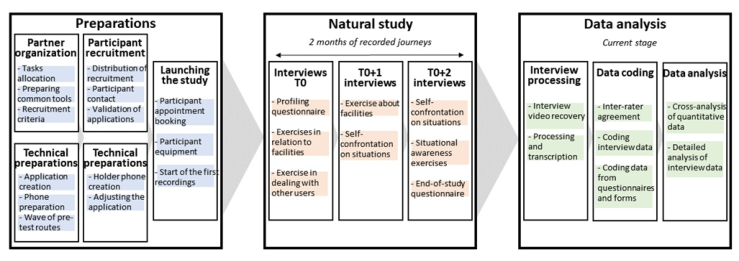
Field Study and Data Analysis Preparation and Recruitment The first stage of the field studies has consisted in preparing the collabo- ration between the various field partners. Thus, the preparation of study
materials (smartphones, stands, harnesses, etc.), the choice of recruitment criteria, the creation and distribution of a call for candidates, the contact and the validation of applications were divided up according to the availability and relevance of the project’s actors.
Iterations were carried out between the different stages of participant recruitment, to ensure the target participant number of 50 per sites. Three launch waves were set up, to spread the participant load across the different methods.
Data Collection After this stage came the data collection, divided into three stages. An ini- tial interview at the start of the study (T0) to clarify certain concepts with participants, such as the “risky situations”.
After one month of daily journeys we have conducted another interview (T0+1) centered on self-confrontation method, in which we discuss the risky situations encountered in the previous period, inviting them to choose between two and three of the most striking risky situations reported. An ini- tial viewing verifies that the situation is indeed the one chosen, and then we begin the work of making explicit the experience, using the video recording and self-confrontation methods (delving into emotions, in situ perceptions, experienced risk, decision-making, compromises).
One month later, a final interview came to end the study (T0+2). The main part of the interview covered the risky situations encountered in the last month of the study, and again carries out a self-confrontation exercise. This allows us to observe the evolution of the situations encountered and compare them over an extended 2-month period.
The interview was completed with two exercises designed to qualify the risky situations in a broader way, to explore the responsibilities perceived by the participant and get him/her to elaborate on the occurrence of possible errors or functional failures (Hoc and Amalberti, 1994).
We end the interview with the transmission of the final study questionnaire. It enables us to collect data on the dimensions of sensation seeking, their relationship to the rule (Cestac et al., 2018) and to risks (CBQ) (Useche et al., 2018).
Data Analysis Analysis of the study’s qualitative data requires systematic transcription of all interviews. The data collected is then coded in more objectified variables (e.g. emotions felt, action taken, information gathered, etc.).
For coding consistency between researchers, an inter-rater agreement (Cohen, 1968) was performed on a panel of 10 situations. Since all the inter- rater results are above 0.8, the quality and consistency of the data can be considered as high.
Finally, the qualitative analyses involve the systematic processing of all the verbatim collected during the self-confrontation and explanatory inter- views, in order to gain a detailed understanding of users’ experiences in risky situations.
How Can the Analysis of Human Factors in Risky Situations Encountered by Users 521
Cross-analyses should enable us to identify the main types of situations, their severity and the associated contexts (type of layout, other users involved, etc.). By cross-referencing the input data, the various study milestones and the exit questionnaire, it will be possible to draw up a genuine trajectory of the various users.
Figure 1: Summary diagram of NewMob natural study method.
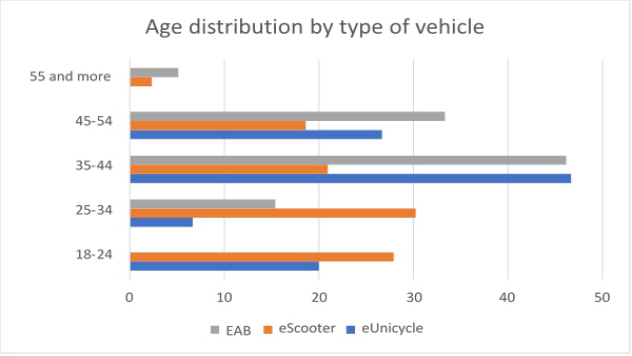
PRELIMINARY RESULTS In this section, the initial results1 of our analysis of the NewMob study data are presented. Figure 2 shows participants’ profiles in terms of age and type of vehicle.
Participant Profiles Age and Vehicles
Figure 2: Age distribution by type of vehicle.
1Data analysis underway on studies 1 and 2 (Marseille and Lyon), further results to follow (Paris)
Among electric scooters, the 25–34 and 18–24 age groups are the most represented, which is consistent with our initial hypotheses: in these two youngest categories, scooters are the most represented.
Among electric bicycles (EABs), the most represented age categories are 35–44 and 45–54. This distribution is very different from that of scooters, as the user profiles are not the same. The 18–24 age group is also completely absent.
Lastly, for electric unicycle, the 35–44 category is the most represented, which corresponds to the typical profile predicted at the start of the project, although the other age categories are more evenly distributed than expected.
Gender and Vehicles
Table 1. Gender distribution by vehicles.
Table available in the original PDF paper.
Gear type Type Quantities of group Electric unicycle 1. Male 15 15 100,0 2. Woman 0 0,0 Electric scooter 1. Male 32 43 74,4 2. Woman 11 25,6 Electric bike 1. Male 18 39 46,2 2. Woman 21 53,8
Electric unicycles involved in our studies are exclusively male, which tends to confirm the initial hypothesis of a very specific user profile.
The electric scooter group is predominantly male (74.4%), with only a minority of women (25.6%).
Finally, the EAB group is evenly distributed, with slightly more women (53.8%) than men (46.2%). This could be explained by the uses associated with the machine, which we’ll detail in the next section.
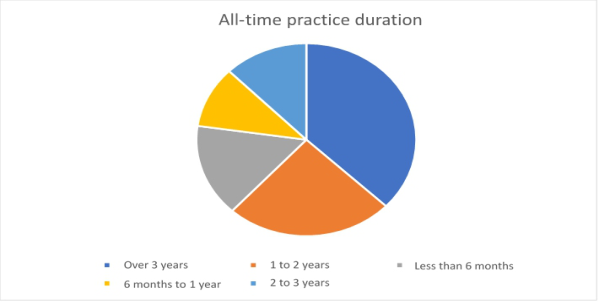
Figure 3: Distribution of practice duration among all participants.
How Can the Analysis of Human Factors in Risky Situations Encountered by Users 523
In the study population, the most represented category is: “more than 3 years” of practice. This does not necessarily correspond to our hypothe- ses about the population using the new mobility, and it is possible that this is associated with a selection bias of the study, which would only interest individuals who are more sensitive to the issue of safety.
Users with less than a year’s experience represents only 25% of the sample. This can be explained by the fact that the study is mainly focused on users who own their own device, which may reduce the number of novice profiles. However, taking them into account seems essential to understanding risky situations.
Uses and Journeys In this section, the analyses of the uses observed during the study are pre- sented. In particular, the practice of multimodal trips and the main areas of use by participants are detailed.
Multimodal Journeys
Table 2. Frequencies of multimodal journeys and vehicles.
Table available in the original PDF paper.
Multimodal journeys? Quantities % of Total
1. Yes 40 41.2 % 2. No 57 58.8 % Gear type Quantities Total % by group Electric unicycle 12 15 80% Electric scooter 20 43 46,5% Electric bike 8 39 20.5%
We note that a large proportion of the study panel makes journeys using a means of transport that complements their vehicle (multimodal), with just over 40% of participants.
In detail, electric unicycles are the most reprensented in multimodality (80%), followed by electric scooters (46%) and, finally, electric bikes (20%). These results may be explained in particular by the practicality of smaller machines compared to electric bikes, which are easier to transport.
Journeys Usage Zones
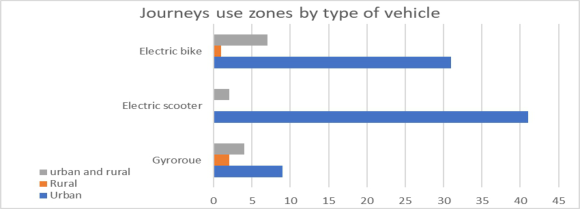
Figure 4: Journeys use zones by type of vehicle.
The main uses declared by participants are in urban areas, which is con- sistent with the main objective of the study. Nevertheless, we note that some users also make journeys in rural areas, notably with electric unicycles, and also in mixed settings such as with EABs.
Electric scooters do not seem to be used in rural areas, if at all, which seems consistent with our hypotheses on usage, particularly in relation with the issue of autonomy.
Risky Situations Encountered
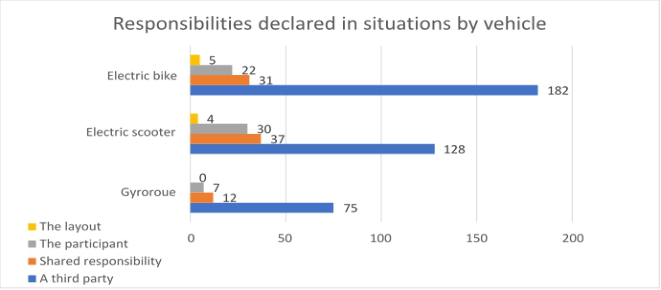
Figure 5: Responsibilities declared in situations by type of vehicle.
Among all the risky situations reported in the survey, scooters are pro- portionally more likely to consider themselves responsible than other users. (15% of cases vs. 7.5% for electric unicycles and 13% for electric bikes).
Electric unicycles never blame responsibility for the layout, but this may have something to do with the way they are used. In fact, they are more likely to behave like motorized vehicles, preferring roads to cycle paths.
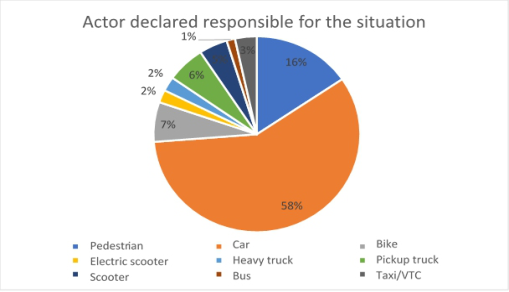
Figure 6: Actor declared responsible for the situation.
How Can the Analysis of Human Factors in Risky Situations Encountered by Users 525
In situations where the other person is considered responsible, the actor involved is mainly the car (over 57%), followed by the pedestrian (around 16%). Bicycles and scooters, which make up the majority of traffic encountered on our roads (particularly on cycle paths), are considered to be responsible for only 9% of reported risky situations. This can be explained by the low severity of the situations in which they are involved, compared with cars.
DISCUSSION AND FURTHER WORK Thanks to field methods involving 150 users of electric bikes, scooters and electric unicycles over 2 months of daily commuting, we were able to ana- lyze in detail their practices and uses, which are still poorly described in the scientific literature.
Initial results have enabled us to gain a better understanding of the pro- files of users who use certain individual mobility rather than others. We can also describe in more details the uses associated with certain types of mobility, such as the multimodal use of electric unicycle and electric scoot- ers. Finally, we can describe more accurately the types of risky situations that users encounter on their journeys. Participants mainly report situations in which another user is identified as being responsible for the situation, with cars appearing most often, followed by pedestrians. These initial results show that the uses and risky situations of electric scooters, electric unicycles and electric bikes appear to differ in some aspects.
Ongoing analysis of the results for the most frequent risk scenarios has already enabled us to identify “refusal to give right of way when turning right”as the most frequent situation, which is consistent with previous studies carried out on bicycles. We’ll have the opportunity to discuss these results in a future article, linking the most frequent scenarios with the facilities involved, to gain a better understanding of the deeper causes of the most dangerous risky situations.
Finally, qualitative analysis of the interviews could provide us with key criteria to take into account in the human factor to limit risk situations. An initial lead is emerging on the question of information intake and lack of visibility during situations.
ACKNOWLEDGMENT
This study was funded by the French National Research Agency and carried out in partnership with the Gustave Eiffel and Paris Cité universities.
REFERENCES
Aupetit, S., Gallier, V., Riff, J., Espié, S., Delgehier, F., 2016. Naturalistic study of the risky situations faced by novice riders. Ergonomics 59, 1109–1120. https: //doi.org/10.1080/00140139.2015.1120887
Cestac, J., Carnis, L., Assailly, J. P., Eyssartier, C., Garcia, C., 2018. Enquête sur le rapport à la règle chez les automobilistes français. (Research Report). IFSTTAR - Institut Français des Sciences et Technologies des Transports, de l’Aménagement et des Réseaux. Daniellou, F., 2005. The French-speaking ergonomists’ approach to work activity:
cross-influences of field intervention and conceptual models. Theor. Issues Ergon. Sci. 6, 409–427. https://doi.org/10.1080/14639220500078252 Falzon, P., 2005. Ergonomie, Conception ET Développement, in: Conférence introductive. Presented at the 40ème Congrès de la SELF, Saint-Denis, La Réunion, p. 12. Hoc, J.-M., Amalberti, R., 1994. Diagnostic et prise de décision dans les situations
dynamiques. Diagn. Prise Décision Dans Situat. Dyn. 39, 177–192. Leplat, J., 2008. Repères pour l’analyse de l’activité en ergonomie. Presses Universitaires de France. https://doi.org/10.3917/puf.lepla.2008.01 Theureau, J., 2010. Les entretiens d’autoconfrontation et de remise en situation par
les traces matérielles et le programme de recherche ≪cours d’action ≫. Rev. Anthropol. Connaiss. Vol. 4, 2, 287. https://doi.org/10.3917/rac.010.0287 Theureau, J., 2006. Le cours d’action: Méthode développée. Useche, S. A., Montoro, L., Tomas, J. M., Cendales, B., 2018. Validation of the Cycling Behavior Questionnaire: A tool for measuring cyclists’ road behaviors. Transp. Res. Part F Traffic Psychol. Behav. 58, 1021–1030. https://doi.org/10. 1016/j.trf.2018.08.003 Vermersch, P., 2019. Entretien d’explicitation, in: Vocabulaire des histoires de vie et
de la recherche biographique, Questions de société. Érès, Toulouse, pp. 340–342. https://doi.org/10.3917/eres.delor.2019.01.0340
LISTED IN THE AHFE DIGITAL BOOKSTORE CATALOGUE
Explore the complete digital volume
Advances in Human Factors of Transportation
Read this individual research paper free through the original publisher, or explore the full digital proceedings book.
ISBN 978-1-964867-24-3
Explore this ISBN in the AHFE Bookstore ↗Listed in the July 2026 bookstore catalogue; search by ISBN to confirm current availability · Digital book purchase optional