Xiaoqiao Li, Ho Yin Ma, Cheuk-kit Chung Chung (2026). Phantom Terrain: Evoking Community Memory Through Gaussian Point Cloud VR and Immersive Landscape Reimagination. In: Human Interaction and Emerging Technologies (IHIET-AI 2026): Artificial Intelligence and Future Applications. AHFE Open Access, vol. 201, pp. 167–178. https://doi.org/10.54941/ahfe1007171
This artistic research examines how immersive virtual reality experiences utilizing Gaussian point cloud technology can evoke and reconstruct community memory through reimagined landscapes. The creative project, Phantom Terrain: Landscapes Reimagined Through Gaussian Point Clouds, explores the intersection of digital capture technologies, artistic intervention, and collective remembrance. Gaussian point cloud technology offers unprecedented fidelity in capturing spatial information while providing malleable data structures for creative transformation. Distinct from traditional photogrammetry, Gaussian splatting preserves environmental authenticity while enabling fluid manipulation. This creates a unique aesthetic space where memory functions as a dynamic, participatory experience rather than a fixed record. Phantom Terrain captures real-world locations through high-density scanning, then subjects these datasets to artistic intervention. By distorting scales, blending temporal layers, and fragmenting spatial continuities, the project generates environments that feel simultaneously familiar and uncanny. These function as "memory palaces of the collective unconscious," where viewers project their personal experiences onto the shared cultural geography they encounter. The VR component transforms passive observation into embodied exploration. When participants enter these environments, they experience landscapes as inhabited spaces, triggering somatic memories through bodily engagement rather than purely visual recognition. Community memory operates on multiple registers: individually, landscapes surface personal histories through environmental recognition; collectively, virtual terrains encode cultural narratives embedded in landmark patterns, architectural remnants, and ecological transformations. The methodology targets locations of communal significance undergoing rapid transformation, employing "speculative archaeology" to construct landscapes hovering between the real and the imagined. Viewers become active agents of meaning-making, enacting embodied historiography through spatial navigation.
Urbanization, climate change, and economic shifts are all accelerating landscape change. This raises important questions about how communities preserve and share cultural memories of place. Conventional documentation techniques, such as photographs, videos, and written narratives, represent landscapes as external entities rather than as experiential environments infused with embodied knowledge and collective significance. This artistic research project posits that immersive virtual reality technologies, particularly those that utilize Gaussian point cloud representations, offer unparalleled opportunities to elicit community memory through spatial reimagination.
New advances in 3D capture and rendering technologies have enabled this study. Gaussian splatting, inspired by Neural Radiance Fields (NeRFs), renders scenes as millions of volumetric particles that can be rendered in real time with photo-realistic quality. Gaussian splatting, on the other hand, maintains a continuous, point-based representation that preserves the indexical relationship to the real world while also allowing artistic manipulation. Traditional photogrammetry makes polygon meshes. When experienced through immersive VR headsets, these environments go beyond mere visual recordings. They activate what neuroscience calls “body memory,” which refers to how spatial experiences are stored in the sensorimotor systems rather than just in cognitive memory.
This paper builds on previous research on Gaussian splatting as an “organological extension of imagination in artistic processes” (Li et al., 2025). It illustrates how this technology can facilitate memory evocation and community narrative construction when integrated with immersive VR interaction. The study adds to new conversations about the intersection of digital heritage preservation, embodied cognition in virtual environments, and artistic interventions in landscape representation.
The paper establishes a theoretical framework synthesizing phenomenology, memory studies, and digital aesthetics. It begins by detailing the technical methodology, tracing the workflow from initial data capture to the creation of an immersive experience. Subsequent sections examine the artistic process, specifically focusing on strategies for creative intervention. The discussion then shifts to insights gained from firsthand engagement with the work. Finally, the paper concludes by outlining the broader implications of this approach for both research and creative practice.
THEORETICAL FRAMEWORK Embodied Memory and Bodily Intentionality
Phenomenological philosophy offers a foundational framework for understanding how virtual reality can evoke memory through the experience of space. We often engage with the world before we consciously reflect on it, an interaction described by the concept of “bodily intentionality.” It suggests that the body possesses a form of knowledge distinct from intellectual thought. We do not simply exist inside a space like an object in a box; we actively inhabit it, relying on an internal, unconscious guide known as the “body schema.”
Phantom Terrain: Evoking Community Memory 169 This system maps our physical capacities and helps us understand how to move through our surroundings, structuring every encounter with the environment.
Recent neuroscience research validates these earlier philosophical insights by identifying how the brain records our experiences of space. Riva (2018) describes this through the concept of the “spatial body,” a term referring to how we integrate sensory information to feel a sense of “self-location.” This process relies heavily on somatic memory systems, meaning we do not always store our past as explicit stories that we can verbally recount. Instead, we often keep them as physical sensations or motor patterns. In practical research scenarios, we observe that users who move naturally in a virtual world form stronger memories. When visual input synchronizes with physical movement, memory encoding improves, as active engagement creates a more profound impression than disembodied, passive viewing.
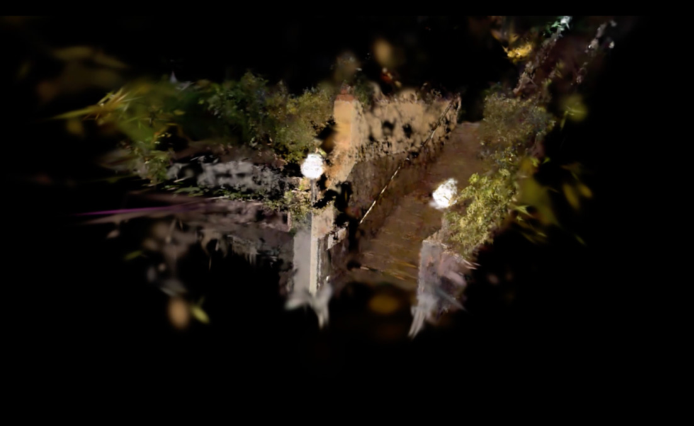
This theoretical background directly informs the design of specific virtual experiences, such as the Phantom Terrain project (Figure 1). The experience allows users to navigate through reimagined digital landscapes, where immersive movement can trigger embodied memories. A user might recognize the shape of a room or a specific quality of light, elements that often mirror the atmospheric conditions of their own lived history. The deep connection between the body, the environment, and action, sometimes called the “intentional arc,” becomes active again within the virtual space. This allows memory to emerge through spatial engagement, ensuring the user does not need to rely on cognitive retrieval to access the past.
Figure 1: The Phantom Terrain project set within a virtual reality scene.
Community Memory and Landscape as Palimpsest Community memory extends beyond individual recollection to encompass shared narratives, collective meanings, and cultural knowledge transmitted through generations and inscribed in physical environments. Drawing on
cultural geography and memory studies, landscapes function as palimpsests, layered texts where successive inscriptions partially obscure yet retain traces of prior meanings. As Huyssen (2003) argues, urban spaces operate as palimpsests where the past is never entirely erased but persists as traces beneath and alongside the present, creating a temporal layering that shapes how communities inhabit and remember place. This dialectic of presence and absence, visibility and erasure, defines how landscapes carry cultural memory.
The palimpsest metaphor proves particularly apt for understanding both the process of landscape transformation and the artistic intervention strategy employed in Phantom Terrain. Real-world landscapes already embody multiple temporal layers: architectural remnants that index past communities, infrastructural traces that reveal patterns of habitation and movement, and vegetation patterns that reflect ecological succession. The project’s methodology of digitally capturing these sites, then artistically recombining and transforming them, extends the palimpsest logic into virtual space, creating what might be termed “speculative palimpsests” landscapes that foreground the constructedness of memory while inviting participatory meaning-making.
Virtual reality enhances this palimpsestic quality by juxtaposing multiple spatial and temporal layers within a single navigable environment. VR landscapes can function as heterotopic “memory palaces” where fragments from different locations and times coexist, creating spaces that nonetheless shape real experience.
Authenticity, Familiarity, and the Uncanny Digital reconstruction of landscapes for memory evocation raises critical questions about authenticity, fidelity, and the phenomenology of recognition. Heritage conservation discourse distinguishes between “objective authenticity” (material accuracy to historical evidence) and “constructive authenticity” (negotiated meaning-making through interpretation). Phantom Terrain deliberately occupies an ambiguous position between these authenticities, prioritizing what might be termed “experiential authenticity”—the capacity to evoke genuine affective and mnemonic responses even through fictional recombination.
This strategy engages research on perceptual familiarity and the uncanny valley effect. Studies demonstrate that familiarity expands perceptual bandwidth and enhances memory encoding; familiar scenes are processed more efficiently and remembered more vividly than novel ones. Simultaneously, stimuli that approach but do not fully replicate reality can trigger uncanny responses characterized by both attraction and unease. The project leverages this tension, creating landscapes familiar enough to evoke recognition and memory associations, yet sufficiently transformed to prompt reflective awareness of memory’s constructedness.
The point cloud aesthetic itself contributes to this effect. Unlike photorealistic rendering, which aims for seamless illusion, Gaussian splatting’s
Phantom Terrain: Evoking Community Memory 171 visible granularity and characteristic softness maintain the aesthetic tension between hyperreal detail and painterly abstraction described by Harmon and Serrano (2022). This visual quality prevents complete immersion in the illusion while maintaining an indexical connection to captured reality, creating what could be termed a “critical presence” awareness of both being- there and representation simultaneously.
TECHNICAL PIPELINE AND IMPLEMENTATION (FIGURE 2) Capture: Scaniverse and Mobile LiDAR
The initial capture phase uses Scaniverse, a mobile application that leverages the LiDAR sensors integrated into iPhone 15 Pro Max and later models. This consumer-grade technology democratizes high-fidelity 3D scanning, enabling artists and researchers to capture environments without specialized equipment or technical expertise. Scaniverse generates Gaussian splat representations directly on-device, processing captured spatial and color data into point clouds that can be exported in multiple formats.
The capture methodology prioritizes sites with significant communal and cultural meaning: abandoned rural villages undergoing depopulation, marginal urban spaces transformed by development, and landscapes bearing visible traces of historical land use. Each scanning session lasts 2-5 minutes and captures spatial extents ranging from individual architectural elements to entire village plazas. The iPhone’s mobility and ease of use are crucial for accessing sites that would be impractical to document with traditional laser- scanning equipment.
Scaniverse’s real-time feedback during capture enables responsive documentation—areas requiring additional detail can be rescinded immediately, and the visual representation of captured versus uncaptured regions (displayed as red areas in the application interface) guides comprehensive spatial coverage. The resulting Gaussian splat files typically range from 50,000 to 500,000 individual points per scan, with color, position, opacity, and scale attributes encoded for each point.
Figure 2: Technical workflow pipeline.
Figure available in the original PDF paper.
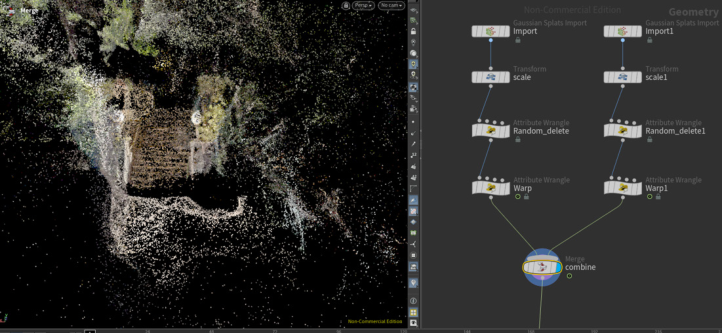
Artistic Intervention: Houdini Point Cloud Manipulation Following capture, the Gaussian splat files are imported into SideFX Houdini, a procedural 3D modeling and effects platform with robust point- cloud processing capabilities. Houdini’s node-based workflow enables non- destructive, iterative artistic intervention while maintaining the point cloud structure (Figure 3). The creative manipulation strategies employed include:
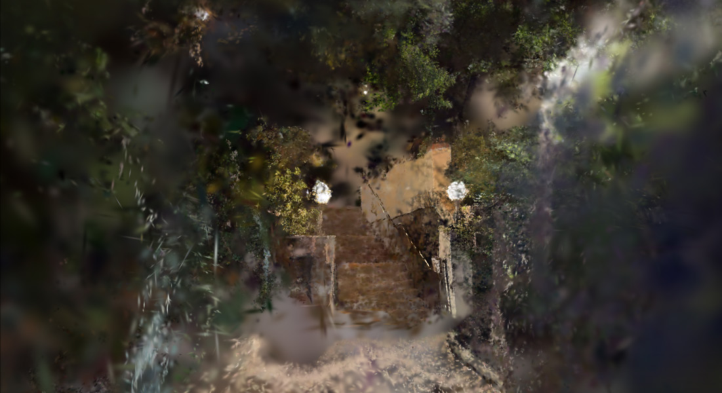
Spatial Recombination: Point clouds from geographically separate locations are merged into single virtual landscapes, creating impossible spatial juxtapositions that nonetheless maintain experiential coherence. For instance, architectural elements from an abandoned mountain village might be integrated with agricultural terracing from a coastal region, producing hybrid spaces that evoke generalized memories of rural transformation rather than specific places (Figure 4).
Scale Transformation: Individual point clouds are scaled differentially, disrupting conventional spatial hierarchies. Intimate domestic spaces might be enlarged to monumental proportions. At the same time, vast agricultural landscapes are condensed, foregrounding the subjective, memory-driven experience of space in which emotionally significant locations assume disproportionate perceptual presence.
Temporal Layering: Multiple scans of the exact location captured at different times (seasons, lighting conditions, stages of transformation) are layered with varying opacity and color adjustments, creating palimpsestic visualizations in which past and present states coexist.
Fragmentary Dissolution: Point densities are selectively reduced in peripheral areas, while core spaces maintain high fidelity, mimicking the phenomenology of memory, in which central experiences remain vivid while peripheral details fade. This technique also references the characteristic degradation of architectural ruins—the material palimpsests that inspire the project’s conceptual framework.
Houdini’s procedural approach allows these interventions to be parameterized and systematically varied, generating multiple aesthetic variations from the same source data. The final modified point clouds are exported in formats compatible with Unity game engine integration.
Figure 3: Houdini pipeline: point cloud manipulation.Figure 4: Spatial recombination using Houdini to create a combined scene.
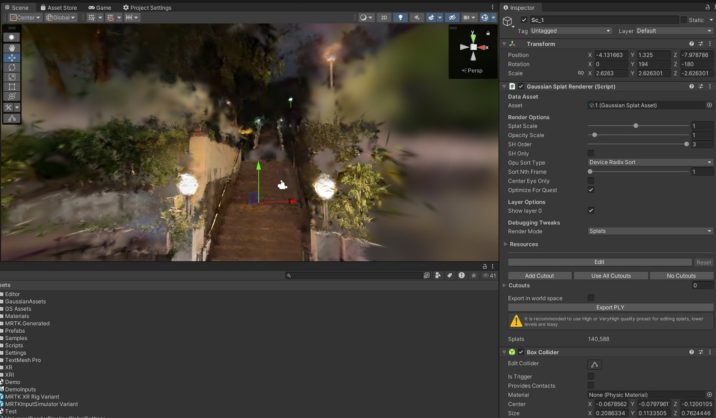
VR Implementation The immersive VR experience is implemented in the Unity game engine using community-developed Gaussian splatting rendering packages. These packages enable real-time visualization of point cloud data on standalone VR headsets, specifically the Meta Quest 3 (Figure 5).
Figure 5: Implement a virtual reality scene using the Unity game engine.
The Quest 3 provides several capabilities critical to the project: standalone processing eliminates tethering to PCs, allowing unrestricted movement through virtual landscapes; mixed reality passthrough cameras enable optional blending of real and virtual environments; and the Snapdragon XR2 Gen 2 processor delivers sufficient performance for real-time Gaussian splat rendering at 90-120Hz refresh rates. The headset’s specifications—2064×2208 pixels per eye, 110° horizontal field of view, 8GB RAM—represent the current consumer-grade standard for immersive VR experiences.
However, technical constraints require careful optimization. Standalone Quest 3 performance degrades significantly beyond 150,000–500,000 splat points. To maintain frame rates above 72fps (the threshold below which presence and immersion degrade), the project implements several strategies: Custom level-of-detail (LOD) systems that dynamically adjust point density based on viewing distance; spatial chunking that loads only visible regions of large environments; and artistic manipulation that strategically reduces point counts in peripheral areas while maintaining density in focal regions.
Navigation design follows embodied interaction principles. Users move through virtual landscapes using natural walking locomotion within the Quest 3’s tracking space, with smooth teleportation for longer distances. Head and hand tracking enable natural, gesture-based interaction. Notably, the experience avoids UI overlays or explicit instructions, allowing environmental exploration to proceed through the same bodily intentionality that structures real-world spatial engagement.
ARTISTIC METHODOLOGY AND INTERVENTION STRATEGIES Site Selection and Community Engagement
Site selection for Phantom Terrain prioritizes locations that embody community memory under threat of erasure. Following methodologies from participatory heritage preservation and community-based art practices, the project engages with local communities to identify culturally significant spaces: ancestral villages experiencing depopulation, agricultural landscapes transformed by industrial development, marginal urban spaces slated for redevelopment, and ecologically threatened regions.
While comprehensive participatory co-design was beyond the scope of this initial artistic research phase, informal consultation with community members informed site selection and interpretive framing. Future iterations will expand participatory elements, incorporating oral histories, community- provided archival materials, and collaborative decisions about which features to emphasize or suppress in the reimagined landscapes.
Speculative Archaeology: Between Documentation and Fiction The artistic intervention methodology draws on the concept of “speculative archaeology” digital landscape reconstructions that acknowledge incompleteness and embrace interpretive imagination. Unlike heritage reconstruction projects that aim for historical accuracy constrained by
Phantom Terrain: Evoking Community Memory 175 archaeological evidence, Phantom Terrain deliberately produces landscapes that “could have existed, might exist, or exist only in collective imagination”.
This approach responds to theoretical critiques of digital reconstruction’s claims to objective authenticity. Any digital interpretation of historical landscapes necessarily involves what might be termed “constructive authenticity,” a recognition that gaps in the archival and material record are inevitable and that filling them requires careful negotiation between what is documented and what must be imaginatively reconstructed. Traditional heritage visualizations often obscure this negotiation, presenting seamless images that mask the interpretive decisions underlying their construction. Rather than concealing this process, Phantom Terrain foregrounds it through visible artistic transformation, acknowledging the creative labor inherent in any act of remembering or representing the past.
The point cloud medium proves particularly suited to this strategy. Its granular, particle-based aesthetic maintains an indexical connection to captured reality (each point represents a surface measured by LiDAR or photogrammetry). At the same time, its visible constructedness prevents the illusion of complete representation. When point clouds from different sites are merged, or when point densities are dramatically reduced, the manipulation becomes perceptually noticeable, yet the spatial and atmospheric qualities that evoke memory persist.
Memory Palaces and Spatial Narrative The conceptual framework of “memory palaces” informs the spatial composition of reimagined landscapes. This ancient mnemonic technique, in which information is mentally associated with locations in an imagined architectural space, finds new technological instantiation in VR. As Yang et al. (2021) demonstrated, VR memory palaces significantly enhance knowledge retention compared to traditional study methods, with the spatial and embodied nature of VR navigation creating stronger memory encoding.
Phantom Terrain inverts this logic: rather than using spatial environments to encode new information, it creates spatial environments designed to evoke existing memories, both individual autobiographical memories of similar landscapes and collective cultural memories embedded in shared environmental archetypes. The spatial narrative emerges not from prescribed paths or explicit storytelling but from participants’ exploratory movement and the associative connections triggered by ecological features.
Preliminary experiential encounters suggest that participants engage in what might be termed “memory walking,” a mode of navigation wherein movement through virtual space becomes entangled with memory retrieval and imaginative projection. A participant might pause before a particular spatial configuration, such as a courtyard or a view through layered terrain, and report memories of similar spaces from their lived experience, even though the virtual landscape depicts a place they have never personally visited.
DISCUSSION: EVOKING COMMUNITY MEMORY THROUGH EMBODIED VR Presence, Embodiment, and Memory Phenomenology
Experiential evaluations of Phantom Terrain reveal a complex phenomenology in which participants report simultaneously experiencing virtuality and emotional presence in reimagined landscapes. This aligns with recent VR presence research, which emphasizes that technological fidelity alone does not determine presence; instead, presence emerges from the psychological coherence among environmental features, user expectations, and intentional structures.
Participants frequently describe a “critical presence, “ an awareness of the virtual environment’s constructed, artistic nature that coexists with genuine affective engagement and memory evocation. The point cloud aesthetic contributes to this effect: its “ghostly transparency” and visible granularity prevent complete perceptual illusion while maintaining spatial coherence and atmospheric fidelity. This quality may actually enhance memory evocation by signaling that the environment should be engaged as a mnemonic prompt rather than a documentary representation.
The embodied navigation proves crucial. When participants physically walk through virtual landscapes (within Quest 3’s tracking space), they report stronger memory associations and emotional responses than when viewing passively or using controller-based locomotion. This finding supports embodied cognition research demonstrating that motor activity during encoding enhances memory through sensorimotor traces.
Community Memory at Multiple Scales Community memory operates at multiple scales in Phantom Terrain experiences. At the individual scale, participants recognize spatial archetypes, courtyard configurations, agricultural landscapes, and architectural proportions that resonate with their personal histories, even when the specific virtual landscape is entirely fictional. This recognition-through-familiarity suggests that community memory is encoded partially through environmental schemas, generalized spatial patterns that transcend particular locations.
At the collective scale, the reimagined landscapes evoke shared cultural narratives about rural transformation, the costs of modernization, and the relationships between communities and land. Participants from similar cultural backgrounds often identify common thematic readings, suggesting that landscapes carry semiotic codes—“ways of seeing” shaped by cultural membership—that persist even in artistically transformed virtual representations.
The palimpsest quality of merged temporal layers proves particularly evocative. When the exact location appears in multiple seasonal or developmental states, in parallel (achieved through layered point clouds with varying opacity), participants report experiencing “compressed time,” in which past, present, and imagined futures coexist. This temporal multiplicity mirrors how community memory often conflates different periods into composite narratives.
Phantom Terrain: Evoking Community Memory 177 Ethical Considerations and Cultural Representation
The project raises critical ethical questions about representing communities’ landscapes and memories, particularly when those communities are marginalized or undergoing displacement. While the current phase prioritizes artistic research and phenomenological investigation, future development must address issues of consent, representation, and benefit.
Digital reconstruction and reinterpretation of culturally significant sites risk what heritage scholars term “cultural appropriation” or “decontextualization,” the extraction of elements from their social contexts and their reframing according to external agendas. To mitigate these risks, future iterations will expand participatory design elements, ensuring communities have agency in determining which sites are represented, how they are interpreted, and who has access to virtual experiences.
The speculative, artistically transformed nature of Phantom Terrain provides some ethical advantages over attempts at documentary reconstruction. By foregrounding the work’s artistic and imaginative character, it avoids claiming authoritative historical accuracy that might override community members’ own memories and interpretations. The visible constructedness signals that these landscapes are prompts for memory and reflection rather than definitive representations.
Gaussian Splatting as Artistic Medium The research validates and extends Li et al.’s (2025) theorization of Gaussian splatting as an “organological extension of imagination in artistic processes”. Beyond the technical advantages of real-time rendering and photorealistic fidelity, Gaussian splatting’s aesthetic characteristics—its grain, transparency, and relationship to captured reality—create a unique expressive register, especially suited to memory and landscape representation.
The medium occupies a productive space between indexicality in photography and painterly abstraction. Each point retains causal connection to a measured surface, providing what Harmon and Serrano (2022) describe as “indexical authority”. Yet the aggregate effect is atmospheric and impressionistic rather than sharply defined. This dual quality documentary and artistic, precise and suggestive mirrors the phenomenology of memory itself, which maintains a connection to experience while continually reconstructing and reimagining it.
The ease of artistic manipulation distinguishes Gaussian splatting from traditional photogrammetry. While mesh-based models require complex retopology and texture editing for significant alterations, point cloud data can be directly manipulated through transformations, filtering, and recombination. This malleability enables the iterative, experimental artistic process at the heart of Phantom Terrain.
CONCLUSION
Phantom Terrain demonstrates that immersive VR experiences utilizing Gaussian point cloud technology can effectively evoke community memory through artistic reimagination of landscapes. The project contributes across
multiple dimensions. It synthesizes phenomenology, memory studies, and embodied cognition to illuminate how virtual environments trigger affective and mnemonic responses, while proposing “speculative archaeology” as an alternative to documentary reconstruction that embraces memory’s imaginative dimensions. The workflow, developed from mobile capture through procedural intervention to immersive experience, offers a replicable model accessible to communities without specialized expertise and validates that consumer-grade hardware and accessible software tools are sufficient for creating presence-inducing virtual experiences. More broadly, Phantom Terrain argues that digital technologies of spatial capture need not remain confined to preservation or documentation. When approached as artistic media, these technologies can generate experiential spaces where community memory becomes not a fixed archive but a living, participatory process, landscapes reimagined through the interplay of bodies, narratives, and the evocative materiality of point clouds suspended between presence and absence, reality and imagination.
ACKNOWLEDGMENT
The author acknowledges that, as English is not their first language, a large language model was used to assist in polishing the final text of this paper.
REFERENCES
Huyssen, A. (2003). Present Pasts: Urban Palimpsests and the Politics of Memory.
Stanford University Press. Harmon, B., & Serrano, N. (2022). Point cloud aesthetics. Journal of Digital Landscape Architecture, 7, 335–344. https://doi.org/10.14627/537724033 Li, X., Li, R., Chung, C.-K., Ma, H.-Y., & Lai, C.-F. (2025). Reimagining creativity:
Gaussian splatting as an organological extension of imagination in artistic processes. Leonardo, 58(3), 241–249. Riva, G. (2018). The neuroscience of body memory: From the self through the space to the others. Cortex, 104, 241–260. Yang, F., Qian, J., Novotny, J., Badre, D., Jackson, C. D., & Laidlaw, D. H. (2021).
A variant of the virtual reality memory palace aids knowledge retrieval from scholarly articles. IEEE Transactions on Visualization and Computer Graphics, 27(12), 4359–4373. https://doi.org/10.1109/TVCG.2020.3009003
LISTED IN THE AHFE DIGITAL BOOKSTORE CATALOGUE
Explore the complete digital volume
Human Interaction and Emerging Technologies (IHIET-AI 2026): Artificial Intelligence and Future Applications
Read this individual research paper free through the original publisher, or explore the full digital proceedings book.
ISBN 978-1-964867-77-9
Explore this ISBN in the AHFE Bookstore ↗Listed in the July 2026 bookstore catalogue; search by ISBN to confirm current availability · Digital book purchase optional