Lai Man Tin (2026). Eastern Wisdom Extraction: AI-Driven Synthesis of Traditional Chinese Landscape Art and Shifting Perspective Principles through Immersive Technologies. In: Human Interaction and Emerging Technologies (IHIET-AI 2026): Artificial Intelligence and Future Applications. AHFE Open Access, vol. 201, pp. 559–567. https://doi.org/10.54941/ahfe1007209
This paper introduces an innovative approach for studying and reimagining traditional Chinese landscape painting (Shan Shui) and its underlying perspective principles by leveraging cutting-edge artificial intelligence (AI) and immersive technologies. The research demonstrates how contemporary technological tools can extract, interpret, and regenerate ancient Eastern wisdom, contributing to the expansion of humanity’s collective knowledge sphere (Noosphere). The research employs a multi-layered technological framework combining AI-machine learning, Gaussian splatting, and VR immersive systems. It demonstrates how AI can serve as a knowledge extraction tool, identifying patterns and correlations in artistic databases that might be beyond human perception. The technological approach employed in this research not only preserves traditional artistic expression but also creates new possibilities for experiencing and understanding Eastern wisdom in contemporary contexts, contributing to the expansion of the Noosphere through the digital preservation and evolution of cultural knowledge, which opens new pathways for cultural transformation, artistic innovation, and the integration of traditional wisdom with modern technological capabilities.
By investigating the philosophy Shan Shui (mountain-water), a traditional Chinese landscape genre that emphasizes the harmonious, ever-changing nature of mountain forms and spatial depth, this research utilizes AI, digital media and immersive system to explore a new frontier within the philosophical underpinnings of Shan Shui art.
The digital representation of Shan Shui highlights a transformation from the traditional interplay between humanity and nature to algorithmic processing (Manovich, 2018). This transformation is further investigated through the concept of the “Noosphere,” as developed by Vladimir Vernadsky and Pierre Teilhard de Chardin (1959), which explores the sphere of human thought as a distinct evolutionary stage. This framework allows for a deeper Received February 27, 2026; Revised March 16, 2026; Accepted March 21, 2026; Available online April 1, 2026
560 Tin understanding of how traditional wisdom and cultural assets are transformed within the context of advancing technology.
Standard 3D modelling and spatial creation are always reliant on Cartesian coordinates and provide fixed-point perspective. This presents the challenge for this research to translate traditional Chinese landscape art into a digital environment that can still capture the “shifting perspective” (Sullivan, 1984) and signify “scattered point of view” inherent in traditional Shan Shui painting. This paper analyzes the artwork “Eastern Wisdom Extracting Machine” (Tin, 2024) to demonstrate how a multi-layered technological framework can overcome the limitations of 2D and the static form of art expression, and extract ancient Eastern wisdom to create an immersive experience that expands the notion of Noosphere.
THEORETICAL FRAMEWORK Unlike many landscape representations, in particular, the traditional Western landscape painting rooted in linear perspective, which positions the viewer at a fixed point and presents the landscape from a particular perspective, Shan Shui painting invites the viewer to observe the landscape from a dynamic, wandering position. This approach resonates with Merleau-Ponty’s (1962) concept of embodied perception, which emphasises that we perceive the world through active bodily engagement. By creating a shifting perspective that converges various mountain forms and spatial depths into a single composition that represents observations from different steps, faces, seasons, and times (Bush & Shih, 1985), thereby enabling a fresh view that makes the journey through nature possible (Sullivan, 1984). This artistic representation constitutes the philosophy of Shan Shui painting as a vehicle not just for the eye and mind, but also for a virtual, embodied experience that invites the viewer to “wander” the landscape across high mountains and deep valleys through level distances within an unfolding time.
The artistic framework was also heavily influenced by Taoist concepts, most notably the concept of Yin-yang, the opposite but complementary forces that interact and interconnect with each other, forming a dynamic system of balance. Yin-yang is always represented in black and white, an instance of two distinct connecting and entangling with each other. In ink wash painting, the Yin-yang concept is reflected in the brushstroke (substance) and “void” (emptiness), similar to the Western artistic concept of positive and negative space. In Shan Shui art, the unpainted area is not merely empty, it represents mist, cloud, sky, water, light, or the infinite. Similar to the concept of positive and negative volumes in Henry Moore’s (1966/1992) sculpture, the unpainted void and the painted landscape in Shan Shui merge to form an interconnected, organic form and space.
Drawing on the frameworks of shifting perspective and Yin-yang, this research investigates the digital replication and creation of spatial-temporal perception in Shan Shui, leveraging AI to extract this ancient Eastern wisdom.
Vladimir Vernadsky and Pierre Teilhard de Chardin coined the Noosphere as a “thinking layer” of the biosphere. AI represents a new “layer” to accelerate the evolution of the Noosphere. In “Eastern Wisdom Extracting Machine,” the machine perceives the patterns of Eastern wisdom embedded in ancient brushwork, extracts value from it, and transforms the complex cultural framework into digital code.
Eastern Wisdom Extraction: AI-Driven Synthesis of Traditional Chinese Landscape 561 According to Pasquinelli and Joler’s concept (2021), AI serves as an “instrument of knowledge extractivism.” In this connection, the AI models employed in this research do not simply copy the Shan Shui painting, they internalize and transform the patterns of Shan Shui, including the scattered point of view within the Ying-yan framework. The AI becomes an agent that generates new iterations of Shan Shui.
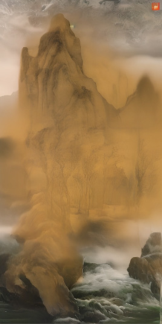
Figure 1: AI-generated Shan Shui series as original source for generating “Eastern Wisdom Extract Machine.”
A. Discrete Input B. AI Synthesis Model B. Dynamic Experience
Depth-Aware
The Living Stream The static ink is transformed
Static Artifacts Traditional Shan Shui
into a temporal continuum,
painting exists as discrete spatial layouts without temporal
Equation reproduced from the original PDF.
simulating the flow of perspective and nature’s
continuity.
for foreground and
evolution.
background layers (parallax).
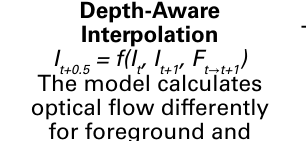
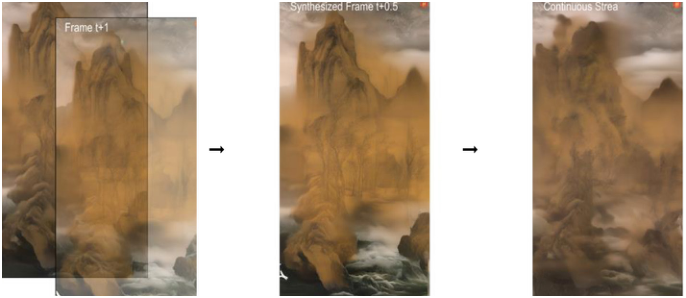
Figure 2: The transformation process in AI-Generated Shan Shui through the neural network. (A) The system takes discrete static frames from Shan Shui paintings. (B) Using a depth-aware neural network, the system separates foreground and background ele ments and calculates motion vectors to synthesize intermediate frames It+0.5 that do not exist in the original artwork. (C) The result is a fluid, continuous video stream where the landscape appears to change and evolve, adding the dimension of time to the original spatial arrangement.
A Shot of 2D Dynamic
A Shot of Dynamic Shan
Shan Shui
Shui with Gaussian Splatting
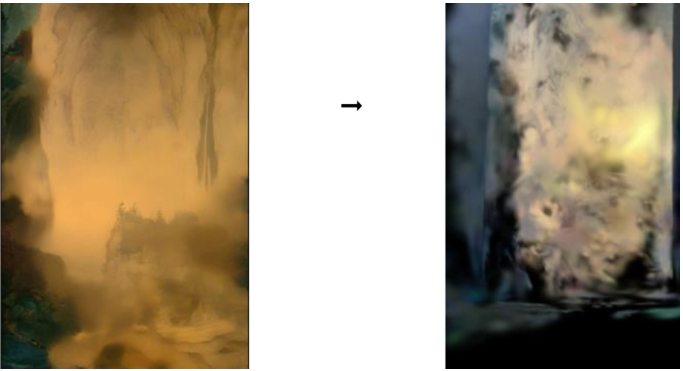
Figure 3: 3D Gaussian Splatting for Shan Shui reconstruction.
GENERATIVE PIPELINE METHODOLOGY Refer to “Eastern Wisdom Extracting Machine,” the artwork employs a multi-layered technological framework to formulate the generative pipeline and spatial simulation. An image dataset of traditional Chinese landscape painting was curated from artworks for machine learning models to extract the pattern of Shan Shui painting across various dynasties. The model identifies correlations between high mountains and deep valleys, and the elements within the paintings, such as stones and rocks, trees and forests, rivers and waterfalls, etc., brushstroke and void, and the Shan Shui perspective. The framework decodes the visual language of ancient Eastern art (see Figure 1).
To capture the dynamic representation of mountain forms and spatial depth, the artwork employs frame interpolation techniques. Convolutional Neural Networks (CNNs) and Depth-Aware Video Frame Interpolation (DAIN) were used to synthesise intermediate frames within the dataset and generate frame interpolation (Bao et al., 2019) of Shan Shui (see Figure 2). The method is a common video processing algorithm that analyses consecutive frames and creates intermediate frames between existing frames for motion compensation, smoothness, or slow-motion effects. The project utilises the feature of deep learning architecture to transform the static Shan Shui into a dynamic viewing experience of the Shan Shui scenery, creating spatial and temporal dimensions with new perspectives embedded that build on the existing ones.
To enhance the volumetric feature that transforms the 2D output of frame-interpolated Shan Shui into a 3D environment, the artwork employed
Eastern Wisdom Extraction: AI-Driven Synthesis of Traditional Chinese Landscape 563 a novel Gaussian Splatting method based on some seminal researches, such as “3D Gaussian Splatting for Real-Time Radiance Field Rendering” (Kerbl et al., 2023), and “StyleGaussian: Instant 3D Style Transfer with Gaussian Splatting” (Liu et al., 2024) that captures the 2D dynamic Shan Shui scenery and renders it as a cloud of 3D Gaussians (see Figure 3). This method allows the rendering of spatial features of Shan Shui and enhances the sense of geometry and void in the scenery. As the whole Shan Shui work consists of cloud data points of multiple sceneries that allow the viewer to look through and “wander” around, it perfectly simulates the concept of shifting perspective that converges different mountain forms and spatial depths into a single composition, and at the same time, enhances the sense of void. Moreover, this method transforms the static viewing experience into a dynamic one that engages the viewer in accessing the digital Shan Shui space randomly and in controlling their own wandering time, where spatial and temporal perception unfold together.
CASE STUDY ANALYSIS: EASTERN WISDOM EXTRACTING MACHINE The visual output of “Eastern Wisdom Extracting Machine” is an evolving landscape that transforms the original static nature of the data source. The volumized landscapes overlap with each other, enhancing changes or transitions of landscapes and the observation perspectives as the work is viewed from different angles. The volumetric feature of Gaussian Splatting facilitates “digital ink wash” dissolution, where Yin-yang, the fullness and emptiness of the scenery, dissolve into each other to transform into new structures (Cheng, 1994).
The AI “learned” the Shan Shui art pattern, in which the elements that constitute high mountains and deep valleys are liberated from 2D to 3D suspension through the application of Gaussian Splatting. The volumetric and translucent clusters create a visual depth that is both computational and atmospheric. Aligning with Paul’s (2023) discussion that the core of digital art is the database, where the creativity lies in how the information is recontextualized, the AI did not randomly generate the landscape compositions, it “recontextualized” Shan Shui tradition, mading compositional decisions based on the “wisdom” it extracted from the dataset. The visual output bridges the ancient form and computational representation, expanding the concept of “chiasm” (Merleau-Ponty, 1968) into digital form, where the past and neural network cross over.
This synthesis demonstrates the possibility of translating traditional artwork into code, with the Yin and Yang materialised as digital assets. The “shifting perspective” is no longer a mental projection of the artist or the viewer, but a literal property of the “wandering” path in the virtual environment.
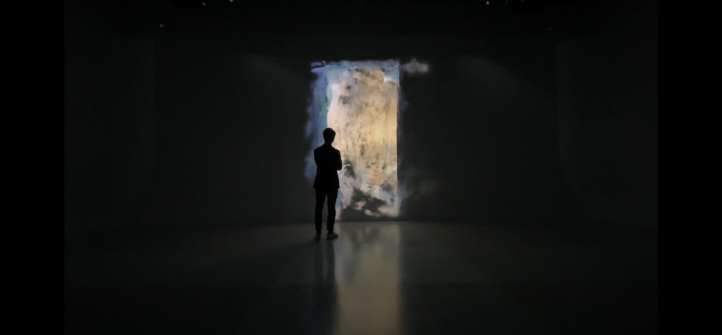
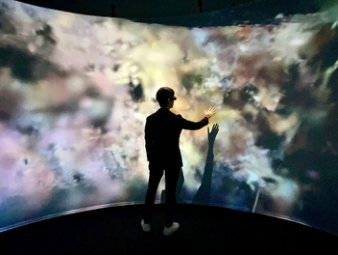
Figure 4: Dynamic 3D Gaussian Splatting presented in 270-degree CAVE.Figure 5: Dynamic 3D Gaussian Splatting presented in 360-degree CAVE.
IMMERSIVE PRESENTATION To create an environment that fully realizes the volumetric composition and allow the viewer to “wander” the AI-generated Shan Shui with “shifting perspectives,” 270-degree and 360-degree CAVE (Cave Automatic Virtual Environment) systems were utilized respectively to present the “Eastern Wisdom Extracting Machine.” These systems move beyond the flat, static presentation of landscape painting, instead, the immersive systems engage the viewer in embodying themselves within a specific CAVE space to view the digital Shan Shui rather than merely observing the painting in front of the display case or monitor.
The 270-degree CAVE is equipped with a projection wall measuring 10.45 m (W) x 3.5 m (H), on which the dynamic 3D Gaussian Splatting Shan Shui painting can be scaled to fully utilize the projection area, creating a sense of immersion (see Figure 4). The viewer’s proprioception is engaged as the digital landscape continues to change, where the body becomes an active digital information “framer” (Hansen, 2006). The volumetric “void” creates a sense of spatial presence that transcends the conventional blank space on paper.
The artwork is also adapted for a 360-degree CAVE system. The CAVE is equipped with a panoramic structure measuring 5 m diameter and 2.8 m height. This configuration further eliminates the sense of “frame,” achieving a 360-degree all-around perspective. The digital Shan Shui envelops the viewer from all angles (Grau, 2023), simulating the “wandering” experience within the mountain and water (see Figure 5). This enclosure experience pushes the boundaries between the physical body and the digital nature, allowing the viewer to be immersed in the generative latent space of AI without fixed form. This reiterates the Taoist Yin-yang concept of interconnection between the two distinct realms of human wanderer and virtual Shan Shui.
EXPANDING THE NOOSPHERE This research validates the concept of AI as an “instrument of knowledge extractivism.” The wisdom extracted from the artwork embodies the understanding of landscape and nature accumulated by ancient masters across dynasties. By quantifying the “wisdom” into algorithms, the AI synthesised Shan Vernadsky Shui in a format accessible to the age of generative AI. The AI and immersive technologies bridge ancient and digital art, translating the analog “code” of shifting perspective in static painting into the digital “code” of dynamic wandering angles. The research exemplifies how the hidden logic and aesthetics of Shan Shui can be re-examined and revealed through a poetic interpretation, using the suggested generative and digital pipeline.
“Eastern Wisdom Extracting Machine” demonstrates the possibilities of merging the technological and cultural spheres, extending ancient philosophies into the technological domain and contributing to the development of the Noosphere, echoing Vladimir Vernadsky’s (1998) theory of human intelligence and scientific thought evolving into distinct force to reconstruct the biosphere. It also suggests a shift from preserving the artifact toward the system for cultural heritage. The generated artwork is not a recording of a past painting, it is a new artwork and art form created from the past “wisdom.”
566 Tin This research also demonstrates the potential to engage viewers in changing their habit of adopting a perspective. It reveals a fundamental transformation in the formation of perception itself. The perception formed can be shifted from somatic interaction between the human body and the physical world to a synthesis of digital relations. In this context, “image” is no longer a recording of the physical reality, but as what Yuk Hui (2016) describes as a digital object constituted by data and metadata. AI serves as the primary perceiver to analyse the latent patterns of the dataset and constitute the reality embedded in the code before it is projected. Thus, the viewer perceives the Shan Shui in CAVE systems as a machine’s perception of landscape. The future of aesthetic experience will no longer be defined by the limitations of the human eye and vision, but by the generative capacities of algorithms and computer vision, marking a transformation from “embodied phenomenology” to “algorithmic phenomenology.”
CONCLUSION
This research reveals the potential of AI in the arts, underscoring the transformation of ancient philosophy through frontier technology and the preservation of system that articulate what Yuk Hui (2021) coined the internal logic rather than focusing on artifact for living heritage. The case study of the “Eastern Wisdom Extracting Machine” investigates the extraction and re-materialization of ancient “wisdom” through a multi- layered technological framework that translates the aesthetic principle of Shan Shui into a generative, volumetric system.
Through frame interpolation algorithms, volumetric Gaussian Splatting, and immersive CAVE environments, the technological framework allows the traditional Shan Shui concept of “shifting perspective” to evolve from ancient painting into a navigable experience, shifting perception from a passive, somatic observation to an active, immersive engagement with digital tools (Ihde, 1990). Despite the machine’s capacity to extract ancient wisdom, and the AI stack and immersive system articulating the shifting perspective principle in the contemporary technological context, the new form of “algorithmic phenomenology” requires further study, such as exploring the possibility of employing LLM-GS system in VR environment (Mao et al., 2025) for Shan Shui painting to investigate its effects on human perception, knowledge, and wisdom transformation.
REFERENCES
Bao, W., Lai, W., Ma, C., Zhang, X., Gao, Z. and Yang, M. (2019) “Depth-Aware Video Frame Interpolation”, proceedings of the 2019 IEEE/CVF Conference on Computer Vision and Pattern Recognition (CVPR). pp. 3698–3707. Bush, S. and Shih, H. (1985). Early Chinese Texts on Painting. Cambridge, MA:
Harvard University Press. Cheng, F. (1994). Empty and Full: the Language of Chinese Painting. Boston: Shambhala.
Eastern Wisdom Extraction: AI-Driven Synthesis of Traditional Chinese Landscape 567 Grau, O. (2003). Virtual Art: From Illusion to Immersion. Cambridge, MA: MIT
Press. Hansen, M. B. N. (2006). Bodies in code: interfaces with digital media. New York: Routledge. Hui, Y. (2016). On the Existence of Digital Objects. Minneapolis: University of
Minnesota Press. Hui, Y. (2021). Art and Cosmotechnics. Minneapolis: University of Minnesota Press. Ihde, D. (1990). Technology and the Lifeworld: From Garden to Earth. Bloomington: Indiana University Press. Kerbl, B., Kopanas, G., Leimkühler, T. and Drettakis, G. (2023). “3D Gaussian
Splatting for Real-Time Radiance Field Rendering”, ACM Transactions on Graphics (TOG), 42(4). Lai, M. T. (2024). Eastern Wisdom Extracting Machine. House of the Lords of Kunštát, Brno, Czech Republic. Liu, K., Zhan, F., Xu, M., Theobalt, C., Shao, L., and Lu, S. (2024) “StyleGaussian:
Instant 3D Style Transfer with Gaussian Splatting”, SIGGRAPH Asia 2024 Technical Communications, Tokyo, Japan. Manovich, L. (2018). AI Aesthetics. Moscow: Strelka Press. Mao, H. Xu, Z. Wei, S. Quan, Y. Deng, N. Yang, X. (2025) “LIVE-GS: LLM Powers Interactive VR by Enhancing Gaussian Splatting”, proceedings of the 2025 IEEE Conference on Virtual Reality and 3D User Interfaces Abstracts and Workshops (VRW), pp. 1234–1235. Merleau-Ponty, M. (1962). Phenomenology of Percepltion. London: Routledge. Merleau-Ponty, M. (1968). The visible and the invisible. Evanston, IL: Northwestern
University Press. Moore, H. (1966/1992). Henry Moore on Sculpture: a collection of the sculptor’s writings and spoken words. James, P. (Ed.). New York: Da Capo Press. Pasquinelli, M. and Joler, V. (2021). “The Nooscope Manifested: AI as Instrument of
Knowledge Extractivism”, AI & Society, 36. pp. 1263–1280. Paul, C. (2023). Digital Art (4th ed.). London: Thames & Hudson. Sullivan, M. (1984). The Arts of China. Berkeley: University of California Press. Teilhard de Chardin, P. (1959). The Phenomenon of Man. New York: Harper &Row. Vernadsky, V. I. (1998). The Biosphere. New York: Copernicus.
LISTED IN THE AHFE DIGITAL BOOKSTORE CATALOGUE
Explore the complete digital volume
Human Interaction and Emerging Technologies (IHIET-AI 2026): Artificial Intelligence and Future Applications
Read this individual research paper free through the original publisher, or explore the full digital proceedings book.
ISBN 978-1-964867-77-9
Explore this ISBN in the AHFE Bookstore ↗Listed in the July 2026 bookstore catalogue; search by ISBN to confirm current availability · Digital book purchase optional