Toshihisa Doi (2023). Investigation of a home office environment and lifestyles of workers that affect their perceived comfort in work-from-home. In: Emerging Technologies and Future of Work. AHFE Open Access, vol. 117, pp. 289–297. https://doi.org/10.54941/ahfe1004429
This study aimed to clarify the living environment at home that is comfortable and less burdensome for workers, targeting work-from-home, which has increased rapidly since the Corona disaster. To this end, a questionnaire survey was conducted on workers' satisfaction, stress reaction, and work engagement, as well as their work status, living space, and living conditions. By analysing the relationships among these factors, the study aims to comprehensively investigate the living environment of workers from home, including not only their physical condition and facilities but also their daily rhythm and relationship with their roommates, and to examine measures for creating a more favourable living environment for workers from home. The work environment during work from home was examined from various perspectives based on the framework of the SHEL model: software (work content, lifestyle, etc.), hardware (furniture, equipment, etc.), environment (indoor environment), and liveware (relationships with family members who live together). Multiple regression analysis was used to analyse the effects of each explanatory variable related to the living environment on the objective variables (satisfaction, work engagement, and stress reaction) related to comfort while working at home. The results suggest that job autonomy and interruptions due to household chores significantly impact the comfort level of work-from-home.
The number of people who work from home has increased rapidly since the corona disaster. Working from home has advantages such as eliminat- ing restrictions due to commuting and work location and making it easier to balance work with childcare and nursing care. For employees to work comfortably from home under these circumstances, ergonomic knowledge to construct an appropriate work environment at home is indispensable.
In Japan, for example, the Ministry of Health, Labor and Welfare, the Japan Human Factors and Ergonomics Society, the Japan Society of Office Studies, and others have published guidelines (JES, 2020; MHLW, 2021; JOS, 2021). However, it is not easy to create a work environment at home that satisfies all of the furniture, lighting, air conditioning, etc., recommended in
these guidelines. Establishing a work environment at home would be more effective if the recommended items could be assigned a level of importance.
In many cases, the focus is only on reducing physical burden, and the rela- tionship between the stress response (including mental health), satisfaction, productivity, and work engagement of workers who work from home has not been fully clarified. Considering the temporary work from home during the Corona Disaster, it was necessary first to reduce the physical workload. However, when working from home is implemented as a long-term work style, it is necessary to consider the physical aspects and the perspectives above. Because most of the previous studies focused on physical aspects, the ergonomics guidelines mainly referred to physical facilities such as computers and other equipment, furniture, lighting, etc. In order to properly assess the compatibility between workers who work from home and the home environ- ment, it is necessary to consider not only the physical facilities but also their life rhythm, relationship with people who live with them, work content and time, and other factors.
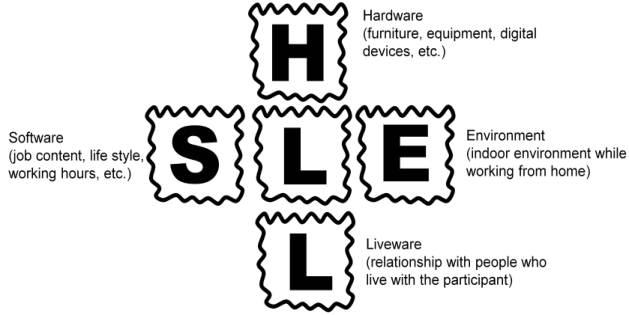
This study aimed to investigate the factors of workspace and living envi- ronment related to satisfaction, stress reaction, and work engagement of work from home to improve ergonomics guidelines for work from home considering the abovementioned points. In order to comprehensively under- stand the work-from-home situation, the workspace and living environment were examined from the perspective of the SHEL model, which is often used in ergonomics to examine the suitability of human-machine systems, using the S: Software (work content, life rhythm, etc.), H: Hardware (furni- ture, equipment, etc.), E: Environment (indoor environment), and L: Live- ware (relationships with family members living together). The relationships between these factors and physical and mental stress responses, satisfaction, and work engagement were analysed to contribute to ergonomic guidelines for constructing environments for work-from-home.
METHODS
Participants A web-based questionnaire survey was conducted on 88 workers (mean 41.57 years, SD: 9.50, 44 males and 44 females) recruited via an Internet research company and working from home two or more days a week for at least six months. All of them lived in Japan and worked from home in Japan.
Questionnaire Items In this study, the following indices were measured to examine the sub- jective comfort level of the work environment from home: overall sat- isfaction with the work style of work from home, satisfaction with the physical work environment, work engagement, and stress reaction. Each of these was used as an objective variable to examine how the work environment at home affects these variables. The following items were used to measure each of the indicators of comfort in the work environment.
Investigation of a Home Office Environment and Lifestyles of Workers 291
Satisfaction The participants were asked to indicate their overall satisfaction with the work style of work-from-home and their satisfaction with the physical indoor environment of the work-from-home. The responses to both questions were obtained using a seven-point Likert scale.
Work Engagement Work engagement is a positive and fulfilling psychological state related to work. The Utrecht Work Engagement Scale was proposed by Schaufeli & Bekker (2010) as a measure of work engagement. This study used the Japanese version of the Utrecht Work Engagement Scale (simplified version) (Shimazu et al., 2008; Schaufeli et al., 2019). This scale asks for responses to three questions about vitality, enthusiasm, and immersion, using a 7-point rating scale. This study used the total score of the three items as the work engagement score.
Stress Reaction The Brief Job Stress Questionnaire is frequently used in Japan as a stress check (about four studies by the Ministry of Health, Labor, and Welfare). This questionnaire consists of three parts: job stressors, stress reactions, and modifiers, and is used to select high-stress workers (Shimomitsu et al., 2000). In this study, 29 items on stress reactions were used in the questionnaire. These 29 items consisted of the following four-point rating scales: liveness, irritability, fatigue, anxiety, depression, and somatic complaints. This study used the total score after reversing the reversed items as the stress reaction score.
As for the questions to capture the work environment from home, which affects the above objective variables, the SHEL model, often used in analysing human-machine systems, was used as a reference. The SHEL model was origi- nally proposed by Hawkins (1987) as a model for understanding human error among aircrew, and is depicted in Figure 1. It explains that errors occur due to a mismatch (a gap between the central L and other elements) in the relation- ship between the central party (Liveware) and the surrounding S (Software), H (Hardware), E (Environment), and L (Liveware). Although this model was proposed as a perspective for human error analysis, it is general-purpose in terms of capturing the appropriateness of systems that include people, and the model can be used to consider the compatibility between work-from-home workers and their surrounding SHEL in the work-from-home environment targeted in this study. Therefore, the explanatory variables to capture the work environment from the viewpoint of the SHEL model were examined. The main items of the questionnaire are described below.
Software The primary questions were job content, life rhythm, and working hours. Specifically, the following questions were asked: job autonomy, number of days worked from home per week, frequency and duration of online meet- ings, daily working hours and breaks, quality workload, quantity workload, whether they take regular breaks, whether they eat at regular times, how often
292 Doi
they interrupt their work due to household chores, time spent on household chores, and frequency of overtime work, and so on.
Figure 1: Framework of SHEL model in this study.
Hardware The primary questions were about furniture and equipment used by work- from-home. Specifically, the following questions were asked: desk size, avail- ability of a chair for oneself, availability of armrests on the chair, availability of an adjustable chair, subjective Internet speed, subjective PC performance, availability of a PC monitor, PC monitor size, and availability of external speakers, microphones, and headsets, and so on.
Environment The primary focus of the questionnaire was on the indoor environment while working from home. The following questions were asked: subjective brightness of the room, subjective ambient noise level, subjective size of the workroom, whether the workroom is a dedicated space for oneself, whether the workspace is within the space used for housework and daily life, and whether there is a space for eating and resting other than the workspace, and so on.
Liveware The primary question was about the relationship with family members who live with the participants. The following questions were asked: the presence of a live-in family member and their attributes, the presence of a live-in family member in the same room when working at home, the degree of intervention by the live-in family member while working at home, and the degree to which the live-in family member shares the responsibility for household chores, and so on.
Data Analysis Multiple regression analysis was used to analyse the relationship between indicators of work comfort from home and living environment factors. Four
Investigation of a Home Office Environment and Lifestyles of Workers 293
regression models were derived, using four comfort indices (overall satis- faction, satisfaction with indoor environment, work engagement, and stress reaction) as objective variables and comprehensive living environment factors based on the SHEL model and personal attributes (age, gender, and whether manager or not) as explanatory variables. In all cases, explanatory variables were selected using a stepwise increasing/decreasing method. The criterion for variable selection was p=0.2 for both inputs and removals.
RESULTS
First, correlation coefficients were calculated to confirm the relationship among the objective variables. Table 1 shows the results.
Table 1. Correlation coefficients among the variables which relate comfortless of workfrom-home.
Table 2 shows the results of a multiple regression analysis using overall satisfaction with work-from-home as the objective variable. The adjusted R2 for this model was 0.46 (F(10,77)=8.31, p<0.01).
Table 2. Result of multiple regression analysis (objective variable: overall satisfaction).
Table available in the original PDF paper.
t VIF Predictors b SE β 95% Confidence Interval of b Lower Upper
0.36 0.23 0.13 −0.10 0.83 1.55 1.20
job autonomy 0.22 0.05 0.44 0.13 0.32 4.65 ** 1.43 size of workroom 0.22 0.14 0.16 −0.06 0.50 1.55 1.78 desk size −0.34 0.14 −0.28 −0.61 −0.07 −2.51 * 2.01 internet speed 0.41 0.14 0.28 0.14 0.68 3.00 ** 1.41 availability of external speakers −0.53 0.26 −0.18 −1.04 −0.01 −2.03 * 1.28 availability of a dedicated workspace −0.26 0.11 −0.22 −0.47 −0.05 −2.47 * 1.28 living with parent(s) 0.56 0.33 0.14 −0.09 1.21 1.71 1.13 frequency of interrupt the work due to household chores
−0.26 0.11 −0.25 −0.47 −0.05 −2.46 * 1.65
frequency of overtime work 0.38 0.11 0.35 0.16 0.60 3.49 ** 1.64 frequency of looking at the PC on weekends constant 0.30 0.59 −0.87 1.46 0.51
**: p<0.01, *: p<0.05
294 Doi
Table 3 shows the results of a multiple regression analysis using satisfaction with the indoor environment as the objective variable. The adjusted R2 for this model was 0.47 (F(10,76)=7.92, p<0.01).
Table 3. Result of multiple regression analysis (objective variable: satisfaction with indoor environment).
Table available in the original PDF paper.
t VIF Predictors b SE β 95% Confidence Interval of b Lower Upper
internet speed 0.23 0.12 0.18 0.00 0.46 1.97 1.42 0.61 0.20 0.26 0.21 1.00 3.05 ** 1.18 availability of a dedicated workspace
−0.39 0.22 −0.15 −0.83 0.04 −1.80 1.09
whether the workspace is within the space used for housework and daily life living with parent(s) 0.55 0.29 0.16 −0.02 1.13 1.92 1.18
whether he/she eat at regular times 0.23 0.10 0.23 0.04 0.43 2.39 * 1.54 −0.26 0.09 −0.26 −0.45 −0.08 −2.88 ** 1.30 frequency of interrupt the work due to household chores
frequency of overtime work 0.19 0.09 0.21 0.02 0.37 2.21 * 1.44 −0.13 0.08 −0.14 −0.29 0.03 −1.62 1.22 number of days worked from home per week
duration of online meeting per day −0.18 0.13 −0.12 −0.44 0.08 −1.39 1.25 constant 0.28 0.65 −1.02 1.58 0.43
**: p<0.01, *: p<0.05
Table 4 shows the results of the multiple regression analysis with work engagement as the objective variable. The adjusted R2 for this model was 0.51 (F(12,75)=8.55, p<0.01).
Table 4. Result of multiple regression analysis (objective variable: work engagement).
Table available in the original PDF paper.
t VIF Predictors b SE β 95% Confidence Interval of b Lower Upper
whether there is a space for eating and resting other than the workspace
(Continued)
Investigation of a Home Office Environment and Lifestyles of Workers 295
Table 4. Continued.
Table available in the original PDF paper.
t VIF Predictors b SE β 95% Confidence Interval of b Lower Upper
living with parent(s) −2.28 0.98 −0.19 −4.23 −0.33 −2.33 * 1.21 −0.49 0.22 −0.20 −0.94 −0.05 −2.20 * 1.47 degree to which the live−in family member shares the responsibility for household chores
−0.86 0.31 −0.24 −1.48 −0.24 −2.74 ** 1.34
frequency of interrupt the work due to household chores time spent on household chores 1.31 0.36 0.36 0.59 2.03 3.61 ** 1.73
0.83 0.27 0.26 0.30 1.36 3.11 ** 1.25
frequency of looking at the PC on weekends
−0.89 0.29 −0.27 −1.47 −0.32 −3.13 ** 1.34
number of days worked from home per week constant 1.32 1.71 −2.08 4.72 0.77 **: p<0.01, *: p<0.05
Table 5 shows the results of the multiple regression analysis with the stress response as the objective variable. The adjusted R2 for this model was 0.42 (F(13,74)=5.85, p<0.01).
Table 5. Result of multiple regression analysis (objective variable: stress reaction).
Table available in the original PDF paper.
t VIF Predictors b SE β 95% Confidence Interval of b Lower Upper
availability of a dedicated chair -13.44 3.87 -0.37 -21.14 -5.74 -3.48 ** 1.73 -6.30 3.59 -0.18 -13.45 0.86 -1.75 1.66 availability of armrests on the chair
availability of external speakers 7.22 4.95 0.20 -2.63 17.08 1.46 2.68 availability of external mic 8.49 4.59 0.24 -0.65 17.63 1.85 2.43
-5.39 3.70 -0.16 -12.77 1.98 -1.46 1.73
availability of a dedicated workspace
-9.32 3.54 -0.24 -16.36 -2.27 -2.63 * 1.21
whether there is a space for eating and resting other than the workspace Living with partner -10.32 3.62 -0.30 -17.54 -3.10 -2.85 ** 1.65
1.78 1.12 0.17 -0.45 4.01 1.59 1.75
degree to which the live-in family member shares the responsibility for household chores whether he/she eat at regular times 3.82 1.70 0.26 0.43 7.20 2.25 * 1.99
3.02 1.40 0.20 0.22 5.81 2.15 * 1.30
frequency of interrupt the work due to household chores frequency of overtime work 5.03 1.36 0.34 2.32 7.74 3.70 ** 1.24 constant 64.74 9.75 45.31 84.17 6.64 **
**: p<0.01, *: p<0.05
296 Doi
DISCUSSION
First, for overall satisfaction, the standard partial regression coefficients for job autonomy, internet speed, and frequency of looking at PCs for work on days off were particularly significant, suggesting that these factors sig- nificantly impacted the overall satisfaction level. Of these, the frequency of looking at the PC on weekends had a negative impact. The more frequent interruptions due to household chores tended to decrease overall satisfac- tion, suggesting that interruptions due to household chores have a negative impact on overall satisfaction. A positive correlation was found between the frequency of working outside of work hours and overall satisfaction, which may indicate that the higher the overall satisfaction, the higher the frequency of working outside of work hours. In other words, overall satisfaction may cause a causal relationship, while the frequency of working outside of work hours may be the result. The desk space negatively correlated with overall satisfaction, but this result may be due to the low average desk space and the fact that many respondents thought their desks needed to be more spacious.
Job autonomy, availability of dedicated workspace, and frequency of inter- ruptions due to household chores greatly impacted satisfaction with the physical environment of the room. Although the physical facilities were thought to influence the indoor environment greatly, the influence of job autonomy was found to be extremely large. In addition, the presence of a workspace dedicated to one’s work is considered to increase satisfaction significantly.
The effects of job autonomy, environmental noise, frequency of interrup- tions due to household chores, time spent on household chores, frequency of looking at a PC on days off, and number of days worked from home per week were significant for work engagement. Of these, environmental noise, fre- quency of interruptions due to housework, and the number of days working from home per week were negatively correlated. While there was a negative correlation between the frequency of interruptions due to housework and work engagement, the results suggest that work engagement is higher for those whose jobs allow them to spend time on housework.
The stress reaction suggests that the participants felt higher stress when they were in non-managerial positions, had less job autonomy, did not use their chairs, and did not live with their partners. An office chair, rather than a shared chair used in daily life, is likely to reduce stress.
The common points among the models were the influence of the burden of household chores (time and frequency spent on them) and the high degree of job autonomy. These are important points that should be taken into account when creating a work environment for work-from-home. The standard par- tial regression coefficients for work engagement and overall satisfaction were significantly higher for job autonomy, suggesting that the influence of job autonomy is extremely large. In the model for stress reactions, in addition to job autonomy, the presence or absence of a private chair, living with a part- ner, the frequency of thinking about work outside of work hours, and the degree to which one eats at a regular time were found to have the same level of influence. The results suggest that a wide range of life factors are related to increased stress reactions.
Investigation of a Home Office Environment and Lifestyles of Workers 297
SUMMARY In this study, the effects of the living environment in terms of software (work content, life rhythm, etc.), hardware (furniture, equipment, etc.), environ- ment (indoor environment), and liveware (relationships with family members who live together) on satisfaction, stress reaction, and work engagement in work-from-home were investigated. Multiple regression analysis was used to analyse the effects of each explained variable related to the living envi- ronment on each objective variable related to comfort while working from home. The results suggest that the positive aspects of satisfaction and work engagement are more influenced by a high degree of job autonomy and fewer interruptions due to household chores than by physical environmental fac- tors. In terms of the negative aspect of stress reaction, the results suggest the influence of various life environment factors in addition to low job auton- omy. In the future, the author would like to increase the number of samples and discuss the relationship among variables in more detail.
ACKNOWLEDGMENT
This research was funded by JSPS KAKENHI, grant number 22K18140.
REFERENCES
Hawkins, H. F. (1987) Human Factors in Flight, Gower Technical Press Ltd. Japan Human Factors and Ergonomics Society (JES). (2020) Seven practical human factors and ergonomics (HF/E) tips for teleworking/home-learning using tablet/s- martphone devices. The IEA Press: https://ergonomics.jp/official/wp-content/uplo ads/2020/05/7tips_guideline_0506_en_final.pdf (accessed on 25 July 2023). Ministry of Health, Labor, and Welfare (MHLW). (2021) Guidelines for appro-
priate labor management at work from home. https://www.mhlw.go.jp/content /000759469.pdf (accessed on 25 July 2023). Office Ergonomics Research Group, Japan Society for Office Studies (JOS). (2021) Ergonomics Guidelines for “Work from Home”. https: //docs.google.com/viewer?url=https%3A%2F%2Fwww.jos-japan.jp%2Facti vity%2Fpdf%2Fhumanengineering_2021.pdf (accessed on 25 July 2023). Schaufeli, W. B., Bakker, A. B. (2010) Defining and measuring work engagement: Bringing clarity to the concept. In A. B. Bakker, M. P. Leiter (Eds) Work engagement: Recent developments in theory and research, pp. 10–24, Psychology Press. Schaufeli, W. B., Shimazu, A., Hakanen, J., Salanova, M., De Witte, H. (2019). An
ultra-short measure for work engagement: The UWES-3 validation across five countries. European Journal of Psychological Assessment, 35, pp. 577–591. Shimazu, A., Schaufeli, W. B., Kosugi, S. et al. (2008). Work engagement in Japan: Validation of the Japanese version of Utrecht Work Engagement Scale. Applied Psychology: An International Review, 57, pp. 510–523. Shimomitsu T, Yokoyama K, Ohno H, Maruta T, Tanigawa T. (2000) Manual of the
Brief Job Stress Questionnaire. In: Reports on the study of job stress and its effects on health in the workplace: The research grant for the prevention of work-related diseases from the Japan Ministry of labour. Tokyo: The Ministry of Labor.
LISTED IN THE AHFE DIGITAL BOOKSTORE CATALOGUE
Explore the complete digital volume
Emerging Technologies and Future of Work
Read this individual research paper free through the original publisher, or explore the full digital proceedings book.
ISBN 978-1-958651-93-3
Explore this ISBN in the AHFE Bookstore ↗Listed in the July 2026 bookstore catalogue; search by ISBN to confirm current availability · Digital book purchase optional