Casey Kovesdi (2023). A Review of Sociotechnical Approaches for Nuclear Power Plant Modernization. In: Emerging Technologies and Future of Work. AHFE Open Access, vol. 117, pp. 1–9. https://doi.org/10.54941/ahfe1004399
The nuclear power continues to be a safe, reliable, and carbon-free electricity generating source for the United States (U.S.), though the cost of operating and maintaining the current U.S. nuclear power plant fleet has become uncompetitive with other sources. This gap is attributed to the advent of new digital technologies that other electricity generating industries are currently leveraging to streamline work and greatly reduce operating, maintenance, and support costs. To address the gap, the U.S. Department of Energy (DOE) Light Water Reactor Sustainability (LWRS) Program Plant Modernization Pathway is conducting targeted research and development (R&D) to keep the existing U.S. nuclear power plants economically viable and extend their lifespans by improving their performance through two complementary mission areas:1.Delivering a sustainable business model that enables a cost-competitive U.S. nuclear industry, and2.Developing technology modernization solutions that address aging and obsolescence challenges.Integrated operations for nuclear (ION) is a driving LWRS Program plant modernization research area that focuses on delivering a sustainable business model to provide direction and focus for cross-functional R&D across the LWRS Program that focuses on developing technology modernization solutions. Recent ION research provides a target cost reduction needed in the next 3–5 years for the nuclear industry to remain cost competitive. This research identified major technological advancements (herein referred to as critical work domains) that will significantly reduce cost needed to operate, maintain, and support the existing U.S. nuclear power plant fleet. Some of these key critical work domains include: •Digital instrumentation and control (I&C) and control room modernization•Work/ requirement reduction•Mobile worker technology•Condition-based monitoring•Remote collaboration•Plant automation•Advanced analytics and assuranceThe scope of ION across these critical work domains is to enable transformation of work in a way that improves plant performance and efficiencies through a holistic analysis of the work performed. ION thereby emphasizes the implementation of advanced technologies that eliminate tedious manual tasks, reduce workload, improve team situation awareness, and improve organizational decision-making. To enable the success of ION, this work positions the need to apply a sociotechnical approach that carefully considers the work domain and its constraints to inform the how new technologies can be incorporated to support continued safe and reliable operation of the plant while maximizing the benefits of the new technology. Specifically, this work explores sociotechnical approaches such as cognitive work analysis, co-active design/ interdependency analysis, and systems theoretic process analysis to address the function allocation and data visualization elements of an ION transformation to ensure the economic viability of the existing U.S. nuclear power plant fleet.
The existing nuclear power plants are critical infrastructure for continued carbon-free electricity generation in the United States (U.S.); however, these plants are becoming less competitive with other electricity generating sources as they begin to leverage digital technologies that significantly reduce their operating and maintenance (O&M) cost. The current U.S. nuclear power plant fleet is in imminent need of a digital transformation that will funda- mentally change the way work is performed. To support this need, the U.S. Department of Energy (DOE) Light Water Reactor Sustainability (LWRS) Program Plant Modernization Pathway is completing targeted research and development (R&D) that fulfills two complementary mission areas:
1. To deliver a sustainable business model that enables a cost-competitive U.S. nuclear industry with reduced O&M cost, and 2. To develop technology modernization solutions that address aging and obsolescence challenges and meet business needs.
One area within the LWRS Program, Integrated Operations for Nuclear (ION), focuses on the former mission area and provides a clear business case in applying technology modernization solutions that address aging and obso- lescence, as well as significantly reduce O&M cost (Remer et al., 2021). The
ION research area provides a target cost reduction through enabling mod- ernization solutions needed in the next 5 years for the nuclear industry to remain economically viable. Complementary to ION, the LWRS Program Human and Technology Integration (HTI) research area applies targeted human factors research to ensure that these modernization solutions continue to support safe and reliable operation. Together, ION and HTI are collaborat- ing with industry across critical work domains that will significantly reduce cost needed to operate, maintain, and support the existing U.S. nuclear power plant fleet. Some of these key critical work domains include:
Digital instrumentation and control (I&C) and control room modernization
Work/ requirement reduction
Mobile worker technology
Condition-based monitoring
Remote collaboration
Plant automation
Advanced analytics and assurance The scope of ION across these critical work domains is to enable transfor- mation of work in a way that improves plant performance and efficiencies through a holistic analysis of the work performed. ION thereby emphasizes the implementation of advanced technologies that eliminate tedious man- ual tasks, reduce workload, improve team situation awareness, and improve organizational decision-making. To enable the success of ION, this work sug- gests the need to apply a sociotechnical approach that carefully considers the work domain and its constraints to inform how new technologies can be incorporated (i.e., function allocation) for joint optimization and to support continued safe and reliable operation of the plant while maximizing the bene- fits of the new technology. Indeed, this viewpoint seems to be aligned with the greater human factors community that projects continued need of addressing function allocation in the use of advanced automation forms, including auto- mated cars, drones, and artificial intelligence systems to name a few (Janssen, Donker, Brumby, & Kun, 2019).
Specifically, this work, extending from Kovesdi and colleagues (2022), fol- lows recent work from Roth and colleagues (2019) and explores recently introduced sociotechnical approaches to address the function allocation and data visualization elements of an ION transformation to ensure the eco- nomic viability of the existing U.S. nuclear power plant fleet. This work is currently exploring the emerging methods described in Roth and colleagues (2019) to address function allocation across the ION-identified critical work domains at U.S. nuclear power plants for sustained safe and reliable operation with reduced cost. Specifically, this work explores the integrated approach to addressing function allocation under the following areas:
To analyze operational demands and work requirements.
To explore alternative distributions of work across automation and people (i.e., authors refer to this as human-machine teaming).
A Review of Sociotechnical Approaches for Nuclear Power Plant Modernization 3
To examine interdependencies between people and automation required for effective teaming.
To explore trade-spaces of alternative human-machine teaming options.
Notable sociotechnical methods from Roth and colleagues (2019) as seen most impactful for nuclear power plant modernization are described next, followed by a discussion of how these methods are planned to be integrated in future research.
ANALYZE OPERATIONAL DEMANDS AND WORK REQUIREMENTS Cognitive Task Analysis: Knowledge Elicitation Techniques
Cognitive task analysis (CTA) consists of a set of task data collection and knowledge representation techniques that focuses on the cognitive aspects of work (Crandall, Klein, & Hoffman, 2006). There are several different CTA approaches, and a detailed description of these methods goes beyond the scope of this work. The reader should refer to Stanton and colleagues (2013 & 2017), or Crandall and colleagues (2006). However, it should be noted that such methods may be useful in enriching knowledge elicitation when understanding existing pain points from an existing work system or defining new requirements for proposed technology being introduced in an existing work system (Kovesdi et al., 2021).
Cognitive Work Analysis: Work Domain Analysis Complementary to CTA, cognitive work analysis (CWA) is a sociotechnical framework that begins its analysis on the work domain and governing con- straints rather than tasks at hand. There are several phases to CWA, which are outlined in Table 1 (Stanton et al., 2017).
Table 1. Phases of cognitive work analysis.
Table available in the original PDF paper.
Phase Purpose Outputs Work domain analysis (WDA) Describes the system’s objectives and defines the bounding work under analysis.
Contextual activity template, decision ladder
Abstraction hierarchy, Abstraction-decomposition space Control task analysis Defines the work system’s functions, situations, and key decisions needed to achieve the system objectives.
Information flow map
Strategies analysis Defines the work domain’s strategies that are performed using flow maps.
Examines the assignment of agents to perform work within the domain.
Social organization and cooperation analysis
Mapping (i.e., via color shading) of associated agents (people and technology) to the above. Worker competencies analysis
Skills, rules, and knowledge inventory for assigned functions to people.
Examines worker competencies (knowledge, skills, and abilities) required of people to perform work within the system.
4 Kovesdi
Each of these phases in CWA evaluate the work domain through different lens of abstraction. Because CWA is technology agnostic in the sense of ana- lyzing the work domains through its goals, constraints, and functions (i.e., means-end), CWA can be applied to address function allocation by examin- ing how such allocations can be realized across the work domain (i.e., using WDA) and across different work system situations (control task analysis). Roth and colleagues (2019) discuss how the use of the WDA abstraction hierarchy and control task analysis decision ladders can be used to analyze different assignments of function in terms of their overall impacts on decision making.
To no surprise, WDA is readily applied within the human factors com- munity. For instance, the use of WDA in combination with social network analysis was recently applied by Schmid and colleagues (2020) to enable a reduced flight deck crew for commercial airlines through modernization of existing infrastructure that leverages increased automation. It should be noted that such problem space is similar to the existing U.S. nuclear power plant fleet needs in which technology is needed to streamline staffing require- ments through increased levels of automation. Thus, the application of CWA is a notable tool in analyzing organizational and work requirements that ensure joint optimization between people and technology through new allocations of function.
EXPLORE ALTERNATIVE DISTRIBUTIONS OF WORK Following the analysis of operational demands and work requirements, alter- native distributions of work (i.e., assignment of function to technology or people) can be analyzed by using control task analysis contextual activ- ity templates from the CWA framework (Table 1). The contextual activity template maps work functions to specific work situations in tabular format (Stanton et al., 2017), and typically is represented as the situations located as rows and functions as columns. The output of the contextual activity tem- plate specifies whether a particular identified function is performed across each of the identified situations within the work domain; it can also be extended using the social organization and cooperation analysis phase of CWA to specify which agents are responsible for the performance of each function and situation.
EXAMINE THE INTERDEPENDCIES BETWEEN PEOPLE AND AUTOMATION Cognitive Work Analysis: Control Task Analysis Decision Ladders
Decision ladders, within CWA control task analysis, examine critical deci- sions made by the human-automation system (Stanton et al., 2017; Kovesdi et al., 2022). Decisions ladders are used to analyze the flow of information and to identify key decisions made by the overall system, which is a critical step in ensuring joint optimization between people and technology.
Decision ladders have been recently used to support function allocation and evaluation for a major safety-related digital upgrade at a U.S. nuclear
A Review of Sociotechnical Approaches for Nuclear Power Plant Modernization 5
power plant (Kovesdi et al., 2023). In this work, decision ladders were used to characterize the key decisions made for the licensed operators when mit- igating specific plant transients that exercised impacts plant systems and functions from the upgrade. A key output from the decision ladders used were established performance-based acceptance criteria for the evaluation of safety-important manual actions impacted by the upgrade. The decision ladders were used as a theoretical framework for defining rule-based and knowledge-based decision making of the operators across key scenarios that encompassed specific transients that related to the upgrades.
System Theoretic Process Analysis System Theoretic Process Analysis (STPA) focuses on the interactions between the components of a system, using the control structure as an explanatory framework (Levenson & Thomas, 2018). STPA has been applied by HTI researchers to support plant modernization, such as in the modern- ization of a nuclear power plant’s preventative maintenance program (Joe et al., 2023). Here, the researchers were able to apply CWA WDA with STPA and a related framework, Causal Analysis based on STAMP (CAST), to develop requirements for information automation that improves (i.e., mit- igating unsafe control actions through design controls) a plant’s preventative maintenance program. STPA was found to be a highly useful risk analy- sis framework, providing rich insights into the work system’s constraints, and a complementary tool to better inform design decisions for information automation.
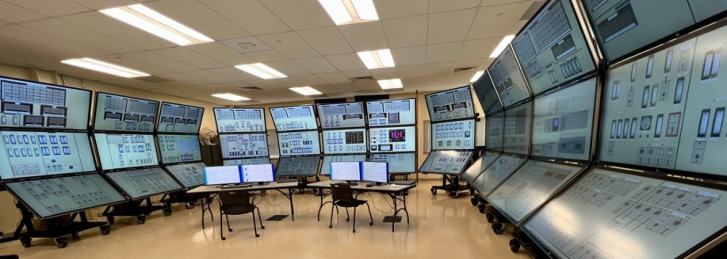
EXPLORE FUNCTION ALLOCATION TRADE SPACE In assigning a function to people or technology, tradeoffs must be made. A notable method that has been demonstrated in the nuclear industry to explore and analyze function allocation trade space encompasses the use of simula- tion and modeling techniques (Kovesdi et al., 2021; Joe & Kovesdi, 2021). Digital human models have been used in recent plant modernization anal- yses to address anthropometric and ergonomic considerations with digital upgrades, as well as to communicate to stakeholders (e.g., senior manage- ment and operations) the physical impacts to the control facilities to identify engineering tradeoffs early and to enable technology acceptance from end users (Mohon & Kovesdi, 2022). Complementary to digital human model- ing, human-in-the-loop tests have been utilized using a glasstop testbed to evaluate human-system performance tradeoffs (Figure 1).
Simulators like in Figure 1 can be used to support iterative tests and eval- uations of proposed modifications, allowing for both knowledge elicitation and performance-based tests to address tradeoffs with assignment of func- tion for digital control systems that leveraged increased automation. Put simply, simulators enable addressing the functional (cognitive) characteristics associated with controlling the nuclear power plant, where measures include impacts to workload, situation awareness, task performance, and teamwork (Kovesdi et al., 2022). Simulation techniques that utilize glasstop testbeds
6 Kovesdi
(e.g., Figure 1) is considered a “gold standard”for these tests and evaluations that explore function allocation trade space (Joe & Kovesdi, 2021).
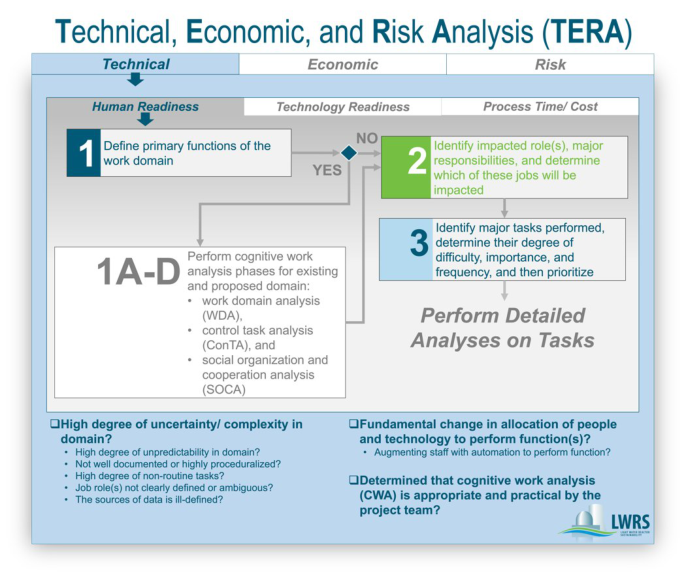
INTEGRATING SOCIOTECHNICAL METHODS FOR NUCLEAR POWER PLANT MODERNIZATION Roth and colleagues (2019) offer an integrated approach to function allo- cation in the advent of advanced digital technologies that change the way in which work is performed. As previously addressed, a set of sociotechni- cal methods has been identified as being potentially useful tools to support ensuring safe and reliable use with new digital technologies. One such cross- functional between the ION and HTI research areas includes developing a framework that can be used by industry to screen and assess moderniza- tion opportunities through economic, technical, and safety risk (Spangler et al., 2023). The development of the Technical, Economic, and Risk Anal- ysis (TERA) framework is a risk assessment tool that supports industry in modernizing through assessing these risk areas. The framework applies a combination of quantitative and qualitative analyses that provide a holis- tic assessment of potential modernization opportunities. Within TERA, this work focuses on developing a risk assessment strategy to enable human readi- ness, such as defined in ANSI/HFES-400 (2021). A proposed framework is illustrated in Figure 2, below (also see Kovesdi, Mohon, & Wilhite, 2023).
The human readiness assessment component of TERA is part of the tech- nical risk assessment element. The methods noted in Roth and colleagues (2019), and particularly the CWA WDA phase, is an analysis framework for assessing the human readiness of introducing a particular new technology (e.g., electric work package system) to an already established work domain at nuclear power plants. As seen in Figure 2, the first phase includes defining the primary functions of the work domain. It is envisioned that the abstrac- tion hierarchy used in CWA WDA can serve as a foundational tool to define a work domain’s goals and missions, values and constraints, and high-level functions that are assumed to be modified through digital technology; this corresponds to analyzing the operational demands and work requirements as discussed earlier. Interviews with existing plant staff can be applied at
A Review of Sociotechnical Approaches for Nuclear Power Plant Modernization 7
this phase using CTA techniques to understand existing pain points and cog- nitive requirements that drive the design of future digital technology and automation.
Figure 2: Technical, Economic, and Risk Analysis (TERA) Framework.
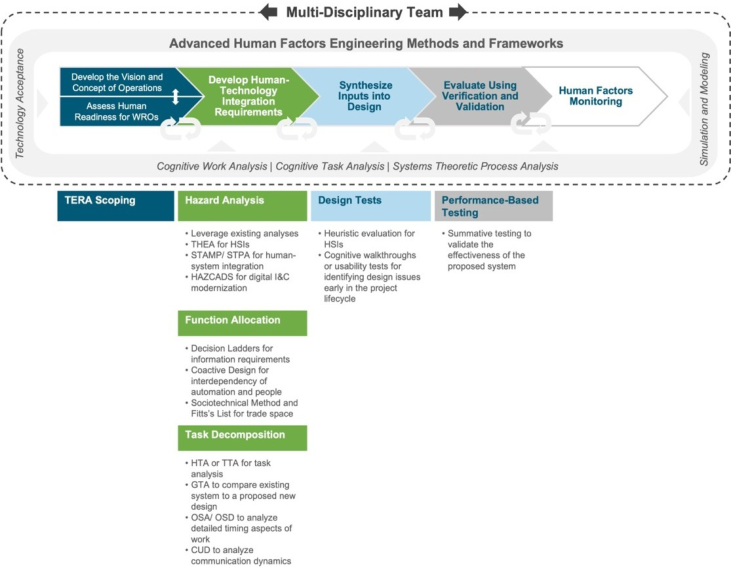
Phases 2 and 3 as seen in Figure 2 are then performed; these phases help further prioritize impacted functions and tasks that are of highest safety or economic risk. Here, impacted roles and jobs are identified through a combi- nation of knowledge elicitation techniques and document reviews. Within the identified roles and jobs, tasks that are impacted of highest priority (i.e., to safety or economics) are identified and then analyzed using detailed human factors methods, such as extending CWA using control tasks analy- sis techniques (e.g., contextual activity templates or decision ladders), STPA, or applying simulation and modeling techniques. A detailed overview of proposed methods are described in detail in Kovesdi, Mohon, and Wilhite (2023), but are illustrated in Figure 3.
It is expected that this proposed framework that leverages sociotechni- cal approaches to address function allocation considerations and enable large-scale modernization at nuclear power plants will be demonstrated in combination with ION-lead research in future U.S. industry collaborations. Lessons learned regarding the development and use of this framework will be shared through these collaborations.
This work of authorship was prepared as an account of work sponsored by Idaho National Laboratory (under Contract DE-AC07-05ID14517), an agency of the U.S. Government. Neither the U.S. Government, nor any agency thereof, nor any of their employees makes any warranty, express or implied, or assumes any legal liability or responsibility for the accuracy, com- pleteness, or usefulness of any information, apparatus, product, or process disclosed, or represents that its use would not infringe privately owned rights.
REFERENCES
ANSI/HFES. (2021). “Human Readiness Level Scale in the System Development Process.” ANSI/HFES- 400–2021. Crandall, B., G. Klein, and R. Hoffman. 2006. Working Minds: A Practitioner’s
Guide to Cognitive Task Analysis. MIT Press. Janssen, C. P., Donker, S. F., Brumby, D. P., & Kun, A. L. (2019). History and future of human-automation interaction. International journal of human-computer studies, 131, 99–107. Joe, J., and C. Kovesdi, 2021. “Using Qualified On-Site Nuclear Power Plant Simu-
lators in Human Factors Validations of Control Room Upgrades.” INL/CON-21- 61472, Idaho National Laboratory.
A Review of Sociotechnical Approaches for Nuclear Power Plant Modernization 9
Joe, J., L. Hettinger, Y. Yamani, P. Murray, and M. Dainoff. 2023. “Optimizing Information Automation Using a New Method Based on System-Theoretic Pro- cess Analysis: Tool Development and Method Evaluation.” INL/RPT 23 74217, Idaho National Laboratory. Kovesdi, C., J. Mohon, and C. Pedersen-San Miguel. 2023. “Demonstration of the
Human and Technology Integration Guidance for the Design of Plant-Specific Advanced Automation and Data Visualization Techniques.” INL/RPT 23 71395, Idaho National Laboratory. Kovesdi, C., J. Mohon, and K. Wilhite. 2023. “Human and Technology Integration Evaluation of Advanced Automation and Data Visualization.” INL/RPT 23 74346, Idaho National Laboratory. Kovesdi, C., P. Hunton, J. Mohon, R. Hill, J. Joe, T. Miyake, and S. Whitmore. 2022.
“Demonstration and Evaluation of the Human-Technology Integration Function Allocation Methodology.” INL/RPT 22 68472, Idaho National Laboratory. Kovesdi, C., Z. Spielman, R. Hill, J. Mohon, T. Miyake, and C. Pedersen. 2021.
“Development of an Assessment Methodology That Enables the Nuclear Indus- try to Evaluate Adoption of Advanced Automation.” INL/EXT 21 64320, Idaho National Laboratory. Levenson, N. and J. Thomas. 2018. “STPA Handbook.” Mohon, J. and C. Kovesdi, (2022). “Demonstrating the Value of 3D Models to Support Large-Scale Digital Modifications at Nuclear Power Plants.” In: Sofia Scataglini and Sudhakar Rajulu (eds) Digital Human Modeling and Applied Opti- mization. AHFE (2022) International Conference. AHFE Open Access, vol 46. AHFE International, USA. Remer, J., K. Thomas, S. Lawrie, K. Martin, and C. O’Brien. 2021. “Process for
Significant Nuclear Work Function Innovation Based on Integrated Operations Concepts” INL/EXT-21-64134, Idaho National Laboratory. Roth, E. M., et al. 2019. “Function allocation considerations in the era of human autonomy teaming.” Journal of Cognitive Engineering and Decision Making 13(4): 199–220. Schmid, D., Korn, B., & Stanton, N. A. (2020). Evaluating the reduced flight deck
crew concept using cognitive work analysis and social network analysis: Compar- ing normal and data-link outage scenarios. Cognition, Technology & Work, 22, 109–124. Stanton, N. A., P. M. Salmon, G. H. Walker, and D. P. Jenkins, Eds. 2017 Cognitive Work Analysis: Applications, Extensions and Future Directions. CRC Press. Stanton, N. A., P. M. Salmon, L. A. Rafferty, G. H. Walker, C. Baber, and D. P. Jenkins.
2013. Human Factors Methods: A Practical Guide for Engineering and Design. CRC Press.
LISTED IN THE AHFE DIGITAL BOOKSTORE CATALOGUE
Explore the complete digital volume
Emerging Technologies and Future of Work
Read this individual research paper free through the original publisher, or explore the full digital proceedings book.
ISBN 978-1-958651-93-3
Explore this ISBN in the AHFE Bookstore ↗Listed in the July 2026 bookstore catalogue; search by ISBN to confirm current availability · Digital book purchase optional