Hector Rafael Morano-okuno, Rafael Caltenco Castillo, Guillermo Sandoval (2023). Use of collaborative robots to generate movement trajectories for rehabilitating patients with joint mobility limitations of the upper extremities. In: Emerging Technologies and Future of Work. AHFE Open Access, vol. 117, pp. 133–140. https://doi.org/10.54941/ahfe1004413
In the 2000s, the application of collaborative robots began to be heard more frequently in various sectors, such as the Manufacturing industry and Healthcare. One of its main advantages is the way of interacting with the user; since it allows to share workspaces more closely without any fatal collisions. Currently, the price of these robots varies with the task type; the more transport load they support and the greater precision in their movements, the more expensive they will be. Nowadays, several works mention the use of collaborative robots to assist in the rehabilitation process of patients. These procedures are expensive since, initially, the purchase of the robot is required, and later the application software to generate the patient's rehabilitation movements. This article presents a methodology to generate the trajectory of the rehabilitation movements of patients with limitations in the upper joints. Engineering application software is used for the academic community (Professors and students). The licenses for operating this software application are free for the academy. In university courses, inverse kinematics projects of collaborative robots can be proposed to generate the rehabilitation trajectories of the patients mentioned above. With this methodology, only the collaborative robot would be required, reducing the initial investment of this type of treatment. When using student software applications, it would be possible to use the other tools that this type of computational tool has, such as 3D printing of parts, some ergonomic analysis of components, or the design of parts or fasteners through the finite element method. To test the methodology developed, a case study was used. It was a final project in the Automation of Manufacturing Systems course of the Tecnologico de Monterrey for students of the Mechatronics Engineering career. In this case study, the generated trajectories stimulate patients' motor skills to draw 2D contours. However, an advantage of the described methodology is that it can be used to generate any 2D or 3D trajectory as required by the patient. The methodology consists of the following stages, 1) 3D modeling of the parts of the collaborative robot that intervenes to generate trajectories, 2) consultation of the reference system of the axes of the collaborative robot, 3) definition of the appropriate movements for the rehabilitation of the patient and 4) programming of the robot. At the beginning of the article, different configurations and applications of collaborative robots are mentioned. Subsequently, the characteristics of the collaborative robot used for this work are described. Next, the methodology implemented for generating trajectories for rehabilitating patients with limitations of the movements of the upper limbs is detailed. Then, the developed methodology is implemented through a case study. Finally, the results, conclusions, and future work are presented.
In order to help the recovery of sensorimotor function once the central ner- vous system is damaged, it is necessary to use physiological limb muscle activation through arm/hand and leg movement exercises (Gassert and Dietz, 2018). This can be carried out through collaborative robots that help patients perform the necessary movements to activate the different upper or lower extremities. Using robots in the complex obtaining of biopsies reduces stress on physicians and patients; it also increases the efficiency in the collection of said samples (Berger et al., 2022). Some research papers report successful experiences with the use of industrial robots as devices that work collabo- ratively to take biopsies. One of the main problems of collaborative robots, used to generate guided trajectories through the movement of the hand, is the possibility of reaching singularity positions, which prevent the free movement of the robot. To avoid these singularity positions, a variational approach has been developed that aims to detect singularity positions in order to avoid them during robot programming (Salvato et al., 2022). Another application of collaborative robots to assist patients without mobility is the proposal pre- sented by Biton et al. (2022), where robots are the ones that move patients autonomously to avoid pressure wounds caused by long periods in a certain position in bed.
Developments have also been generated to design robotic hands (Antonelli et al., 2018) with a quality similar to the texture of human fingers. In this way, they can be used in collaborative robots to assist patients with mobility problems in the upper limbs. The materials used allow the fingers to perform smooth movements similar to those of the human being. To give this type of robotic hand a controlled movement, control algorithms based on Coupling Dynamic Movement Primitives have been developed (Tu et al., 2022). These methods allow obstacle avoidance, human teaching, and compliance control. Decision-making is through adjusting the weighting factors. In addition to the applications of collaborative robots in medicine and, in particular, in assisting patients with mobility problems, new kinematics analysis methods have con- tinued to be developed to control the movements of these devices, achieving more efficient and smooth movements during his trajectory; some of these examples is the work done by Mishra et al. (2022) corroborated with Robo- Analyzer tool application, Kefan et al. (2021) where he considers the problem of joint temperature rising under universal joint rating analyzed with Ansys- Workbench tool application and a strategy to decrease the joint temperature is proposed based on the simulation model and the work by Tarbouriech and Suleiman (2020), who future a new bi-objective safety-oriented path planning strategy for robots to avoid being very close to obstacles (human body parts).
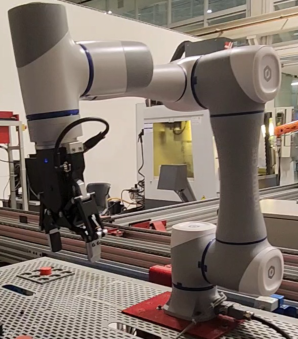
CHARACTERISTICS OF THE COLLABORATIVE ROBOT EMPLOYED The robot used is a Dobot brand, model CR5, with six degrees of freedom and a maximum load capacity of 5kg (see Figure 1). The control software application is DobotStudio Pro, which accepts DobotBlockly and Script pro- gramming. The maximum working speed is 3m/s, and the repeatability is
Use of Collaborative Robots to Generate Movement Trajectories 135
±0.02mm (Shenzhen, 2022). Figure 1 shows the robot used. The available gripper is a ROBOTIQ-2F85; it has two fingers and a maximum opening of 85mm. The gripper fingers allow adaptation to grip circular or prismatic objects. The range of the closing force between the fingers is 25 – 235 N. The payload will depend on the material to be loaded, its friction between the contact surfaces, and the acceleration at which the gripper moves; however, for the application of the movement of a person’s arm, accelerations greater than 1G will not be required, so, in general, the maximum payload will be 5kg. The range of the closing speed of the fingers is from 20 to 150 mm/s. The movement of the gripper fingers is carried out employing an actuator, which can control the closing position, the closing force, and the closing speed.
Figure 1: Collaborative robot employed.
METHODOLOGY FOR GENERATING TRAJECTORIES FOR REHABILITATING PATIENTS Stage 1: 3D Modeling of the Collaborative Robot Parts That Intervene to Generate Trajectories
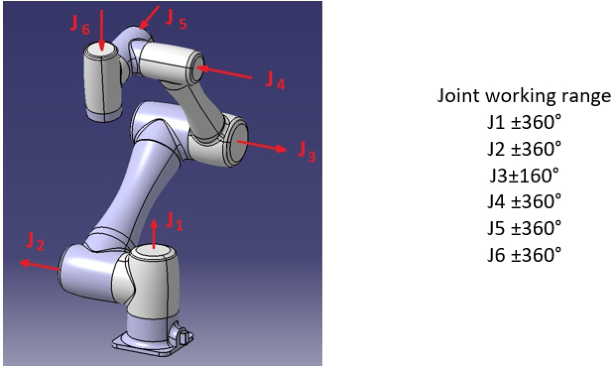
Initially, the robot’s dimensions to be used were obtained; only those that intervene in the movement of the different degrees of freedom of the robot were considered, such as the distances between the joints and the position of the different degrees of freedom. For 3D modeling, the CATIA V5-6R2022 application software was used, starting from the base towards the sixth degree of freedom. Details such as color attributes and labels were not considered for the modeling since they do not intervene in the robot’s move- ments. Subsequently, each component was assembled, and their kinematic constraints were defined so the robot could move (Okuno et al., 2023). All joints were of the revolution type. Figure 2 shows the modeling of the robot with the positive sense of its different degrees of freedom, the above accord- ing to the right-hand rule. The range of rotation for each degree of freedom is also shown.
Figure 2: Modeling of the robot with its degrees of freedom.
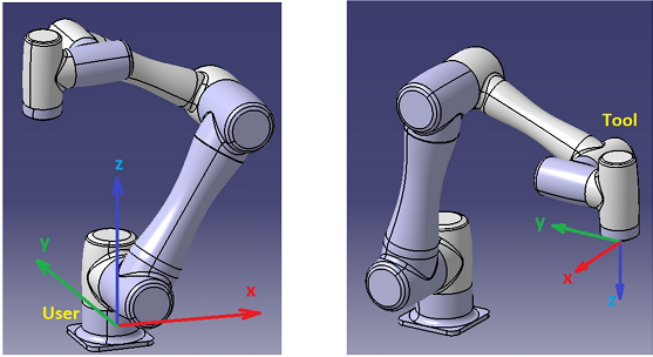
Stage 2: Consultation of the Reference System of the Collaborative Robot Axes The Dobot CR5 robot allows ten user coordinate systems, of which the user coordinate system 0 is defined by default and cannot be changed (see Figure 3). On the other hand, the robot also supports ten tool coordinate systems, and the tool coordinate system 0 is located at the end effector and cannot be changed (see Figure 3). For the generation of trajectories, we can use any of these two reference systems to avoid having to define new systems, thus simplifying the generation of trajectories; since the modeled robot can be oriented to coincide with these reference systems.
Figure 3: User coordinate system 0 and tool coordinate system 0.
Use of Collaborative Robots to Generate Movement Trajectories 137
Stage 3: Definition of the Appropriate Movements for the Rehabilitation of the Patient With the help of the collaborative robot, it is intended to exercise the upper limbs, either with the ROBOTIQ-2F85 gripper or another special end effec- tor adapted to hold the upper limb; it will be guided to follow a specific trajectory. The patient will visualize the route and will try to move his arm to trace said trajectory; the robot will begin to move the upper limb until finishing the route. These movements or trajectories will be defined by the therapist.
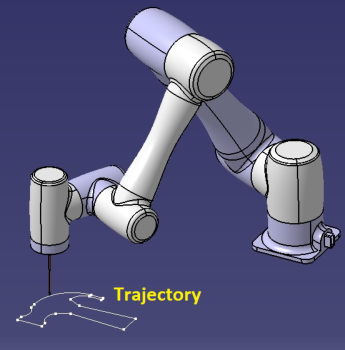
Figure 4 shows an example of the trajectory to follow. The image of the hammer occupies an area of a letter-size sheet (21.59 cm x 27.94 cm), and the perimeter of the hammer is 857.0425mm
Figure 4: Trajectory to follow and location of the reference system 1.
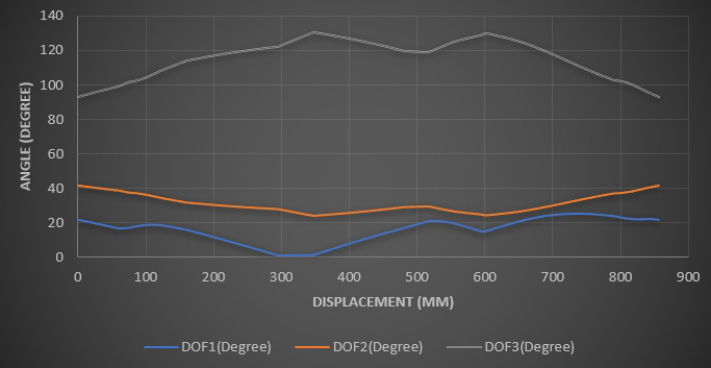
Stage 4: Programming the Robot For the programming of the robot, it is initially required to obtain the inverse kinematics of the end effector so that it follows the defined trajectory. For this, it is necessary to define a reference system with respect to which the displacements will be generated. To obtain the inverse kinematics of the robot, a pencil-shaped marker will be placed at the end of the end effec- tor; this position can be modified by actually holding the upper limb of a person. Figure 4 also shows the position of reference system 1, which will be used to obtain the inverse kinematics. Figure 5 shows the curves of the inverse kinematics of the position of the degrees of freedom 1, 2, and 3.
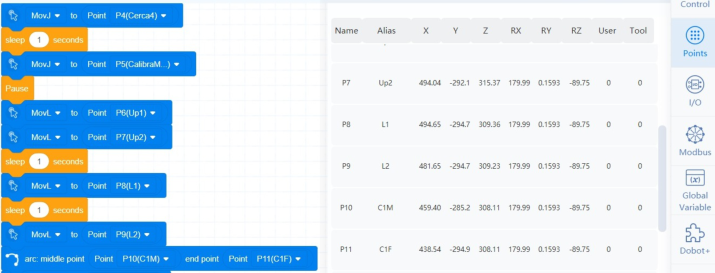
The displacement speed of the end effector can also be defined; for this case, it will be fixed at 60mm/s. With inverse kinematics, the robot program will be obtained so that the end effector follows the speci- fied trajectory. Figure 6 shows part of the robot’s program to run the specified path.
Figure 5: Inverse kinematics of position for degrees of freedom (DOF) 1, 2, and 3.Figure 6: Part of the robot program.
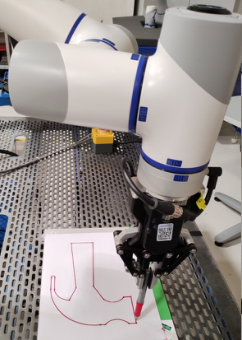
IMPLEMENTATION OF THE METHODOLOGY THROUGH A CASE STUDY The case study consisted of making the gripper of the Dobot CR5 robot move. A marker was placed on the end of the gripper to outline the hammer (see Figure 7). The program developed with the inverse kinemat- ics of Stage 4 was used. The realization of the case study was the final project in the Automation of Manufacturing Systems course of the Tecno- logico de Monterrey for students of the Mechatronics Engineering career. The conditions under which the tests were carried out were the follow- ing: 1) the gipper used was ROBOTIQ-2F85, 2) a marker was held by the fingers of the gripper, 3) the trajectory began at the origin of reference system 1, and 4) the speed of movement of the end effector was 6mm/s. Figure 7 shows the trajectory generated by the robot’s movement when guid- ing the gripper. The contour drawn by the robot can be seen in red, and in black, the original silhouette of the trajectory (hammer) can be slightly visualized.
Use of Collaborative Robots to Generate Movement Trajectories 139
Figure 7: Result of the trajectory generated by the movement of the robot.
CONCLUSION AND FUTURE WORK With the proposed methodology, it is not necessary to purchase a tool applica- tion software to generate trajectories in collaborative robots; it only requires movement simulation software, which exists in a wide variety and with licenses for students. Rehabilitation trajectories can be generated as projects for engineering students; to reinforce the topics of inverse kinematics of collaborative robots.
This methodology allows for generating various rehabilitation trajecto- ries quickly; expert users in the robotics area are not required, only the dimensions or coordinates of the trajectories are needed, and the software application will quickly generate the inverse kinematics of the robot to program the trajectories.
Depending on the rehabilitation treatment, not only 2D contour trajecto- ries can be generated, but also complex 3D trajectories can be generated.
Later on, the design of upper limb holders will be required, which can be moved by the robot’s gripper or screwed directly to the sixth degree of freedom.
Subsequently, it will be necessary to test this methodology with actual patients, considering the degree of involvement of the upper extremity, whether at the level of the fingers, wrist, forearm, or shoulder.
ACKNOWLEDGMENT
The authors would like to acknowledge the financial support of Writing Lab, TecLabs, and Tecnologico de Monterrey, Mexico, in producing this work.
We would also like to thank Alejandra Ocáriz, Information Technol- ogy leader, and Samuel Miranda, Information Technology coordinator from the Tecnologico de Monterrey, campus Edo. de Mexico, for the support provided for the computer equipment assigned to develop this work.
REFERENCES
Antonelli, M. G., D’Ambrogio, W., Durante, F. (2018) ‘Development of a pneumatic soft actuator as a hand finger for a collaborative robot’. Proceedings of the 2nd International Conference on Mechatronics Systems and Control Engineering, pp. 67–71. https://doi.org/10.1145/3185066.3185079 Berger, J., Unger, M., Keller, J., Reich, M., Neumuth, T., Melzer, A. (2022) ‘Design
and validation of a medical robotic device system to control two collaborative robots for ultrasound-guided needle insertions’, Journal of Frontiers in Robotics and AI, Volume 9. https://doi.org/10.3389/frobt.2022.875845 Biton, A., Shoval, S., Lerman, Y. (2022) “The Use of Cobots for Disabled and Older Adults”, in: 14th IFAC Workshop on Intelligent Manufacturing Systems, Volume 55, No. 2, pp. 96–101. https://doi.org/10.1016/j.ifacol.2022.04.176 Gassert, R., Dietz, V. (2018) ‘Rehabilitation robots for the treatment of sensorimo-
tor deficits: a neurophysiological perspective’, Journal of NeuroEngineering and Rehabilitation, Volume 15, No. 46. https://doi.org/10.1186/s12984-018-0383-x Kefan, X., HaoQin, G., Diansheng, C., Diwen, W., Ruilong, X. (2021) “A Thermal Analysis Method for Integrated Joints of Collaborative Robots”, in: Lecture Notes in Computer Science, 13015 LNAI, pp. 515–523. https://doi.org/10.1007/978-3- 030-89134-3_47 Mishra, P., Jagadeesh, H., Shashikant, K. L., Talli, A. (2022) “Kinematic Study of
Collaborative Robot”, in: Lecture Notes in Mechanical Engineering, pp. 697–704. https://doi.org/10.1007/978-981-16-7909-4_64 Okuno, H., Sandoval, G., Castillo, R., Merino, D., Cordova, J., Garcia, A. (2023).
“Simplified CAD model of a person for the simulation of their movements”. In: Jay Kalra (eds) Human Factors in Aging and Special Needs. Volume 88. http://doi.org/10.54941/ahfe1003663 Salvato, E., Vanzella, W., Fenu, G., Pellegrino, F. A. (2022) ‘Singularity Avoidance for Cart-Mounted Hand-Guided Collaborative Robots: A Variational Approach’, Journal of Robotics, Volume 11, No. 4, Article number 79. https://doi.org/10. 3390/robotics11040079 Shenzhen Yuejing Technology Co., Ltd. China (2022). “Dobot CR Series, User
Guide”. Issue V1.0. www.dobot.cc Tarbouriech, S., Suleiman, W. (2020) ‘Bi-objective Motion Planning Approach for Safe Motions: Application to a Collaborative Robot’, Journal of Intelligent and Robotic Systems: Theory and Applications, Volume 99, No. 1, pp. 45–631. https://doi.org/10.1007/s10846-019-01110-1 Tu, Z., Zhang, T., Yan, L., Lam, T. L. (2022) ‘Whole-Body Control for Velocity-Controlled Mobile Collaborative Robots Using Coupling Dynamic Movement Primitives’. Proceedings of IEEE-RAS 21st International Conference on Humanoid Robots, pp. 119–126. https://doi.org/10.1109/Humanoids53995. 2022.10000097
LISTED IN THE AHFE DIGITAL BOOKSTORE CATALOGUE
Explore the complete digital volume
Emerging Technologies and Future of Work
Read this individual research paper free through the original publisher, or explore the full digital proceedings book.
ISBN 978-1-958651-93-3
Explore this ISBN in the AHFE Bookstore ↗Listed in the July 2026 bookstore catalogue; search by ISBN to confirm current availability · Digital book purchase optional