Shraga Shoval, Amir Biton, Yuval Cohen (2026). Analyzing Stress and Perceived Safety in Human-Cobot Collaboration: The Impact of Task Proximity, Interface Cues, and System Errors. In: Human Interaction and Emerging Technologies (IHIET 2026). AHFE Open Access, vol. 236, pp. 80–88. https://doi.org/10.54941/ahfe1008084
Collaborative robots (cobots) are increasingly deployed in shared workspaces, where effective interaction depends not only on physical safety but also on operator trust, transparency, and comfort. This study investigates how collaboration structure, feedback modality, and system reliability affect task performance, user experience, trust, perceived safety, and physiological responses during human–cobot interaction.Eighty participants performed collaborative assembly tasks under two scenarios: a low-collaboration turn-taking task and a high-collaboration synchronous task. Feedback conditions included visual, auditory, multimodal auditory–visual feedback, and a Projected Assistive Interface (PAI) in the high-collaboration scenario. In addition, controlled anomalies, including robot failures, communication errors, and motion errors, were introduced to evaluate system resilience.Subjective evaluations, task completion times, and heart-rate variability (HRV) measures were collected. Results show that feedback effectiveness depends strongly on both collaboration structure and system state. Multimodal feedback and PAI improved task understanding, comfort, and trust, particularly during high-collaboration tasks. Preliminary results indicate that system errors reduced trust and perceived safety while eliciting measurable physiological responses. Motion errors produced stronger stress reactions, whereas robot failures primarily reduced perceived reliability. Transparent multimodal feedback also facilitated trust recovery following error events.These findings suggest that feedback mechanisms should be designed not only to support task execution but also to maintain trust and resilience under imperfect operating conditions. The study provides practical design guidelines for human-centered collaborative robotic systems operating in both normal and failure conditions.
Collaborative robots are transforming industrial environments by enabling humans and robots to work together within shared physical workspaces. Unlike traditional industrial robots operating behind safety barriers, cobots Received June 12, 2026; Revised July 6, 2026; Accepted July 26, 2026; Available online August 25, 2026
Analysing Stress and Perceived Safety in Human-Cobot Collaboration 81 continuously interact with human operators, creating new challenges related to trust, transparency, safety perception, and psychological acceptance.
Previous studies have shown that feedback mechanisms play a critical role in communicating robot intentions, improving situational awareness, and supporting efficient collaboration. Auditory signals, visual indicators, and projected interfaces can improve operator understanding and reduce uncertainty regarding robot actions.
However, most existing studies focus on normal system operation. Real industrial environments inevitably involve unexpected events such as communication delays, robot failures, trajectory deviations, and sensor faults. Such anomalies may significantly alter operator trust, stress levels, and behavioral adaptation. Understanding how users react to these events is essential for designing robust human-centered collaborative systems.
This paper investigates two complementary research questions: RQ1: How do different feedback modalities influence performance, trust,
user experience, and physiological responses during human–cobot collaboration? RQ2: How do system errors affect trust, perceived safety, and physiological responses, and can feedback mechanisms mitigate these effects?
To address these questions, we evaluate multiple feedback modalities across two collaboration scenarios and introduce controlled system anomalies representing common industrial failures.
RELATED WORK
Research in human–robot interaction (HRI) has consistently shown that transparency and predictability are central determinants of trust in automation. Trust is especially important in contexts where users cannot fully anticipate system behavior, because it shapes reliance, acceptance, and the willingness to continue interaction after uncertainty or failure (Lee & See, 2004). Meta-analytic evidence further suggests that robot-related performance and attribute factors are among the strongest predictors of trust in HRI, while environmental factors play a more moderate role (de Visser et al., 2011). Accordingly, interface designs that make a robot’s state, intentions, and next actions more legible may support more appropriate reliance and reduce uncertainty during collaboration (Lee & See, 2004).
A growing body of work also indicates that richer feedback modalities can improve operator awareness and perceived safety. Visual and auditory cues can help users interpret robot behavior more effectively, particularly when tasks are dynamic or safety critical, and can therefore support trust calibration over time. Recent reviews of trust assessment in HRI note that trust can be captured not only through self-report, but also through observable behavior and physiological measures, underscoring the value of multimethod assessment in interaction design (Campagna & Matthias, 2025). In this framework, feedback is not merely informational; it helps users to form more accurate expectations about system performance and intent, which is essential for maintaining trust during collaboration (Lee & See, 2004).
Research on trust dynamics further shows that automation failures can produce trust decrements that are disproportionate to the objective severity of the error. Experimental studies have demonstrated that even failures on tasks that are relatively easy for human operators can sharply undermine trust and reliance (Madhavan et al., 2006). More recent work in automation and HRI similarly suggests that trust tends to decline rapidly after failure and recover more slowly, indicating an asymmetry between trust loss and trust repair ( Baker et al., 2018; Liu et al., 2024). This pattern highlights the importance of post-failure communication and interface design, since the effects of a single error may persist beyond the immediate event.
Physiological measures have emerged as useful complements to self-report instruments for examining stress, workload, and operator state during human–robot interaction. Heart rate variability (HRV), in particular, has been widely discussed as an indicator of mental workload and autonomic regulation in collaborative and automated settings (Shao et al., 2021). Analysis of physiological matrices during human–robot collaboration suggest that electrophysiological measures can provide fine-grained insight into user responses that may not be captured through subjective ratings alone (Rihet et al., 2024). However, findings remain mixed: some studies report meaningful physiological sensitivity to robot reliability or workload, whereas others find limited direct correspondence between HRV and trust change (Alzahrani & Ahmad, 2024). This suggests that HRV may be most informative when interpreted in relation to specific interaction events, such as failures, recovery phases, and interface feedback conditions.
Despite these advances, relatively few studies have examined physiological responses to robot failures while also testing how interface design influences trust recovery after errors (Baker et al., 2018). Most existing research has focused either on trust as a subjective outcome or on physiological workload without integrating both perspectives into a single experimental framework. The present study addresses this gap by combining controlled error scenarios with feedback-modality manipulations and physiological measurement. In doing so, it aims to clarify how visual and auditory feedback shape trust dynamics, operator stress, and recovery processes following robot failure (Lee & See, 2004; Madhavan et al., 2006).
EXPERIMENTAL METHODOLOGY Participants
Eighty university students (Industrial Engineering and Management) participated in the experiment. Most had limited prior experience working with collaborative robots, mainly trough academic courses.
Experimental Setup The experimental platform consisted of an industrial collaborative robot and a workstation designed to simulate two types of assembly operations. Following that, two collaboration scenarios were examined:
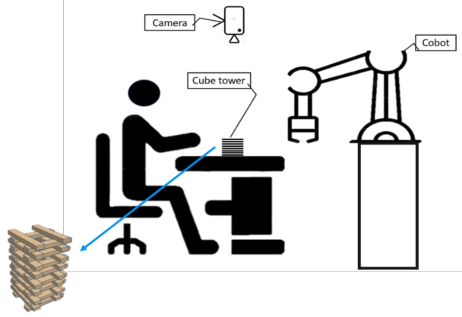
Scenario #1 – Low Collaboration: The human and the cobot performed sequential turn-taking actions with minimal real-time coordination. In this setup, the human operator and the cobot built a wooden block tower
Analysing Stress and Perceived Safety in Human-Cobot Collaboration 83 together in a shared workspace, taking turns one after the other. They stood across from each other at a worktable, and the task was structured so that only one could act at a time. A vision-based hand tracking system monitored the participant’s hand entering the shared area; after the participant placed a block and withdrew, the cobot automatically placed the next one. This turn- based arrangement ensured clear temporal separation between human and cobot actions and supported consistent task flow (Figure 1).
Figure 1: Setup for scenario #1.
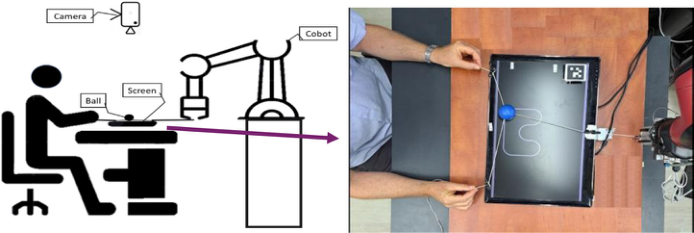
Scenario 2 – High Collaboration: Human and cobot simultaneously shared the workspace and continuously coordinated actions. In this scenario, the participant and cobot jointly guided a ball along a projected path using a string-tension interface. The human controlled movement along the X-axis, while the cobot controlled movement along the Y-axis by mechanically pulling or releasing a string attached to its gripper. An overhead camera tracked the ball’s position relative to the target trajectory. The setup for this high- collaboration condition is shown in Figure 2. This task required synchronous human–robot coordination, with both agents working at the same time toward a shared objective. Success depended on continuous adjustment and close mutual adaptation between the participant and the cobot.
Figure 2: Setup for scenario #2.
Feedback Modalities The following feedback modalities were evaluated:
None: No supplementary cues; participants relied solely on the natural task dynamics.
Auditory: Spoken cues from the cobot (e.g., “Now it’s your turn” in scenario #1 or “Pull right”, “Pull left” in scenario #2).
Visual: Screen-based signals, indicating that the participant should take their turn (scenario #1), or directional arrows that indicate the required pulling direction and a circular icon that warns of excessive string tension (scenario #2).
Auditory + Visual: Synchronous presentation of both auditory and visual cues.
Projected Assistive Interface (PAI): Task instructions, robot intentions, and operational status were projected directly into the operator’s workspace.
System Error Conditions Three controlled error types were introduced during selected trials:
Robot Failure (RF): The cobot unexpectedly stopped execution and entered a fault state.
Communication Error (CE): Robot status information was delayed, incomplete, or contradictory.
Motion Error (ME): The robot executed a safe but unexpected trajectory deviation (e.g. putting a wooden block in the wrong position in scenario 31, or pulling the ball in the wrong direction in scenario #2).
Participant experienced all error conditions in randomized order.
Measurements Self-Report Questionnaire
Using a self-report questionnaire, participants ranked their subjective perception of the interaction. These include the following terms:
Trust – The extent to which users believe the cobot will perform reliably, predictably, and in their best interest.
Perceived Safety – The user’s subjective feeling of being safe while working alongside the cobot.
Task Understanding – The degree to which users understand the cobot’s actions, intentions, and task objectives.
Comfort – The level of physical and psychological ease experienced during interaction with the cobot.
Workload – The amount of mental and physical effort required from the user during task execution.
Interaction Quality – The overall effectiveness, smoothness, and satisfaction of the human – cobot interaction.
Attitude Toward Robots – The user’s general positive or negative disposition toward robots and robotic technologies.
Analysing Stress and Perceived Safety in Human-Cobot Collaboration 85 Perceived workload was assessed with the NASA-TLX questionnaire, and attitudes toward robots with the NARS, and stress and trust with post- task questionnaire items. Internal consistency of the composite scales was evaluated using Cronbach’s α.
Task Completion Time For each experiment, task completion time was measured. This objective measure provides an indication of the effectiveness and fluency of the interaction between the human operator and the cobot. Comparisons of completion times across conditions were used to evaluate the impact of the proposed interface on task performance.
Physiological Measures The physiological measures include the following HRV matrices:
Stress Index: A physiological metric derived from heart rate variability (HRV) analysis that quantifies the overall level of stress or autonomic nervous system imbalance. Higher values typically indicate greater stress or sympathetic dominance.
SNS Index (Sympathetic Nervous System Index): An HRV-based measure reflecting the activity of the sympathetic nervous system, which drives the “fight-or-flight” response. Elevated SNS values suggest increased sympathetic activation, often associated with stress, arousal, or cognitive load.
PNS Index (Parasympathetic Nervous System Index): An HRV-based measure reflecting the activity of the parasympathetic nervous system, which promotes relaxation and recovery (“rest-and-digest”). Higher PNS values indicate greater parasympathetic tone and typically lower stress levels.
SDNN (Standard Deviation of NN Intervals): The standard deviation of all normal-to-normal (NN) heart rate intervals over a recording period. It is a long-term HRV metric that reflects overall variability and autonomic function; higher SDNN indicates greater heart rate variability and typically better autonomic regulation.
RMSSD (Root Mean Square of Successive Differences): A short-term HRV metric calculated from the root mean square of successive differences between adjacent NN intervals. It primarily reflects parasympathetic (vagal) activity and is widely used as an indicator of stress recovery and relaxation capacity; higher RMSSD suggests stronger vagal tone.
RESULTS
User Experience and Trust Multimodal feedback consistently achieved higher ratings for comfort, task understanding, and trust than unimodal conditions. In high-collaboration tasks, PAI achieved the highest ratings across all subjective measures. System
errors significantly reduced trust ratings. Robot failures produced decline in perceived reliability, while motion errors generated the strongest reduction in perceived safety.
Task Performance For low-collaboration tasks, no-feedback conditions achieved the fastest completion times. For high-collaboration tasks, richer feedback progressively improved performance, with PAI producing the shortest completion times. These effects were strongest following motion errors.
Physiological Responses Low-collaboration tasks produced relatively small physiological differences across feedback conditions. On the other hand, high-collaboration tasks revealed significant differences in HRV measures. PAI produced elevated sympathetic activation accompanied by improved performance and positive subjective evaluations, suggesting productive engagement rather than harmful stress. All error conditions generated significant physiological responses. Motion errors produced the largest increases in Stress Index and SNS activation. Communication errors resulted in moderate stress increases accompanied by elevated cognitive workload. Robot failures generated prolonged physiological responses that persisted beyond the immediate error event, suggesting slower trust recovery.
DISCUSSION
The findings reveal that feedback design and system reliability jointly determine human responses during collaboration. Under normal operating conditions, multimodal feedback and PAI improve transparency, understanding, and performance. During abnormal conditions, these same mechanisms play a critical role in supporting trust recovery. The results further demonstrate that different error classes influence distinct psychological constructs. Reliability-related failures primarily affect trust, whereas unexpected robot motions primarily affect perceived safety.
Importantly, physiological activation should not automatically be interpreted as negative stress. Several conditions associated with improved performance also produced elevated physiological activation, indicating increased engagement rather than discomfort. These findings support the development of adaptive interfaces capable of providing additional explanations and guidance when anomalies occur.
DESIGN IMPLICATIONS The results suggest several practical guidelines:
Match feedback modality to collaboration intensity. The choice of feedback modality should reflect the level of interaction required between the human and the cobot. Tasks involving close and continuous
Analysing Stress and Perceived Safety in Human-Cobot Collaboration 87 collaboration may benefit from richer feedback, such as visual, auditory, or multimodal cues, whereas simpler tasks may require only minimal feedback. Adapting the feedback modality to the collaboration context can improve user understanding, trust, and task performance.
Employ spatially integrated interfaces for high-collaboration tasks. In tasks that require frequent coordination between humans and cobots, information should be presented as close as possible to the workspace and relevant objects. Spatially integrated interfaces (e.g. PAI) reduce the need for users to shift attention between the task and a separate display. This can decrease cognitive workload and support more efficient and natural collaboration.
Provide explicit explanations following failures. When errors or unexpected behaviors occur, the system should clearly communicate the reasons for the failure and any corrective actions being taken. Transparent explanations help users understand the cobot’s behavior and reduce uncertainty. As a result, users are more likely to maintain trust in the system despite occasional failures.
Prioritize trajectory transparency to preserve perceived safety. Users should be able to anticipate the cobot’s future movements and intentions during task execution. Visualizing planned trajectories or providing advance motion cues can make robot behavior more predictable. Increased predictability enhances users’ sense of safety and confidence when working in close proximity to the cobot.
Use physiological monitoring as a complementary indicator of trust degradation. Physiological signals such as heart rate variability, skin conductance, or eye-tracking measures can provide additional insights into users’ reactions during interaction. These measures may reveal changes in stress, workload, or trust that are not captured through self- report questionnaires alone. Consequently, physiological monitoring can serve as a valuable complementary tool for assessing trust dynamics in human–cobot collaboration.
CONCLUSION
This study examined how feedback modalities and system errors influence performance, trust, perceived safety, and physiological responses during human–cobot collaboration. The results demonstrate that multimodal feedback and projected assistive interfaces improve collaboration quality during normal operation and accelerate trust recovery following system anomalies. System errors affect both subjective and physiological responses, with different error types influencing different dimensions of the human– robot relationship. These findings highlight the importance of designing collaborative systems that support not only efficient task execution, but also resilience, transparency, and trust maintenance under imperfect operating conditions. Future work will investigate adaptive error-recovery interfaces, longitudinal trust development, and real industrial deployment scenarios.
REFERENCES
Alzahrani, A., & Ahmad, M. (2024, November). Real-time trust measurement in human-robot interaction: Insights from physiological behaviours. In Proceedings of the 26th international conference on multimodal interaction (pp. 627–631). Baker, A. L., Phillips, E. K., Ullman, D., & Keebler, J. R. (2018). Toward an
understanding of trust repair in human-robot interaction: Current research and future directions. ACM Transactions on Interactive Intelligent Systems (TiiS), 8(4), 1–30. Campagna, Giulio, and Matthias Rehm. “A systematic review of trust assessments in human–robot interaction.” ACM Transactions on Human-Robot Interaction 14.2 (2025): 1–35. de Visser, E. J., Pak, R., & Shaw, T. H. (2011). A meta-analysis of factors affecting
trust in human-robot interaction. Human Factors, 53(5), 517–527. https://doi. org/10.1177/0018720811417254 Lee, J. D., & See, K. A. (2004). Trust in automation: Designing for appropriate reliance. Human Factors, 46(1), 50–80. https://doi.org/10.1518/ hfes.46.1.50_30392 Liu, P., Chu, Y., Wang, G., & Xu, Z. (2024). To err is automation: Can trust be
repaired by the automated driving system after its failure?. IEEE Transactions on Human-Machine Systems, 54(5), 508–519. Madhavan, P., Wiegmann, D. A., & Lacson, F. C. (2006). Automation failures on tasks easily performed by operators undermine trust in automated aids. Human Factors, 48(2), 241–256. https://doi.org/10.1518/001872006777724408 Rihet, M., Sarthou, G., Clodic, A., & Roy, R. N. (2024). Electrophysiological
Measures for Human–Robot Collaboration Quality Assessment. In Discovering the Frontiers of Human-Robot Interaction: Insights and Innovations in Collaboration, Communication, and Control (pp. 363–380). Cham: Springer Nature Switzerland. Shao, S., Wang, T., Li, Y., Song, C., Jiang, Y., & Yao, C. (2021). Comparison Analysis of Different Time-Scale Heart Rate Variability Signals for Mental Workload Assessment in Human-Robot Interaction. Wireless Communications and Mobile Computing, 2021(1), 8371637.
SEARCH THE AHFE DIGITAL BOOKSTORE BY ISBN
Explore the complete digital volume
Human Interaction and Emerging Technologies (IHIET 2026)
Read this individual research paper free through the original publisher, or explore the full digital proceedings book.