Vasiliki Konstantopoulou, Foteini Paraskeva (2026). Architecting Digital Educational Escape Rooms: A Framework for Instructional Orchestration, Role-Based Collaboration, and AI-Supported Learning. In: Human Interaction and Emerging Technologies (IHIET 2026). AHFE Open Access, vol. 236, pp. 131–141. https://doi.org/10.54941/ahfe1008089
Digital Educational Escape Rooms (DEERs) have increasingly emerged as innovative technology-enhanced learning environments capable of promoting learner engagement, motivation, and collaborative participation. Nevertheless, their instructional effectiveness may remain limited when collaboration, progression, and learner support are not systematically orchestrated within the architecture of the environment itself. Existing implementations often emphasize gamification elements without embedding pedagogically aligned mechanisms that regulate interaction flow, interdependence, and reflective learning processes.Objective:To design, develop, and examine a system-oriented Digital Educational Escape Room environment that integrates conditional progression, role-based collaboration, and AI-supported scaffolding through an instructional orchestration framework grounded in the MCIEC model.Methodology: The study adopted a design-based and system-oriented approach focusing on the architectural and technical implementation of the Find Mr. X Digital Educational Escape Room. The environment was developed on the Wix platform using Velo Dev Mode and implemented into an event-driven learning system through code-based interaction management. The instructional design was structured according to the five phases of the MCIEC model (Motivation, Context, Interactivity, Evaluation, and Connectivity). Learner progression was regulated through hidden navigation, conditional redirection, event triggers, and validation mechanisms ensuring task-dependent advancement. Furthermore, the Jigsaw collaborative strategy was operationalized through differentiated expert pathways and role-based access structures, while Artificial Intelligence tools were embedded as optional scaffolding resources supporting reflection, verification, and collaborative inquiry.Results: Findings from a pilot implementation involving 30 pre service an in service teachers demonstrate the operational reliability and pedagogical feasibility of embedding instructional orchestration directly into the system architecture, resulting in a 100% completion rate with no navigation errors. Participants positively evaluated the system’s contribution to mathematical understanding and learning (M = 4.30/5.00), while the embedded AI-supported scaffolding layers were similarly perceived as effective support mechanisms (M = 4.13/5.00). Conditional progression mechanisms successfully reduced unstructured trial-and-error behaviors by enforcing meaningful sequential interactions, while the role-based Jigsaw structure promoted positive interdependence and collaborative knowledge synthesis. Finally, the study contributes a transferable design framework linking instructional affordances with platform-level implementation mechanisms, including hidden navigation, visibility constraints, event-driven interactions, and collaborative orchestration patterns.
Digital Educational Escape Rooms (DEERs) have attracted increasing attention in educational contexts because they combine narrative, challenge-based progression, collaboration, and problem solving. Their educational value, Received July 4, 2026; Revised July 26, 2026; Accepted August 10, 2026; Available online August 25, 2026
132 Konstantopoulou and Paraskeva however, depends not only on game elements but also on how progression, collaboration, and support are organized within the environment (Veldkamp et al., 2020; Jiménez et al., 2020; Makri et al., 2021). When these elements remain loosely structured, learners may engage in superficial participation or adopt unproductive trial and error approaches to problem solving. Find Mr. X addresses this challenge by embedding pedagogical orchestration directly into the system architecture, ensuring that learner progression remains aligned with intended learning pathways and conceptual understanding (Dillenbourg, 2013; Prieto et al., 2015).
From a collaborative learning perspective, knowledge construction depends on how roles, responsibilities, and interdependencies are structured (Dillenbourg, 1999). The Jigsaw strategy is a well established example of structured collaboration in which learners become responsible for different parts of a shared task and the final solution depends on the combination of all contributions (Aronson et al., 1978). In Find Mr. X, Jigsaw is embedded directly within the system architecture through the assignment of distinct roles and differentiated interaction pathways, creating positive interdependence among group members .
At the same time, artificial intelligence (AI) has created new opportunities for learner support. While AI has frequently been used to generate narratives, hints, and puzzles within digital escape rooms (Stojšić, 2024), its role as a scaffold for reasoning and reflection remains less explored. When carefully integrated, AI can support learners in verifying intermediate steps, exploring alternative approaches, and reflecting on their reasoning without directly providing solutions, thereby functioning as a cognitive scaffold that promotes complex thinking and reflection (Zhai & Krajcik, 2024). Within Find Mr. X, AI tools are available throughout selected activities as optional sources of feedback and guidance, supporting learners as they navigate mathematical challenges and reflect on their problem solving processes.
Previous work on this environment examined its instructional design and pilot evaluation in relation to computational thinking, mathematical understanding, and AI supported scaffolding. The present study shifts the focus from learning outcomes to implementation, examining how pedagogical principles were translated into concrete interaction mechanisms within a Wix/Velo environment. The study therefore contributes a system oriented perspective on the design of AI enhanced digital educational escape rooms by illustrating how pedagogical orchestration can be embedded within platform architecture (Fotaris et al., 2023).
The contribution of this paper is design oriented. Specifically, it presents an orchestration framework that links pedagogical intentions with technological affordances and platform functionalities to support the development of targeted learner competencies within a Digital Educational Escape Room via a Wix/Velo learning environment.
CONCEPTUAL BACKGROUND As digital learning environments become increasingly complex, attention has shifted from content delivery to learning orchestration. Orchestration refers to the deliberate design and regulation of interactions among learners, tools,
Architecting Digital Educational Escape Rooms 133 and tasks to support pedagogical goals (Dillenbourg, 1999; Dillenbourg, 2013). Rather than allowing completely open ended participation, orchestrated environments structure interactions, sequence activities, and regulate access to resources through mechanisms such as conditional access, task dependencies, guided interaction flows, and controlled content visibility. In digital escape rooms, this implies that progression and interaction should be intentionally designed and technically supported rather than emerging solely from gameplay.
Collaboration is a central element of contemporary learning approaches, but its effectiveness depends on how roles and responsibilities are organized. The Jigsaw strategy provides a model of structured collaboration in which learners assume complementary roles and become responsible for different parts of a shared task, creating positive interdependence among group members (Aronson et al., 1978; Dillenbourg, 1999). In digital environments, implementing Jigsaw at the platform level requires mechanisms such as access based on learner roles, differentiated task spaces, and structured recombination phases, transforming collaboration from an instructional guideline into a feature of the system itself.
Digital escape rooms offer educational affordances including narrative immersion, sequential problem solving, immediate feedback, and collaborative engagement (Fotaris & Mastoras, 2019; Jiménez et al., 2020). However, these affordances support meaningful learning only when learning objectives, tasks, and interaction mechanisms are carefully aligned (Dillenbourg, 2013; Prieto et al., 2015). From a design perspective, this requires translating pedagogical affordances into concrete system mechanisms, such as conditional feedback, controlled navigation, and progression dependent on task completion. Artificial intelligence is increasingly used in educational environments to provide guidance and support. While previous work has primarily examined AI as a design aid for generating puzzles, narratives, and hints (Stojšić, 2024), its role as an embedded learning scaffold remains less explored. When integrated within the interaction flow, AI can support learners in analyzing problems, reflecting on intermediate steps, and refining solution strategies without replacing their own reasoning. To function effectively as scaffolding, AI support should be carefully aligned with learning objectives and designed to encourage reflection without directly providing answers.
METHODOLOGY
Design Approach Find Mr. X was developed as a Digital Educational Escape Room (DEER) designed to support instructional orchestration. Rather than evaluating learning outcomes, this study focuses on the contribution of translating pedagogical principles into a functional digital learning environment. As noted in recent literature, the effectiveness of such environments depends on how learning processes are structured within the digital space (Makri et al., 2021; Dillenbourg, 2013).
The environment was guided by three design priorities: structured progression, collaboration based on specific learner roles, and integrated scaffolding. Progression is regulated through task completion, ensuring that
134 Konstantopoulou and Paraskeva advancement remains contingent upon the successful completion of learning activities. Collaboration is embedded within the system architecture through access based on specific learner roles, operationalizing a Jigsaw structure in which successful completion depends on the combined contributions of all group members (Aronson et al., 1978). Finally, guidance provides through artificial intelligence is integrated directly into the activity flow, supporting reflection and verification of intermediate reasoning without providing direct solutions (Stojšić, 2024; Zhai & Krajcik, 2024). These principles informed the Wix/Velo implementation presented in the following sections.
Instructional to System Mapping A central aspect of the environment’s architecture is the translation of pedagogical affordances into technological affordances within a Wix and Velo learning environment. Rather than evaluating learning outcomes, this study focuses on how pedagogical strategies were implemented through platform functionalities and aligned with the development of targeted learner competencies.The macro-structure of Find Mr. X is guided by the MCIEC model (Ahn & Edwin, 2018), whose five phases—Motivation, Context, Interactivity, Evaluation, and Connectivity—are reflected in the sequence of escape room activities. Each phase is associated with specific progression requirements, ensuring that advancement remains contingent upon task completion.
The design adopts a unified orchestration model in which progression, collaboration, and support operate as interconnected components (Prieto et al., 2015; Dillenbourg, 2013). The Jigsaw structure distributes complementary roles among learners, making collaboration a technical requirement for advancement, while hints, peer interaction, and AI-assisted guidance are embedded directly within the activity flow. Through conditional access, sequential interaction constraints, and structured support mechanisms, the system aligns platform behavior with intended learning pathways. Table 1 presents the proposed orchestration framework which illustrates how instructional strategies embedded within the MCIEC model give rise to specific educational affordances, how these affordances are implemented through platform functionalities and technological affordances within Wix/Velo, and how they ultimately support the development of targeted competencies.
Table 1: Instructional orchestrational framework.
Table available in the original PDF paper.
Wix/Velo Implement Competencies
Strategy Educational Affordances
Technological Affordances
Motivation Phase Narrative engagement
Guided exploration, narrative progression
Engagement, motivation, initial problem orientation
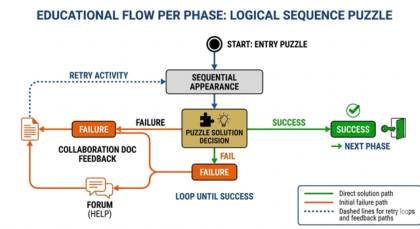
Phase Execution Logic and Recovery Scaffolding The technical implementation of each phase in Find Mr. X follows a standardized execution pattern, illustrated in Figure 1. Learners attempt a task, and the system evaluates their response against predefined phase requirements. Successful completion generates a progression code that unlocks the next phase, whereas unsuccessful attempts activate structured recovery pathways.
This design treats failure as a constructive element of the learning process. Rather than terminating the activity, unsuccessful attempts redirect learners to support mechanisms, including collaboration documents, peer feedback, forum-based discussion, and AI-assisted hints. These recovery pathways encourage learners to reflect on their reasoning, address misconceptions, and retry the task before advancing.
The execution logic is operationalized through completion criteria and support mechanisms associated with each MCIEC phase. Progression remains contingent upon task completion, ensuring that code issuance and phase transitions occur only after the corresponding requirements have
Architecting Digital Educational Escape Rooms 137 been satisfied. Figure 1 presents the generic execution cycle that governs progression across all phases of the environment. Table 2 subsequently details the completion criteria and recovery mechanisms associated with each MCIEC phase.
Find Mr. X was implemented on the Wix platform using Velo Dev Mode, enabling custom scripting, event driven behavior, and conditional navigation. To preserve the escape-room logic, the main navigation menu was restricted, while progression was managed through hidden pages, event triggers, and conditional redirection. Interface elements, tools, and navigation options are progressively revealed based on user actions, creating a sequential interaction flow aligned with the phase execution logic presented in Figure 1.
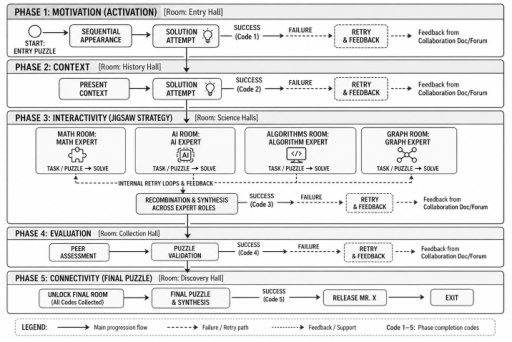
Access to subsequent stages is regulated through a code based progression mechanism. Learners enter access codes obtained through task completion, triggering validation processes that determine transitions between phases. This approach ensures that progression remains tightly coupled with task completion and preserves the intended instructional sequence. In cases of unsuccessful validation, Velo scripts redirect learners to the recovery pathways described in Table 2. The overall workflow of the environment is illustrated in Figure 2.
Figure 2: Workflow of the find Mr. X environment.
Interaction Design and Controlled Progression Learners interact with the environment through three persistent interaction anchors: a speaker, a robot, and a notebook. The speaker provides instructions associated with each room, the robot enables access to discussion spaces, and the notebook serves as a workspace for recording intermediate solutions and access codes. Together, these elements support guidance, collaboration, and information management throughout the activity. Additional elements are initially hidden and progressively revealed through visibility control mechanism based on predefined constraints. Interaction events trigger the appearance of new clues, objects, and task components, enforcing a structured interaction sequence and reducing reliance on trial and error strategies.
Role Based Collaboration and Embedded Support Collaboration is implemented through a Jigsaw structure. Learners are assigned to groups of four and take on distinct expert roles (Math, AI, Algorithm, and Graph), creating parallel but interdependent learning trajectories. The AI Expert role was responsible for validating intermediate solutions and exploring alternative solution pathways through AI-assisted reasoning activities, while the remaining expert roles focused on algebraic, procedural, and graphical representations of the problem. Recombination into the original group is required for final task completion. Access to resources and interaction spaces was regulated through visibility controls and conditional access mechanisms associated with each role, ensuring that learners engage with complementary aspects of the activity. This structure reinforces interdependence by requiring learners to exchange information across expert roles before progressing to the final synthesis phase. Learners are supported through multiple pathways, including retry mechanisms, hints, peer discussion, and embedded AI-supported guidance. These pathways provide support while preserving the structured progression of the activity.
Architecting Digital Educational Escape Rooms 139 Implementation Observations and Evaluator Perceptions
Although this study does not provide a formal experimental evaluation of student learning outcomes, observations at the system level and expert evaluation data were collected to examine operational behavior and pedagogical feasibility. System logs indicated that all participants completed the full interaction sequence, suggesting that the conditional progression and validation mechanisms supported uninterrupted navigation across stages without any structural routing errors. Regarding participant perceptions, the descriptive statistical analysis reflected a highly positive reception of the environment’s structural attributes. Participants positively evaluated the environment’s contribution to mathematical understanding and learning (M = 4.30, SD = 0.50), while the scaffolding provided through artificial intelligence was similarly perceived as effective support (M = 4.13, SD = 0.50).
DISCUSSION
The findings suggest that embedding pedagogical principles directly into the technical architecture of the environment can support a more structured and coherent learning experience. The proposed design integrates hidden navigation, conditional progression, collaboration based on learner roles, and scaffolding provided through artificial intelligence within a unified orchestration framework. Rather than functioning as independent features, these mechanisms collectively regulate learner progression, interaction, and access to support. In particular, the Jigsaw structure transforms collaboration into a requirement of the system, while artificial intelligence is positioned as a scaffolding resource that supports reasoning and reflection rather than providing direct solutions. Overall, the study supports the view that the educational value of digital escape rooms depends not only on gamification elements but also on how progression, collaboration, and support are orchestrated through the underlying system architecture.
CONCLUSION
This paper presented the design and implementation of Find Mr. X, a Digital Educational Escape Room developed on the Wix platform using Velo Dev Mode. The proposed architecture integrates guided progression, collaboration based on learner roles, embedded communication tools, and scaffolding provided through artificial intelligence within a unified orchestration framework.
The main contribution of the study is the presentation of a framework that links pedagogical affordances, technological affordances, and learner competencies within a digital educational escape room. By demonstrating how pedagogical intentions can be translated into platform functionalities and technical mechanisms, the framework provides a structured approach for designing collaborative and technology enhanced learning environments. Future work should investigate the educational impact of the proposed framework through classroom implementations involving larger populations and explore its adaptation to other disciplinary contexts and digital learning platforms.
ACKNOWLEDGMENT
This work has been partly supported by the Research Center of the University of Piraeus.
REFERENCES
Ahn, J.Y. and Edwin, A., 2018. An e-Learning Model for Teaching Mathematics on an Open Source Learning Platform. The International Review of Research in Open and Distributed Learning, 19(5). Available at: https://doi.org/10.19173/ irrodl.v19i5.3733. Aronson, E., Blaney, N., Stephan, C., Sikes, J. and Snapp, M., 1978. The jigsaw
classroom. Beverly Hills: Sage Publications. Deci, E.L. and Ryan, R.M., 1985. Intrinsic Motivation and Self-Determination in Human Behavior. New York: Plenum Press. Dillenbourg, P., 1999. Collaborative learning: Cognitive and computational
approaches. Amsterdam: Elsevier. Dillenbourg, P., 2013. Design for classroom orchestration. Computers & Education, 69, pp. 485–492. Available at: https://doi.org/10.1016/j.compedu.2013.04.013. Fotaris, P., Mastoras, T. and Lameras, P., 2023. Designing Educational Escape Rooms
With Generative AI: A Framework and ChatGPT Prompt Engineering Guide. In: Proceedings of the 17th European Conference on Games Based Learning (ECGBL 2023), Enschede, The Netherlands. Fotaris, P. and Mastoras, T., 2019. Escape Rooms for Learning: A Systematic Review.
In: Proceedings of the 13th European Conference on Games Based Learning (ECGBL 2019), Odense, Denmark, pp. 235–243. Jiménez, C., Aris, N., Magreñán, Á. and Orcos, L., 2020. Digital Escape Room, Using Genial.ly and a Breakout to Learn Algebra at Secondary Education Level in Spain. Education Sciences, 10(10), 271. Available at: https://doi.org/10.3390/ educsci10100271. Keller, J.M., 1987. Development and use of the ARCS model of instructional design.
Journal of Instructional Development, 10(3), pp. 2–10. Available at: https://doi. org/10.1007/BF02905780. Makri, A., Vlachopoulos, D. and Martina, R.A., 2021. Digital escape rooms as innovative pedagogical tools in education: A systematic literature review. Sustainability, 13(8), p. 4587. Available at: https://doi.org/10.3390/su13084587. Prieto, L.P., Dimitriadis, Y., Asensio-Pérez, J.I. and Looi, C.K., 2015. Orchestration
in learning technology research: Evaluation of a conceptual framework. Research in Learning Technology, 23. Available at: https://doi.org/10.3402/rlt.v23.28019. Stojšić, I., 2024. Possible utilization of generative artificial intelligence tools for creating digital educational escape rooms. SCIENCE International Journal, 3(1), pp. 43–47. Available at: https://doi.org/10.35120/sciencej0301043s. Sweller, J., 1988. Cognitive load during problem solving: Effects on learning.
Cognitive Science, 12(2), pp. 257–285. Available at: https://doi.org/10.1207/ s15516709cog1202_4. Veldkamp, A., van de Grint, L., Knippels, M.C.P.J. and van Joolingen, W.R.,
2020. Escape education: A systematic review on escape rooms in education. Educational Research Review, 31, 100364. Available at: https://doi.org/10.1016/ j.edurev.2020.100364. Vygotsky, L.S., 1978. Mind in Society: The Development of Higher Psychological Processes. Cambridge, MA: Harvard University Press.
Architecting Digital Educational Escape Rooms 141 Wood, D., Bruner, J.S. and Ross, G., 1976. The role of tutoring in problem solving.
Journal of Child Psychology and Psychiatry, 17(2), pp. 89–100. Available at: https://doi.org/10.1111/j.1469-7610.1976.tb00381.x. Zhai, X. and Krajcik, J., 2024. Artificial Intelligence-Based STEM Education. In: Zhai, X. and Krajcik, J. (eds.) Uses of Artificial Intelligence in STEM Education. Oxford: Oxford University Press, pp. 3–14. Available at: https://doi.org/10.1093/ oso/9780198882077.003.0001.
SEARCH THE AHFE DIGITAL BOOKSTORE BY ISBN
Explore the complete digital volume
Human Interaction and Emerging Technologies (IHIET 2026)
Read this individual research paper free through the original publisher, or explore the full digital proceedings book.