Vasiliki Karampa, Foteini Paraskeva (2024). Team Effectiveness of Higher Education Students through Project-based and Agile Education for Sustainable Development. In: Human Interaction and Emerging Technologies (IHIET-AI 2024): Artificial Intelligence and Future Applications. AHFE Open Access, vol. 120, pp. 47–55. https://doi.org/10.54941/ahfe1004554
Agile methodologies derived from software development are today successfully applied in educational contexts as they provide a robust description of process workflows in team-based learning. It appears that the Agile Scrum model enhances team effectiveness, particularly focusing on teamwork and team interaction, which indicate effective collaboration. Agile methodologies further help learners develop sustainability competences because they reflect the current fast-paced and dynamically changing processes of our world. As Higher Education (HE) students are at the threshold of their careers, it is essential to strengthen soft skills beyond their academic subject. On these grounds, this study attempts to evaluate team effectiveness through the participation of 63 higher education students in an e-course, designed and developed according to the processes of the Scrum model appropriately embedded in Project-Based Learning (PjBL). Students were divided into small teams to provide sustainable smart solutions for their city, contributing to UNESCO's Global Goal 11 for Sustainable Development. Team effectiveness was assessed employing the "Big Five" framework. A questionnaire of 18 questions (Likert scale 1-5) was distributed to the students after the processes of the Agile Scrum. Initial results appear to be encouraging and motivating for authors to conduct further research.
In today’s fast-paced society, Education for Sustainable Development (ESD) requires modern and innovative pedagogical methodologies – smart peda- gogies – that facilitate the transfer of skills to learners and the development of sustainability competencies (López-Alcarria et al., 2019). Throughout the years, several sustainability competence frameworks have been proposed, including interpersonal and collaborative competencies (i.e., Brundiers et al., 2021; Wiek, Withycombe, and Redman, 2011; Wiek et al., 2014 etc.). It is particularly important for students in Higher Education (HE) to develop such competencies, since their future careers will likely include a variety of posi- tions requiring effective written and oral communication (i.e., active listening, inquiry, negotiation, positive feedback), a variety of types of collaboration,
including teamwork, cross-cultural collaboration, and stakeholder engage- ment especially in sustainability efforts (Wiek et al., 2015). Graduates with interpersonal competence can manage projects, be leaders to motivate and assist coworkers, resolve conflicts, and face challenges related even with sustainability issues (Cörvers et al., 2016).
This can be achieved with both Project-Based Learning (PjBL) and Agile methodologies in ESD. Research has shown that PjBL not only addresses real-world sustainability problems (Wiek et al., 2014) but also fosters this educational innovation by transforming learning environments into learner- centered, experiential, interactive, situated and social (Cörvers et al., 2016). PjBL fosters interpersonal, collaborative, and social skills (i.e., Chen and Yang, 2019; Guo et al., 2020; Kokotsaki, Menzies and Wiggins, 2016 etc.). At the same time, Agile methodologies and the Scrum model in particular, are considered suitable in HE because most university degrees are geared towards creating a product or service and Scrum facilitates the deployment of a creative and innovative learning environment. Additionally, most courses require team-based work, which is monitored and assessed by the Scrum team continually as the project progresses (López-Alcarria et al., 2019). Team effectiveness primarily stems from the internal interaction of team processes and teamwork, to achieve a team performance. More specifically, it refers to the results of the team’s efforts and is an indicator of the effectiveness of the applied pedagogical methodologies to students’ ESD. By following the processes of PjBL and Scrum, this paper aims to investigate the team effec- tiveness of the Agile teams in HE, as they construct products, namely smart solutions for sustainable cities. To draw conclusions, a brief theoretical back- ground, including design principles of PjBL and the Agile Scrum, is presented. Then, a description of the method, involving ESD in HE, follows. Finally, the evaluation of team effectiveness using the “Big Five”framework is delineated.
The idea of PjBL emerged as an educational practice that encourages stu- dents to become the center of the learning process. It was first inspired by Kilpatrick’s “project method” as well as Dewey’s “learning by doing” theory and later influenced by Papert’s constructionism theory, based on Piaget’s constructivist conceptualizations. Through collaborative work, which requires students’ engagement in tasks related to their own lives and experiences at their own pace, the latter can learn and solve problems as a community. This is what makes PjBL an innovative and effective way to teach and learn, resulting not only in content knowledge but also in deeper learning and skill development (Condliffe et al., 2017).
There are several common features, criteria, or design principles associ- ated with PjBL that have been described in the international literature (Han and Bhattacharya, 2001; Larmer and Mergendoller, 2015; Mergendoller and Thomas, 2005; Thomas, 2000) and can be summarized as follows: First, there is a significant degree of student autonomy and involvement in the projects. As students take ownership of the project and are held responsible
Team Effectiveness of Higher Education Students 49
for their own learning, they become more involved in decision-making and problem-solving (students’ voice and choice). This leads to a more learner- centered environment. The second is that projects are central, not peripheral, in the curriculum, so students are able to encounter the central principles and concepts of the discipline through projects. Moreover, curricular content integration requires standards, clearly defined goals, and support and demon- stration of content learning in both process and product. Third, the learning tasks are authentic, the projects are realistic, and the products are composed of artifacts, if not tangible, then certainly digital. Authenticity means that since projects address real world issues, students can make links with the world outside the learning environment, such as professionals and experts. Furthermore, students seek to successfully complete their project, make it publicly available, and receive community acknowledgement for their effort. To accomplish this goal, they participate in scientific practices, conducting a constructive inquiry driven by a “challenging question or a complex and open-ended meaningful problem” and effectively use various technologies in preparing, developing, or presenting their projects. The fifth design principle PjBL is based on encompasses project management, including time manage- ment, since projects often extend over a time (several days, weeks, or months). Therefore, students need to work towards deadlines. Prior to finalizing work, these deadlines can be used to solicit feedback. The sixth is collaboration. Stu- dent researchers work together in teams, able to empower collaborative skills, including group decision-making, interdependence, integrating and providing thoughtful peer feedback. Finally, authentic assessment is about continuously documenting students’ learning using a variety of methods, forms, and types, including self-assessment, peer assessment, teacher assessment, and reflection on both process and product. To this end, it is essential to provide cycles of work with ongoing assessment, feedback, and reflection.
Agile Methodologies – The Scrum Model Agile methodologies emerged as a solution to the problem of excessive plan- ning and documentation in software development projects, contrary to the satisfaction customers should receive (Beck et al., 2001). Despite its popular- ity in software development, agile has expanded to other fields like education, thanks to high success rates compared with waterfall linear-process projects (López-Alcarria et al., 2019). The constructivist roots of agile education are evident in its principles including meaningful team-based learning. Teams are adjustable, self-organized and reflect on how to become more effective.
Considering the design principles of PjBL mentioned in the previous section, Agile – especially the Scrum Model – could enhance the pro- cesses of PjBL (Dinis-Carvalho et al., 2019). Scrum employs collaborative, autonomous, and short iterative fixed-length work cycles – the Sprints – of planning, action, correction, and adjustment to produce value-added improvements (López-Alcarria et al., 2019). Scrum teams, the fundamental unit of Scrum, have specific roles but no hierarchies or sub-teams. A Scrum master guides the team and ensures that the processes are followed. A product owner is responsible for the product. He comprehends the requirements of
50 Vasiliki and Foteini
the project and set the priorities. Dev-team (Development team) includes all those job titles who develop the project. Therefore, a Scrum team is a group of professionals working together on one specific objective at a time and their responsibilities include stakeholder collaboration, verification, mainte- nance, operation, experimentation, and research (Schwaber and Sutherland, 2022). During the project, the Scrum team conducts a series of meetings – the ceremonies – to exchange ideas in order to develop products that meet vari- able requirements, while they receive feedback after timely and continuous delivery of these products.
METHOD
Research Question Using the PjBL and Agile Scrum processes, the following research question was formulated to examine their impact on ESD: Is there a statistically signif- icant impact of PjBL processes, enhanced by Agile Scrum processes, on team effectiveness when teams construct a sustainable city project? To address the research question, a conceptual framework was first orchestrated. Then, in line with this orchestration, an e-course was developed and delivered to 63 HE ICT students. Finally, team effectiveness was evaluated by using the “Big Five” framework, as an index for the impact of PjBL, enhanced by the agile Scrum processes. The procedure is outlined in the sections to follow.
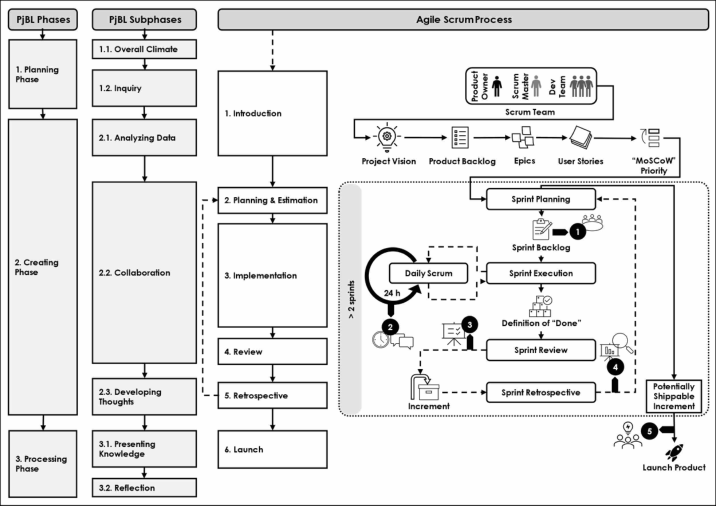
Conceptual Framework Orchestration With PjBL and Agile Scrum A project is the culmination of a series of activities conducted by students throughout an organized process (Du and Han, 2016). However, a project is a complex task based on challenging questions that drives activities, which combined amount to a meaningful result (Brown and Campione, 1994; Thomas, Mergendoller and Michaelson, 1999). PjBL has been defined by several researchers (i.e., Korkmaz and Kaptan, 2001) as a series of different linear steps or stages, but all agree that the process consists of the follow- ing common phases: project assignment, planning, investigation, design and development, presentation, and evaluation. This study presents a conceptual framework orchestration based on Han and Bhattacharya’s teaching method (2001). According to their proposed PjBL processes, Scrum processes are embedded appropriately (Figure 1).
During the “Planning” phase two sub-phases can be identified. The first subphase of the “Overall Climate”, ensures that all conditions for inquiry, challenge and collaboration are in place. Real-world connections need to be established, and students are provided with the course syllabus. In the second subphase of “Inquiry”, students select themes and topics, share resources, research, and investigate. Scrum processes are introduced in this subphase, including the configuration of the Scrum team and the assignment of the Scrum roles (1. Introduction). After investigation, a business proposal, and a strategic plan take place to provide the project vision. This occurs in the PjBL phase of “Creating”. “Data Analysis”, the first subphase of the process, involves the analysis of the collected data. Therefore, project specifications
Team Effectiveness of Higher Education Students 51
and requirements are agreed, and a product backlog is compiled. In a prod- uct backlog, User Stories describe customer-requested functionalities and are grouped into Epics, which refer to greater volumes of work. Furthermore, a priority system i.e., MoSCoW, for user stories and a product progress map are established. A set of sprints (usually more than two) are used to facili- tate collaborative processes of the team, creating artifacts, assembling them, and constructing the final product. Sprints are adapted to the second and third PjBL subphases of “Collaboration”and “Developing Thoughts”respec- tively. Four distinct processes are followed by the Scrum team in every sprint: Planning and estimation, Implementation, Review, and Retrospective. At the beginning of each sprint (Planning and Estimation), the team reprioritizes and updates the Sprint Backlog of identified tasks as well as estimates the required effort, holding a sprint planning meeting (Index1). Next comes sprint exe- cution (Implementation), in which the product artifacts are gradually built until the “done” condition is met. As part of the sprint execution process, the team meets daily for a Scrum to discuss work progress and potential obstacles (Index2).
Figure 1: Conceptual framework orchestration with PjBL and Agile Scrum.
In the sprint review (Review), the Scrum team reveals the accomplish- ments, namely what backlog items have been completed and what product increments are possible, receiving feedback from the instructors (Index3). As a final process, the sprint retrospective (Retrospective) allows the team to review dynamics, processes, and tools, as well as develop plans for improve- ment (Index4). Prior to launching the product, the team holds a final meeting to review and evaluate it in total (Index5). In the third phase of PjBL, the
52 Vasiliki and Foteini
“Processing Phase”, the product is launched at the subphase of “Presenting Knowledge”, and the student reflections on the entire process are conducted through different types of evaluations (e.g., peer evaluations, self-evaluations etc.) in the last subphase of “Reflection”.
E-Course Development for ESD Considering the orchestration of the conceptual framework, an e-course related to Teaching Methods was developed on the Moodle platform and delivered to 63 ICT undergraduates. After completing the e-course, students would be able to: describe PjBL and Agile Scrum principles and processes; apply PjBL and Agile Scrum to collaborate on a sustainable city project; develop a product solution in the form of a mock-up mobile app for sus- tainable cities; present their product to peers and disseminate the venture to the public through an educational video; provide documentation for their delivered product; continuously evaluate individual and team progress and reflect on processes and delivered products. The e-course utilized a case study where students were invited by the university’s liaison office to work in their municipality as part of an internship, proposing and designing mobile apps for the sustainability of their city. Additionally, on the premises that their business ideas were deemed feasible and innovative, the municipality would implement them, and the project teams would be invited to participate in an inter-university start-up entrepreneurship competition. The 63 students who participated in the semester-long e-course, formed 23 teams of 2–3 members, followed the PjBL and Agile Scrum processes, and after running two sprints (alternating roles in every sprint) they delivered, presented, and evaluated 23 well-structured solutions (i.e., apps for smart parking, smart shelters for homeless, smart and green parks, smart transportation for energy saving and zero carbon footprint, smart recycle bins and garbage management systems etc).
Team Effectiveness Evaluation Based on the “Big Five” Framework In 2005, Salas, Sims and Burke articulated a framework acknowledged as the “Big Five” due to the five core components of teamwork. Based on studies of “Big Five” components addressed in Scrum (Moe and Dingsøyr, 2008; Moe, Dingsøyr and Røyrvik, 2009), an improvised 18-question survey (Likert scale 1-5, where 1 = Strongly Disagree, 2 = Disagree, 3 = Neutral, 4 = Agree, 5 = Strongly Agree) was developed and distributed to the students after the Scrum process was completed.
To answer the research question, IBM SPSS (version 27.0.1) was used to conduct statistical tests for team effectiveness based on the following factors: Shared Leadership involves creating and preserving a shared mental model, transferring authority according to key skills, knowledge, abilities, and shar- ing decision-making responsibilities (mean = 3,944444, St.D. = 0,412615); Team Orientation is the propensity to take other members’ behaviour into consideration during team interactions with team goals being prioritized over individual ones (mean = 4,281746, St.D. = 0,441067); Redundancy often described as backup behaviour, is the cross-functional approach that prevents
Team Effectiveness of Higher Education Students 53
bottlenecks, enables workloads to be shifted, and facilitates mutual assis- tance (mean = 3,761905, St.D. = 0,456646); Learning is needed for teams to develop shared mental models. To enhance team performance, norms, rules, and actions can be adapted (adaptability) as the broader environment changes through learning (mean = 4,380952, St.D. = 0,621759); and Auton- omy is the team’s ability to control the boundary conditions and the influence of other individuals (outside the team) on its performance (mean = 3,719577, St.D. = 0,634171).
Table 1. Statistical tests for team effectiveness (one sample t-test).
Table available in the original PDF paper.
Team Effectiveness t df Sig. (2-tailed) Mean Difference
95% Confidence Interval of the Difference Lower Upper
The p-values of the t-tests are presented in Table 1. All the mean values are greater than the test value 3, which is the mean value of 5-scale while p-values (sig) are lower than 0,05. According to the t-test, all p-values indi- cate a statistically significant impact of PjBL processes, enhanced by Agile Scrum processes on all team effectiveness components, as well as on the team effectiveness individually, answering the research question.
CONCLUSION
Team Orientation as well as Learning indicated very high mean values (greater than 4), followed by shared leadership, redundancy, and autonomy. Through planning (including sprint planning and daily scrum), as well as ret- rospective meetings, team vision and goals managed by the Product Owner, Scrum fostered team orientation and team consensus. While team members made commitments that fit their needs, the whole team was responsible for the final product (Moe and Dingsøyr, 2008).
In this study, besides, instructors rewarded teams’ efforts for completing projects successfully and on time (delivery, documentation, and presenta- tion), indicating a public recognition. Learning was also considered essential by teams to promote self-optimization through frequent feedback loops and replanning (review and retrospective meetings). This process encour- aged team to cope with uncertainty, reflect and improve both the project and the process and thus confirmed the agility of Scrum (Moe, Dingsøyr and Røyrvik, 2009). As project managers, Scrum masters make decisions, solve problems removing impediments, and facilitate shared leadership, while
54 Vasiliki and Foteini
redundancy indicates the self-organizing feature of Scrum teams; due to members’ alternating roles in every sprint, this became apparent.
Regarding autonomy, it had no significant influence on operational deci- sions, despite the feedback provided by instructors and other teams. In this study, the PjBL design principles were indirectly confirmed (e.g., learner- centeredness, project-management, authentic assessment), mainly highlight- ing the collaborative process enhanced by Scrum. However, the authenticity, was served by the authentic case-study, which was related to students’ lives and goals with regards to their future careers. At the same time, the authentic case-study was extended to interdisciplinary content (sustainable develop- ment, teaching methods and ICT content) and was a starting point for students to get involved in PjBL and Scrum processes as well as to proceed in well-structured sustainable solutions for their city.
In the present study, modern and innovative pedagogies, namely smart pedagogies were used to enhance team effectiveness, providing promising evidence for ESD and the development of relative competencies in HE such as collaborative and interpersonal competencies. Smart pedagogies are the future of 21st century education and as such they require further and more thorough investigation.
ACKNOWLEDGMENT
This work has been partly supported by the Research Center of the University of Piraeus.
REFERENCES
Beck, K., Beedle, M., Van Bennekum, A., Cockburn, A., Cunningham, W., Fowler, M., Grenning, J., Highsmith, J., Hunt, A., Jeffries, R. and Kern, J., 2001. Manifesto for agile software development. Brown, A. L. and Campione, J. C., 1994. Guided discovery in a community of
learners. The MIT Press. Brundiers, K., Barth, M., Cebrián, G., Cohen, M., Diaz, L., Doucette-Remington, S., Dripps, W., Habron, G., Harré, N., Jarchow, M. and Losch, K., 2021. Key com- petencies in sustainability in higher education—toward an agreed-upon reference framework. Sustainability Science, 16, pp. 13–29. Chen, C. H. and Yang, Y. C., 2019. Revisiting the effects of project-based learning on
students’ academic achievement: A meta-analysis investigating moderators. Edu- cational Research Review, 26, pp. 71–81. Condliffe, B., Quint, J., Visher, M. G., Bangser, M. R., Drohojowska, S., Saco, L., Nelson, E., 2017. Project-Based Learning: a literature review. Working Paper.New York. Oaklandd. MDRC. Cörvers, R., Wiek, A., de Kraker, J., Lang, D. J. and Martens, P., 2016. Problem-based
and project-based learning for sustainable development. Sustainability Science: An Introduction, pp. 349–358. Du, X. and Han, J., 2016. A literature review on the definition and process of Project- Based Learning and other relative studies. Creative Education, 7(07), p.1079. Dinis-Carvalho, J., Ferreira, A., Barbosa, C., Lopes, C., Macedo, H. and Tereso, P.,
2019. Effectiveness of Scrum in project based learning: Students view. In Innova- tion, engineering and entrepreneurship (pp. 1118–1124). Springer International Publishing.
Team Effectiveness of Higher Education Students 55
Guo, P., Saab, N., Post, L. S. and Admiraal, W., 2020. A review of project-based learning in higher education: Student outcomes and measures. International journal of educational research, 102, p. 101586. Han, S. and Bhattacharya, K., 2001. Constructionism, learning by design, and project
based learning. Emerging perspectives on learning, teaching, and technology, pp. 127–141. Korkmaz, H. and Kaptan, F., 2001. Fen e˘gitiminde proje tabanlı ö˘grenme yakla¸sımı. Hacettepe Üniversitesi E˘gitim Fakültesi Dergisi, 20(20). López-Alcarria, A., Olivares-Vicente, A. and Poza-Vilches, F., 2019. A systematic review of the use of agile methodologies in education to foster sustainability competencies. Sustainability, 11(10), p. 2915. Mergendoller, J. R. and Thomas, J. W., 2005. Managing project based learning:
Principles from the field. California: Buck Institute for Education. Moe, N. B., and Dingsøyr, T., 2008. Scrum and team effectiveness: Theory and practice. In Agile Processes in Software Engineering and Extreme Programming: 9th International Conference, XP 2008, Limerick, Ireland, June 10–14, 2008. Proceedings 9, Springer Berlin Heidelberg, pp. 11–20. Moe, N. B., Dingsøyr, T. and Røyrvik, E. A., 2009. Putting agile teamwork to the test–
an preliminary instrument for empirically assessing and improving agile software development. In Agile Processes in Software Engineering and Extreme Program- ming: 10th International Conference, XP 2009, Pula, Sardinia, Italy, May 25–29, 2009. Proceedings 10 (pp. 114–123). Springer Berlin Heidelberg. Kokotsaki, D., Menzies, V. and Wiggins, A., 2016. Project-based learning: A review of the literature. Improving schools, 19(3), pp. 267–277. Larmer, J. and Mergendoller, J., 2015. Why we changed our model of the “8 Essential
Elements of PBL”. Buck Institute for Education, 1, pp. 1–3. Salas, E., Sims, D. E. and Burke, C. S., 2005. Is there a “big five”in teamwork?. Small group research, 36(5), pp. 555–599. Schwaber, K. and Sutherland, J., 2022. The Scrum Guide, The Definitive Guide to
Scrum: The Rules of the Game, November 2020. Thomas, J. W., 2000. A review of research on project-based learning. San Rafael, CA.
The Autodesk Foundation. Thomas, J. W., Mergendoller, J. R. and Michaelson, A., 1999. Project based learning: A handbook for middle and high school teachers. Buck Institute for Education. Wiek, A., Withycombe, L. and Redman, C. L., 2011. Key competencies in sustain-
ability: A reference framework for academic program development. Sustainability science, 6, pp. 203–218. Wiek, A., Xiong, A., Brundiers, K. and Van der Leeuw, S., 2014. Integrating problem-and project-based learning into sustainability programs: A case study on the School of Sustainability at Arizona State University. International Journal of Sustainability in Higher Education, 15(4), pp. 431–449. Wiek, A., Bernstein, M. J., Foley, R. W., Cohen, M., Forrest, N., Kuzdas, C., Kay,
B. and Keeler, L. W., 2015. Operationalising competencies in higher education for sustainable development. In Routledge handbook of higher education for sustainable development (pp. 241–260). Routledge.
LISTED IN THE AHFE DIGITAL BOOKSTORE CATALOGUE
Explore the complete digital volume
Human Interaction and Emerging Technologies (IHIET-AI 2024): Artificial Intelligence and Future Applications
Read this individual research paper free through the original publisher, or explore the full digital proceedings book.
ISBN 978-1-958651-96-4
Explore this ISBN in the AHFE Bookstore ↗Listed in the July 2026 bookstore catalogue; search by ISBN to confirm current availability · Digital book purchase optional