Foteini Paraskeva, Eleni Neofotistou (2024). Digital creativity and problem-solving in higher engineering education: Developing an e-course using the educational affordances of STEAM methodology. In: Human Interaction and Emerging Technologies (IHIET-AI 2024): Artificial Intelligence and Future Applications. AHFE Open Access, vol. 120, pp. 370–379. https://doi.org/10.54941/ahfe1004588
STEAM methodology has been proven effective in combining different learning topics in inter-disciplinary teaching approaches, to achieve better learning results. It appeals to the contemporary world’s demands by preparing tomorrow citizens in terms of job efficacy and 21st century skills. Especially, students with high engineering expertise need to develop core skills, including problem-solving, information processing, collaboration and communication skills, and engagement in life-long learning perspectives, embedded in current social and economic circumstances. To do so, inter-disciplinary education which -among others- blends science and humanitarian studies, and creativity development explored in technology-enhanced learning environments, are found to be of great importance. In this direction, we developed a web-based educational framework appealing to engineering students’ needs in higher education. In this study, it is explored how STEAM methodology bridges the desired educational standards to 21st century skills and consecutively it is proved that students’ involvement in a properly designed STEAM problem-solving instructional scenario affects positively their creative thinking skills. Through the experimental design, students elaborated on the factors that structure creativity, such as imagination, self-esteem, experimentation, implementation, and communication throughout their engagement in the creative problem-solving process in a STEAM methodology framework, called “STEAMapT2theGalaxy”.
Creativity and problem-solving are vital skills for anyone in modern soci- ety, regarding academic and professional fields (Martz et al., 2017 & Ashgar and Prime, 2012). Creativity is most of the times related to problem-solving, as it reflects the multi-dimensional nature of the process and is related to the experimental and inquiring procedure rather than to the invention of one unique solution (P21 Framework, 2015). These demands require a set of skills that lead to developing creative, cross-disciplinary, multiple, and
Digital Creativity and Problem-Solving in Higher Engineering Education 371
adaptive solutions, that could not be achieved by traditional, based on facts education (Madden et al., 2013). This range of skills should be combined to fostering responsibility in learning and then scaffolding continuous profes- sional development, as engineering studies may prepare students for various careers, including academic, law, business, even medicine (Ulsoy, 2005).
Consequently, it is important to select and orchestrate suitable methodolo- gies to meet these requirements. Relevant research has shown that instruc- tional approaches based on STEM methodology enhance technology literacy that leads to economic development (Croak, 2018) while improving the learning experience itself (Ashgar and Prime, 2012). These benefits, of course, could be obtained only if such methodologies get embedded in all educa- tional levels, ranging from under-graduate classes to university (Fortenberry, 1996 & Brown, 2012). Higher education has to re-invent rational thinking, information processing, collaboration, communication, flexibility in learn- ing, problem-solving and creativity skills, along with individual initiative and aptitudes, as it is shown in common cores worldwide (Tytler et al., 2008 & Balakrishnan, 2014).
The nature of the engineering science itself makes it necessary to prefer such approaches and as a result to examine them and their affordances further (Pecanin et al., 2019). STEAM approaches place emphasis on science and mathematics, as well as on design, arts, and social studies. This is since arts and design motivate the modern economy as science did until recently (STEM to STEAM, 2016). On the contrary, strict technocratic education could make these advantages to fade. Adding the “A”in STEAM methodology means that linguistics, fine arts, social studies, physical arts, even music and dancing are included in the newly designed approaches (Sanders, 2009 & Bybee, 2010). Arts’ integration fosters the operational connection between the initial STEM subjects and broadens and strengthens the relation to everyday challenges and problems (Yakman, 2012).
Creativity elements could be attached to fields such as science or technol- ogy, while the connection between technology, arts, and social studies is as important as the one between technology and science, even if it is not always detected in everyday practice (Williams, 2009). Recent research in engi- neering education indicates the importance of finding the balance between humanities and science without disregarding technology (Godfroy, 2012), while enabling the development of students’ innovative thinking (Pecanin et al., 2019). This reasoning suits the idea that creative and rational or practical thinking are not to be separated (Daugherty, 2013 & Henriksen, 2014). Considering all the above, it is obvious that there is an urgent need for well-designed educational frameworks that promote creativity and corre- spond to current standards towards engineering studies, 21st century skills and life-long learning. As there is no standard reference work for com- puter science education in the above fields, it is necessary to explore which instructional approach would be effective in supporting higher engineer- ing education in this context. To do so, an e-course was created, enti- tled “STEAMapT2theGalaxy”. It is orchestrated by the principles of the “Creative Problem-Solving” (Treffinger, 1995) theory accompanied by the
372 Foteini and Eleni
“6 Thinking Hats” (de Bono, 1989) strategy. STEAM methodology affor- dances, related to creativity enhancement in terms of engineering studies, that are underlined and utilized by the sequencing of the tasks included, prove that it is the proper methodology to guide this training.
THEORETICAL BACKGROUND Modern research merges creativity with divergent thinking, as it is about pro- ducing many multiple solutions to a specific problem, through interpreting and analysing the collected information in unexpected or innovative ways (Walczyk et al., 2008). In addition to this reasoning, there is Herrmann’s theory that has already underlined the need for a flexible transition from divergent to convergent thinking when it comes to selecting the proper solu- tion to the specific situation being examined (Herrmann, 1995). By proposing this framework, it is necessary to explore how creativity is thoroughly con- nected to the arts in general, as STEAM methodology claims. On the one hand, this could be easily explained by examining the major artistic person- alities throughout humanity who defined the term “creativity” as the ability to produce and present something completely new, that could motivate think- ing (e.g. major art movements) or provide new affordances in a specific field (e.g. innovative inventions). This perspective derives from the idea of “homo universalis” that motivated thinking through a significant period.
Combining the above, throughout the whole e-course, creativity is directly connected to five (5) main factors that have been proven to be of significant value when creativity enhancement is considered: imagination, self-esteem, experimentation, implementation, and communication. These thinking dis- positions and habits are connected to specific reasoning prototypes that scaffold creativity (Kaufman et al., 2012). First, imagination is a necessary skill in order, someone, to manage to think out of the box and figure out new ways to deal with a specific problem or situation. In this attempt, self- confidence gives the power to adapt to change and face any difficulties that occur. When someone has a positive attitude towards the above, familiarizes with the experimental process and tries out many new solutions that pos- sibly suit the circumstances. The final selection should be among complete products that would propose instant solutions, otherwise, the experimen- tal process is still on. Finally, as Amabile underlines, creativity may be an individual or collaborative process towards innovation (Amabile, 1988), so communication skills are crucial. If the whole procedure is delivered on- line and the creativity factors mentioned are scaffolded through e-learning instructional paths, the creativity could be described as digital.
The Creative Problem-Solving Model Problem-based learning is a commonly used instructional approach that has already been used widely in K-12 education, business fields and STEM (Martz et al., 2017). In engineering education problem-based learning has risen as the basis of creating inclusive learning experiences that prepare students to deal with real world problems, where innovative thinking and collaboration are crucial competencies (Samavedham and Ragupathi 2012 & Batanero et al.,
Digital Creativity and Problem-Solving in Higher Engineering Education 373
2017). The key to this process is the group of learners to prepare or identify the problem and its general context, to handle properly the relevant environ- ment, where learning takes place. As a result, the learner has the chance to utilize his own experience and prior knowledge and learn the proper tools and techniques to master the new skills (Martz et al., 2017).
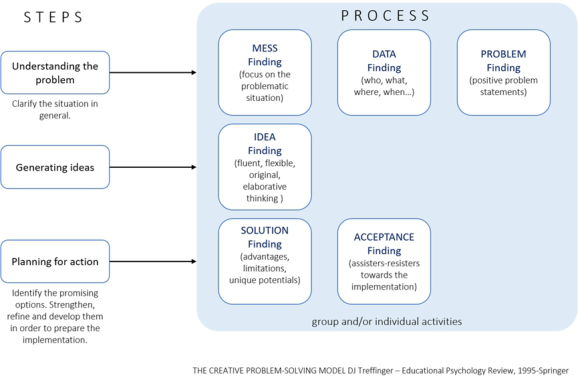
The analysis of this whole procedure, according to Treffinger, involves three (3) consecutive levels [44]: the familiarization with specific problem- solving prototypes and tools, the systematic problem identification and processing, the dealing with real-world problems.
Figure 1: The creative problem-solving model by Treffinger, 1985.
The second level is the one connected to creativity as it includes the inquiry process that leads to innovative and creative thinking. This process is described in the Creative Problem-Solving model (Isaksen and Treffinger, 1985). This model combines the individual interpretation of the problem to group work when needed. The problem processing is flexible, as the phases described above do not follow a strict linear sequence.
THE METHODOLOGY The Research Framework
In this paper, STEAM methodology was considered appropriate, because it provided the opportunity to combine the practical needs mentioned to devel- oping creativity skills. Students familiarize with the initial STEM method- ology to understand its deficiencies and move on to STEAM, as a way to correspond to contemporary educational challenges in general.
To explore creativity enhancement in STEAM educational fields, an e-learning course for engineering students was designed. The instructional design developed in this e-course is delivered through “STEAMapT2the Galaxy” site and aims to familiarize participants with STEAM methodology through interactive and collaborative activities that would develop their cre- ative thinking as well. A problem-solving pattern is followed, because it suits
374 Foteini and Eleni
to creative thinking as explained above and, also, it ensures the connection to participants’ everyday practice and interests.
The research that was conducted was driven by the following ques- tion: How effective is the designed educational scenario based on “Creative Problem-Solving” methodology in correlation with the integrating “6 Think- ing Hats” activities on students’ creative thinking? Data analysis was facili- tated by dividing the previous research question into five (5) sub-questions, each of them representing a specific aspect of creative attitude. So, the data collected were used to explore whether imagination, self-esteem that is enhanced by the new ideas’ production, experimentation towards the new product, instant practical implementation of the product and communication are considered important in developing creative thinking by the trainees.
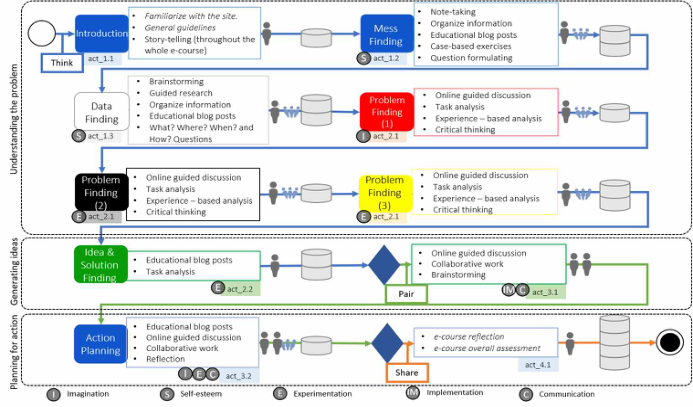
Even if the linear sequence of the model’s phases is not mandatory, in the e- course “STEAMapT2theGalaxy”a specific path is followed, to ensure that all participants familiarize with the methodology and pass through all the activ- ities included, to successfully graduate. The attendance is enabled by the “6 Thinking Hats” problem-solving technique (de Bono, 1989 & Walter, 1996) and get enriched by a storyline about discovering STEAM methodology through an imaginary space journey. Also, to facilitate collaboration, “Think- Pair-Share” (Mundelsee and Jurkowski, 2021) strategy is used to enable par- ticipants to switch from individual to pair and group activities, as instructed by the scenario. Students could interact with each other and with the lecturer to exchange information and build knowledge together before collaborat- ing systematically throughout the activities (Balakrishnan, 2014). In other words, all the uploaded course material acquires meaning through group exploration, interpretation and peer-feedback provided, via synchronous and asynchronous means of communication (Violante and Vezzetti, 2012).
Figure 2: The macro-scenario by the computer-supported collaborative learning principles.
Digital Creativity and Problem-Solving in Higher Engineering Education 375
Each phase is combined with a coloured hat and is presented as a different travel chapter. The variety in hats’ colours portrays the different conceptual meaning that each hat holds, while the sequence followed (Blue – White – Red – Black – Yellow – Green – Blue) is the more suitable when it comes to problem-solving frameworks (Aithal and Suresh Kumar, 2017). The e-course design process was because the index of each phase matches the thinking paradigms proposed by each hat. So, by using the “6 Thinking Hats”, par- ticipants could understand the thinking dispositions activated in each phase in a more descriptive way (Marwa et al., 2020), and as a result, they get more easily familiar with the “Creative Problem-Solving” model in gen- eral. Besides, they all follow the designed path, changing from one chapter (phase/hat) to the next one facing similar deadlines, to facilitate collaboration and make sure they elaborate on each thinking paradigm during the problem exploration (Aithal and Suresh Kumar, 2017).
The Creativity Potential Throughout the whole e-course, creativity is the main skill being explored along with some other cognitive factors. Creativity, in fact, could be taught as any other skill, by orchestrating proper instructional approaches (Villalba, 2008 & Dehaan, 2009). Initially, the “Creative Problem-solving” model is the one that is proposed in general when it comes to creativity enhance- ment as it combines individual and group work to inventing new ways to see things. Moreover, collaboration is necessary for most of the activities. Open-ended and collaborative tasks are included to provide a construc- tive learning environment where new conceptions, skills and creativity are supported (Conradty and Bogner, 2018).
Creativity is scaffolded in the designed workflow, supported by the creativ- ity factors defined (Tsai et al., 2015). As a result, in the whole instructional design, specific affordances towards creativity enhancement can be detected. To be more specific, imagination is crucial, as trainees were assigned to create a whole new scenario using STEAM methodology, to think of an innovative and holistic approach to teach a subject of their choice. As they work on their projects, they get instant feedback throughout the whole course, via the instructor and their colleagues, so their self-esteem is developed. Exper- imental process is included, as they re-consider their thoughts or products individually or in pairs. The final product of the course is a lesson plan inte- grating STEAM methodology, which is asked to be fully aligned to trainees’ interests and needs, so they are motivated to prepare and implement it. Col- laboration is present in every part of the course, whether it is among the whole group via the e-learning platform or in pairs in the team activities.
Findings In the research that was conducted participated 85 students from the Depart- ment of Digital Systems in the University of Piraeus. The students were both pre-graduate and post-graduate and had attended relevant computer science and technology lessons. Both teams attended the lesson online, through the educational site “STEAMapT2theGalaxy”. The participants were asked to
376 Foteini and Eleni
answer a questionnaire about creative attitude before starting the course and one after they had completed it. The questionnaires were embedded in the educational site, as any other material needed for the course. The questionnaire included all the factors influencing creativity development that were mentioned. The main reasoning was to explore how students would transform their beliefs towards creativity and be able to notice the factors that affect its enhancement in their one practice. Students’ responses were collected and analyzed through detailed statistical process.
To decide on how their creative attitude was affected in general, the attributes on pre-test and post-test were compared using a T-test on inde- pendent samples. By reviewing the test’s results (see Table 1), it is directly assumed that in most of the cases the difference detected is statistically impor- tant. Trainees assessed their creative thinking as improved and developed after completing the e-course. So, the instructed scenario gave them the chance to exercise new skills and tools while inventing unexpected ways to deal with the STEM problem they selected.
Table 1. Average values and deviation PRE TEST – POST TEST regarding the creative attitudes.
Table available in the original PDF paper.
Creativity Factors Mean N Std. Deviation Pair 1 Imagination PRE 4,31 85 ,655 Imagination POST 4,48 85 ,503 Pair 2 Self-esteem PRE 4,14 83 ,899 Self-esteem POST 4,28 83 ,650 Pair 3 Experimentation PRE 4,40 83 ,715 Experimentation POST 4,37 83 ,693 Pair 4 Implementation PRE 4,16 83 ,773 Implementation POST 4,37 83 ,578 Pair 5 Communication PRE 4,37 84 ,861 Communication POST 4,61 84 ,621
The average values of the factors affecting creativity were analysed further (see Table 2). As far as imagination, implementation and communication are concerned, there was a significant statistical divergence (sig < 0, 5) between pre-test and post-test, so it is clearly shown that participants valued as more important these factors for creative and innovative thinking development than they used to believe. Regarding self-esteem and experimentation, par- ticipants’ views were slightly transformed, as these factors got a high rating already in the pre-test. In any case, it is common sense that to invent some- thing new or solve a problem, try-and-error process, as well as persistence and faith, are vital.
Finally, participants managed to understand what creative thinking is about and monitor their own practice throughout the e-course’s activities to spot these factors and connect them to creativity. It is expected that, from now on, participants will be able to exercise on these practices and develop their creative attitude even more in their fields of expertise.
Digital Creativity and Problem-Solving in Higher Engineering Education 377
Table 2. Compare average values PRE TEST – POST TEST regarding the creative attitudes.
Table available in the original PDF paper.
Creativity Factors Paired Differences t df Sig. (2-Tailed) Mean Std. Dev. Std. Error Mean
95% Confidence Interval of the Difference Lower Upper
The e-course designed by the principles of “Creative Problem Solving” and the “6 Thinking Hats”to familiarize students with STEAM methodology and produce lesson plans that develop through the five (5) silos, is effective in enhancing creativity skills. Moreover, it is assumed that creativity should no longer be connected strictly to art projects, because it is proved that derives through multi-disciplinary instructions, such as STEAM scenarios (Conradty and Bogner, 2018).
Through “STEAMapT2theGalaxy” e-course, students are exposed to specific utilization paradigms, to elaborate on them and find different STEAM applications (Hoven, 2007). STEAM affordances, explored in “STEAMapT2theGalaxy”e-course, are the elements of the methodology that allow its potential use in many areas of expertise for the goals discussed above, while enabling the participants to expand the methodology and invent new applications. Trainees had the chance, beginning from STEM practice, to explore a problem of their own interest and figure out a way to han- dle it, utilizing STEAM methodology, as well as creative thinking. In other words, arts’ integration helped transfer trainees’ interest in learning to the new STEM skills, while developing creativity (Conradty and Bogner, 2018). STEAM methodology affordances were proved to be effective in practice, as the trainees managed to find many different fields of expertise to apply it and fulfill the goals they declared at the beginning of the creative problem-solving process.
The summative assessment of the e-course validates the importance of providing the proper learning environment and the tools to discover new solutions and ideas in problems that derive from everyday prac- tice (Harris and de Bruin, 2018). The participants’ successful progress proves that STEAM methodology could provide a proper educational framework when it comes to teaching and learning procedures aim- ing to correspond to contemporary society’s needs and to develop skills such as creativity and innovation. In conclusion, further research should emphasize on STEAM methodology affordances in developing various skills and elaborate on applications in differentiated teaching and learning environments.
378 Foteini and Eleni
REFERENCES
Aithal, P. S., Suresh Kumar, P. M. (2017). Ideal Analysis for Decision Making in Critical Situations through Six Thinking Hats Method. International Journal of Applied Engineering and Management Letters (IJAEML), 1(2), 1–9. Amabile, T. (1988). Model of Creativity and Innovation in Organizations. Research
in Organizational Behaviour, 10, 123–167. Asghar, A., & Prime, G. M. (2012). Supporting STEM Education in Secondary Science Contexts, 6(2). Balakrishnan, B. (2014). Online Computer Supported Collaborative Learning
(CSCL) for Engineering Students: A Case Study in Malaysia. Computer Appli- cations in Engineering Education, 352–362. http://doi.org/10.1002/cae.21605 Batanero, C., Fernández-sanz, L., Piironen, A., Holvikivi, J., Hilera, J. R., Oton, S., & Alonso, J. (2017). Accessible platforms for e-learning: A case study. Computer Applications in Engineering Education, 25(March), 1018–1037. http://doi.org/10. 1002/cae.21852 Brown, J. (2012). The Current Status of STEM Education Research, 13(5), 2012. Bybee, R. W. (2010). Advancing STEM Education: A 2020 Vision. Technology and
Engineering Teacher, 70(1), 30–35. Conradty, C., & Bogner, F. X. (2018). From STEM to STEAM: How to Monitor Creativity. Creativity Research Journal, 30(3), 233–240. http://doi.org/10.1080/ 10400419.2018.1488195 Croak, M. (2018). The Effects of STEM Education on Economic Growth. Daugherty, M. K. (2013). The Prospect of an “A” in STEM Education. Journal
of STEM Education: Innovations and Research, 14(2), 10–15. Retrieved from http://search.ebscohost.com/login.aspx?direct=true&db=eric&AN=EJ1006879& site=ehostlive%5Cnhttp://ojs.jstem.org/index.php?journal=JSTEM&page=article &op=view&path[]=1744&path[]=1520. de Bono, E. (1989). Six Thinking Hats. Educational Psychology in Practice, 4(4), 208–215. http://doi.org/10.1080/0266736890040408 Dehaan, R. L. (2009). Teaching Creativity and Inventive Problem Solving in Science.
Life Sciences Education, 8, 172–181. http://doi.org/10.1187/cbe.08 Fortenberry, N. L. (1996). Under the Jeweler’s Loupe Future Challenges in Engineering Education. Computer Applications in Engineering Education, 4(3), 253–256. Godfroy, A. S. (2012). Thinking Interdisciplinarity in Engineering Education. In
GIEE 2011: Gender and Interdisciplinary Education for Engineers (pp. 197–206). SensePublishers, Rotterdam. Harris, A., & de Bruin, L. R. (2018). Secondary school creativity, teacher practice and STEAM education: An international study. Journal of Educational Change, 19(2), 153–179. http://doi.org/10.1007/s10833-017-9311-2 Henriksen, D. (2014). Full STEAM Ahead : Creativity in Excellent STEM Teaching
Practices Full STEAM Ahead : Creativity in Excellent STEM Teaching Practices, 1(2). http://doi.org/10.5642/steam.20140102.15 Herrmann, N. (1995). Creative Problem Solving. IEEE Potentials Magazine, 4–9. Hoven, D. (2007). The affordance of technology for student teachers to shape their education experience. In Preparing and developing technology-proficient L2 teachers. CALICO Monograph Series. (pp. 133–164). Isaksen, S. G., & Treffinger, D. J. (1985). Creative problem solving: The basic course.
Buffalo, NY: Bearly Limited. Kaufman, J. C., Plucker, J. A., & Russell, C. M. (2012). Identifying and Assessing Creativity as a Component of Giftedness. http://doi.org/10.1177/ 0734282911428196
Digital Creativity and Problem-Solving in Higher Engineering Education 379
Madden, M. E., Baxter, M., Beauchamp, H., Bouchard, K., Huff, M., Ladd, B., Plague, G. (2013). Rethinking STEM Education: An Interdisciplinary STEAM Curriculum, 20, 541–546. http://doi.org/10.1016/j.procs.2013.09.316 Martz, B., Hughes, J., Braun, F., Martz, B., Hughes, J., & Braun, F. (2017). Creativity
and Problem-Solving: Closing The Skills Gap. Journal of Computer Information Systems, 57(1), 39–48. http://doi.org/10.1080/08874417.2016.1181492 Marwa, F. M., Hend, E. M., Hala, A. A., & Adel Al Wehedy, I. (2020). The effectiveness of using the six-hats teaching method on improving thinking skills among critical care nursing. International Academic Journal of Health, Medicine and Nursing (IAJHMN), 2(1), 1–11. Mundelsee, L., & Jurkowski, S. (2021). Think and pair before share: Effects
of collaboration on students’ in-class participation. Learning and Individual Differences, 88, 102015. Pecanin, E., Spalevic, P., Mekic, E., Jovic, S., & Milovanovic, I. (2019). E - learning engineers based on constructive and multidisciplinary approach. Computer Applications in Engineering Education, 27(August), 1544–1554. http://doi.org/ 10.1002/cae.22168 Samavedham, L., & Ragupathi, K. (2012). Facilitating 21st Century Skills in Engi-
neering Students. Journal of Engineering Education Transformations, 25(4-1), 37–49. Sanders, M. (2009). Integrative STEM Education: Primer. The Technology Teacher, 68(4), 20–26. STEM to STEAM. (2016). What is STEAM. Retrieved March, 2, 2016, from http:
//stemtosteam.org/. The Partnership for 21st Century Learning. (2015). P21 Framework Definitions, 1–9. Treffinger, D. J. (1995). Creative Problem Solving : Overview and Educational Implications, 7(3), 301–312. Tsai, C. Y., Horng, J. S., Liu, C. H., Hu, D. C., & Chung, Y. C. (2015). Awakening
student creativity: Empirical evidence in a learning environment context. Journal of Hospitality, Leisure, Sport & Tourism Education, 17, 28–38. Tytler, R., Osborne, J., Wiiliams, G., Tytler, K., & Cripps Clark, J. (2008). Opening up pathways : Engagement in STEM across the Primary-Secondary school transition. Ulsoy, A. G. (2005). A 21st century engineering education for leading concurrent
discovery and innovation. Villalba, E. (2008). On Creativity Towards an Understanding of Creativity and its Measurements. http://doi.org/10.2788/2936 Violante, M. G., & Vezzetti, E. (2012). Implementing a New Approach for the Design
of an E-Learning Platform in Engineering Education. Computer Applications in Engineering Education, 708–727. http://doi.org/10.1002/cae.21564 Walczyk, J. J., Runco, M. A., Tripp, S. M., & Smith, C. E. (2008). The Creativity of Lying : Divergent Thinking and Ideational Correlates of the Resolution of Social Dilemmas, 20(3), 328–342. http://doi.org/10.1080/10400410802355152 Walter, J. C. (1996). Six Thinking Hats : Argumentativeness and Response to Think-
ing Model. In Annual Meeting of the Southern States Communication Association (Memphis, TN,) (p. 42). Williams, P. J. (2009). STEM Education : Proceed with caution. Design and Technology Education: An International Journal, 16(1), 26–35. Yakman, G. (2012). Why STEAM Education.
LISTED IN THE AHFE DIGITAL BOOKSTORE CATALOGUE
Explore the complete digital volume
Human Interaction and Emerging Technologies (IHIET-AI 2024): Artificial Intelligence and Future Applications
Read this individual research paper free through the original publisher, or explore the full digital proceedings book.
ISBN 978-1-958651-96-4
Explore this ISBN in the AHFE Bookstore ↗Listed in the July 2026 bookstore catalogue; search by ISBN to confirm current availability · Digital book purchase optional