Yun Gil Lee (2026). Affordance Detection in Atypical Architectural Spaces Using Behavior Pattern Recognition. In: Human Interaction and Emerging Technologies (IHIET 2026). AHFE Open Access, vol. 236, pp. 142–148. https://doi.org/10.54941/ahfe1008090
Atypical architectural spaces present significant challenges for predicting and evaluating human behaviors during the architectural design process. Conventional human behavior simulation methods often rely on predefined rules or agent-based pathfinding approaches, which have limitations in representing the complex relationships between spatial form and potential human actions in highly irregular environments. To address this issue, this study proposes an affordance detection approach for atypical architectural spaces using behavior pattern recognition. The proposed method focuses on extracting geometric patterns associated with human behaviors and utilizing them to identify spatial affordances in newly designed spaces. First, spatial locations where human behaviors are successfully placed in atypical environments are analyzed to extract surrounding geometric configurations. These configurations are formalized as behavior-inducing geometry patterns and organized into a structured behavior pattern database. Each geometry pattern is linked to a corresponding human behavior model, establishing a relationship between spatial form and potential human actions. Based on this database, behavior pattern recognition is applied to analyze newly designed atypical architectural spaces by searching for geometric configurations similar to the stored patterns. When a matching pattern is detected, the associated human behavior model is automatically assigned to the corresponding spatial location. Through this process, the system identifies spatial regions where specific human behaviors are likely to occur, effectively detecting spatial affordances in atypical architectural environments. Implemented within the Rhino and Grasshopper computational design environment, the proposed approach supports behavior-informed architectural design by enabling designers to evaluate potential human behaviors during the design process.
Atypical architectural spaces have increasingly emerged in contemporary architecture with the advancement of digital design technologies and computational design methods. These spaces are characterized by irregular geometries, non-linear spatial configurations, and complex surface morphologies that differ significantly from conventional orthogonal spatial organizations. While such spatial forms provide new architectural possibilities and spatial experiences, they also introduce challenges in
Affordance Detection in Atypical Architectural Spaces Using Behavior 143 predicting and evaluating potential human behaviors during the architectural design process. In particular, understanding how spatial geometry influences the occurrence of human actions remains a fundamental problem in human- centered architectural design.
Previous studies have explored various approaches for analyzing human behavior in built environments. Agent-based simulations and rule-based navigation models have been widely used to analyze pedestrian movement and crowd dynamics in architectural and urban environments (Hong et al., 2016; Gunay et al., 2019). Although these approaches are effective for modeling movement patterns, they primarily focus on navigation and pathfinding behaviors. As a result, they have limited ability to explain how specific spatial geometries may induce particular human actions, especially in atypical architectural environments where spatial structures are irregular and complex.
The concept of affordance provides an important theoretical framework for understanding the relationship between spatial environments and human actions. Gibson (1979) defined affordances as the action possibilities that the environment offers to an actor. In architectural research, spatial affordances are interpreted as physical characteristics of the environment that enable or encourage particular human behaviors. For example, certain spatial geometries may afford sitting, leaning, or resting depending on their physical configuration. Despite the conceptual importance of affordances, computational methods capable of detecting such spatial conditions in complex architectural geometries remain limited.
To address this limitation, this study aims to develop an affordance detection technology for atypical architectural spaces using behavior pattern recognition. The proposed approach extracts geometric patterns associated with locations where human behaviors occur and utilizes these patterns to detect similar spatial configurations in newly designed architectural environments. By linking spatial geometry patterns with human behavior models, the method enables the identification of spatial affordances within complex architectural spaces.
The development process consists of two main stages. First, spatial locations where specific human behaviors can occur are identified using a genetic algorithm–based behavior exploration method developed in previous research. The geometric characteristics surrounding these locations are analyzed to extract behavior-inducing geometry patterns, which are organized into a behavior pattern database. Second, a behavior pattern recognition method is developed to detect similar geometric configurations in newly designed atypical architectural spaces. When a matching pattern is identified, the associated human behavior model is automatically placed at that location, enabling designers to visually analyze spatial affordances during the design process.
BEHAVIOR PATTERN EXTRACTION USING GENETIC ALGORITHM In order to analyze spatial conditions where human behaviors are likely to occur, this study first identifies spatial locations where specific behaviors can emerge and then extracts geometry patterns associated with those locations. This process serves as the foundational step for establishing a relationship
144 Lee between spatial geometry and human behavior in atypical architectural environments. To identify potential behavior locations, a genetic algorithm– based behavior exploration method developed in previous research is adopted. Lee (2025) proposed an evolutionary computation approach that searches for spatial positions where posture primitives representing human actions can be successfully realized on atypical surfaces. In this approach, human behavior models are repeatedly placed within a spatial environment under varying positional and orientation conditions. Each configuration is evaluated according to interaction criteria between the posture model and the surrounding spatial geometry. Through evolutionary optimization, configurations that satisfy predefined evaluation criteria are selected as candidate locations where specific human behaviors can occur (Lee, 2025).
Once such behavior occurrence locations are identified, the surrounding spatial geometry is analyzed to extract geometry patterns associated with the behavior. The analysis focuses on the geometric configuration around the central position of the behavior model, including local surface conditions and spatial relationships between adjacent geometric elements. These spatial configurations are then formalized as behavior-inducing geometry patterns. Such patterns represent spatial characteristics that enable or encourage specific human actions. The extracted geometry patterns are stored together with their associated behavior models in a behavior pattern database. Each entry in the database contains geometric descriptors representing the spatial configuration and a corresponding human behavior model that can occur within that configuration. This database provides a structured representation of the relationship between spatial geometry and human behavior.
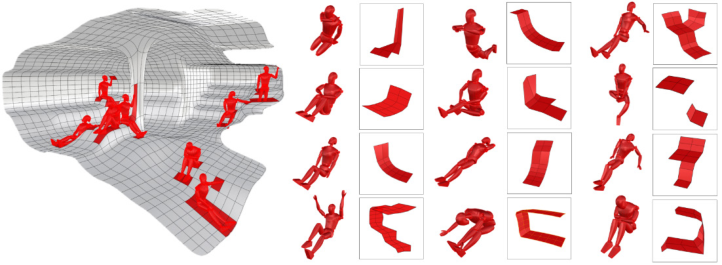
Figure 1 illustrates examples of geometry patterns extracted from locations where human behaviors occur within atypical architectural environments. These patterns represent recurring geometric characteristics observed around behavior occurrence locations. In the subsequent stage of this research, these patterns serve as reference templates for identifying similar spatial configurations in newly designed architectural environments. By extracting geometry patterns from behavior occurrence locations and organizing them into a structured database, the proposed method establishes a pattern-based representation of the relationship between spatial geometry and human actions. This data- driven representation provides the foundation for detecting spatial affordances in atypical architectural spaces through behavior pattern recognition.
Figure 1: Geometry patterns extracted from spatial locations where human behaviors occur in atypical architectural environments.
BEHAVIOR PATTERN RECOGNITION FOR SPATIAL AFFORDANCE DETECTION This study proposes a behavior pattern recognition–based method for detecting spatial affordances in atypical architectural environments. The proposed approach identifies spatial locations where human behaviors are likely to occur by recognizing geometric patterns that are associated with previously observed behavior occurrences. First, the input architectural model is converted into a voxel-based spatial representation in order to enable efficient geometric comparison. Voxelization discretizes the continuous spatial geometry into regular volumetric units, allowing spatial structures to be analyzed using consistent computational operations. This representation is particularly effective for atypical architectural spaces that contain complex curved surfaces and irregular geometric configurations. Using the voxelized spatial representation, geometry patterns stored in the behavior pattern database are applied as templates for pattern recognition. Each geometry pattern represents spatial conditions extracted from locations where specific human behaviors occur. During the recognition process, the spatial geometry at each candidate location is compared with the stored patterns to evaluate geometric similarity. If the similarity between a spatial configuration and a stored geometry pattern exceeds a predefined threshold, the location is identified as a potential behavior occurrence location. The behavior model associated with the recognized pattern is then automatically placed at that position. Through this process, spatial locations that support particular human behaviors can be systematically identified. An important parameter in this pattern recognition process is the tolerance value used for evaluating geometric similarity. The tolerance parameter determines how closely the spatial configuration must match a stored pattern in order to be recognized as the same pattern. A lower tolerance value results in the detection of only highly similar spatial configurations, while a higher tolerance allows a broader range of spatial geometries to be recognized as similar patterns. Through the integration of geometry pattern recognition and behavior placement, the proposed method enables the detection of spatial affordances in atypical architectural environments. The detected locations can be interpreted as areas where spatial geometry supports particular human actions.
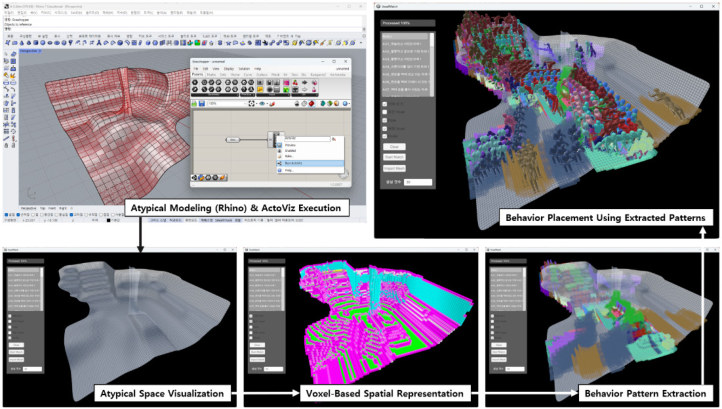
SYSTEM IMPLEMENTATION The proposed affordance detection method was implemented within a computational design environment based on Rhino and Grasshopper. The system processes atypical architectural models and performs behavior pattern recognition to identify spatial locations where human behaviors may occur. Figure 2 illustrates the overall workflow of the implemented system. A spatial model created in the Rhino environment is first imported into the Grasshopper environment, where it is converted into a data structure suitable for spatial analysis. The geometric model is then transformed into a voxel-based spatial representation to enable efficient pattern recognition
146 Lee operations. Using this voxelized spatial data, the system performs behavior pattern recognition based on the geometry patterns stored in the behavior pattern database. The recognition process searches for spatial configurations that are geometrically similar to the stored patterns across the entire spatial model.
Figure 2: Workflow of behavior pattern recognition and affordance detection using the ActoViz system.
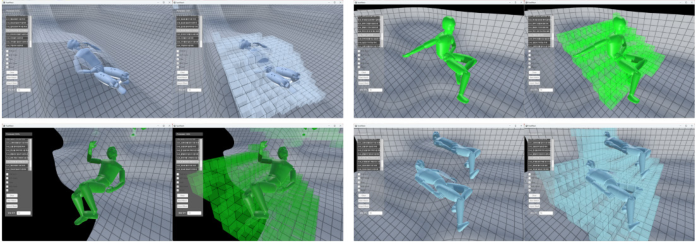
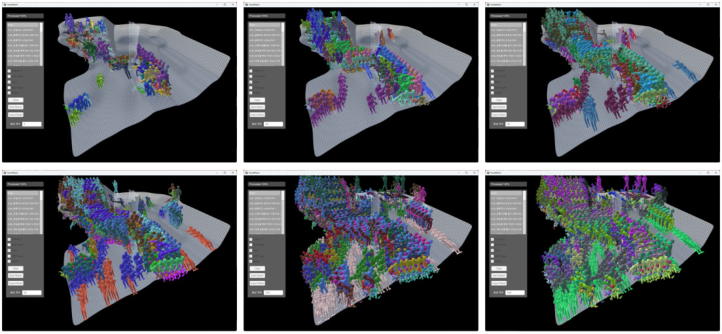
Figure 3 shows the execution of the behavior pattern recognition algorithm within the spatial environment. During this process, geometry patterns stored in the database are compared with spatial configurations throughout the architectural model. When a matching configuration is detected, the corresponding human behavior model associated with the pattern is automatically placed at that location. As a result, potential behavior occurrence locations become visually identifiable within the spatial model. Figure 4 demonstrates how the tolerance parameter affects the distribution of detected patterns and associated behavior placements. When the tolerance value is set to a low level, only spatial configurations that closely match the stored patterns are detected, resulting in a limited number of behavior placements. As the tolerance value increases, a wider range of spatial geometries is recognized as matching patterns, leading to a broader distribution of detected behaviors throughout the spatial environment. The implemented system integrates these processes into the ActoViz platform, which was developed as a computational tool for analyzing the relationship between spatial geometry and human behavior in atypical architectural spaces. By combining pattern extraction, pattern recognition, and behavior visualization within a single workflow, the system enables designers to analyze potential spatial affordances during the architectural design process.
Figure 3: Execution of behavior pattern recognition and automatic placement of behavior models.Figure 4: Visualization of detected spatial affordances and distribution of behavior.
CONCLUSION
This study proposed an affordance detection method for atypical architectural spaces based on behavior pattern recognition. The primary objective of the research was to develop a computational approach that can identify spatial locations where human behaviors are likely to occur within complex architectural geometries. To achieve this goal, the study introduced a two-stage framework that combines behavior pattern extraction and pattern recognition–based affordance detection. In the first stage, spatial locations where human behaviors can occur were identified using a genetic algorithm–based exploration method developed in previous research. The geometric characteristics surrounding these locations were analyzed to extract behavior-inducing geometry patterns, which were then organized into a behavior pattern database. In the second stage, a behavior pattern recognition method was developed to detect similar spatial configurations within newly designed architectural environments. By matching geometry patterns stored in the database with spatial configurations in the architectural model, the system automatically places associated behavior
148 Lee models at locations where similar spatial conditions are detected. The proposed method enables the identification of spatial affordances in atypical architectural environments through a pattern-based representation of the relationship between spatial geometry and human behavior. Unlike conventional rule-based behavior simulations, the proposed approach derives spatial affordances directly from geometry patterns extracted from behavior occurrence locations. The method was implemented in a Rhino–Grasshopper environment through the ActoViz system, allowing designers to visualize potential human behaviors during the architectural design process. The results demonstrate that behavior pattern recognition can provide a practical computational framework for detecting spatial affordances in complex architectural geometries. Future research will focus on expanding the behavior pattern database and improving pattern recognition algorithms in order to enhance the robustness and scalability of affordance detection in diverse architectural environments.
ACKNOWLEDGMENT
This work was supported by the National Research Foundation of Korea (NRF) grant funded by the Korean government (MSIT) (RS-2023-00207964).
REFERENCES
Booher, H.R., Minninger, J. (2003) Human systems integration in army systems acquisition. In: Handbook of Human Systems Integration. Wiley. Gibson, J.J. (1979). The Ecological Approach to Visual Perception. Houghton Mifflin. Gunay, H.B., O’Brien, W., Beausoleil-Morrison, I. (2019). A critical review of occupant
behaviour modelling and its application in building performance simulation. Building and Environment, 146, pp.199–214. https://doi.org/10.1016/j. buildenv.2018.10.057 Hong, T., Taylor-Lange, S.C., D’Oca, S., Yan, D., Corgnati, S.P. (2016). Advances in research and applications of energy-related occupant behavior in buildings. Energy and Buildings, 116, pp.694–702. https://doi.org/10.1016/j.enbuild.2015.11.052 Schweiker, M., Wagner, A., et al. (2020). Review of multi-domain approaches to
indoor environmental perception and behaviour. Energy and Buildings, 219. https://doi.org/10.1016/j.enbuild.2020.110007 Lee, Y.G. (2025). Developing Optimal Affordance Detection Technology Using Genetic Algorithm Based on Posture Primitives on Atypical Surfaces. Proceedings of AHFE / IHIET. https://doi.org/10.54941/ahfe1005971
SEARCH THE AHFE DIGITAL BOOKSTORE BY ISBN
Explore the complete digital volume
Human Interaction and Emerging Technologies (IHIET 2026)
Read this individual research paper free through the original publisher, or explore the full digital proceedings book.