Yun Gil Lee (2022). Developing a Virtual User’s Autonomous Social Behaviors for Advanced Human Behavior Simulation in Atypical Architectural Design. In: Human Interaction & Emerging Technologies (IHIET-AI 2022): Artificial Intelligence & Future Applications. AHFE Open Access, vol. 23. https://doi.org/10.54941/ahfe100866
The importance of user simulation has been highlighted by the recent advent of atypical buildings. In these situations, it is easy to overlook the importance of a given building’s users because atypical architecture is the result of focusing on the shape of the building. Human behavior simulations using intelligent human-shaped agents are emerging as a potential method for solving this problem. However, extant human behavior simulation technology is mostly used in limited situations that do not involve social interaction. This study therefore aims to develop simulation technology that considers social situations within the given architectural space. This study is related to the intelligence of human-shaped agents; the agent developed here can not only respond to a physical space but also perform social interaction with other agents. This paper introduces the developed technology and examines the results of testing this technology with architecture students.
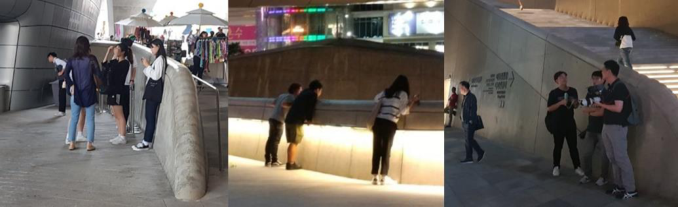
One of the most important factors for determining the value of a building is user satisfaction. Images of human figures have been traditionally used to represent and evaluate the size of the building, the relationship between the building and the user, and the function of the space within with the goal of designing a building that satisfies users. There are also representative methods for evaluating the human factor of a building; these utilize factors such as experience, laws, and virtual users. Such methods have traditionally been used to evaluate the user-based performance of buildings throughout the architectural design process. Recently, however, the increased relevance of novel buildings with complex forms and functions has led to limits on user behavior evaluation that uses building laws and architectural experience; this has highlighted the importance of user simulation. As atypical architecture is the result of greater attention being paid to the shape of the building, it is easy to overlook the building’s users in this situation. Human behavior simulations using intelligent human-shaped agents are therefore emerging to solve this problem.(Hong et al, 2016)(Simeone et al, 2013) It is difficult to predict the behavior of a user in a designed building and then evaluate the performance of the building through this lens. This is because a given user behaves in different ways according to changes in physical situations, the user’s psychology, and other related situations. For this reason, existing human behavior simulation technology is mostly used only in very specific situations. One such example is simulation technology that performs escape simulations in cases of emergency, such as fires. However, it is difficult to evaluate the kind of action that the designed space induces in a user in a general situation. This is even more true in an atypical space in which it is difficult to imagine the user’s behavior based on the shape of the space. The physical, social, and environmental conditions of a given space must all be considered in order to create advanced human behavior simulations. Figure 1 shows social behaviors in atypical architectural space.
Figure 1. Social behaviors in atypical architectural space This study therefore aims to develop simulation technology by considering social situations in a given architectural space. Examining the existing research shows that
Human Interaction & Emerging Technologies (IHIET-AI 2022) Artificial Intelligence & Future Applications https://openaccess.cms-conferences.org/#/publications/book/978-1-7923-8989-4 the development of human behavior simulation technology that responds to the physical situation within an architectural space has occurred; it is difficult, however, to find a study on simulation technology for a social situation that is created from a physical situation. Human behavior simulation technology that considers this factor is necessary because architectural spaces are the basis of their users’ social interactions. This is essential for the reproduction of more natural human behavior simulation for the designed building. Through prior research, social interaction based on physical space in architectural space was defined as self-perception, behavioral conformity, in-group bias, and behavioral settings. In this study, we intended to develop a simulation technology for behavioral conformity, in-group bias, and behavioral settings as self-perception is difficult to express in a visual simulation.
The suggested technology is an automated behavior expression technology using a human-shaped agent. In other words, this technology induces social behavior based on the physical situation of an atypical space. We developed a technology that can perform real-time human behavior simulations on the designated results based on the most commonly used design tools in the architecture field. This study is related to the intelligence of human-shaped agents. The agent developed in this study can not only respond to a physical space but also perform social interaction with other agents. Although the developed technology cannot account for all social situations that may occur in the real world, we were able simulate human behavior for the social interaction associated with the physical situation of the defined space using previous research. This paper introduces the developed technology and introduces the results of testing this technology for architecture students.(Lee and Lee, 2020)
AUTONOMOUS SOCIAL BEHAVIORS IN A HUMAN BEHAVIOR SIMULATION FOR AN ATYPICAL ARCHITECTURAL DESIGN
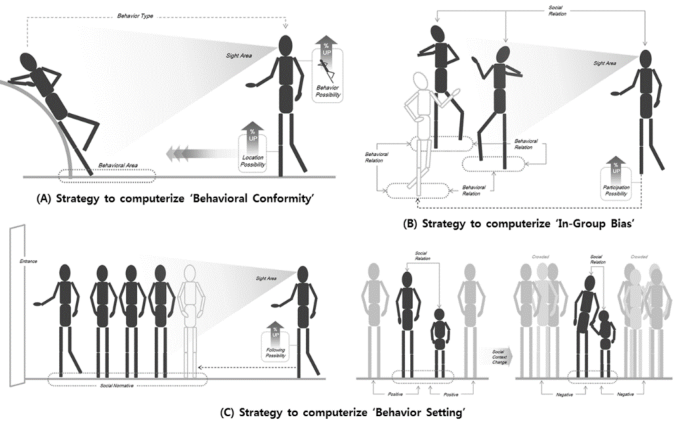
Figure 2 is a diagram of our established strategy for the computerized systematization of social interaction in an atypical architectural space. It is the result of a study on how virtual users conduct reactive actions for social interaction in a human behavior simulation. An automation algorithm for each social action was therefore developed and agents’ behaviors were modeled. We developed an algorithm that automatically finds a location in which social behavior can be expressed by turning atypical architectural spaces into voxels. It was developed so that social behavior can be automatically expressed in the position where the social behavior searched through voxelization is possible. This technique allows the agent to reproduce social behavior at a specific location; there is a limitation, however, in that the agent cannot think of the social behavior and automatically express it itself. Despite this, it is possible to consider the social characteristics of the physical space in the architectural design process because the social reaction behavior of the agent can be visualized.(Lee et al, 2020)
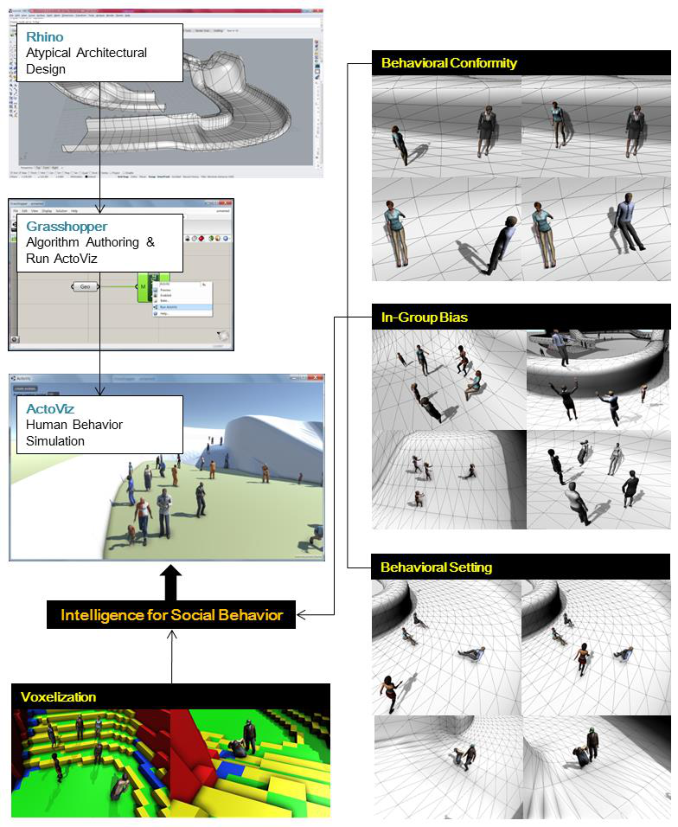
Figure 3 shows a reproduced, automated social interaction in ActoViz, a human behavior simulation tool developed in this study. ActoViz is based on Rhino and Grass-hopper, which are atypical architectural design tools, and operates in real time throughout the architectural design process. As shown in Figure 3, the agent's social interactions related to behavioral conformity, in-group bias, and behavioral setting are randomly reproduced based on the design created using Rhino in ActoViz. The architect can then visually confirm the social characteristics in his design through the reproduced appearance of the agent's social interaction.(Lee et al, 2021)(Lee, 2019)
Figure 2. The strategies of developing social behaviors in atypical spaces[4]
EVALUATION OF THE DEVELOPED AUTONOMOUS SOCIAL BEHAVIORS OF THE VIRTUAL AGENT IN THE ATYPICAL ARCHITECTURAL DESIGN PROCESS In order to determine the effect of the developed social interaction technology, an experiment was conducted on 23 architecture students. A human behavior simulation was performed using ActoViz for the atypical architectural design process; questionnaires were then answered. During the course of the human behavior simulation, the use of its social interaction function was compared with a version that
Human Interaction & Emerging Technologies (IHIET-AI 2022) Artificial Intelligence & Future Applications https://openaccess.cms-conferences.org/#/publications/book/978-1-7923-8989-4 did not use it.
Figure 3. Agent’s autonomous social behaviors in ActoViz
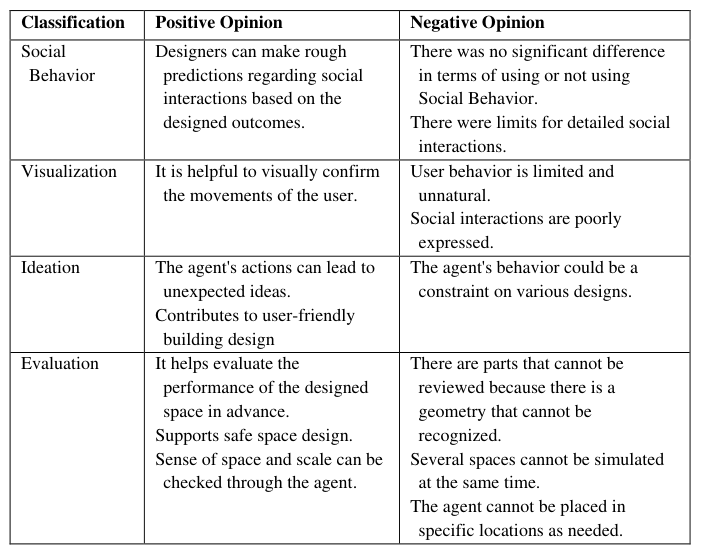
Table 1 shows students' positive and negative opinions and synthesizes similar responses. In terms of the agent's social behavior, there was an opinion that it was possible for the designer to review the design result roughly. On the other hand, it was also stated that distinguishing between social interaction and general behavior was difficult, and that social interaction was not specific.
Other opinions indicated that this system assisted in the design process because the agent’s behavior was visible; conversely, some responses indicated that the agent's behavior was not diverse and was unnatural. Social interaction seemed to assist in developing new, unexpected ideas for some, while others felt that social interaction could actually limit designs. In terms of design review, some students felt that the agent performing the social action offered an opportunity to review the designed plan in advance in terms of sense of space, scale, and safety. Other students stated that it was difficult to review their designed plans because the simulation function was not perfect.
Table 1. Positive and negative opinions from students after using ActoViz's social behavior function
CONCLUSIONS
This study aimed to develop simulation technology that considers social situations in a given architectural space, specifically an automated behavior expression technology of a human-shaped agent. In other words, this study examined the development of a technology that induces social behavior based on the physical situation of an atypical space. The social interaction function developed for more natural human behavior simulation is loaded into ActoViz. The social interaction simulation function
Human Interaction & Emerging Technologies (IHIET-AI 2022) Artificial Intelligence & Future Applications https://openaccess.cms-conferences.org/#/publications/book/978-1-7923-8989-4 developed through 23 architecture students was tested. As such, this user interaction technology has the advantage of being able to visually predict and review the social behavior of the user in the designed atypical space. Some of the study’s participants indicated that agent's actions could provide designers with new ideas. However, since the developed technology is not technically perfect, some participants found the agent's behavior to be unnatural. Overall, this study found that a social interaction function enables more advanced human behavior simulations, though technical improvements in the agent's social behavior should be developed in subsequent studies.
ACKNOWLEDGMENTS
This work was supported by the National Research Foundation of Korea (NRF) grant funded by the Korean government (MSIT) (NRF-2018R1A2B6005827).
REFERENCES
Hong, S.W., Schaumann, D., Kalay, Y.E. (2016) “Human behavior simulation in architectural design projects: An observational study in an academic course”, Computer, Environment, and Urban Systems, Volume 60. Lee, Y.G. (2019) “ActoViz: A Human Behavior Simulator for the Evaluation of the
Dwelling Performance of an Atypical Architectural Space”, Communications in Computer and Information Science, Volume 1034. Lee, Y.G., Jang, H.S., Kim, S.J., Kim, H.J., Jo, H.M. (2021) “Developing a Technology of Tracing a Trigger Spot for Human Behavior through Voxelization of Atypical Architectural Shapes”, Communications in Computer and Information Science, Volume 1420. Lee, Y.L., Lee, Y.G. (2020) “A Study on the Strategies of Developing the
Autonomous Human Social Behavior of Virtual Users Based on Psychological Interpretation in an Atypical Architectural Shape”, Asia-pacific Journal of Convergent Research Interchange (APJCRI), Volume 6, No.11. Lee, Y.L., Lee, Y.G. (2020) “Psychological Interpretation of Human Social Behaviors in the Atypical Architectural Shape”, Advances in Intelligent Systems and Computing. Volume 1269. Simeone, D., Kalay, Y.E., Schaumann, D., Hong, S.W. (2013) “Modeling and
simulating use processes in buildings”, Proceedings of Education and Research in Computer Aided Architectural De-sign in Europe.
Read this individual research paper free through the original publisher, or explore the full digital proceedings book.
ISBN 978-1-7923-8989-4
Explore this ISBN in the AHFE Bookstore ↗Listed in the July 2026 bookstore catalogue; search by ISBN to confirm current availability · Digital book purchase optional